Form your Bahrain company from Greece and benefit from generally no corporate income tax for most sectors. Easy setup process for Greek entrepreneurs seeking tax-efficient business solutions.
Key Takeaways
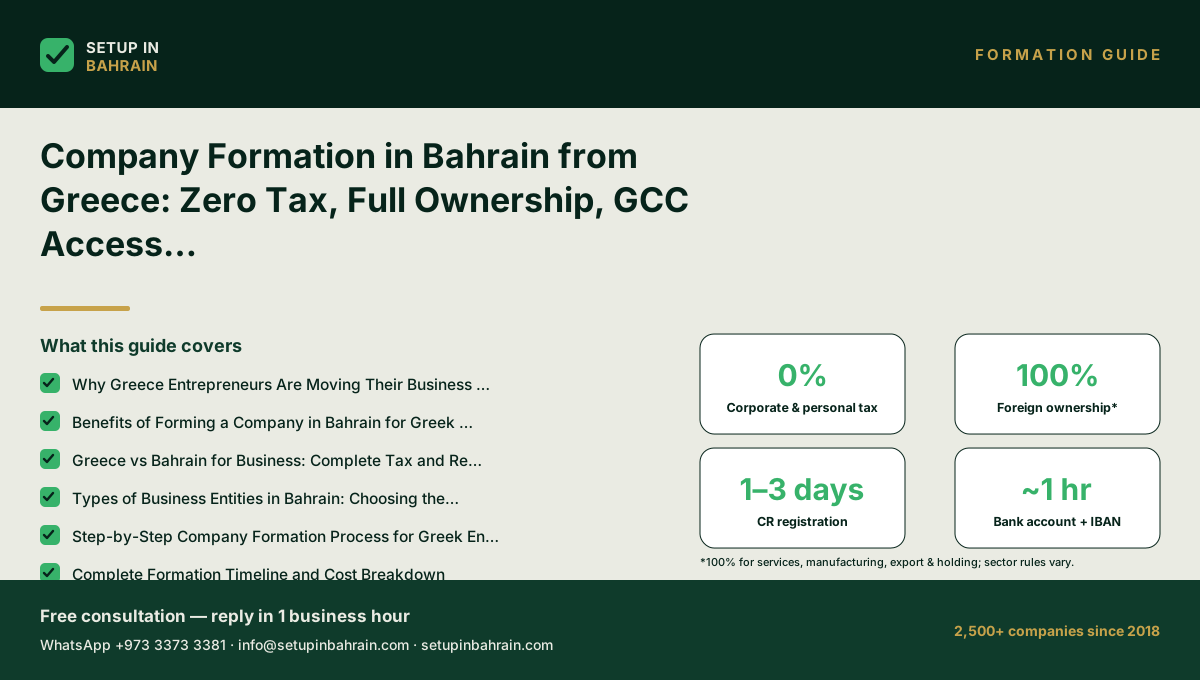
- Why Greece Entrepreneurs Are Moving Their Business to Bahrain
- Benefits of Forming a Company in Bahrain for Greek Citizens
- Greece vs Bahrain for Business: Complete Tax and Regulatory Comparison
- Types of Business Entities in Bahrain: Choosing the Right Structure
- Step-by-Step Company Formation Process for Greek Entrepreneurs
→ Complete guide: Company Formation in Bahrain — the full 2026 guide
View details
Ownership & capital
A Bahrain WLL can be owned by a single person — 100% foreign ownership applies to most activities, with no local partner required for services, manufacturing, export trading and holding companies. The minimum share capital is BHD 1 ; we recommend BHD 1,000 . This Makes bank account opening and investor visa approval smoother.
The breaking point for Stavros came on a Wednesday afternoon in February 2025. His accountant had just finished walking him through the annual numbers for his maritime logistics software company. The reality was stark. From €1.4 million in revenue generated by his Piraeus-based team of 15 developers, Stavros would keep about €640,000 after corporate taxes, employer social security contributions, and the mounting compliance costs that had somehow become normal.
"I built this company over nine years," Stavros told me during our first consultation. "I've missed birthdays, holidays, and countless dinners with my family. And for what? To hand over more than half of everything to a system that treats me like a suspect every time I file a report?"
His frustration had been building for months. The AADE IRIS platform had flagged two of his invoices for "timing irregularities" because his German clients paid on Net-45 terms while the system expected faster reconciliation. The resulting audit consumed six weeks of his CFO's time and €8,500 in additional accounting fees. Meanwhile, a promising contract with a logistics consortium in Riyadh had stalled because Greek banking infrastructure made GCC transactions bureaucratically nightmarish.
Stavros isn't an outlier. He represents a growing wave of Greek entrepreneurs who have done the math and reached an uncomfortable conclusion: Greece's business environment, despite its talented workforce and strategic Mediterranean location, has become structurally hostile to companies with international growth ambitions.
This guide exists specifically for Greek founders like Stavros—and perhaps like you. Not generic offshore incorporation advice recycled from content written for Americans or Brits, but precise, actionable intelligence for entrepreneurs who understand the particular pain of navigating GEMI registration delays, the frustration of employer social contributions consuming nearly a quarter of every salary euro, and the strategic limitation of operating outside the world's most dynamic trade bloc.
Bahrain offers something Greece cannot: a business environment designed for growth rather than extraction. Generally no corporate income tax for most sectors on most activities. One hundred percent foreign ownership without sponsors. A banking system that welcomes international commerce. And direct access to the $1.4 trillion GCC market through preferential trade agreements.
Let's examine exactly how this works for Greek entrepreneurs—with real numbers, genuine comparisons. The practical steps you need to make this transition successfully.
Why Greece Entrepreneurs Are Moving Their Business to Bahrain
The migration of Greek business owners toward Bahrain isn't happening because of slick marketing or tax haven mythology. It's happening because the mathematical reality of running a growth-oriented company in Greece has become untenable for founders who compete internationally.
The Cumulative Burden of Greek Taxation
Consider what a typical profitable Greek company actually pays. The 22% corporate tax rate gets the headlines, but it's merely the entrance fee. Employer social security contributions add 22.29% to every euro of salary paid. When the owner extracts profits as dividends, another 5% disappears. VAT compliance requires monthly declarations and creates cash flow gaps that can stretch for months before refunds materialize.
A software company generating €800,000 in annual profit with a team of eight employees paying average salaries of €35,000 faces this reality:
Corporate tax consumes €176,000 immediately. Employer social contributions on €280,000 in total salaries add €62,412 in hidden costs. If the founder takes €200,000 as dividends, another €10,000 evaporates. Professional fees for navigating IRIS compliance, monthly VAT declarations. Annual GEMI filings typically run €15,000-€25,000 for a company this size.
From €800,000 in profit, the founder keeps roughly €520,000—and that's before personal income tax on any salary drawn. The effective extraction rate approaches 50% when all factors combine.
AADE IRIS: The Digital Tax Inspector That Never Sleeps
The introduction of the AADE IRIS platform was supposed to modernize Greek tax administration. For many entrepreneurs, it has instead created a perpetual compliance burden that consumes productive hours and generates unexpected penalties.
IRIS requires real-time or near-real-time reporting of all invoices. The system cross-references payment timing, bank reconciliation data, and counterparty filings to identify "irregularities." For businesses with international clients who pay on Net-30, Net-45, or Net-60 terms—standard practice in B2B commerce—this creates constant friction.
Konstantinos, who runs an IT consulting firm in Athens with primarily German and Dutch clients, describes his experience: "We invoice on completion of milestones. Our clients pay according to their own procurement cycles, usually 45 to 60 days later. IRIS sees a gap between our invoice date and the bank credit and assumes we're hiding something. I've had three audits in two years, all resolved in our favor. Each one cost us €6,000-€9,000 in accountant fees and dozens of hours of management time."
The platform's logic assumes domestic payment norms. International commerce operates differently, and Greek entrepreneurs serving foreign clients bear the burden of that mismatch.
Banking Instability and the Sovereign Debt Shadow
Greece's banking sector has stabilized greatly since the crisis years. The structural consequences of the sovereign debt crisis continue affecting business owners in subtle ways.
Capital controls, though officially lifted, created institutional behaviors that persist. Greek banks remain cautious about international transactions, especially with counterparties in regions they consider higher risk—which ironically includes much of the Middle East and North Africa, precisely where growth opportunities concentrate.
Opening correspondent banking relationships for GCC transactions from a Greek company often requires extensive documents, compliance reviews that can take weeks. Fees that reflect the banks' risk-averse posture. For a Greek company trying to serve Saudi Arabian, Emirati, or Qatari clients, this creates competitive disadvantages against firms operating from jurisdictions with smoother Gulf banking access.
Commercial Court Delays: Justice Deferred
When business disputes arise, Greek entrepreneurs face a judicial system that moves at bureaucratic pace. Simple payment disputes that should resolve in weeks can stretch across months or even years in the commercial courts.
A logistics company owner from Thessaloniki shared his experience: "A client owed us €47,000 for delivered services. Clear contract, clear delivery confirmation, clear non-payment. It took fourteen months to get a judgment, then another eight months for enforcement. By the time we collected, the amount barely covered our legal fees and the opportunity cost of management distraction."
This reality affects not just dispute resolution but commercial behavior. Greek companies often accept unfavorable terms or write off legitimate claims rather than enter a court system where time works against the plaintiff.
The GCC Opportunity Greece Cannot Access
Perhaps the most significant factor driving Greek entrepreneurs toward Bahrain is market access. The Gulf Cooperation Council represents a combined GDP exceeding $1.4 trillion with economies actively diversifying beyond hydrocarbons. Saudi Arabia's Vision 2030, the UAE's industrial expansion. Qatar's post-World Cup infrastructure programs have created massive demand for services, technology, and expertise.
Greek companies possess relevant capabilities—shipping expertise, engineering talent, software development skills, and professional services experience. But serving GCC markets from Greece means navigating complex import regulations, banking friction, visa complications for business travel. The simple perception problem of being outside the regional trade framework.
A company registered in Bahrain, by contrast, operates within the GCC ecosystem. Preferential trade agreements eliminate or reduce tariffs. Banking relationships function smoothly. Business visas process quickly. And clients perceive a Bahrain entity as committed to the region rather than reaching from afar.
Benefits of Forming a Company in Bahrain for Greek Citizens
Bahrain's appeal to Greek entrepreneurs extends beyond tax rates, though that advantage alone justifies serious consideration. The Kingdom has deliberately constructed a business environment that removes obstacles rather than creating them.
Generally no corporate income tax for most sectors on Most Business Activities
The headline benefit is straightforward: Bahrain imposes no corporate income tax on companies engaged in most commercial activities. Unlike jurisdictions that advertise low taxes but impose them through alternative mechanisms, Bahrain's zero-tax framework is genuine and comprehensive for most business types.
The only significant exception applies to companies engaged in oil and gas extraction or refining. This Face a 46% rate. For software companies, consultancies, trading firms, professional services providers. Virtually every other business type a Greek entrepreneur might operate, the rate is zero.
This isn't a temporary incentive or a special economic zone benefit requiring specific locations or activities. It's the standard tax treatment for all qualifying companies throughout the Kingdom.
Compare this directly to Greece: €500,000 in profit means €110,000 in corporate tax under Greek rules. That same €500,000 in Bahrain remains €500,000. Over five years, assuming stable profits, the cumulative difference exceeds half a million euros—capital that could fund expansion, talent acquisition, or technology investment.
100% Foreign Ownership Without Local Sponsors
Historical barriers to Gulf business entry often required foreign companies to partner with local sponsors who held majority ownership stakes. Bahrain eliminated this requirement for most business activities, allowing Greek entrepreneurs to maintain complete control of their ventures.
This matters beyond the obvious control considerations. When disputes arise with local partners—and they do arise—foreign shareholders in minority positions have limited recourse. The sponsor system created dependency relationships that sometimes evolved into extraction mechanisms rather than genuine partnerships.
Bahrain's foreign ownership rules mean your company remains your company. Strategic decisions, profit distribution, and exit timing all stay within your control.
Rapid Company Formation: Days, Not Months
Greek entrepreneurs accustomed to GEMI registration timelines and bureaucratic back-and-forth will find Bahrain's formation process remarkably efficient. The standard timeline for establishing a fully operational company runs 7 to 14 business days from application submission to commercial registration certificate.
This assumes documents arrives complete and accurate. Greek founders working with experienced formation advisors regularly achieve registration within the faster end of that range. The Bahraini government has invested heavily in digital infrastructure supporting business registration. The Ministry of Industry and Commerce (MOIC) processes applications with genuine efficiency.
Compare this to Greece, where GEMI registration can stretch to 25 business days even with complete documents. Complications often extend timelines further. For entrepreneurs with time-sensitive opportunities or clients waiting for contract execution, this difference has real commercial value.
Strategic Location and GCC Market Access
Bahrain occupies a position of genuine strategic value. The 25-kilometer King Fahd Causeway connects directly to Saudi Arabia, providing land access to the Arab world's largest economy. Bahrain International Airport offers direct flights to every major GCC city, with Dubai reachable in one hour and Riyadh in less than ninety minutes.
More importantly, Bahrain's GCC membership means companies registered there operate within the preferential trade framework connecting Saudi Arabia, the UAE, Kuwait, Qatar, and Oman. Tariff reductions or eliminations apply to goods moving between member states. Service providers face fewer regulatory barriers. And the perception of regional commitment—rather than foreign opportunism—affects client relationships in ways that transcend formal trade rules.
For Greek companies serving or hoping to serve GCC clients, this positioning transformation alone might justify relocation. Operating from within the market rather than reaching into it from outside changes everything from proposal competitiveness to payment collection reliability.
Business-Friendly Banking Environment
Bahrain hosts the largest concentration of financial institutions in the Gulf region, with the Central Bank of Bahrain (CBB) supervising over 400 banks, insurance companies, and investment firms. This concentration creates practical benefits for business owners.
Opening corporate accounts proceeds relatively smoothly for legitimate businesses with clear commercial purposes. Unlike Greek banks that often view international transactions with suspicion, Bahraini institutions exist specifically to help Gulf and global commerce. Multi-currency accounts are standard. International transfers execute without the documentary demands that Greek banks impose.
For Greek entrepreneurs who have struggled to serve Middle Eastern clients efficiently from Greek banking infrastructure, this difference proves transformative in daily operations.
Quality of Life Considerations
Business decisions shouldn't rest solely on tax mathematics. Bahrain offers genuine quality of life advantages for entrepreneurs considering relocation.
The Kingdom maintains a cosmopolitan character, with English widely spoken in business contexts and a diverse expatriate population that includes significant European representation. International schools serve families with children. Healthcare facilities meet high standards. And the cost of living, while not inexpensive, compares favorably to major European business centers.
Bahrain also maintains a more relaxed social environment than some neighboring Gulf states, with fewer restrictions on personal conduct while still respecting Islamic cultural norms. For Greek entrepreneurs accustomed to Mediterranean social patterns, this balance often proves comfortable.
Greece vs Bahrain for Business: Complete Tax and Regulatory Comparison
Understanding the full scope of differences between Greek and Bahraini business environments requires systematic comparison across multiple dimensions. The following analysis covers the factors that most directly affect business decision-making.
Corporate Taxation Comparison
| Factor | Greece | Bahrain |
| Standard Corporate Tax Rate | 22% | 0% (most activities) |
| Tax on Dividends | 5% | 0% |
| Capital Gains Tax | 15% (varies by asset type) | 0% |
| Withholding Tax on Royalties | 20% (reduced by treaties) | 0% |
| Annual Tax Filing Requirement | Yes, complex | Yes, minimal |
| Tax Audit Frequency | Common | Rare for compliant companies |
Greece: €132,000 corporate tax plus €30,000 dividend tax on full distribution equals €162,000 in direct taxation. Effective rate exceeds 27% before accounting for employer social contributions or compliance costs.
Bahrain: €0 corporate tax, €0 dividend tax. Effective rate 0%.
Over a five-year period with stable profits, this difference exceeds €800,000 in retained capital.
Employment Costs and Social Contributions
Greek employers face social security contributions of 22.29% on gross salaries. This represents a substantial hidden cost that many entrepreneurs underestimate when projecting employment expenses.
An employee earning €40,000 annually in Greece costs the employer about €48,916 when social contributions are included—before accounting for mandatory bonuses, leave provisions, and other statutory requirements.
Bahrain's social insurance system imposes considerably lighter burdens. Bahraini nationals require employer contributions of 12% toward the Social Insurance Organization, while foreign employees require just 3%. For a company primarily employing expatriate staff—common among Greek entrepreneurs relocating their operations—employment costs as a percentage of salary drop dramatically.
The same €40,000 salary in Bahrain with a foreign employee costs about €41,200 including social insurance. The difference of nearly €7,700 per employee per year accumulates greatly across a team.
Regulatory Compliance Burden
Greek businesses navigate multiple regulatory frameworks that consume management attention and professional service budgets.
AADE requirements extend beyond simple tax filing to include real-time invoice reporting through IRIS, monthly VAT declarations. Documents requirements that assume guilt until proven innocent. GEMI registration and annual compliance filings add another layer. Labor regulations impose inflexibility on hiring, termination, and working arrangements.
Bahrain maintains regulatory oversight appropriate to a modern economy without the adversarial posture Greek entrepreneurs have internalized as normal. The MOIC handles commercial registration. The CBB oversees financial activities for companies requiring such supervision. But the overall compliance burden—measured in hours spent, professional fees paid. Management distraction absorbed—runs greatly lighter.
Greek entrepreneurs commonly report spending €15,000-€25,000 annually on tax and regulatory compliance for mid-sized companies. Equivalent Bahrain operations typically require €4,000-€8,000 for similar professional support.
Banking and Financial Services
The comparison between Greek and Bahraini banking environments affects daily operations in ways that tax rates don't capture.
Greek banks emerged from the sovereign debt crisis with conservative risk postures that persist years after capital controls lifted. International transactions receive scrutiny. Correspondent banking relationships for certain corridors remain complicated. Account opening for new companies can require weeks and extensive documents.
Bahraini banks operate as regional financial intermediaries by design. Multi-currency accounts are standard offerings. International transfers execute smoothly to most global destinations. Account opening for legitimate businesses with clear commercial purposes typically completes within 2-4 weeks.
For Greek companies serving international clients, this operational difference often exceeds the tax benefits in practical importance.
Legal System and Dispute Resolution
Greece's commercial courts process disputes at paces that challenge the patience of entrepreneurs with active business concerns. Simple payment disputes routinely extend beyond twelve months. Complex matters can stretch for years.
Bahrain offers multiple dispute resolution pathways, including courts that operate with greater efficiency and well-established arbitration frameworks. The Bahrain Chamber for Dispute Resolution provides an arbitration venue with international credibility. Contract enforcement, while never instantaneous anywhere, proceeds with reasonable predictability.
For entrepreneurs who have experienced the Greek judicial system's pace, this difference represents a genuine reduction in commercial risk.
Types of Business Entities in Bahrain: Choosing the Right Structure
Bahrain offers several entity types suited to different business purposes. Greek entrepreneurs should understand the options available and their implications before proceeding with formation.
Limited Liability Company (WLL)
The most common structure for foreign entrepreneurs establishing operational businesses in Bahrain, the Limited Liability Company—known locally by its Arabic designation WLL (With Limited Liability)—offers flexibility and straightforward governance.
Key characteristics:
- a single shareholder (one person can own 100%) required (can include corporate shareholders)
- Minimum capital requirement of BHD 1 (we recommend BHD 1,000) (about €118,000) for companies with foreign shareholders
- Limited liability protection for shareholders
- No corporate income tax on profits
- Full repatriation of profits and capital permitted
For Greek entrepreneurs establishing trading companies, consultancies, technology firms, or service businesses, the WLL structure typically offers the best combination of flexibility and protection.
The minimum capital requirement appears substantial but doesn't necessarily require full funding at incorporation. Bahraini regulations allow partial payment with remaining capital contributed according to schedules specified in company documents.
single-shareholder WLL
Bahrain permits single-shareholder companies, addressing a limitation that affects entrepreneurs who prefer complete individual control without involving partners or corporate co-shareholders.
Key characteristics:
- Single natural person or corporate shareholder
- Same minimum capital requirements as WLL
- Full limited liability protection
- Simplified governance without shareholder meetings
- Suitable for entrepreneurs establishing personal operating entities
Greek founders who previously operated as sole proprietors or single-member EPEs in Greece often find the WLL structure familiar and appropriate.
Branch Office
Foreign companies can establish Bahrain branches rather than forming new local entities. This structure suits companies seeking Bahrain presence while maintaining their Greek (or other) parent company structure.
Key characteristics:
- Not a separate legal entity—extension of parent company
- Parent company retains liability for branch obligations
- Simpler formation requirements
- Must appoint local representative
- Suitable for companies testing the market before full setup
Greek companies wanting Gulf presence without full relocation sometimes use branch offices as initial steps. But, the lack of separate legal personality means Greek parent company liability extends to Bahrain operations—potentially problematic given Greece's tax and regulatory environment.
Holding Company
Entrepreneurs with multiple business interests or complex ownership structures can establish Bahrain holding companies to manage investments and subsidiaries.
Key characteristics:
- Can hold shares in Bahrain and foreign companies
- Zero tax on dividends received from subsidiaries
- Zero capital gains tax on disposal of investments
- Suitable for structuring regional operations
- Requires appropriate substance in Bahrain
Greek entrepreneurs with existing multiple entities or plans for regional expansion often benefit from holding company structures that centralize ownership and simplify profit extraction across their business portfolio.
Free Zone Companies
Bahrain's free zones—the Bahrain Logistics Zone and Bahrain International Investment Park—offer specialized environments for certain business activities with additional regulatory benefits.
Key characteristics:
- 100% foreign ownership (standard in free zones)
- Exemption from import duties on goods for re-export
- Streamlined customs procedures
- Dedicated infrastructure for logistics and manufacturing
- Ten-year land lease guarantees
Greek companies engaged in trading, logistics, or light manufacturing sometimes find free zone setup advantageous, especially for goods moving through Bahrain to other GCC destinations.
Step-by-Step Company Formation Process for Greek Entrepreneurs
The practical process of establishing a Bahrain company involves sequential steps that. Straightforward, require careful attention to documents and procedural requirements.
Step 1: Define Your Business Structure and Activities
Before initiating formal registration, clarify the fundamental questions that determine your application pathway.
Entity type selection: Based on your ownership preferences, capital availability. Business activities, determine whether a WLL, WLL, or other structure best serves your needs.
Activity licensing: Bahrain's commercial registration system categorizes business activities using specific codes. Your company can engage only in activities listed on its commercial registration. Ensure your intended activities are accurately captured—adding activities later requires separate applications and fees.
Trade name selection: Your company name must be unique within Bahrain's commercial registry and comply with naming conventions. Arabic company names are required, though English equivalents are commonly used in practice.
Step 2: Reserve Your Company Name
Submit a name reservation application through the Sijilat online portal (Bahrain's business registration platform) or through a formation agent handling the process on your behalf.
Name reservation typically processes within 1-3 business days. The reservation remains valid for 30 days, providing time to complete remaining formation steps.
Common issues for Greek entrepreneurs: Names that translate awkwardly into Arabic or that resemble existing registered companies face rejection. Working with local advisors familiar with naming conventions helps avoid delays.
Step 3: Prepare Constitutional Documents
Bahrain companies require founding documents that establish governance frameworks and shareholder relationships.
Articles of Association: Define the company's internal governance, shareholder rights, profit distribution mechanisms, and decision-making procedures. These documents require drafting by a licensed Bahraini lawyer and must be notarized before the Ministry of Justice.
For WLL structures: Articles typically address share transfer restrictions, meeting requirements, management appointment procedures, and dissolution provisions.
For WLLs: Simpler constitutional documents reflecting the single-shareholder structure.
Greek entrepreneurs should ensure their constitutional documents are drafted with future flexibility in mind. Amending articles later requires additional fees and procedures.
Step 4: Capital Deposit and Bank Account
The minimum capital for companies with foreign shareholders must be deposited in a Bahrain bank account. This typically requires:
- Opening a formation account with a Bahrain bank
- Transferring the required capital from your Greek bank account
- Obtaining a certificate of capital deposit for submission to MOIC
Banking timeline considerations: Bank account opening for new companies typically requires 2-4 weeks. Required documents includes:
- Passport copies of all shareholders and directors
- Proof of address for all principals
- Business plan or description of intended activities
- Source of funds documents
- Greek company documents if a corporate shareholder exists
Greek entrepreneurs should initiate banking discussions early in the formation process to avoid delays at this stage.
Step 5: Submit Commercial Registration Application
With constitutional documents prepared and capital deposited, submit your commercial registration application to MOIC through the Sijilat portal.
Required documents:
- Completed application form
- Notarized Articles of Association
- Capital deposit certificate
- Name reservation confirmation
- Passport copies of shareholders and directors
- Proof of registered office address
- Activity-specific approvals (if required for your business type)
MOIC typically processes complete applications within 5-7 business days, issuing commercial registration certificates upon approval.
Step 6: Get Necessary Licenses and Approvals
Depending on your business activities, additional licenses may be required from regulatory bodies beyond MOIC.
Common additional requirements:
- Financial services: Central Bank of Bahrain licensing for banks, investment firms, insurance companies, and related activities
- Healthcare services: National Health Regulatory Authority approval
- Educational services: Ministry of Education authorization
- Food businesses: Ministry of Health permits
- Construction: Public Works Affairs licensing
Most trading, consulting, and technology companies require only the standard commercial registration without additional specialized licenses.
Step 7: Register for Social Insurance
Companies employing staff must register with the Social Insurance Organization (SIO) within specified timeframes after hiring employees.
The registration process is straightforward and typically completes within 1-2 weeks of submission.
Step 8: Establish Operational Infrastructure
With legal formation complete, establish the practical elements necessary for business operations:
- Physical or virtual office: Your commercial registration specifies a registered address. Many Greek entrepreneurs initially use serviced office arrangements or virtual office solutions before establishing permanent premises.
- Banking arrangements: Beyond the formation account, establish operational banking relationships suited to your transaction patterns.
- Accounting and compliance: Engage local accountants or your formation advisors to establish compliant record-keeping systems.
Complete Formation Timeline and Cost Breakdown
Understanding realistic timelines and costs helps Greek entrepreneurs plan their transition effectively.
Formation Timeline: Realistic Expectations
| Stage | Typical Duration | Potential Delays |
| Name reservation | 1-3 business days | Rejection requires resubmission |
| Document preparation | 3-5 business days | Complex structures take longer |
| Bank account opening | 2-4 weeks | KYC requirements vary by bank |
| Capital transfer from Greece | 3-7 business days | Greek bank procedures vary |
| MOIC registration processing | 5-7 business days | Incomplete applications delayed |
| License issuance | 1-3 business days | Post-approval |
| Total typical timeline | 4-6 weeks | Complex cases may extend |
Formation Costs: Detailed Breakdown
| Cost Category | Typical Range (EUR) | Notes |
| Government registration fees | €500-€800 | Varies by entity type and activities |
| Legal drafting fees | €1,500-€3,000 | Articles of Association preparation |
| Notarization fees | €300-€500 | Ministry of Justice charges |
| Formation agent fees | €2,000-€4,500 | Full-service support |
| Bank account setup | €200-€400 | Initial deposits may be required |
| Registered office (annual) | €2,500-€6,000 | Serviced office or virtual address |
| Total initial formation | €7,000-€15,000 | Excluding minimum capital |
Minimum Capital Requirements
The BHD 1 (we recommend BHD 1,000)minimum capital for foreign-owned companies represents committed capital rather than operational funding. This amount must be deposited but can then be used for legitimate business purposes—it doesn't sit frozen in an account.
Greek entrepreneurs sometimes explore structures that reduce capital requirements, such as:
- Free zone companies: Some free zones have reduced capital requirements
- Minority Bahraini shareholder arrangements: Companies with 51%+ Bahraini ownership face lower minimums
But, for most entrepreneurs seeking full ownership and control, meeting the standard capital requirement proves more straightforward than working around it.
Banking and Financial Infrastructure in Bahrain
The practical experience of banking in Bahrain differs greatly from what Greek entrepreneurs know from their home market.
Opening Corporate Bank Accounts
Bahrain's banking sector includes international institutions (HSBC, Standard Chartered, Citibank), regional banks (Gulf International Bank, Arab Banking Corporation). Local institutions (National Bank of Bahrain, Ahli United Bank).
Account opening requirements typically include:
- Commercial registration certificate
- Articles of Association
- Board resolution authorizing account opening
- Passport copies and proof of address for signatories
- Business description and projected transaction volumes
- Source of funds documents
Timeline: 2-4 weeks from document submission to account activation.
Practical tip for Greek entrepreneurs: Banks appreciate clarity about your business model and transaction patterns. Prepare a concise business description explaining your activities, client base, and expected payment flows. Vague or incomplete explanations trigger extended due diligence reviews.
Multi-Currency Capabilities
Bahraini banks routinely offer multi-currency accounts, allowing you to hold balances and receive payments in EUR, USD, GBP, SAR, AED. Other currencies without continuous conversion.
This proves especially valuable for Greek entrepreneurs serving diverse client bases. Receiving EUR from European clients, USD from American contracts. SAR from Saudi customers—all into a single banking relationship—eliminates the friction Greek banks create for similar arrangements.
International Transfer Efficiency
The contrast with Greek banking emerges most sharply in international transfer handling. Bahraini banks process international payments as routine operations, not exceptions requiring special documents.
Same-day or next-day execution is typical for transfers to major currency zones. Fees are competitive with international norms. And the documentary requirements that Greek banks impose—explanations, contracts, beneficial ownership declarations for routine transactions—don't apply in Bahrain for established business relationships.
Central Bank of Bahrain Oversight
The CBB maintains comprehensive regulatory oversight of financial institutions while fostering an environment supportive of legitimate business. The regulator has earned recognition for balanced supervision that protects stability without impeding commerce.
For companies engaged in financial services, insurance, or investment activities, CBB licensing requirements apply. These processes are thorough but navigable for companies with genuine business purposes and appropriate expertise.
Residence Visa and Relocation Pathways for Greek Entrepreneurs
Greek founders establishing Bahrain companies typically need to address their personal immigration status, whether for permanent relocation or regular business presence.
Investor Residence Visa
Business owners investing in Bahrain companies can get investor residence visas tied to their commercial activities.
Basic requirements:
- Valid commercial registration in Bahrain
- Minimum investment threshold (typically met by company formation)
- Proof of financial means
- Clean criminal record
- Health insurance coverage
Duration: Initial visas typically granted for 1-2 years with renewal options.
Family inclusion: Spouse and dependent children can be included in residence applications.
Employment Visa (Self-Sponsorship)
Entrepreneurs can also get employment visas sponsored by their own companies, effectively self-sponsoring their residence.
This approach requires:
- Approval from the Labour Market Regulatory Authority (LMRA)
- Genuine business activities justifying employment
- Compliance with Bahrainisation requirements (percentage of Bahraini employees in total workforce)
Golden Residency Program
Bahrain's Golden Residency program offers extended residence options for high-value contributors, including investors, entrepreneurs, and professionals.
Categories relevant to Greek entrepreneurs:
- Investors meeting certain thresholds
- Entrepreneurs with innovative business concepts
- Professionals with exceptional skills
Golden Residency provides longer validity periods and additional benefits compared to standard residence permits.
Practical Relocation Considerations
Greek entrepreneurs considering permanent relocation should address several practical matters:
Tax residency implications: Relocating to Bahrain doesn't automatically terminate Greek tax residency. Greece taxes worldwide income of tax residents, and the determination of residency involves multiple factors beyond physical presence. Professional tax advice addressing both jurisdictions is essential.
Healthcare: Bahrain offers quality healthcare facilities. Private health insurance is readily available and typically required for residence visas.
Education: International schools serving various curricula (British, American, International Baccalaureate) operate in Bahrain for families with children.
Cost of living: Bahrain's cost of living is moderate by Gulf standards. Housing costs vary greatly by location and accommodation type. Reasonable housing is available at prices comparable to or below Athens.
Key Regulatory Bodies and Official Sources
Greek entrepreneurs should familiarize themselves with the governmental bodies that will interact with their Bahrain businesses.
Ministry of Industry and Commerce (MOIC)
The primary regulatory authority for commercial registration and licensing. MOIC handles:
- Company registration and commercial licenses
- Trade name registration
- Activity licensing for most business types
- Annual registration renewals
Official portal: sijilat.bh (Bahrain Business Registration System)
Economic Development Board (EDB)
Bahrain's investment promotion agency, the EDB provides support services for foreign investors including:
- Investment facilitation services
- Business setup guidance
- Sector-specific expertise
- Introduction to relevant partners and service providers
The EDB serves as a useful first point of contact for Greek entrepreneurs exploring Bahrain opportunities.
Central Bank of Bahrain (CBB)
The financial sector regulator overseeing:
- Banking institutions
- Insurance companies
- Investment businesses
- Payment service providers
- Capital markets
Companies engaged in regulated financial activities require CBB licensing beyond standard commercial registration.
Bahrain Investors Center (BIC)
A one-stop-shop service providing consolidated access to government services required for business setup. BIC facilitates:
- Company registration
- License applications
- Visa processing
- Labor market registrations
Greek entrepreneurs using formation agents typically interact with BIC indirectly through their advisors.
Labour Market Regulatory Authority (LMRA)
Handles employment permits, visa processing, and labor market regulations. Key functions include:
- Work permit issuance
- Flexi-permit system administration
- Bahrainisation compliance monitoring
Frequently Asked Questions: Greek Entrepreneurs and Bahrain Formation
Can I maintain my Greek company while forming in Bahrain?
Yes. Many Greek entrepreneurs maintain existing Greek entities while establishing parallel Bahrain structures. The appropriate arrangement depends on your business activities, client relationships, and tax planning objectives. Some founders eventually migrate operations entirely to Bahrain; others maintain dual presences indefinitely.
Will I still owe Greek taxes after forming a Bahrain company?
Greek tax obligations depend on your personal tax residency status and the structure of your business arrangements. If you remain a Greek tax resident, Greece taxes your worldwide income—including income from foreign companies. Shifting tax residency to Bahrain requires genuinely relocating your center of life, not merely incorporating abroad.
Professional tax advice addressing both Greek and Bahraini rules is essential before making structural decisions.
How difficult is it to open bank accounts for a new Bahrain company?
Bank account opening in Bahrain is straightforward for legitimate businesses with clear commercial purposes. The primary challenges involve documents preparation and demonstrating your business purpose clearly to bank compliance teams.
Greek entrepreneurs should expect the process to take 2-4 weeks and should prepare comprehensive documents about their business activities, client base. Transaction expectations.
Can I hire Greek employees to work in Bahrain?
Yes. Foreign employees, including Greek nationals, can work in Bahrain on employment visas. The process involves:
- Labor market approval from LMRA
- Work permit issuance
- Residence visa processing
Bahrain Business Guides for Greece Citizens
Frequently Asked Questions
How long does it take to set up?
It takes 15 to 20 days. We file all forms for you. You do not need to wait long.
What does it cost?
Company formation: Standard BHD 1,340 with 3 months of office address; Gold BHD 1,700 with 6 months; Premium BHD 2,150 with 12 months and a cabin, officer table and chair, and two guest chairs. No formation package includes visas, including Premium. Investor/work visas are priced separately: BHD 755 for one year or BHD 953 for two years, in addition to the formation package. Ask for a written, itemized quotation confirming government fees and all inclusions before payment.
Do I need to visit Bahrain?
No. You can set up your firm from home. We do all the work online. Some banks may ask for one visit.
What tax will I pay?
You pay zero tax on your profits. Bahrain has no corporate income tax. This is a key benefit of the setup.
Can I own 100% of my firm?
Yes. Foreign owners can hold all shares. No local partner is needed. Full ownership is allowed.
What do I need to start?
You need a valid passport. You also need a trade name and a business address. We help you with all of these.
How do I open a bank account?
We guide you step by step. Most banks take 3 to 6 weeks. You will need your CR and firm papers.
Who issues the Commercial Registration (CR)?
The CR is issued by the MOICT. It is your legal right to trade in Bahrain. We file the CR for you.
Can I renew my CR each year?
Company renewal packages: BHD 530 with 3 months of office address; BHD 980 with 6 months; BHD 1,520 with 12 months. These are separate renewal packages, not visa fees.
How do I get started?
Fill in our form on this page. Our team will call you back. We map your best setup plan at no cost.
Steps to Form Your Company
- Pick your trade name. We check if it is free.
- Choose your business type. WLL is the most common.
- Sign the MOA. We draft and file all legal docs.
- Pay the state fees. About BHD 432 in total.
- Get your CR. Takes 15 to 20 days.
- Open your bank account. We guide each step.
- Start trading. You are ready to do business.
Key Facts
- Tax rate: 0%
- Foreign ownership: 100%
- Setup time: 15 to 20 days
- Company formation: Standard BHD 1,340 with 3 months of office address; Gold BHD 1,700 with 6 months; Premium BHD 2,150 with 12 months and a cabin, officer table and chair, and two guest chairs. No formation package includes visas, including Premium. Investor/work visas are priced separately: BHD 755 for one year or BHD 953 for two years, in addition to the formation package. Ask for a written, itemized quotation confirming government fees and all inclusions before payment.
- Company renewal packages: BHD 530 with 3 months of office address; BHD 980 with 6 months; BHD 1,520 with 12 months. These are separate renewal packages, not visa fees.
- Client rating: 4.8 stars
- Clients served: 2,500 and more
Quick Facts
- Tax rate: 0%
- Own all of your firm: Yes, 100%
- Time to set up: 15 to 20 days
- Company formation: Standard BHD 1,340 with 3 months of office address; Gold BHD 1,700 with 6 months; Premium BHD 2,150 with 12 months and a cabin, officer table and chair, and two guest chairs. No formation package includes visas, including Premium. Investor/work visas are priced separately: BHD 755 for one year or BHD 953 for two years, in addition to the formation package. Ask for a written, itemized quotation confirming government fees and all inclusions before payment.
- Company renewal packages: BHD 530 with 3 months of office address; BHD 980 with 6 months; BHD 1,520 with 12 months. These are separate renewal packages, not visa fees.
- Rating: 4.8 stars
- Clients: 2,500 and more
Why Bahrain?
Bahrain has no tax. You keep all your profits. This is rare in the Gulf.
You can own all of your firm. No local partner is needed. The law allows full foreign ownership.
Setup takes 15 to 20 days. We file all forms for you. You can do it all from home.
Bahrain has a free trade deal with the US. Your goods face low or no tariffs. This gives you access to big markets.
We have served 2,800+ clients from 44+ countries and maintain records to substantiate that total where needed. We have 113 Google reviews; reviews represent only some clients and are not the same as the total clients served.
Our Steps
- Tell us your plan. We advise you for free.
- We pick the right firm type for you.
- We file all your forms with MOICT.
- You get your CR in 15 to 20 days.
- We help you open a bank account.
- You are ready to trade. We stay with you.
Why Set Up in Bahrain?
Bahrain is a great place to run a firm. It has no tax. You keep all your profits. This is rare in the Gulf.
You can own your firm 100%. No local partner is needed. The law is clear and fair.
It is fast to set up. You can have a CR in 15 to 20 days. We file all forms for you.
Bahrain has a free trade deal with the US. Your goods face low or no tariffs. This gives you access to big markets.
The banks are good. The roads are good. The schools are good. It is a well-run state.
We have served 2,800+ clients from 44+ countries and maintain records to substantiate that total where needed. We have 113 Google reviews; reviews represent only some clients and are not the same as the total clients served.
Our Services
- Company formation: Standard BHD 1,340 with 3 months of office address; Gold BHD 1,700 with 6 months; Premium BHD 2,150 with 12 months and a cabin, officer table and chair, and two guest chairs. No formation package includes visas, including Premium. Investor/work visas are priced separately: BHD 755 for one year or BHD 953 for two years, in addition to the formation package. Ask for a written, itemized quotation confirming government fees and all inclusions before payment.
- Company renewal packages: BHD 530 with 3 months of office address; BHD 980 with 6 months; BHD 1,520 with 12 months. These are separate renewal packages, not visa fees.
- Investor Visa — from BHD 755
- Work Visa — LMRA managed
- Virtual office — from BHD 600 per year
- Bank account opening — 3 to 6 weeks
- Family visa — for spouse and kids
- UBO filing — as required by law
Bahrain at a Glance
- Tax rate: 0%
- Foreign ownership: 100%
- Setup time: 15 to 20 days
- Free trade deal: Yes, with the US
- Language: Arabic and English
- Currency: Bahraini Dinar (BHD)
- Time zone: UTC+3
- GDP growth: Steady and strong
How to Start
- Fill in the form on this page. It takes 3 minutes.
- We call you back the same day.
- We map the best plan for your firm type and goals.
- We file all forms. We deal with MOICT for you.
- You get your CR in 15 to 20 days.
- We help you open a bank account and get your visa.
- You are ready to trade. We stay with you.
Common Questions
Do I need to visit Bahrain to set up?
No. You can do it all from home. We file online. You may need one visit to open a bank account.
Is Bahrain safe for business?
Yes. Bahrain is a stable state. It has a clear legal system. Your firm and funds are safe here.
Can I hire staff from any country?
Yes. You can hire from any country. Each hire needs a work permit from LMRA. We manage this for you.
What type of firm should I set up?
Most clients choose a WLL. This is a limited liability firm. It is flexible and well-known in Bahrain. We advise you on the best type for your case.
How do I get in touch?
Fill in our form. We call you back the same day. You can also email us or use the chat on this page.
Ready to set up in Bahrain from Greece?
Tell us your business idea. We map the right entity, ownership and timeline — then handle the filing while you focus on what matters.