Complete guide for Gambia entrepreneurs: form a company in Bahrain with generally no corporate income tax for most sectors, 100% foreign ownership. GCC market access. Costs, steps, visas, banking.
Key Takeaways
- Why Gambian Entrepreneurs Are Moving Their Business to Bahrain
- Bahrain: The Strategic Gateway for Gambian Businesses
- Understanding Bahrain's Company Structures for Gambian Entrepreneurs
- The Step-by-Step Company Formation Process in Bahrain (For Gambian Nationals)
- Key Documents Required from a Gambian Entrepreneur
→ Complete guide: Company Formation in Bahrain — the full 2026 guide
View details
Ownership & capital
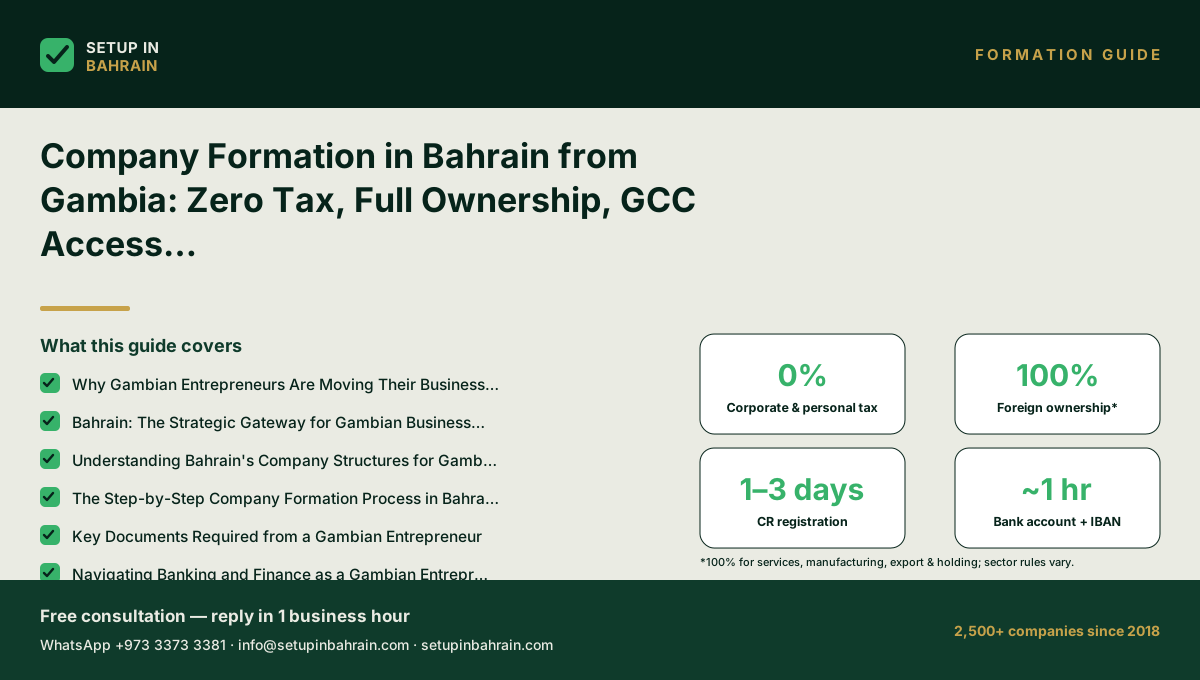
A Bahrain WLL can be owned by a single person — 100% foreign ownership applies to most activities, with no local partner required for services, manufacturing, export trading and holding companies. The minimum share capital is BHD 1 ; we recommend BHD 1,000 . This Makes bank account opening and investor visa approval smoother.
The business spirit in Gambia is undeniable. From the bustling markets of Banjul to the burgeoning tech scene, Gambian innovators possess a potent blend of resilience, ambition. A keen eye for opportunity. Yet, imagine dedicating countless hours, pouring your very soul into building a profitable enterprise, only to watch a significant portion of your hard-earned revenue vanish into a 27% corporate income tax.
Picture the daily struggle with a currency that loses 10-15% of its value against major international denominations year after year, steadily eroding your purchasing power for crucial imports and diminishing the real value of your future profits.
For Mariama, a seasoned entrepreneur who built a thriving cashew export business from scratch in Farafenni, this reality was a constant source of frustration. "We work so hard," she'd lament, reflecting on her years in business. "We open new markets, negotiate better prices, but every year, a quarter of our profit goes to tax. Then the Dalasi weakens, making our international transactions prohibitively expensive.
It feels like we're running on a treadmill, just to stay in place." Mariama also grappled with the limited reach of Gambia's local banking sector, which, with its mere five commercial banks and restricted international capabilities, often felt like a bottleneck. She further faced the bureaucratic hurdles of a regulatory environment still finding its footing, compounded by the GRA’s (Gambia Revenue Authority) limited e-filing capabilities that often meant lengthy, in-person processes.
She knew her ambition stretched beyond Gambia's modest 2.5 million-person market. Accessing the global stage, or even the lucrative GCC markets, felt like an insurmountable challenge from Banjul.
This isn't just Mariama's story; it's the shared experience of countless Gambian business owners. You’re innovative, you’re driven. The systemic challenges at home often shackle your growth potential, limit your access to international capital, and diminish your true profitability. But what if there was an alternative?
A strategic move that could liberate your business from these constraints, offering not just a reprieve. A genuine, zero-tax platform for exponential growth, full ownership, and unparalleled access to one of the world's wealthiest markets?
This comprehensive guide is tailored specifically for you, the Gambian entrepreneur. It’s a roadmap to understanding why Bahrain has emerged as a compelling, strategic choice for business relocation and expansion. We’ll delve into the specifics, dissecting the practical steps, costs. Benefits, ensuring you have every piece of information to make an informed decision for your future success.
Why Gambian Entrepreneurs Are Moving Their Business to Bahrain
Let's put it into stark, relatable terms. Picture this: you run a thriving trading company in Banjul, deftly managing groundnut exports and importing essential consumer goods. Last year, thanks to your tireless efforts and astute market analysis, your net profit hit GMD 4.8 million before taxes and mandatory contributions. Then came the reckoning. The Gambia Revenue Authority (GRA) took its formidable 27% corporate income tax slice, reducing your profit to GMD 3.5 million.
On top of that, Social Security and Housing Finance Corporation (SSHFC) contributions, though beneficial, added another layer of mandatory deductions. But the true silent killer was the currency depreciation; the Gambian Dalasi (GMD) lost a staggering 12% against the US Dollar between January and December of last year alone. Your actual take-home in hard currency, the real measure of your international purchasing power and wealth, shrank by nearly a third before you even paid yourself.
This constant erosion makes importing goods more expensive, limits your ability to re-invest in equipment from abroad. Diminishes your future outlook.
This combination – high statutory tax, mandatory social contributions, steady currency erosion. A domestically-focused, limited banking sector – is pushing more Gambian founders to look at Bahrain company formation as a genuinely practical alternative. For many, it's not just about escaping challenges; it's about proactively positioning their business for unprecedented growth and stability.
Here’s a deeper look at the specific pain points driving this strategic shift:
Crippling Corporate Income Tax: The 27% corporate income tax in Gambia is a significant barrier to capital accumulation and reinvestment. Imagine being able to retain 100% of your profits instead of giving away more than a quarter. In a competitive global market, this tax burden can severely limit a company's ability to scale, innovate. Expand.
Persistent Currency Depreciation: The annual depreciation of the Gambian Dalasi (GMD) by 10% to 15% against major international currencies like the USD is a silent, insidious threat to profitability. It makes imports more expensive, erodes the value of your foreign currency earnings when converted back to GMD. Creates significant uncertainty for international trade. For businesses relying on imported raw materials or targeting international markets, this volatility is a constant headache.
Limited Banking Sector & International Reach: Gambia's banking sector, comprising just five commercial banks, offers very limited international banking facilities. This scarcity translates into higher transaction costs, slower international transfers. Restricted access to sophisticated financial products necessary for global trade and expansion. Establishing foreign currency accounts, securing trade finance, or facilitating large cross-border payments can become an arduous, time-consuming process.
In contrast, Bahrain boasts a sophisticated, globally integrated financial sector, regulated by the Central Bank of Bahrain (CBB), offering diverse banking solutions from leading international and regional institutions. Bureaucracy and Limited Digitalization: While efforts are underway, the Gambia Revenue Authority (GRA) still has limited e-filing capabilities for many tax categories, often necessitating cumbersome, in-person processes. This administrative burden adds to operational costs and distracts entrepreneurs from their core business activities.
Bahrain, on the other hand, has made significant strides in digitalizing government services, streamlining company registration and compliance through online portals like the "Sijilat" system. Small Domestic Market: With a population of around 2.5 million, the Gambian domestic market. Growing, presents inherent limitations for ambitious businesses seeking rapid scale. Regional and international expansion often becomes a necessity. Establishing a robust international footprint from Gambia can be difficult due to the aforementioned challenges.
Bahrain, in stark contrast, offers a compelling antidote to these challenges, presenting a robust platform for Gambian businesses to not only survive but thrive on an international scale.
Bahrain: The Strategic Gateway for Gambian Businesses
Bahrain is more than just an island nation in the Arabian Gulf; it is a meticulously crafted economic ecosystem designed for global business. For Gambian entrepreneurs, it represents a profound shift from restrictive environments to one of expansive opportunity.
Economic Stability & Growth
Bahrain’s economy is one of the most diversified in the GCC, moving proactively beyond oil dependency into financial services, manufacturing, logistics. Technology. This diversification underpins a robust and stable economic environment. The Central Bank of Bahrain (CBB) maintains a sophisticated regulatory framework that ensures financial stability, while the Bahraini Dinar (BHD) is consistently pegged to the US Dollar, providing unparalleled currency stability that is a dream for international trade, especially when compared to the GMD's volatility.
The World Bank consistently notes Bahrain's commitment to economic reform and ease of doing business, making it an attractive destination for foreign direct investment.
Zero Tax Advantages
This is arguably the most compelling draw for any entrepreneur, especially those coming from a high-tax jurisdiction like Gambia. Bahrain boasts a 0% corporate income tax on almost all business activities. There is also 0% personal income tax for residents. This means that your company's profits remain entirely within your business for reinvestment, expansion, or distribution to shareholders. Your personal earnings are not subject to income tax.
While Bahrain introduced a 5% Value Added Tax (VAT) in 2019, it only applies to goods and services. Businesses typically register for VAT only if their annual taxable supplies exceed BHD 37,500. For many new startups and service providers, this threshold provides a grace period. Even when applicable, it's a consumption tax, not a direct levy on your profits.
Strategic Location & GCC Access
Situated at the heart of the Arabian Gulf, Bahrain provides unparalleled access to the lucrative markets of the Gulf Cooperation Council (GCC) – a bloc with a combined GDP exceeding US$1.6 trillion and a population of over 50 million affluent consumers. With the 25-kilometer King Fahd Causeway directly connecting Bahrain to Saudi Arabia (the largest economy in the Middle East), your company immediately gains preferential access to a colossal market.
Also, its excellent air and sea links make it an ideal logistical hub for reaching the wider MENA (Middle East and North Africa) region, Europe, and Asia. For a Gambian business seeking to export its products or services, this direct access is a game-changer, dramatically reducing lead times and shipping costs compared to operating from West Africa.
Pro-Business Environment & Simplified Regulations
The Bahrain Economic Development Board (EDB) is at the forefront of fostering an investor-friendly climate. Their mandate is clear: attract foreign investment and make it as easy as possible to set up and operate a business. Bahrain has invested heavily in streamlining company formation processes through its online 'Sijilat' portal (Ministry of Industry, Commerce and Tourism - MOIC). This Allows for most registration steps to be completed digitally.
This focus on efficiency and transparency greatly reduces bureaucratic hurdles, a welcome change for entrepreneurs accustomed to more manual and opaque systems. According to the World Bank's Ease of Doing Business reports, Bahrain consistently ranks among the top countries globally for investor protection and ease of starting a business within the MENA region.
100% Foreign Ownership
A critical advantage for international entrepreneurs, Bahrain permits 100% foreign ownership of companies across almost all sectors. This means you, as a Gambian national, can establish a company in Bahrain and retain complete control without the need for a local partner or sponsor. This autonomy is crucial for maintaining strategic direction and protecting your equity, a freedom often restricted in other jurisdictions.
This applies explicitly to the most common company structure, the With Limited Liability (WLL) company. This Can be owned entirely by a single person.
Skilled Workforce & Diverse Talent Pool
Bahrain offers a well-educated, multilingual local workforce, augmented by a diverse expatriate talent pool. The government has heavily invested in education and vocational training, ensuring a supply of skilled professionals. For businesses looking to scale, this readily available talent pool, often at competitive costs compared to other GCC nations, is a distinct advantage.
Digital Infrastructure & Innovation Ecosystem
Bahrain has positioned itself as a "Smart Island," boasting advanced digital infrastructure, including widespread fiber-optic connectivity and a strong focus on emerging technologies like FinTech, Artificial Intelligence, and blockchain. Initiatives like Bahrain FinTech Bay and numerous startup incubators and accelerators foster a vibrant innovation ecosystem, providing networking opportunities, mentorship. Potential access to capital for tech-driven Gambian businesses. This digital readiness is a stark contrast to some developing markets and enables seamless global operations.
Understanding Bahrain's Company Structures for Gambian Entrepreneurs
Choosing the right legal entity is a foundational decision for your business in Bahrain. For Gambian entrepreneurs, understanding the nuanced differences and selecting the most appropriate structure is crucial for efficient operations, liability protection. Tax optimization (even with generally no corporate income tax for most sectors).
1. With Limited Liability Company (W.L.L.)
This is, overwhelmingly, the most common and recommended company type for foreign entrepreneurs, including Gambians, establishing a presence in Bahrain.
Key Advantages for Gambians: * 100% Foreign Ownership: This is paramount. You, as a Gambian entrepreneur, can own 100% of your WLL company. Crucially, a WLL can be established and fully owned by a single person – zero partners required. This means complete control and no dilution of equity from the outset. * Limited Liability: As the name suggests, your personal assets are protected from the company's debts and obligations. Your liability is limited to your capital contribution.
* Flexibility: WLLs are highly versatile and suitable for a vast range of business activities, including trading, consulting, services, manufacturing, e-commerce. General commercial operations. Capital Requirements: The legal minimum share capital for a WLL is BHD 1 . This is an incredibly low threshold, making Bahrain accessible. But, and this is a critical practical insight:* while BHD 1 is legally sufficient, we strongly recommend setting the initial share capital at BHD 1,000.
This higher capital greatly smooths the path for opening a corporate bank account in Bahrain and securing an investor visa for yourself. Banks often view a BHD 1 capital as a red flag for legitimacy and financial stability, making account opening nearly impossible. The BHD 1,000 signals seriousness and provides initial working capital for bank and visa processing. * Perpetual Existence: The company's existence is independent of its owners, ensuring continuity.
- Suitable for: Any Gambian entrepreneur looking to establish a new, independent commercial entity in Bahrain for a wide array of business activities. It’s ideal for startups, SMEs, and even larger enterprises.
2. Branch of a Foreign Company
If you already have a well-established, operational business in Gambia (or elsewhere), you might consider setting up a branch office in Bahrain.
Key Characteristics: * Extension of Parent Company: A branch is not a separate legal entity but an extension of its parent company. It carries out the same activities as the parent company and is subject to the same legal obligations. * No Separate Legal Personality: Its liabilities are the liabilities of the parent company. * Limited Scope: The activities of the branch are usually restricted to those of the parent company.
* Registration Process: Requires submitting parent company documents, board resolutions, and appointing a general manager in Bahrain.
When it Makes Sense for Gambians: If your Gambian business has a strong brand, existing contracts. You want to expand your reach into the GCC under the same legal umbrella. It can sometimes simplify inter-company transactions but comes with the liability of the parent company. For most new ventures, a WLL offers greater flexibility and liability protection.
3. Holding Company (Utilizing the WLL Structure)
While not a separate legal structure, a WLL can effectively function as a holding company in Bahrain.
How it Works: You establish a WLL whose primary activity is to hold shares in other companies, manage intellectual property, or own real estate. Advantages: * Asset Protection: Centralizes ownership of various assets under one limited liability entity. * Tax Efficiency: With generally no corporate income tax for most sectors, profits from subsidiaries can flow to the Bahraini holding WLL without additional tax burden (subject to international tax rules and any source country taxes).
* Regional Management: Ideal for Gambian entrepreneurs planning to invest in multiple ventures across the GCC or MENA region, providing a stable, tax-efficient base for managing their portfolio.
Dispelling Critical Misconceptions (Crucial for Gambian Entrepreneurs):
NO single-shareholder WLL in Bahrain: It's important to clarify that while many jurisdictions have a single-shareholder WLL type, Bahrain does not have a specific "Single Person Company" legal structure . Instead, the With Limited Liability (WLL) company allows for 100% ownership by a single shareholder , effectively serving the same purpose of individual ownership with limited liability. Do not be misled by references to WLLs in generic guides, as this does not exist as a distinct entity in Bahraini law.
WLL Capital: Reiterate: BHD 1 is the legal minimum . BHD 1,000 is the practical, recommended minimum for bank account opening and investor visa processing. This is a critical distinction that can save you significant time and frustration.
The Step-by-Step Company Formation Process in Bahrain (For Gambian Nationals)
Setting up a company in a new country can seem daunting, but Bahrain has greatly streamlined its processes. For Gambian entrepreneurs, understanding each phase will demystify the journey.
Phase 1: Pre-Registration & Planning
This initial phase is about laying a solid foundation for your Bahraini venture.
Develop a Comprehensive Business Plan: * Even for smaller operations, a clear business plan outlining your objectives, market analysis (especially for GCC), financial projections, and operational strategy is vital. This will guide your activity selection and help articulate your vision to authorities and banks. The EDB (Economic Development Board) offers resources and guidance for business planning in Bahrain. Select Your Business Activities: * Bahrain’s Ministry of Industry, Commerce and Tourism (MOIC) has a detailed classification of business activities.
You need to identify the exact activities your company will undertake. This dictates the type of licenses required. Be precise, as you can add more activities later, but it involves additional steps. Choose a Company Name: * Select at least three preferred company names in order of preference. The name must be unique, not offensive, and not already registered. You'll apply for name reservation through the MOIC's "Sijilat" portal.
Engage a Local Corporate Services Provider/Consultant: This is highly recommended, especially for Gambian entrepreneurs new to Bahrain.* A reputable local consultant specializing in company formation will be invaluable. They can: * Guide you through the selection of activities and legal structures. * Assist with documents (ensuring everything is correctly formatted for Bahraini authorities). * Liaise with the MOIC, CBB, and other government bodies on your behalf. * Help navigate the bank account opening process.
* Provide virtual office solutions if you're not immediately seeking a physical office. * Their expertise will save you time, prevent costly errors, and ensure compliance.
Phase 2: Documents & Application Submission
Once planning is complete, it's time to compile your documents and submit your application to the MOIC.
Prepare Required Documents: * Refer to the detailed list below in the next section. Ensuring all documents are correctly attested and translated (if necessary) is crucial. Draft Memorandum of Association (MoA) & Articles of Association (AoA): * These are the foundational legal documents of your WLL. They define the company's purpose, share capital, shareholder rights, management structure, and operational rules. Your corporate services provider will help draft these in compliance with Bahraini commercial law.
Submit Application via Sijilat Portal: * The primary platform for company registration is the MOIC's "Sijilat" e-portal. Your consultant will typically manage this submission, uploading all prepared documents. Initial Approvals & Due Diligence: * The MOIC will review your application. Depending on your business activities, additional approvals might be required from other government ministries or regulatory bodies (e.g., CBB for financial services, Ministry of Health for medical activities).
This phase also involves standard Know Your Customer (KYC) and Anti-Money Laundering (AML) due diligence checks on the shareholders and directors.
Phase 3: Licensing & Post-Incorporation Formalities
Congratulations, your company is almost legally recognized! This phase activates your business.
Issuance of Commercial Registration (CR): * Once all approvals are obtained and the MOIC is satisfied, your Commercial Registration (CR) certificate will be issued. This is your company's official legal identity in Bahrain, akin to a business license. Open a Corporate Bank Account: This is often the most challenging step for non-resident entrepreneurs.* With your CR in hand, you can approach Bahraini banks.
Remember our earlier advice: presenting an initial share capital of BHD 1,000 will greatly improve your chances of approval. Be prepared for rigorous KYC procedures. Secure a Physical or Virtual Office Address: * All companies in Bahrain must have a registered physical address. This can be a traditional office space or a reputable virtual office provider. Virtual offices are an excellent, cost-effective solution for startups and remote businesses, offering a professional address, mail handling. Sometimes meeting room access.
Get Resident Visas (Investor Visa): * As the owner of a Bahraini company, you are eligible to apply for an investor visa. This process typically begins after your company is registered and bank account is active. Your consultant can guide you through the Labour Market Regulatory Authority (LMRA) procedures. Dependent visas for your family can also be applied for.
Register for VAT (If Applicable): * If your company's taxable supplies are expected to exceed BHD 37,500 annually, you will need to register for VAT with the National Bureau for Revenue (NBR). This is generally a post-incorporation step.
Key Documents Required from a Gambian Entrepreneur
To streamline your company formation process, having the correct and properly attested documents ready is paramount. This list is specific for Gambian nationals:
Certified Passport Copies: * Clear, color copies of the passport of all shareholders and directors, certified by a notary public or the Bahraini Embassy in Dakar (or closest equivalent if direct Gambian attestation is unavailable or complex). Proof of Gambian Address: * Recent utility bill (electricity, water) or bank statement showing your residential address in Gambia (dated within the last 3 months). Personal Bank Statements (Gambia): * Personal bank statements from your Gambian bank account for the last 3-6 months.
This is crucial for initial KYC/AML checks. Detailed Business Plan: * As discussed, outlining your proposed activities, market, and financial projections. Educational Certificates: * Certified copies of academic qualifications (e.g., university degree). These are often required for specific professional licenses (e.g., consulting, finance). Curriculum Vitae (CV): * An up-to-date CV for all shareholders and directors, detailing professional experience.
Letter of No Objection (if employed): * If you are currently employed in Gambia and plan to at once establish a business in Bahrain, your current employer may require a no-objection certificate. This is highly dependent on your employment contract and local Gambian labor laws. Criminal Record Certificate / Good Conduct Certificate: * An official certificate from the Gambian authorities confirming no criminal record.
This can sometimes be challenging to get from abroad and may require local assistance or specific procedures through the Gambian Ministry of Interior or Ministry of Foreign Affairs. Power of Attorney (PoA): * If you appoint a local consultant to act on your behalf, a Power of Attorney will be required, typically notarized in Gambia and then legalized by the Bahraini Embassy.
Proof of Funds (for capital contribution): * While not always required upfront for submission, having evidence of funds for the recommended BHD 1,000 share capital will be essential for bank account opening.
Important Note on Attestation: All documents originating from Gambia will need to be attested by the Gambian Ministry of Foreign Affairs and then by the Bahraini Embassy or Consulate (often located in a neighboring country like Dakar, Senegal). This legalization process is critical for the documents to be legally recognized in Bahrain. Your corporate services provider will guide you on the exact requirements.
Navigating Banking and Finance as a Gambian Entrepreneur in Bahrain
The banking experience in Bahrain will be a significant upgrade from the Gambian banking sector. It comes with its own set of requirements, especially for non-resident company owners.
Opening a Corporate Bank Account
This is often cited as the most time-consuming part of company formation for international clients.
Challenges for Non-Residents: Bahraini banks, like banks worldwide, adhere to stringent Know Your Customer (KYC) and Anti-Money Laundering (AML) regulations. For non-resident individuals, this means more extensive due diligence. Banks will want to understand the source of your funds, the nature of your business, your international payment flows. Your residency status.
The BHD 1,000 Capital Recommendation: Reiterate: presenting the MOIC with a minimum paid-up capital of BHD 1,000 for your WLL company will make the bank account opening process greatly smoother. Banks are hesitant to open accounts for companies with only BHD 1 capital, perceiving them as higher risk or less legitimate. The BHD 1,000 shows a genuine commitment and provides a tangible initial balance.
Reputable Banks in Bahrain: * National Bank of Bahrain (NBB): The oldest and largest bank, offering comprehensive services. * Bahrain Kuwait Bank (BBK): A strong regional player with good corporate offerings. * Al Baraka Banking Group: Known for its Islamic banking solutions. * HSBC, Standard Chartered: Major international banks with a presence, though often with higher thresholds for corporate accounts.
Tip:* Your corporate services provider will likely have relationships with certain banks and can help introductions, helping you select a bank that best suits your business needs and profile. Digital Banking Solutions: Many Bahraini banks offer robust online and mobile banking platforms, enabling you to manage your accounts, make transfers. Conduct transactions efficiently, a stark contrast to the often limited digital capabilities in Gambia.
Capital Requirements
- Legal Minimum: BHD 1 (for a WLL).
- Practical Minimum: BHD 1,000 (recommended for bank account and investor visa). This amount needs to be deposited into the company'
Bahrain Business Guides for Gambia Citizens
Frequently Asked Questions
How long does it take to set up?
It takes 15 to 20 days. We file all forms for you. You do not need to wait long.
What does it cost?
Company formation: Standard BHD 1,340 with 3 months of office address; Gold BHD 1,700 with 6 months; Premium BHD 2,150 with 12 months and a cabin, officer table and chair, and two guest chairs. No formation package includes visas, including Premium. Investor/work visas are priced separately: BHD 755 for one year or BHD 953 for two years, in addition to the formation package. Ask for a written, itemized quotation confirming government fees and all inclusions before payment.
Do I need to visit Bahrain?
No. You can set up your firm from home. We do all the work online. Some banks may ask for one visit.
What tax will I pay?
You pay zero tax on your profits. Bahrain has no corporate income tax. This is a key benefit of the setup.
Can I own 100% of my firm?
Yes. Foreign owners can hold all shares. No local partner is needed. Full ownership is allowed.
What do I need to start?
You need a valid passport. You also need a trade name and a business address. We help you with all of these.
How do I open a bank account?
We guide you step by step. Most banks take 3 to 6 weeks. You will need your CR and firm papers.
Who issues the Commercial Registration (CR)?
The CR is issued by the MOICT. It is your legal right to trade in Bahrain. We file the CR for you.
Can I renew my CR each year?
Company renewal packages: BHD 530 with 3 months of office address; BHD 980 with 6 months; BHD 1,520 with 12 months. These are separate renewal packages, not visa fees.
How do I get started?
Fill in our form on this page. Our team will call you back. We map your best setup plan at no cost.
Steps to Form Your Company
- Pick your trade name. We check if it is free.
- Choose your business type. WLL is the most common.
- Sign the MOA. We draft and file all legal docs.
- Pay the state fees. About BHD 432 in total.
- Get your CR. Takes 15 to 20 days.
- Open your bank account. We guide each step.
- Start trading. You are ready to do business.
Key Facts
- Tax rate: 0%
- Foreign ownership: 100%
- Setup time: 15 to 20 days
- Company formation: Standard BHD 1,340 with 3 months of office address; Gold BHD 1,700 with 6 months; Premium BHD 2,150 with 12 months and a cabin, officer table and chair, and two guest chairs. No formation package includes visas, including Premium. Investor/work visas are priced separately: BHD 755 for one year or BHD 953 for two years, in addition to the formation package. Ask for a written, itemized quotation confirming government fees and all inclusions before payment.
- Company renewal packages: BHD 530 with 3 months of office address; BHD 980 with 6 months; BHD 1,520 with 12 months. These are separate renewal packages, not visa fees.
- Client rating: 4.8 stars
- Clients served: 2,500 and more
Quick Facts
- Tax rate: 0%
- Own all of your firm: Yes, 100%
- Time to set up: 15 to 20 days
- Company formation: Standard BHD 1,340 with 3 months of office address; Gold BHD 1,700 with 6 months; Premium BHD 2,150 with 12 months and a cabin, officer table and chair, and two guest chairs. No formation package includes visas, including Premium. Investor/work visas are priced separately: BHD 755 for one year or BHD 953 for two years, in addition to the formation package. Ask for a written, itemized quotation confirming government fees and all inclusions before payment.
- Company renewal packages: BHD 530 with 3 months of office address; BHD 980 with 6 months; BHD 1,520 with 12 months. These are separate renewal packages, not visa fees.
- Rating: 4.8 stars
- Clients: 2,500 and more
Why Bahrain?
Bahrain has no tax. You keep all your profits. This is rare in the Gulf.
You can own all of your firm. No local partner is needed. The law allows full foreign ownership.
Setup takes 15 to 20 days. We file all forms for you. You can do it all from home.
Bahrain has a free trade deal with the US. Your goods face low or no tariffs. This gives you access to big markets.
We have served 2,800+ clients from 44+ countries and maintain records to substantiate that total where needed. We have 113 Google reviews; reviews represent only some clients and are not the same as the total clients served.
Our Steps
- Tell us your plan. We advise you for free.
- We pick the right firm type for you.
- We file all your forms with MOICT.
- You get your CR in 15 to 20 days.
- We help you open a bank account.
- You are ready to trade. We stay with you.
Next Steps for Gambia Citizens
You can set up a firm in Bahrain from Gambia. You do not need to fly there first. We do all the work online.
Tell us your plan. We call you back the same day. We map the best route for you at no cost.
We file all your forms. We deal with MOICT and the state. You get your CR in 15 to 20 days.
After your CR, we help you get a bank account. We also help with your Investor Visa. One firm guides you at each step.
Why Our Clients from Gambia Choose Us
- We speak your language. We know your needs.
- We have helped clients from Gambia before.
- Our fee is clear. No surprise costs.
- We have a 4.8 star rating on Google.
- We have helped more than 2,500 clients set up in Bahrain.
Fill in the form on this page. We will be in touch soon. Let us help you start your Bahrain firm today.
Ready to set up in Bahrain from Gambia?
Tell us your business idea. We map the right entity, ownership and timeline — then handle the filing while you focus on what matters.