
Complete guide for Fiji entrepreneurs: form a company in Bahrain with generally no corporate income tax for most sectors, 100% foreign ownership, and GCC market access. Costs, steps, visas, banking.
→ Complete guide: Company Formation in Bahrain — the full 2026 guide
View details
Ownership & capital
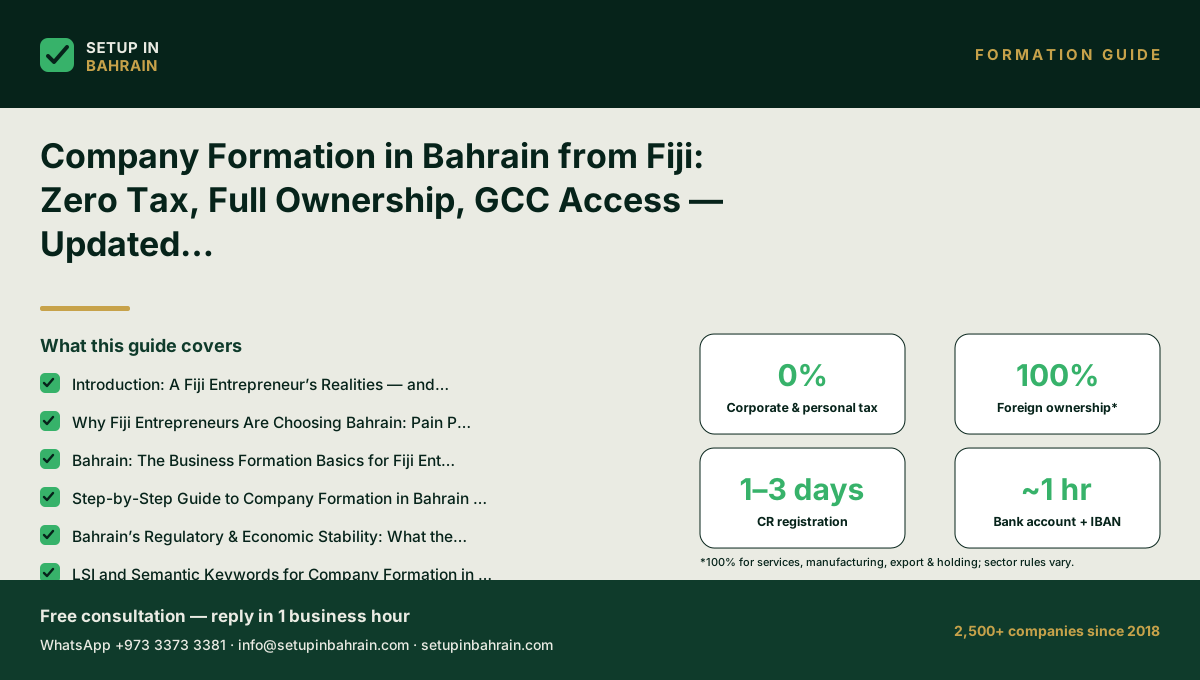
A Bahrain WLL can be owned by a single person — 100% foreign ownership applies to most activities, with no local partner required for services, manufacturing, export trading and holding companies. The minimum share capital is BHD 1; we recommend BHD 1,000, which makes bank account opening and investor visa approval smoother.
Introduction: A Fiji Entrepreneur’s Realities — and Global Possibilities
Imagine you’re Litia, a Fiji-based exporter whose profits are eroded not just by a 20% corporate income tax but also by compulsory FNPF pension contributions, currency depreciation, and capital controls. Your digital consultancy just topped FJD 2.5 million in revenue, only to watch FJD slip 10% against the US dollar. Each bi-annual cycle brings another complex Fiji Revenue & Customs Service (FRCS) filing, sometimes with retroactive re-assessments. When you finally look to reinvest profits abroad, you face an additional maze of Reserve Bank of Fiji (RBF) permissions for outward transfers over FJD 500,000.
In 2024, Ramesh — a peer from Nadi — tried to modernise his tourism operation by importing equipment. By the time his cross-border payment got RBF approval, fluctuating currency and supplier costs shaved 16% off his working capital. The pain points are familiar across Fiji’s entrepreneur community: shrinking retained earnings, red tape, and an unpredictable macroeconomic backdrop.
But what if there was a way to recode your business for a global playing field? Bahrain offers exactly that. This isn’t a theoretical loophole; it’s a robust legal framework recognized by the World Bank and enabled by progressive regulation from Bahrain’s Ministry of Industry & Commerce (MOIC) and Business Registration & Intellectual Property Authority (BIPA). Here, corporate taxes are 0%, the BHD is pegged to the USD (no currency rollercoaster), and 100% foreign ownership is guaranteed — with practical capital thresholds and instant market access to the $2 trillion GCC bloc.
This definitive guide draws on current insights, best practice, and the voices of Fiji business leaders who’ve made the leap in 2026. It’s not about “offshoring” — it’s about building a future-proof base in a world-class ecosystem.
Why Fiji Entrepreneurs Are Choosing Bahrain: Pain Point by Pain Point
Corporate Tax: 20% in Fiji vs. 0% in Bahrain
The Fiji Context
- 2generally no corporate income tax for most sectors: Every FJD 100,000 in profit means FJD 20,000 disappears before you pay yourself, reinvest, or expand.
- FNPF Employer Contributions: Legally required to pay 10% employer contribution to Fiji National Provident Fund on top of gross salary.
- Personal Income Tax: Steep graduate rates, heavily impacting dividends and director’s fees.
The Bahrain Advantage
- 0% Corporate Income Tax (CBB): Applies to all types of resident companies. Your entire profit is yours to reinvest or repatriate.
- 0% Personal Income Tax: Salaries and dividends aren’t taxed for either residents or non-residents.
- 0% Capital Gains/Withholding/Stamp Tax: There are no hidden assessments — confirmed annually by the Central Bank of Bahrain (CBB) and Ministry of Finance.
Concrete Impact: Ramesh’s FJD 380,000 profit in Fiji nets FJD 285,000 after tax. In Bahrain, every dinar earned is retained — a 33%+ bump to the bottom line overnight.
Currency Volatility: FJD vs. USD-Pegged BHD
The Fiji Context
- FJD Depreciation: Averaging 8–12% per year since 2021. A Fijian business earning overseas loses real value, remittances erode, and offshore investment gets pricier every year.
- Unpredictable Hedging Costs: The Reserve Bank of Fiji’s limited FX reserves can delay conversions, making import-export or foreign direct investment unpredictable.
The Bahrain Context
- BHD Stability: The Bahraini dinar (BHD) has been pegged to the USD at a stable rate (BHD 1 = USD 2.65) since 1980.
- No Peg Breaches or Devaluation Episodes: Backed by substantial FX reserves and prudent monetary policy — cited regularly in the World Bank’s “Doing Business in Bahrain” reports.
Practical Benefit: A Fijian entrepreneur forming a Bahrain company earns in BHD, knowing with certainty what those profits are worth in global currency terms.
FRCS Bi-Annual Filings vs. Bahrain’s Streamlined Reporting
Fiji Challenges
- Complexity & Frequency: Mandatory bi-annual tax returns, with multi-layered documentation and risk of heavy penalties for errors or late filings.
- Retroactive Assessments: FRCS is known for reviewing prior years, leading to uncertainty about “closed books” and potential for surprises.
Bahrain Process
- Annual, Transparent Requirements: Bahrain companies file a single set of financial statements each year. For most SMEs, simplified returns are accepted — no hidden add-backs, minimal supporting documentation.
- Sophisticated Regulators, Light-Touch for SMEs: As confirmed by BIPA and MOIC, companies below BHD 100,000 turnover face almost no periodic bureaucracy.
Capital Controls & Outbound Transfers
Fiji Realities
- RBF Approval for Outward Capital: Any transfer above FJD 500,000 needs documentation, board minutes, RBF vetting, and can take 4–8 weeks.
- Foreign Direct Investments Blocked or Delayed: Costs opportunities and increases counterparty risk in international trade.
Bahrain Opportunity
- No Foreign Exchange Controls: Bahrain’s open economy allows businesses to remit profits, dividends, and capital anywhere globally, instantly.
- Global Banks: All major GCC and international banks operate freely.
Head-to-Head: Fiji vs. Bahrain — Entrepreneur's Pain Points
| Feature | Fiji | Bahrain |
| Corporate Tax Rate | 20% | 0% |
| Currency Stability | FJD depreciates 8–12%/yr | BHD/USD fixed; zero loss |
| Employer Pension | 10% FNPF required | No mandatory pension |
| Tax Filing | Bi-annual, complex, risk | Simple annual, flat |
| Outward Capital | >FJD 500k RBF controls + slow | Unrestricted remittance |
| Personal Income Tax | Progressive rates | 0% |
| Government Incentives | Limited, sector specific | All sectors, transparent |
| Foreign Ownership | Generally 100% except land | 100%, no sponsor needed |
Bahrain: The Business Formation Basics for Fiji Entrepreneurs
The WLL: 100% Ownership, Zero Sponsor
- WLL (With Limited Liability Company): The gold standard for foreign founders. Can be formed with a SINGLE shareholder (individual or corporate).
- No Local Sponsor/Partner Required: Fiji nationals need no Bahraini joint venturer. Contrast this with Dubai or Qatar, where a local sponsor was once mandatory.
Core Legal Facts:
- Minimum Share Capital: BHD 1 (legal minimum), but banks and visa authorities recommend starting with at least BHD 1,000.
- Key Authorities:
Practical Steps: The entire formation process can be completed remotely — no requirement for Fiji directors or shareholders to travel until bank onboarding.
What Types of Businesses can a Fiji Entrepreneur Launch in Bahrain?
- Trading (import/export, digital goods, commodities)
- Consultancy (IT, tourism, business services)
- Fintech and Payment Processing (requires CBB approval)
- Manufacturing or Assembly
- Holding/Investment/Intellectual Property
Almost all these business activities can operate at 100% foreign ownership with minimal restrictions.
Step-by-Step Guide to Company Formation in Bahrain (For Fiji Nationals)
Step 1: Decision Framework — Is Bahrain Right for You?
Ask Yourself:
- Are your customers/clients increasingly global?
- Is currency risk draining your profits?
- Are you frustrated with FRCS admin and FNPF costs?
- Do you want unrestricted access to Asia, the GCC, or Europe?
Step 2: Pre-Incorporation Planning
Choose Your Activity & Check MOIC Requirements
- Consult MOIC/BIPA activity lists to confirm licensing category.
- Regulatory review—some activities (financial, telecom, health) require additional sector approvals.
Prepare Identity & Company Documents
- Certified passport copy (Fiji passport recognized)
- Overseas proof of address
- CV and business plan summary (recommended; not always required for standard trading/consultancy)
- Company name options (3 alternatives recommended)
Step 3: Online Company Registration
Via SIJILAT Portal (MOIC Government Platform):
- Register account and submit preliminary application.
- MOIC/BIPA reviews and provides feedback (typically 3–6 business days).
- Name reservation, legal document review, and issuance of Commercial Registration (CR) number.
Tip: Using an approved local service provider (BIPA licensed) can streamline and pre-screen your application.
Step 4: Bank Account Opening
Requirements:
- Approved CR and company documents
- KYC on major shareholders (>10%)
- Initial share capital deposit (practically BHD 1,000 strongly advised, even though BHD 1 is the legal minimum)
- Business plan and evidence of source of funds
Banking Environment:
- All banks are regulated by CBB — high compliance, strong USD and multi-currency accounts.
- Remote onboarding is possible but a director visit is sometimes requested.
Step 5: Visa Application for Investors and Staff
- Residency permit (investor visa) available for 100% foreign company owners.
- Staff visas processed via LMRA (Labor Market Regulatory Authority)—expat quotas are generous.
- Family sponsorship available for founders.
Step 6: Operational Set-up
- Lease virtual or physical office (flexible options from MOIC/MISA-recognized providers)
- Register for VAT (only required above threshold; currently BHD 37,500 annual turnover)
- Go live — issue invoices in BHD or any major currency
FAQs: The Real-World Questions Fiji Entrepreneurs Ask about Bahrain
Can I “offshore” my Fijian company profits to Bahrain and avoid Fiji tax?
If your management and operations genuinely shift offshore, profits earned from Bahrain activity are generally not taxed by Fiji under current double-taxation policy. However, passive income or profits “round-tripped” back to Fiji may attract scrutiny from FRCS. Legal and tax advice is always recommended for residency and source-of-income planning.
Can a single Fiji national own a Bahrain company fully?
Yes. Unlike several Gulf jurisdictions, a Bahrain WLL can have a single shareholder — either an individual or a foreign company. No Bahraini sponsor is needed.
What is the real minimum capital needed to open a bank account?
Legally, BHD 1. In practice, banks rarely approve business accounts below BHD 1,000. Starting with at least BHD 1,000 is recommended for smooth onboarding and to support investor visa eligibility.
Do I need to travel to Bahrain to get started?
Company setup can be completed remotely. However, for bank account signatory or if opening accounts with certain financial institutions, a personal visit or video call is usually required.
How easy is it to get a resident permit/investor visa via a Bahrain company?
Very easy: once you have your CR and company bank account, investor resident status is processed within weeks. You can sponsor your spouse and children as the owner.
How does Bahrain compare to the UAE for Fijians?
| Feature | Bahrain | UAE (Dubai, Abu Dhabi) |
| Corporate Tax | 0% | 9% since 2023 |
| Foreign Ownership | 100% in most sectors | 100% for many “onshore” |
| Bank Account Ease | High, less red tape | High minimum balance |
| Cost | Setup: ~$3,000 all-in; | Setup: $7,000+ for LLC |
| Residency Permit | Easy, minimal spend | Fixed office space cost |
| Local Director Req | None | Some “mainland” sectors |
Bahrain’s Regulatory & Economic Stability: What the Experts Say
CBB, EDB, MOIC, and BIPA have built Bahrain’s reputation as one of the most robust business environments in the region. According to the World Bank Ease of Doing Business 2026:
- Top-10 globally for starting a business
- Number 1 in MENA for investor protection
- GCC’s lowest entry cost for 100% foreign-owned companies
The CBB’s monetary policy ensures the BHD/USD peg is unshakeable, and liquidity is readily available for cross-border trades and capital movements — as confirmed in the quarterly CBB Financial Stability Review.
LSI and Semantic Keywords for Company Formation in Bahrain (and Why They Matter)
- “Bahrain commercial registration”
- “Bahrain WLL company requirements”
- “Bahrain business visa for foreigners”
- “Bahrain company bank account opening”
- “Fijian entrepreneur Bahrain tax”
- “Bahrain generally no corporate income tax for most sectors regime”
- “Foreign direct investment Bahrain”
- “Bahrain economic development FDI”
- “Set up Bahrain company remotely”
Using these LSI keywords in your business plan, website, and formation documents maximizes your profile for digital credibility — more crucial than ever for attracting B2B partners, VC investors, and government grants.
Fiji Entrepreneur Success Story: From Suva to Manama
Case Study: Sereana, Digital Exporter
Background: Sereana ran a thriving digital consultancy in Suva, generating FJD 2.2 million and employing 12 staff. In 2024, she saw only FJD 1.34 million post-tax/fx, after FNPF costs, and lost a key US contract because FRCS paperwork delayed her ability to issue USD invoices on time.
Her move: In 2025, she set up a Bahrain WLL remotely. Her BHD invoices settled instantly. No FNPF, no FRCS biannual filings. Year one post-migration profit, after all costs, was up 26%. She invested in an office at Bahrain’s Gulf Fintech Hub, received a five-year investor visa, and hired two new Fijian graduates as remote staff.
Risks and Realities: Bahrain is Not an “Offshore Haven” — It’s a Real Economy with Standards
- KYC and AML Strictness: Banks in Bahrain, regulated by CBB, now require ultra-transparent source-of-funds and UBO disclosures. Ultimate beneficial owners (UBO) must pass full due diligence.
- Economic Substance Requirements: Certain regulated activities (financial, insurance, holding companies) require local presence or compliance with economic substance rules.
- No Tolerance for Shells: Dormant or “postbox” companies risk deregistration.
- Public Reputation: Bahrain partners with global compliance networks; its 0% regime is recognized for transparency, not secrecy.
Current Costs and Timeline (2026 Update)
| Item | Typical Cost (USD$) | Timeline |
| Company formation (MOIC/BIPA fees) | $1,300–$1,800 | 7–14 days |
| Bank account opening | $0 (plus deposit) | Banking: approximately 1 hour in 99% of our reported cases; our last 100 applications handled in 2026 were approved; subsidiaries or CIS shareholders: 3 days to 2 weeks. Subject to the bank’s final review. |
| Virtual office/Address | $600–$1,200/year | Immediate |
| Investor visa (processing) | $200–$350 | 3–4 weeks |
| Legal/Advisory service (optional) | $800–$1,800 | Simultaneous |
Practical Tips for Fiji Entrepreneurs Moving to Bahrain
1. Prepare robust business documentation: Banks expect clear business plans and proof of client pipeline — make your offshore proposition tangible.
2. Budget for 12–18 months of remote compliance: Include KYC requirements, annual audits, and periodic license renewals. Bahrain’s transparency means future investors and partners will trust your filings.
3. Consider dual-company structures: For legacy Fiji business, consult with an accountant: some entrepreneurs run a Fiji export subsidiary of their Bahrain HQ, reducing regulatory headaches while keeping local FNPF/Fiji tax only on in-country revenue.
4. Know your sector’s specifics: Some lines (banking, fintech, healthcare) need additional MOIC or CBB approvals. General trading and consulting are fastest to launch.
5. Build a local network: The Bahrain EDB, embassies, and expat business chambers provide practical guidance for new investors. Reach out from day one.
Conclusion: Turn Regulatory Headwinds into a Launchpad
Bahrain isn’t just a flag of convenience or another “offshore” destination. For Fiji entrepreneurs, it’s a way to turn predictable regulatory drag into a strategic windfall:
- Every FJD of profit saved from FRCS filings and FNPF is a dollar you can reinvest in growth.
- A stable, USD-pegged currency means global deals won’t slaughter your margins before you even deliver.
- 100% ownership (with practical capital entry points) puts you in the GCC’s fast lane — at a minimum total cost that’s a fraction of UAE or Singapore.
As you weigh the practical details, know this: Hundreds of Fiji’s most ambitious founders are now building their future from Bahrain. You could be next — and with thorough planning, EDB-backed support, and a clear-eyed understanding of regulations, your journey can begin today.
Sources:
- Central Bank of Bahrain: cbb.gov.bh
- Economic Development Board Bahrain: bahrainedb.com
- Ministry of Industry & Commerce: moic.gov.bh
- Business Registration & Intellectual Property Authority: bipa.gov.bh
- Fiji Revenue & Customs Service: frcs.org.fj
- Reserve Bank of Fiji: rbf.gov.fj
- World Bank Doing Business 2026: worldbank.org
Bahrain Business Guides for Fiji Citizens
Ready to set up in Bahrain from Fiji?
Tell us your business idea. We map the right entity, ownership and timeline — then handle the filing while you focus on what matters.