Complete guide for Eswatini entrepreneurs: form a company in Bahrain with generally no corporate income tax for most sectors, 100% foreign ownership, and GCC market access. Costs, steps, visas, banking.
→ Complete guide: Company Formation in Bahrain — the full 2026 guide
View details
Ownership & capital
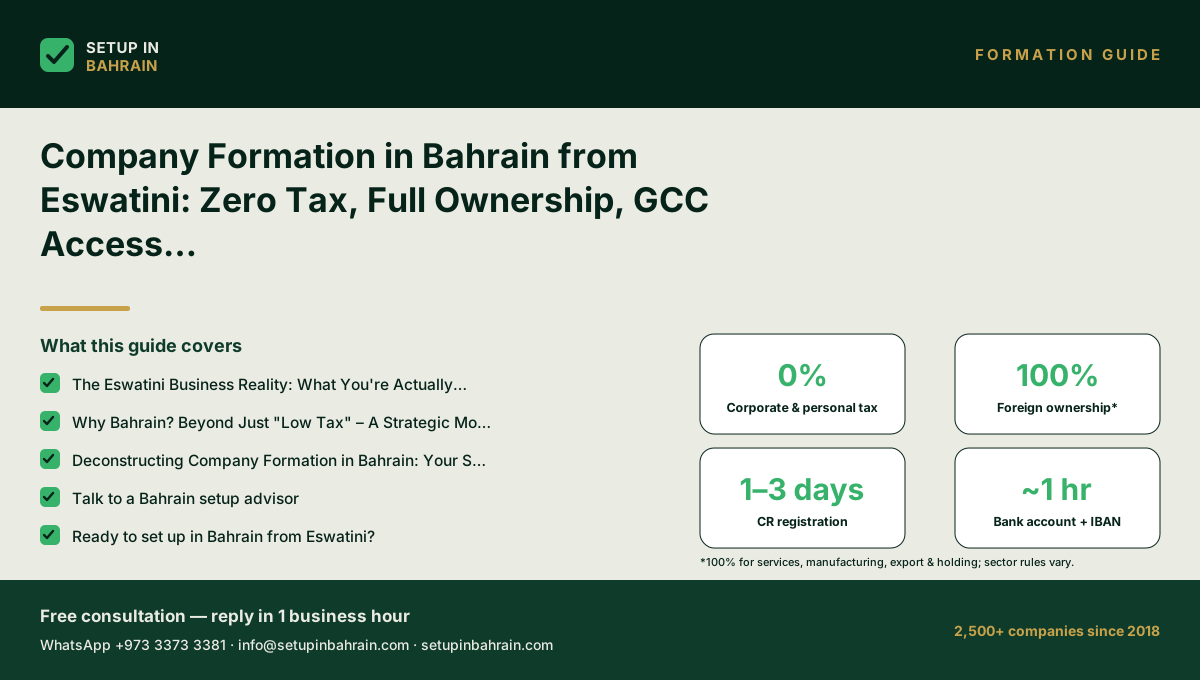
A Bahrain WLL can be owned by a single person — 100% foreign ownership applies to most activities, with no local partner required for services, manufacturing, export trading and holding companies. The minimum share capital is BHD 1; we recommend BHD 1,000, which makes bank account opening and investor visa approval smoother.
The entrepreneurial spirit in Eswatini is undeniable. From the bustling markets of Manzini to the innovative startups emerging in Mbabane, there’s a relentless drive to build, create, and grow. But beneath this ambition, a persistent question nags at many business owners: "Are we truly maximizing our potential here, or is there a better way?"
Picture this: Nomusa, owner of a thriving artisanal crafts export business in Mbabane, has just cleared SZL 2.8 million in revenue last year. After a grueling calculation, she sees nearly 27.5% of her corporate profit vanish into income tax. On top of that, there are the SRA audit fees, the mandatory 10% pension contributions, and a pile of paper-heavy filing requirements that consume valuable time and resources. By the time all is said and done, she's left with just over SZL 1.6 million to reinvest and grow.
Then, the South African Reserve Bank tightens monetary policy again. The lilangeni, pegged directly to the volatile South African Rand (ZAR), moves 8% against the US Dollar in a single month. The cost of her imported raw materials, the logistics software subscriptions, and even the marketing services from abroad suddenly jump overnight. Her domestic market, barely 1.1 million consumers strong, feels saturated, and every attempt to expand regionally runs into the same currency and regulatory hurdles that link her fate inextricably to South Africa's economic ebb and flow. She feels an absolute ceiling on her growth, stifled by factors beyond her control.
Now, imagine Nomusa registering a company in Bahrain. She opens a With Limited Liability (WLL) entity with a practical starting share capital of BHD 1,000. Her corporate tax drops to zero. Her currency stays locked at BHD 1 = USD 2.65, providing unparalleled stability for her international transactions. Within four months, she's routing her GCC sales through her new Bahraini entity, accessing a $2.1 trillion market with 60 million affluent consumers. Her profits are no longer eroding under the weight of tax and currency fluctuations, but compounding, fueling real, sustainable growth.
This isn't an article about vague possibilities or theoretical advantages. This is your definitive 2026 guide, tailored specifically for you, the Eswatini business owner. We'll cut through the noise, address your specific frustrations, and lay out a clear, actionable path to establishing your commercial presence in a nation that offers unparalleled advantages: generally no corporate income tax for most sectors, 100% foreign ownership, and direct access to the lucrative GCC market.
We understand the unique challenges you face. From the persistent SRA paper-heavy filing requirements to the limitations of the CBS (Central Bank of Eswatini) in facilitating seamless international transactions, and the profound impact of the SZL's peg to the ZAR, making your business susceptible to South African economic shifts – these are not minor inconveniences. They are fundamental hurdles that can stifle growth, erode profitability, and limit your global reach.
Bahrain, in stark contrast, offers a sanctuary of fiscal stability, regulatory clarity, and strategic access that can fundamentally transform your business trajectory. Let’s unpack the underlying realities—and see exactly what’s drawing the smartest capital out of Southern Africa and into the heart of the Gulf.
The Eswatini Business Reality: What You're Actually Paying (and Losing)
For entrepreneurs in Eswatini, the headline 27.5% corporate income tax isn’t the only figure cutting into your margins. You’re also facing steep compliance costs, mounting paperwork, and significant regulatory uncertainty that creates a constant drag on profitability and growth.
Corporate Tax: The Crushing 27.5% Burden
Let’s not sugarcoat it: Eswatini’s corporate income tax rate of 27.5% is among the highest in Southern Africa and globally. For context, the average corporate tax rate across Africa in 2023 was around 28%, but many nations are moving to reduce this. Eswatini’s rate offers no competitive edge. Every lilangeni (SZL) of profit your business generates is exposed to this full rate, with virtually no "offshore" or "free zone" carve-outs to provide relief.
Consider the cumulative effect: a business generating SZL 5 million in taxable profit loses SZL 1.375 million directly to corporate tax. This isn't just a number on a spreadsheet; it's capital that could have been reinvested into expansion, research and development, hiring more staff, or increasing shareholder returns. This significant chunk of your earnings disappears before you even consider other operational costs.
The SZL-ZAR Peg: A Ball and Chain for International Ambition
Perhaps one of the most insidious challenges for Eswatini businesses is the currency peg. The Swazi Lilangeni (SZL) is fixed at parity with the South African Rand (ZAR) under the Common Monetary Area (CMA) agreement. While this offers some stability against the ZAR for regional trade, it fundamentally ties Eswatini’s monetary policy and economic stability to South Africa’s.
What does this mean for your business?
- Exposure to ZAR Volatility: When the ZAR weakens against major global currencies like the US Dollar or Euro – which it frequently does due to South Africa’s internal economic pressures or global events – the SZL weakens right along with it. This directly impacts the cost of your imported goods, raw materials, software licenses, or even professional services from outside the CMA. An 8% drop in the ZAR means an 8% increase in your import costs overnight, directly eroding your profit margins and making financial planning a nightmare.
- Limited Monetary Sovereignty: The Central Bank of Eswatini (CBS) has very limited independent monetary policy. Interest rates, inflation targeting, and currency management are largely dictated by what happens in Pretoria, not Mbabane. This makes Eswatini businesses vulnerable to economic shocks emanating from South Africa, even if Eswatini's internal economy is relatively stable.
- Difficulty in International Pricing: If your business deals with international clients or suppliers, the constant fluctuation of the ZAR/SZL against global currencies adds a layer of complexity to pricing, hedging, and managing foreign exchange risk. It can make your products less competitive internationally when the ZAR strengthens or make your imports cripplingly expensive when it weakens.
Regulatory Burden: The SRA Paper Trail and Beyond
The Eswatini Revenue Authority (SRA) plays a crucial role in tax collection, but the compliance process is often described by local entrepreneurs as paper-heavy, time-consuming, and prone to delays.
- Extensive Paperwork: From annual returns to various declarations, the sheer volume of physical documentation required can be daunting, especially for SMEs without dedicated compliance departments. This contrasts sharply with highly digitized systems found elsewhere.
- Audit Frequency and Fees: Businesses often face regular audits, which, while necessary, can be disruptive and incur significant professional fees for accountants and legal advisors.
- Slowness of Processes: Entrepreneurs report that navigating the SRA’s various departments can be slow, leading to delays in approvals, refunds, or clarifications, impacting business operations.
- Limited Digital Integration: Compared to more advanced economies, the digital interface for tax compliance can be less sophisticated, requiring more manual effort.
Limited International Banking Capabilities: The CBS Challenge
The Central Bank of Eswatini (CBS) diligently oversees the nation's financial system, but for businesses looking to operate internationally, the local banking infrastructure presents significant limitations:
- Slow International Transfers: SWIFT transfers, a backbone of global finance, can be notably slow and expensive when originating from or destined for Eswatini banks. This impacts cash flow, supplier payments, and receipt of international revenue.
- Limited Forex Services: Access to a broad range of foreign exchange products and efficient currency conversion services can be restricted, adding costs and complexity to international transactions.
- Challenges with Capital Repatriation: Moving profits or invested capital out of Eswatini can be subject to stringent regulations and processes, often involving delays and administrative hurdles, deterring foreign investment and limiting entrepreneurs' ability to deploy capital globally.
- Fewer Correspondent Banking Relationships: Eswatini banks may have fewer direct correspondent banking relationships with major international financial institutions, necessitating multiple intermediary banks for transfers, increasing costs and transaction times.
Small Domestic Market and Growth Ceiling
With a population of just over 1.1 million, Eswatini's domestic market, while offering local opportunities, inevitably places a ceiling on organic growth. For ambitious entrepreneurs, scaling beyond these borders is essential, but the combined challenges of tax, currency, and banking make this inherently difficult from within Eswatini.
- Market Saturation: For many product and service categories, the local market can quickly become saturated, leading to intense competition and diminishing returns.
- Limited Diversification: The small market size limits opportunities for businesses to diversify their offerings or client base, making them more vulnerable to local economic downturns.
- High Acquisition Costs: Reaching new customers in a small, saturated market can be disproportionately expensive, impacting profitability.
Other Hidden Costs and Burdens
- Social Security & Pension Contributions: Mandatory contributions, such as the 10% pension deduction mentioned earlier, further reduce disposable income and increase employer costs.
- Import Duties and Logistics: Despite regional agreements, the overall cost of importing goods into landlocked Eswatini, coupled with fluctuating currency, adds significantly to operational expenses.
- Regulatory Uncertainty: Frequent changes or lack of clarity in regulations can create an unpredictable business environment, requiring constant monitoring and legal consultation.
In essence, for the Eswatini entrepreneur, the current business environment, while offering local comfort, ultimately creates a significant drag on international ambition and profitability. It's an environment where hard-earned profits are consistently eroded, and growth potential is prematurely capped. This stark reality is precisely why discerning entrepreneurs are actively seeking more advantageous jurisdictions.
Why Bahrain? Beyond Just "Low Tax" – A Strategic Move for Eswatini Growth
If the Eswatini business reality paints a picture of ceilings and erosion, Bahrain offers a canvas of limitless horizons and compounding prosperity. It's not merely about escaping high taxes; it's about strategically positioning your business for unparalleled growth, stability, and access.
1. The Power of Zero: 0% Corporate Income Tax
This is the headline advantage, and its impact cannot be overstated. Bahrain charges 0% corporate income tax on most business activities. (A notable exception is the oil and gas sector, which operates under specific agreements). For a general trading company, a consultancy, an e-commerce venture, or an export business like Nomusa’s, this means every lilangeni (now BHD) of profit remains with your company, available for reinvestment, expansion, or distribution to shareholders.
Think about the psychological relief: no more 27.5% disappearing act. This means:
- Accelerated Reinvestment: More capital available to fund R&D, marketing, new product lines, or talent acquisition.
- Improved Cash Flow: Direct impact on your bottom line, bolstering working capital.
- Enhanced Competitiveness: Ability to offer more competitive pricing or absorb higher operational costs without sacrificing profit.
- Simplified Accounting: A significantly less complex tax compliance regime, freeing up resources.
This isn't just a cost saving; it's a fundamental shift in your business's financial DNA, allowing for a growth trajectory that's simply impossible under a high-tax regime.
2. 100% Foreign Ownership: Absolute Control, No Local Partner Required
A common hurdle for foreign investors in many Gulf nations used to be the requirement for a local sponsor or partner, often holding a majority stake. Bahrain has, for years, championed 100% foreign ownership in most sectors. This is a crucial distinction for Eswatini entrepreneurs.
Specifically, for the most popular legal structure, the With Limited Liability (WLL) company:
- No Local Sponsor: You, as the Eswatini entrepreneur, can own 100% of your Bahraini WLL company. No need to dilute equity or share control.
- Full Autonomy: Complete control over your business decisions, strategic direction, and profit distribution.
- Simplified Operations: No complexities arising from managing a local partner relationship.
This ensures that your vision, your hard work, and your capital remain entirely yours.
3. Gateway to the GCC: A $2.1 Trillion Market on Your Doorstep
Eswatini’s 1.1 million-strong domestic market contrasts sharply with the Gulf Cooperation Council (GCC) market, which Bahrain offers direct access to. The GCC consists of Bahrain, Kuwait, Oman, Qatar, Saudi Arabia, and the United Arab Emirates.
- Market Size: Over 60 million consumers with significant purchasing power and a collective GDP exceeding $2.1 trillion (World Bank, 2023).
- Strategic Location: Bahrain’s geographic position makes it an ideal logistics hub for reaching Saudi Arabia (connected by the King Fahd Causeway), Kuwait, Qatar, and other regional markets.
- Free Trade Agreements: As a member of the GCC, businesses in Bahrain benefit from preferential trade agreements and customs unions, facilitating easier cross-border trade within the bloc.
- Untapped Potential: While competitive, many niches within the GCC market remain less saturated than Western markets, offering significant growth opportunities, especially for innovative businesses.
For an Eswatini exporter looking to scale, this isn't just "regional expansion"; it's a leap into a league of significant global economic power.
4. Stable Currency: The Predictability of BHD Pegged to USD
Remember the anxiety of the SZL-ZAR peg? In Bahrain, that anxiety disappears. The Bahraini Dinar (BHD) has been pegged to the US Dollar at a fixed rate of BHD 1 = USD 2.65 for decades.
- Unwavering Predictability: This peg provides absolute currency stability and predictability for your international transactions, imports, and exports. You know exactly what your costs and revenues will be in major global currencies.
- Simplified Financial Planning: No more hedging strategies against volatile currency swings. Your financial forecasting becomes significantly more reliable.
- Confidence for International Trade: Suppliers and customers worldwide have confidence in the BHD's stability, streamlining international contracts and payments.
- Protection of Capital: Your profits, held in BHD, are shielded from the kind of depreciation seen with more volatile emerging market currencies.
This stability is not merely a technical detail; it’s a bedrock of confidence for any business engaged in international trade and investment.
5. World-Class Infrastructure and Digital Readiness
Bahrain has invested heavily in its infrastructure and digital transformation, positioning itself as a modern, forward-thinking business hub.
- Advanced ICT Infrastructure: High-speed internet, extensive fiber optic networks, and robust data centers support digital businesses.
- Logistics Hub: Strategically located ports, an efficient airport, and the King Fahd Causeway linking to Saudi Arabia facilitate seamless regional and international logistics.
- E-Government Initiatives: The government’s commitment to digitization means most business processes, from company registration to license renewals, can be completed online.
6. Efficient Business Environment: Speed, Simplicity, and Support
The Economic Development Board (EDB) of Bahrain and the Ministry of Industry and Commerce (MOIC) are champions of business efficiency.
- MOIC Online Portal: Company registration can be initiated and often completed entirely online through the Sijilat portal in as little as 1–7 business days, depending on the complexity of your activity and completeness of documents. This is a stark contrast to many paper-heavy jurisdictions.
- EDB Support: The EDB actively supports foreign investors, offering guidance, facilitating connections, and helping navigate the regulatory landscape.
- Ease of Doing Business: Bahrain consistently ranks high in global indices for ease of doing business, reflecting its streamlined processes and investor-friendly policies.
7. Robust & Regulated Banking: The CBB Advantage
In contrast to the limited international banking capabilities of the CBS, Bahrain boasts a sophisticated and highly regulated financial sector overseen by the Central Bank of Bahrain (CBB).
- International Banking Hub: Bahrain is a recognized financial hub in the Middle East, hosting numerous international banks, investment firms, and a burgeoning Fintech sector.
- Efficient Transactions: Experience fast, reliable SWIFT transfers and efficient foreign exchange services.
- Multi-Currency Accounts: Easily open accounts in multiple currencies (USD, EUR, GBP, etc.) to manage your international cash flows.
- Strong Regulatory Oversight: The CBB's robust regulatory framework ensures stability, transparency, and consumer protection, providing confidence for businesses.
- Access to Capital: As a financial hub, Bahrain offers access to a wider range of financing options, from traditional bank loans to venture capital.
8. Quality of Life and Cost-Effectiveness
Bahrain offers an attractive lifestyle for expatriates and a relatively lower cost of living and doing business compared to its GCC neighbors like Dubai or Riyadh.
- Cosmopolitan Environment: A diverse, welcoming society with excellent healthcare, education, and leisure facilities.
- Lower Operating Costs: Office rentals, utilities, and general living expenses are often more affordable than in other major Gulf cities, stretching your business's budget further.
- Access to Talent: Attracts a skilled, multilingual expatriate workforce, complementing local talent.
9. Investor Visa Pathway: A Clear Path to Residency
Forming a company in Bahrain provides a direct pathway to obtaining an investor visa, allowing you to reside in the country and manage your business directly. This extends to family sponsorship, offering a complete relocation solution. This is a tangible benefit for Eswatini entrepreneurs looking for stability and a new home base for their global operations.
In summary, Bahrain offers Eswatini entrepreneurs not just an escape from stifling conditions, but a robust platform for exponential growth, financial stability, and international reach. It’s a strategic move that moves your business from a constrained local market to a dynamic global stage.
Deconstructing Company Formation in Bahrain: Your Step-by-Step Roadmap
Establishing your company in Bahrain is a straightforward process, largely thanks to the Kingdom’s commitment to digital transformation and investor-friendly policies. However, understanding the nuances and practical realities is key to a smooth journey.
1. Choosing Your Legal Structure: The Power of the WLL
For the vast majority of Eswatini entrepreneurs seeking 100% foreign ownership and flexibility, the With Limited Liability (WLL) company is the gold standard.
Understanding the WLL (With Limited Liability) – Your Go-To Structure
- Limited Liability: As the name suggests, your personal assets are protected from the company’s debts and obligations.
- 100% Foreign Ownership: A Bahraini WLL can be owned 100% by foreign individuals or corporate entities. Crucially, a single person can own a WLL. This means you don't need to find a local partner or any additional shareholders, providing complete autonomy. There is NO single-shareholder WLL legal structure in Bahrain, but the WLL effectively serves this purpose for solo entrepreneurs.
- Flexibility: Suitable for a wide range of business activities, from trading and consulting to services and e-commerce.
- Shareholders: Can have 1 to 50 shareholders.
- Management: Can be managed by a single director (who can also be the sole shareholder).
- Corporate Identity: A distinct legal personality, allowing it to enter contracts, own assets, and sue or be sued in its own name.
While other structures exist (such as a Branch of a Foreign Company, or a Bahraini Shareholding Company), the WLL offers the optimal balance of control, protection, and ease of setup for most Eswatini businesses looking to establish a presence.
2. Share Capital: The BHD 1 vs. BHD 1,000 Reality
This is a critical point that often causes confusion.
- The Legal Minimum: Legally, the minimum share capital for a WLL in Bahrain is BHD 1. Yes, just one Bahraini Dinar. This makes company formation highly accessible from a purely statutory perspective.
- The Practical Recommendation: However, from a practical standpoint, we strongly recommend setting your share capital at BHD 1,000. Why?
The capital does not need to be deposited immediately at the time of registration but will be required when opening the corporate bank account.
3. The MOIC Online Portal: Your Digital Gateway (Sijilat)
Bahrain’s Ministry of Industry and Commerce (MOIC) has pioneered a highly efficient online platform called Sijilat (www.sijilat.bh). This portal is your primary interface for company registration and licensing.
Key Steps via Sijilat:
- Name Reservation: Submit your proposed company names for approval.
- Activity Selection: Choose your commercial activities from a comprehensive list. Be precise, as these will define what your company is legally permitted to do.
- Document Submission: Upload required documents digitally.
Required Documents Typically Include:
- Passport copies for all shareholders and directors (notarized and attested).
- Proof of residency (utility bills, etc.).
- A comprehensive business plan (often required by MOIC for certain activities, and definitely by banks).
- Memorandum and Articles of Association (MAA) – drafted according to Bahraini law.
- Office address details (lease agreement or virtual office proof).
- Power of Attorney (if using a third-party agent).
- For corporate shareholders, attested constitutional documents of the parent company.
Processing Time: For standard WLLs with common activities, approval can be as quick as 1-3 business days if all documents are in order. More complex activities requiring external approvals (e.g., financial services needing CBB approval, healthcare needing NHRA approval) may take 1-4 weeks.
4. Commercial Registration (CR) & Licensing
Once your application is approved by MOIC, your company receives its Commercial Registration (CR) certificate. This is your official license to operate in Bahrain. It will list your company name, CR number, legal structure, registered activities, and address.
Some specific business activities may require additional licenses or permits from other government bodies after the CR is issued. For instance:
- Financial Services: Central Bank of Bahrain (CBB)
- Education: Ministry of Education
- Healthcare: National Health Regulatory Authority (NHRA)
- Manufacturing: Ministry of Industry
5. Opening a Corporate Bank Account: A Crucial Step
This is often the most challenging, yet vital, step for foreign entrepreneurs.
- CBB Regulations & KYC: The Central Bank of Bahrain (CBB) has stringent Know Your Customer (KYC) and Anti-Money Laundering (AML) regulations, which all banks must adhere to. This means thorough due diligence.
- In-Person Visit: While some preliminary steps can be done remotely, the signatory (shareholder/director) will almost certainly need to visit Bahrain in person for a face-to-face meeting to complete the account opening formalities.
- Required Documents: Expect to provide:
- Practical Minimum Capital: As discussed, having BHD 1,000 (or more) as initial share capital is crucial for bank acceptance.
- Choosing a Bank: Major local and international banks in Bahrain include National Bank of Bahrain (NBB), Bahrain Commercial Bank (BBK), Ahli United Bank (AUB), and HSBC. Research their services and suitability for your business.
Insight: Don't underestimate the bank account opening process. It often takes longer than company registration itself. Being prepared with all documents and a clear business plan will expedite it. This is where an experienced local consultant adds immense value.
6. Finding an Office/Virtual Office
Every company in Bahrain needs a registered address.
- Physical Office: If you require a dedicated space, commercial properties are readily available in areas like Seef, Diplomatic Area, and Bahrain Bay.
- Virtual Office: For businesses that don't need a physical presence, many business centers and service providers offer virtual office packages, which include a registered address and mail handling services. This is a cost-effective option, particularly in the initial stages.
7. Engaging a Business
Bahrain Business Guides for Eswatini Citizens
Ready to set up in Bahrain from Eswatini?
Tell us your business idea. We map the right entity, ownership and timeline — then handle the filing while you focus on what matters.