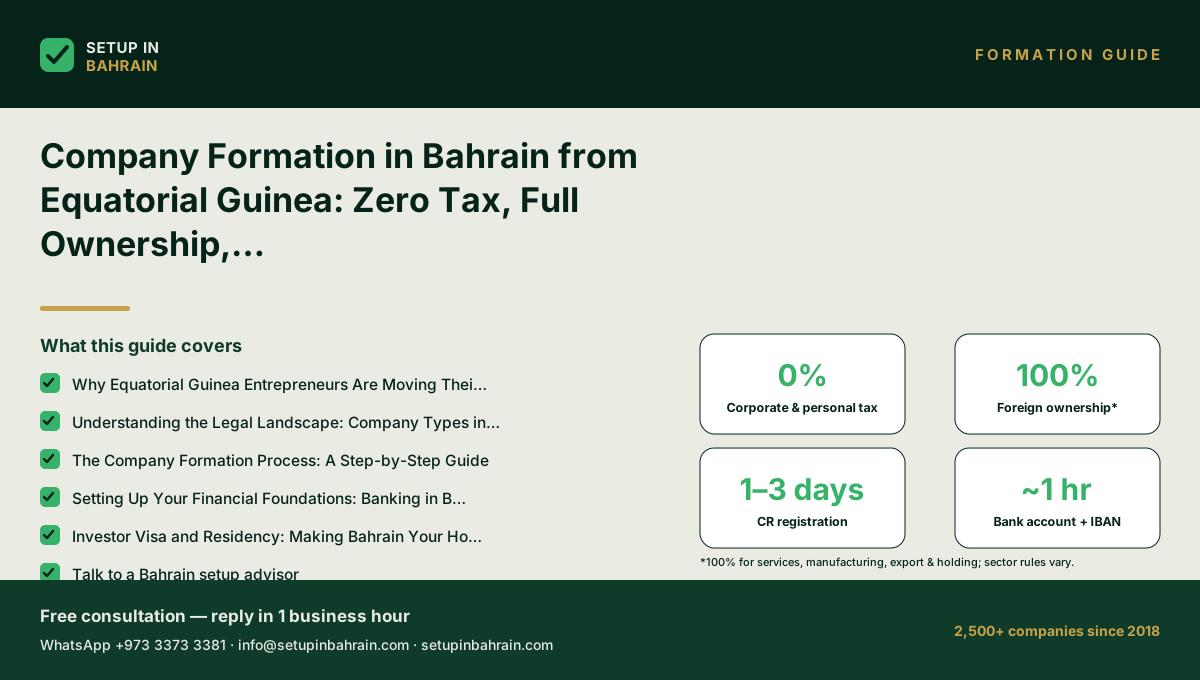
Complete guide for Equatorial Guinea entrepreneurs: form a company in Bahrain with generally no corporate income tax for most sectors, 100% foreign ownership. GCC market access. Costs, steps, visas, banking.
Key Takeaways
- Why Equatorial Guinea Entrepreneurs Are Moving Their Business to Bahrain
- Understanding the Legal Landscape: Company Types in Bahrain
- The Company Formation Process: A Step-by-Step Guide
- Setting Up Your Financial Foundations: Banking in Bahrain
- Investor Visa and Residency: Making Bahrain Your Home
→ Complete guide: Company Formation in Bahrain — the full 2026 guide
View details
Ownership & capital
A Bahrain WLL can be owned by a single person — 100% foreign ownership applies to most activities, with no local partner required for services, manufacturing, export trading and holding companies. The minimum share capital is BHD 1 ; we recommend BHD 1,000 . This Makes bank account opening and investor visa approval smoother.
Entrepreneurship is a journey of ambition, resilience, and calculated risk. But for many founders in Equatorial Guinea, that journey is often burdened by a heavy hand of taxation, stifling bureaucracy. A financial system that feels designed to hold you back, not propel you forward. Imagine launching a venture, pouring your life into it, only to see 35% of your hard-earned corporate profits disappear into government coffers, often with little transparency on how those funds benefit the nation’s infrastructure or business environment.
This isn't just a hypothetical scenario. It's the daily reality for countless businesses across Equatorial Guinea, from the bustling markets of Malabo to the growing industrial zones of Bata. You're navigating a business landscape dominated by the hydrocarbon sector, where the flow of revenue is heavily concentrated and often opaque. You're dealing with a banking system, regulated by BEAC, that imposes severe limitations on non-oil businesses trying to engage internationally, making simple transactions frustratingly complex and costly in terms of time and XAF currency conversion fees. And if you've ever tried to file your annual accounts with the Ministry of Finance, you know the maze of Spanish-language paperwork, the endless waiting, and the all-too-common requests for "facilitation payments" just to move things along. The authoritarian governance, coupled with extremely limited rule of law for foreign investors, creates an environment where legal recourse is often elusive, leaving entrepreneurs vulnerable and hesitant to invest further.
Now, imagine an alternative. A place just hours away by flight, where your corporate income tax is not 35%, but 0% . A jurisdiction where you, as an Equatorial Guinea entrepreneur, can own 100% of your company, with no local sponsor required. Where your profits are yours to reinvest or repatriate freely, without restriction. Where the legal framework is transparent, robust, and designed to protect your investments. This isn't a pipe dream; this is Bahrain, a dynamic island nation at the heart of the Arabian Gulf. A genuine beacon of economic freedom for entrepreneurs like you.
This guide is for you. It's a candid, comprehensive roadmap designed exclusively for Equatorial Guinea entrepreneurs considering company formation in Bahrain. We’ll cut through the noise, address your specific concerns. Provide the actionable insights you need to make an informed decision and successfully launch your venture in this thriving Gulf economy.
Why Equatorial Guinea Entrepreneurs Are Moving Their Business to Bahrain
Consider the case of a Malabo-based logistics operator who spent 2024 watching 35 percent of his company’s net profit disappear into corporate income tax while at once navigating Ministry of Finance filings that arrived only in Spanish and required multiple in-person appearances. The same operator discovered that moving the legal structure to Bahrain eliminated the tax entirely, removed the Spanish-language barrier through the bilingual Ministry of Industry and Commerce (MOIC) Sijilat system, and gave him direct access to the vast Saudi market just 25 kilometers away via the King Fahd Causeway.
Equatorial Guinea entrepreneurs face a unique combination of pressures that make international expansion not just attractive. Often a matter of survival or significant growth. Let’s dissect these pain points and understand how Bahrain offers compelling, direct solutions.
The Heavy Burden of Taxation and Unpredictable Costs
One of the most immediate and significant pain points for businesses in Equatorial Guinea is the 35% corporate income tax rate. For a small to medium-sized enterprise (SME) generating a net profit of, say, XAF 50 million (about $80,000 USD at current exchange rates), this means XAF 17.5 million is siphoned off before any reinvestment or personal gain. This greatly stunts growth, limits capital available for expansion, and makes it harder to compete internationally.
Beyond the headline tax rate, the informal costs of doing business in Equatorial Guinea often erode profitability further. The "facilitation payments" – a euphemism for bribes – that are frequently required to expedite government services or avoid delays can add a substantial, unpredictable percentage to operational expenses. These costs are rarely documented, making financial planning a nightmare and increasing business risk.
Bahrain’s Solution: Bahrain stands in stark contrast. With 0% corporate income tax for most business activities, your profits remain entirely within your company. This means that if your Bahraini company generates BHD 100,000 (about $265,000 USD) in net profit, that entire amount is available for reinvestment, expansion, or distribution to shareholders. This capital retention is a game-changer, allowing for faster growth, greater resilience, and enhanced competitiveness. Also, Bahrain’s transparent and digitally driven regulatory environment, overseen by institutions like the Bahrain Economic Development Board (EDB) and the Ministry of Industry and Commerce (MOIC), drastically reduces the scope for unofficial payments, providing a predictable and stable cost structure.
Navigating a Complex and Opaque Regulatory Landscape
The Ministry of Finance in Equatorial Guinea is known for its complex, often outdated. Primarily Spanish-language filing requirements. For entrepreneurs who may not be fluent in technical Spanish legal jargon, this presents a formidable barrier. The process often necessitates hiring local agents, making multiple in-person visits. Enduring lengthy delays, all of which consume valuable time and resources that could be spent on core business activities. The overall regulatory environment is often perceived as arbitrary, lacking clear guidelines, and subject to frequent, opaque changes.
Bahrain’s Solution: Bahrain prides itself on its ease of doing business, consistently ranking high in World Bank reports for its business-friendly environment. The MOIC's digital platform, Sijilat.bh , is a fully bilingual (Arabic and English) online portal where you can register your company, apply for licenses. Manage your commercial registration with remarkable efficiency. Most processes can be completed remotely, minimizing the need for physical visits and eliminating the Spanish-language barrier. The legal framework is based on common law principles, which are familiar to many international investors. The rule of law is robust, supported by an independent judiciary, ensuring greater predictability and investor protection.
The Straitjacket of XAF Currency and BEAC Regulations
Operating in Equatorial Guinea means dealing with the XAF (Central African CFA franc), a currency pegged to the Euro. While the peg offers some stability, the regulations imposed by the Bank of Central African States (BEAC) on international transactions can be incredibly restrictive for non-oil businesses. Transferring funds, receiving international payments, or investing abroad often involves cumbersome approval processes, high fees, and significant delays. This financial friction severely limits international trade, access to global markets. The ability to repatriate profits or capital efficiently.
Bahrain’s Solution: Bahrain boasts a sophisticated and liberal financial sector, supervised by the Central Bank of Bahrain (CBB) . The Bahraini Dinar (BHD) is pegged to the US Dollar, providing stability and predictable exchange rates. There are virtually no restrictions on capital repatriation or profit transfer . This financial freedom allows you to move funds internationally with ease, engage with global markets seamlessly. Manage your finances without the bureaucratic hurdles associated with BEAC. Access to a wide array of international and local banks, offering multi-currency accounts and advanced digital banking services, further simplifies global financial operations.
Limited Economic Diversification and Market Access
Equatorial Guinea's economy remains heavily dependent on oil and gas. While this sector generates significant revenue, it creates a narrow economic base, offering limited opportunities for diversification and growth in other industries. Non-oil businesses often struggle to find a supportive ecosystem, access local funding, or scale beyond a relatively small domestic market. This makes the economy vulnerable to oil price fluctuations and stifles innovation in emerging sectors.
Bahrain’s Solution: Bahrain has been aggressively diversifying its economy for decades, moving beyond oil to become a regional hub for financial services, ICT, logistics, manufacturing, and tourism, guided by its Economic Vision 2030. This creates a vibrant, multi-faceted ecosystem with ample opportunities for businesses across various sectors. More importantly, Bahrain offers unparalleled access to the entire GCC market, a consumer base of over 50 million people with a combined GDP exceeding $1.6 trillion USD. The physical link to Saudi Arabia via the King Fahd Causeway and excellent air and sea connectivity make Bahrain an ideal logistical and strategic gateway to the wider Middle East and North Africa (MENA) region. This broad market access is a monumental advantage for any Equatorial Guinea entrepreneur looking to scale their business greatly.
Weak Rule of Law and Investor Protection
The perception, and often the reality, of limited rule of law and an unreliable justice system in Equatorial Guinea poses a significant risk for foreign investors. Disputes can be protracted, judgments can be unpredictable. There is often a lack of confidence in the independence of the judiciary. This uncertainty creates an environment where investors are hesitant to commit substantial capital or engage in long-term projects, fearing that their investments are not adequately protected.
Bahrain’s Solution: Bahrain prides itself on its commitment to the rule of law and investor protection. Its legal system is based on civil law, with strong influences from common law. Is constantly being updated to align with international best practices. The judiciary is independent, and the court system is efficient and transparent. Crucially, Bahrain is a signatory to numerous international treaties for investor protection, including bilateral investment treaties (BITs) with many countries. The presence of dispute resolution mechanisms, including arbitration centers, further enhances confidence, providing clear, fair. Predictable avenues for resolving commercial disagreements. For foreign investors, this means a greatly higher degree of security for their capital and operations.
Understanding the Legal Landscape: Company Types in Bahrain
Choosing the right legal structure is the foundational step for your venture in Bahrain. The Bahraini commercial law offers several options, but for most Equatorial Guinea entrepreneurs, especially those looking for full ownership and operational flexibility, the With Limited Liability (WLL) company is overwhelmingly the most suitable and recommended choice. It’s imperative to understand the nuances of each to make an informed decision.
The With Limited Liability (WLL) Company: Your Gateway to Bahrain
The WLL company is the most common and versatile legal entity for foreign investors in Bahrain. It strikes an excellent balance between limited liability protection and operational flexibility.
Key Features of a WLL Company:
100% Foreign Ownership: This is a crucial advantage for Equatorial Guinea entrepreneurs. You can own 100% of your WLL company in almost all business sectors, without the need for a local partner or sponsor. This ensures complete control over your operations and profits, a stark contrast to many jurisdictions that still require local equity participation. Limited Liability: As the name suggests, the liability of shareholders is limited to their capital contribution in the company. This means your personal assets are protected from the company's debts and obligations, providing a critical layer of financial security. Minimum Shareholders: A WLL company can be formed with a single shareholder . This is a critical point: you do not* need partners. Many entrepreneurs mistakenly believe they need a single shareholder (one person can own 100%). Bahraini law allows a single-person WLL, making it ideal for individual founders. Crucially, there is NO "Single Person Company" (WLL) entity in Bahrain; the single-shareholder WLL fulfills this need. Minimum Share Capital: Legally, the minimum share capital for a WLL is BHD 1 . But, while legally permissible, we strongly recommend a practical starting capital of BHD 1,000 . Why? Because while BHD 1 meets the legal threshold, commercial banks in Bahrain will typically require a higher capital to open a corporate bank account. Also, for a director or shareholder to qualify for an investor visa, showing a more substantial investment (like BHD 1,000 or more) is practically necessary to show serious intent and solvency. Attempting to start with BHD 1 will inevitably lead to complications with banking and visa applications, delaying your setup greatly. Permitted Activities: WLL companies can engage in a vast range of commercial, industrial, and service activities. Certain regulated sectors (e.g., banking, insurance, investment funds) have specific capital requirements and licensing procedures from the CBB, but for general trading, consulting, IT, logistics. Many other ventures, the WLL is perfect. Corporate Governance: A WLL company must have a minimum of one director. A company secretary is optional but often recommended for administrative efficiency. Reporting Requirements: WLL companies are required to keep proper books of accounts and submit audited financial statements annually to the Ministry of Industry and Commerce (MOIC). This ensures transparency and compliance with Bahraini regulations.
Other Company Types (Less Common for New EQG Ventures)
While the WLL is generally recommended, it's good to be aware of other structures:
Bahrain Shareholding Company (BSC): * Public (BSC Public): Designed for larger enterprises that intend to list shares on the Bahrain Bourse. Requires a higher minimum capital (BHD 1,000,000) and strict regulatory compliance. Not suitable for most startups or SMEs. * Closed (BSC Closed): For private companies with more complex shareholding structures. Minimum capital BHD 250,000. While offering the ability to issue different classes of shares, it’s generally more complex and has higher capital requirements than a WLL, making it less appealing for initial setup. Partnership Company: * General Partnership: All partners have unlimited liability. Less common for modern foreign investment due to the personal risk involved. * Limited Partnership: Consists of general partners (unlimited liability) and limited partners (liability limited to capital contribution). Branch of a Foreign Company: If you already have an established company in Equatorial Guinea, you can register a branch in Bahrain. This maintains the legal identity of the parent company. But, it requires approval from the MOIC and the parent company remains fully liable for the branch's activities. It's often chosen by larger corporations expanding their international footprint rather than individual entrepreneurs establishing a new venture. Sole Proprietorship (Individual Setup): Only available to Bahraini or GCC nationals. Not an option for Equatorial Guinea entrepreneurs.
Recommendation: For 99% of Equatorial Guinea entrepreneurs initiating a new venture in Bahrain, the With Limited Liability (WLL) company is the most practical, cost-effective, and flexible choice, offering full ownership, limited liability, and streamlined setup.
The Company Formation Process: A Step-by-Step Guide
Forming a company in Bahrain is a straightforward process, thanks to the country's commitment to digital transformation and ease of doing business. The Sijilat.bh portal, managed by the Ministry of Industry and Commerce (MOIC), is your primary interface. Here’s a detailed breakdown of the steps:
Step 1: Business Activity and Company Name Reservation
Before anything else, you need a clear vision for your business.
- Define Your Business Activities: Bahrain’s Sijilat portal allows you to search for and select specific business activities from a comprehensive list. Each activity has an associated Commercial Registration (CR) code. Ensure your chosen activities align with your business model. Some activities may require special approvals from specific ministries or regulatory bodies (e.g., CBB for financial services, Ministry of Health for medical services).
- Reserve Your Company Name: Through Sijilat.bh, you can check the availability of your preferred company name and reserve it. It's wise to have 2-3 options ready, as names must be unique and not conflict with existing registrations. The name reservation is typically valid for 60 days.
Step 2: Prepare Essential Documents
The required documents are standard for company registration and generally include:
Shareholders/Directors: * Copy of valid passport(s) for all shareholders and directors. * Curriculum Vitae (CV) for all shareholders and directors. * Proof of residential address (e.g., utility bill or bank statement) for all shareholders and directors. * Bank reference letter (sometimes required for specific activities or nationalities, especially for investor visa applications). Company Specific: * Draft Memorandum of Association (MOA) and Articles of Association (AOA): These legal documents outline the company's purpose, share capital, governance structure, and shareholder rights. The MOIC provides standard templates, but it's advisable to have them prepared by a local legal consultant to ensure they precisely reflect your business needs and comply with Bahraini law. * Appointment of a company secretary (optional for WLL but recommended) and a legal representative. * Evidence of share capital deposit (see Step 4). * Lease agreement for a physical office space (virtual offices are accepted for some activities initially. A physical presence is generally needed for visas and certain licenses).
Step 3: Online Application Submission via Sijilat.bh
With your documents prepared, you'll submit your application through the Sijilat.bh portal.
- Create an Account: If you don't have one, register for an account on Sijilat.bh.
- Fill Out the Application Form: Input all company details, shareholder information, director details, and proposed business activities.
- Upload Documents: Digitally upload all the required documents. Ensure they are clear, legible, and correctly formatted.
- Pay Registration Fees: The MOIC charges nominal fees for commercial registration, name reservation, and activity licenses. These fees vary depending on the chosen business activities. For example, a basic CR might cost around BHD 100-200.
Step 4: Share Capital Deposit (Crucial for WLL)
Once your initial application is reviewed and conditionally approved by the MOIC, you'll receive a notification to deposit the share capital.
- Open a Provisional Bank Account: With the MOIC's conditional approval letter, you will approach a Bahraini commercial bank (e.g., National Bank of Bahrain (NBB), Bahrain Commercial Bank (BBK), Al Baraka Islamic Bank) to open a provisional corporate bank account. This account is specifically for depositing the company's share capital.
- Deposit Funds: Deposit the agreed-upon share capital. As reiterated, while the legal minimum is BHD 1, practically you should deposit at least BHD 1,000 to help proper bank account activation and subsequent investor visa approval.
- Get Bank Certificate: The bank will issue a certificate confirming the deposit. This certificate is a critical document for the final stages of your company registration.
Step 5: Final Approvals and Commercial Registration Issuance
The MOIC will review all submitted documents and the bank deposit certificate.
Government Entity Approvals: For certain regulated activities, the MOIC will automatically route your application to relevant government entities (e.g., Ministry of Health for medical clinics, CBB for financial services) for their specific approvals. This is largely handled internally, streamlining the process for you. Final Review: Once all departmental approvals are received. The MOIC is satisfied that all requirements are met, they will issue your Commercial Registration (CR) certificate . This document is your official license to operate in Bahrain. Get Business Licenses: Along with the CR, you will also receive specific business licenses for each activity you registered.
Step 6: Post-Registration Formalities
Congratulations, your company is officially registered! But, a few more steps are necessary to become fully operational:
- Activate Corporate Bank Account: With your CR certificate, you can now fully activate your provisional bank account, converting it into a fully functional corporate account. This will allow you to conduct transactions, receive payments, and manage your business finances.
- Register with the Social Insurance Organization (SIO): If you plan to hire employees (Bahraini or expatriate), your company must register with the SIO.
- Register for VAT (if applicable): While Bahrain has generally no corporate income tax for most sectors for most businesses, it implemented a Value Added Tax (VAT) system in 2019, currently at 10%. If your company's taxable supplies exceed certain thresholds (BHD 37,500 annually), you will need to register for VAT with the National Bureau for Revenue (NBR).
- Get Investor/Work Visas: If you are moving to Bahrain to manage your business, you will apply for an investor visa through the Labour Market Regulatory Authority (LMRA) and Nationality, Passports and Residence Affairs (NPRA). Your company can then sponsor work visas for your employees.
How Long Does It Take to Register a Company in Bahrain?
The efficiency of Sijilat.bh means that a straightforward WLL registration can be completed remarkably quickly.
- Name Reservation: Almost instantaneous.
- Initial MOIC Review: 1-3 business days.
- Share Capital Deposit: 2-5 business days (depending on the bank).
- Final Approvals & CR Issuance: 3-7 business days, assuming all documents are correct and no special approvals are needed.
Overall, for a simple WLL, the process can often be completed within 1-2 weeks, provided all documents are in order and the share capital is readily available. But, if specific external approvals are needed (e.g., from the CBB for financial services), or if there are delays in document submission, it can take longer, typically 3-4 weeks. Working with a local business consultant or legal firm can greatly expedite the process and prevent common pitfalls.
Setting Up Your Financial Foundations: Banking in Bahrain
Securing a robust and efficient corporate bank account is paramount for your Bahraini enterprise, especially coming from Equatorial Guinea’s restrictive banking environment. Bahrain’s financial sector is one of the most developed in the Middle East, regulated by the Central Bank of Bahrain (CBB), known for its strong oversight and promotion of financial innovation.
Choosing the Right Bank
Bahrain hosts a wide array of local and international banks, each with its own strengths. For new Equatorial Guinea entrepreneurs, focusing on local Bahraini banks often proves to be a smoother path for initial setup.
Recommended Banks for New Companies:
- National Bank of Bahrain (NBB): The largest commercial bank in Bahrain, NBB offers a full suite of corporate banking services, extensive branch networks, and strong digital capabilities. They are generally welcoming to new businesses and have experience with international clients.
- Bahrain Commercial Bank (BBK): Another leading local bank with a long history, BBK provides comprehensive corporate banking, including trade finance and international services.
- Al Baraka Islamic Bank: If your business aligns with Sharia-compliant financial principles, Al Baraka is an excellent choice, offering ethical and robust Islamic banking solutions.
- Other options: Ahli United Bank, Arab Bank, Standard Chartered (international presence).
Factors to Consider When Choosing a Bank:
Services Offered: Look for multi-currency accounts, international transfer capabilities, online banking portals, trade finance options. Potentially lending facilities if needed in the future. Account Opening Requirements: While the CBB sets general guidelines, individual banks have their own internal Know Your Customer (KYC) and due diligence processes. Some might require a higher initial deposit, additional documents, or a personal visit. Fees and Charges: Compare transaction fees, monthly maintenance charges, international transfer costs, and any other relevant banking fees. Digital Banking Capabilities: A strong, user-friendly online and mobile banking platform is crucial for managing your finances remotely and efficiently.
The Account Opening Process
Even with a registered company, opening a corporate bank account can sometimes be challenging for non-resident directors/shareholders due to stringent international AML (Anti-Money Laundering) and KYC (Know Your Customer) regulations.
Provisional Account: As mentioned in the company formation steps, you will first open a provisional account to deposit your share capital. This account is restricted until the company is fully registered. Required Documents: Once your CR is issued, you’ll need to provide the bank with: * Your company's Commercial Registration (CR) certificate. * Memorandum and Articles of Association (MOA/AOA). * Board Resolution authorizing the account opening and specifying signatories. * Passports of all directors and authorized signatories. * Proof of address for directors/signatories (e.g., utility bill). * Company stamp. * A well-articulated business plan is highly recommended. Banks want to understand your business model, source of funds, expected transaction volumes. Target markets to assess risk. A clear, professional business plan can greatly expedite the process. Physical Presence (Often Required): While some initial steps can be done remotely, expect that at least one authorized signatory (typically a director) will need to be physically present in Bahrain to sign the account opening documents. Compliance Interview: Banks will conduct an interview (in person or via video call) to verify identities and understand your business activities and financial needs. Be prepared to answer questions about your source of funds, expected transactions, and international business relationships.
Challenges and Solutions for EQG Entrepreneurs:
Source of Funds: Banks will scrutinize the source of your funds. Be prepared to provide clear documents about the origin of your capital, especially given the perceived risk associated with some jurisdictions. Initial Deposits: Expect banks to require a higher initial deposit (beyond the BHD 1,000 share capital) to activate the account fully. Minimum average monthly balances. Timeframe: While theoretically quick, the bank account opening process can take 2-4 weeks, or even longer, especially for foreign entities. Factor this into your business launch timeline. Professional Assistance: Engaging a local corporate service provider or consultant can be invaluable. They often have established relationships with banks and can guide you through the process, helping you prepare the necessary documents and liaise with bank officials.
Importance of the CBB
The Central Bank of Bahrain (CBB) plays a pivotal role in ensuring the stability and integrity of the financial sector. Its robust regulatory framework aligns with international standards, instilling confidence in local and international investors. The CBB's commitment to innovation also means Bahrain is at the forefront of adopting financial technologies (FinTech), offering exciting opportunities for businesses in this space. Your company’s dealings with Bahraini banks are implicitly protected and guided by the CBB’s oversight.
Investor Visa and Residency: Making Bahrain Your Home
For entrepreneurs from Equatorial Guinea looking to actively manage their business in Bahrain, obtaining an investor visa and establishing residency is a crucial step. Bahrain offers a welcoming environment for expatriates. Its visa processes are relatively straightforward, especially for those investing in the local economy.
Types of Visas for Entrepreneurs
- Investor Visa: This is the most common route for business owners. It allows you to reside in Bahrain and actively manage your company. The duration is typically 2-3 years, renewable. It often comes with the ability to sponsor your immediate family (spouse and children).
- Work Visa: If you are primarily an employee of your own Bahraini company (e.g., as a General Manager), you might get a work visa sponsored by your company. The process and requirements are similar to the investor visa.
- Self-Sponsorship Visa: Bahrain has recently introduced a self-sponsorship visa (Golden Visa) for certain categories of residents, including highly skilled individuals, retirees, and investors. While not always directly tied to a new company formation, this could be an alternative for substantial investors or those meeting specific criteria.
Investor Visa Application Process
The Labour Market Regulatory Authority (LMRA) and the Nationality, Passports and Residence Affairs (NPRA) are the key governmental bodies involved in the visa process.
Company Registration: Your company must be fully registered with a valid Commercial Registration (CR) before you can apply for an investor visa. LMRA Application: Your company, or a licensed PRO (Public Relations Officer) service, will submit the visa application to the LMRA. Required Documents: * Completed visa application form. * Copy of your passport (valid for at least 6 months). * Passport-sized photographs. * Copy of your company's CR certificate. * Company's Memorandum and Articles of Association (MOA/AOA). * Evidence of share capital deposit (this is where the recommended
Bahrain Business Guides for Equatorial Guinea Citizens
Frequently Asked Questions
How long does it take to set up?
It takes 15 to 20 days. We file all forms for you. You do not need to wait long.
What does it cost?
Company formation: Standard BHD 1,340 with 3 months of office address; Gold BHD 1,700 with 6 months; Premium BHD 2,150 with 12 months and a cabin, officer table and chair, and two guest chairs. No formation package includes visas, including Premium. Investor/work visas are priced separately: BHD 755 for one year or BHD 953 for two years, in addition to the formation package. Ask for a written, itemized quotation confirming government fees and all inclusions before payment.
Do I need to visit Bahrain?
No. You can set up your firm from home. We do all the work online. Some banks may ask for one visit.
What tax will I pay?
You pay zero tax on your profits. Bahrain has no corporate income tax. This is a key benefit of the setup.
Can I own 100% of my firm?
Yes. Foreign owners can hold all shares. No local partner is needed. Full ownership is allowed.
What do I need to start?
You need a valid passport. You also need a trade name and a business address. We help you with all of these.
How do I open a bank account?
We guide you step by step. Most banks take 3 to 6 weeks. You will need your CR and firm papers.
Who issues the Commercial Registration (CR)?
The CR is issued by the MOICT. It is your legal right to trade in Bahrain. We file the CR for you.
Can I renew my CR each year?
Company renewal packages: BHD 530 with 3 months of office address; BHD 980 with 6 months; BHD 1,520 with 12 months. These are separate renewal packages, not visa fees.
How do I get started?
Fill in our form on this page. Our team will call you back. We map your best setup plan at no cost.
Steps to Form Your Company
- Pick your trade name. We check if it is free.
- Choose your business type. WLL is the most common.
- Sign the MOA. We draft and file all legal docs.
- Pay the state fees. About BHD 432 in total.
- Get your CR. Takes 15 to 20 days.
- Open your bank account. We guide each step.
- Start trading. You are ready to do business.
Key Facts
- Tax rate: 0%
- Foreign ownership: 100%
- Setup time: 15 to 20 days
- Company formation: Standard BHD 1,340 with 3 months of office address; Gold BHD 1,700 with 6 months; Premium BHD 2,150 with 12 months and a cabin, officer table and chair, and two guest chairs. No formation package includes visas, including Premium. Investor/work visas are priced separately: BHD 755 for one year or BHD 953 for two years, in addition to the formation package. Ask for a written, itemized quotation confirming government fees and all inclusions before payment.
- Company renewal packages: BHD 530 with 3 months of office address; BHD 980 with 6 months; BHD 1,520 with 12 months. These are separate renewal packages, not visa fees.
- Client rating: 4.8 stars
- Clients served: 2,500 and more
Quick Facts
- Tax rate: 0%
- Own all of your firm: Yes, 100%
- Time to set up: 15 to 20 days
- Company formation: Standard BHD 1,340 with 3 months of office address; Gold BHD 1,700 with 6 months; Premium BHD 2,150 with 12 months and a cabin, officer table and chair, and two guest chairs. No formation package includes visas, including Premium. Investor/work visas are priced separately: BHD 755 for one year or BHD 953 for two years, in addition to the formation package. Ask for a written, itemized quotation confirming government fees and all inclusions before payment.
- Company renewal packages: BHD 530 with 3 months of office address; BHD 980 with 6 months; BHD 1,520 with 12 months. These are separate renewal packages, not visa fees.
- Rating: 4.8 stars
- Clients: 2,500 and more
Why Bahrain?
Bahrain has no tax. You keep all your profits. This is rare in the Gulf.
You can own all of your firm. No local partner is needed. The law allows full foreign ownership.
Setup takes 15 to 20 days. We file all forms for you. You can do it all from home.
Bahrain has a free trade deal with the US. Your goods face low or no tariffs. This gives you access to big markets.
We have served 2,800+ clients from 44+ countries and maintain records to substantiate that total where needed. We have 113 Google reviews; reviews represent only some clients and are not the same as the total clients served.
Our Steps
- Tell us your plan. We advise you for free.
- We pick the right firm type for you.
- We file all your forms with MOICT.
- You get your CR in 15 to 20 days.
- We help you open a bank account.
- You are ready to trade. We stay with you.
Next Steps for Equatorial Guinea Citizens
You can set up a firm in Bahrain from Equatorial Guinea. You do not need to fly there first. We do all the work online.
Tell us your plan. We call you back the same day. We map the best route for you at no cost.
We file all your forms. We deal with MOICT and the state. You get your CR in 15 to 20 days.
After your CR, we help you get a bank account. We also help with your Investor Visa. One firm guides you at each step.
Why Our Clients from Equatorial Guinea Choose Us
- We speak your language. We know your needs.
- We have helped clients from Equatorial Guinea before.
- Our fee is clear. No surprise costs.
- We have a 4.8 star rating on Google.
- We have helped more than 2,500 clients set up in Bahrain.
Fill in the form on this page. We will be in touch soon. Let us help you start your Bahrain firm today.
Ready to set up in Bahrain from Equatorial Guinea?
Tell us your business idea. We map the right entity, ownership and timeline — then handle the filing while you focus on what matters.