Complete guide for El Salvador entrepreneurs: form a company in Bahrain with generally no corporate income tax for most sectors, 100% foreign ownership. GCC market access. Costs, steps, visas, banking.
Key Takeaways
- The Salvadoran Entrepreneur's Dilemma: Why Bahrain Beckons
- Bahrain's Unparalleled Advantage: A Haven for Growth
- Understanding Bahraini Company Structures: The WLL Advantage
- The Step-by-Step Journey: Forming Your Company in Bahrain
- Practicalities for Salvadoran Entrepreneurs: Beyond Registration
→ Complete guide: Company Formation in Bahrain — the full 2026 guide
View details
Ownership & capital
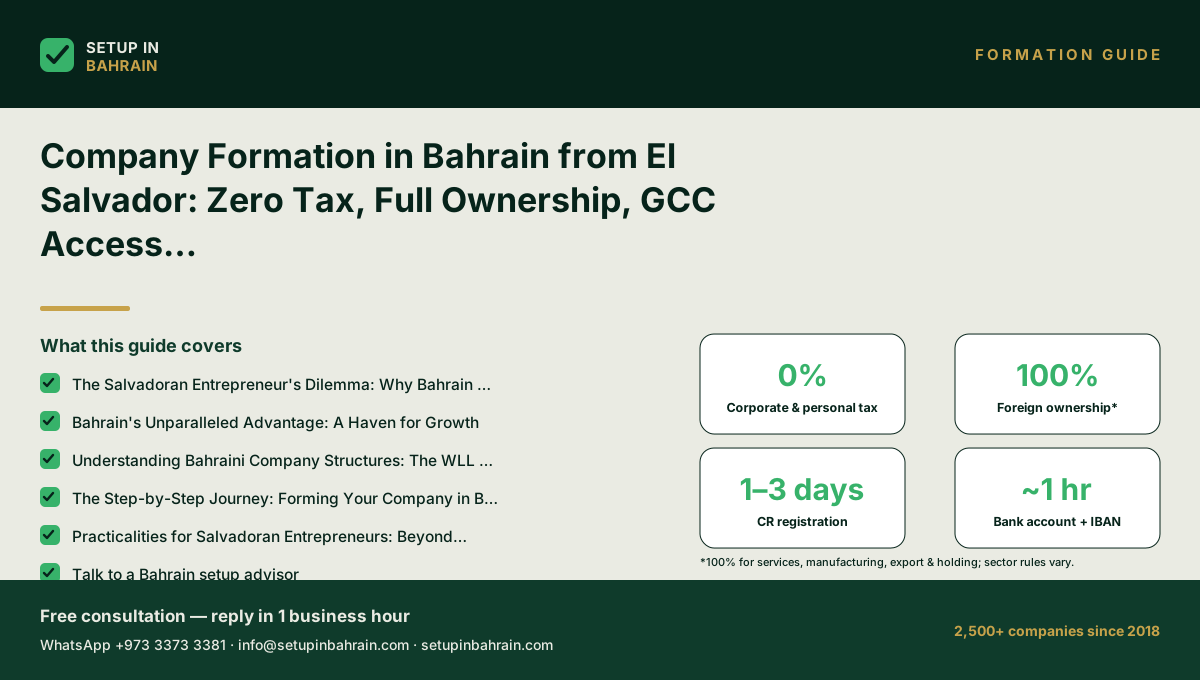
A Bahrain WLL can be owned by a single person — 100% foreign ownership applies to most activities, with no local partner required for services, manufacturing, export trading and holding companies. The minimum share capital is BHD 1 ; we recommend BHD 1,000 . This Makes bank account opening and investor visa approval smoother.
Imagine this: Miguel, a driven software entrepreneur from San Salvador, reviews his company’s quarterly financial statements. Despite his innovative SaaS platform serving a growing base of clients across the U.S. and Europe, he sees nearly a third of his hard-earned profits earmarked for corporate income tax. Then there's the relentless cycle of DGII’s advance payments, a constant drain on his cash flow. The mandatory deductions for AFP pension contributions (6.75% employer share) and ISSS social security, further eroding his margins. Since 2021, the embrace of Bitcoin as legal tender has added yet another layer of accounting friction, forcing his team to reconcile every international invoice in both USD and BTC for local filings. Miguel asks himself: "Am I truly being rewarded for my initiative and risk here, or am I perpetually navigating a system that taxes growth rather than fostering it?"
This isn’t just Miguel’s story; it’s a quiet frustration shared by many ambitious entrepreneurs across El Salvador. You’ve built something valuable, often against significant odds, only to find a substantial portion of your success diverted by a complex and demanding fiscal environment.
This 2026 guide is specifically for Salvadoran founders like Miguel who are ready for a different reality: one defined by stability, generally no corporate income tax for most sectors, and true global reach. Bahrain isn't merely an "offshore" destination; it's a dynamic business ecosystem. Here, you can achieve full foreign ownership, operate with immediate U.S. dollar-pegged payments, benefit from zero tax on corporate profits. Gain direct, unparalleled access to the lucrative Gulf Cooperation Council (GCC) market. All of this, while maintaining the flexibility to manage your company from anywhere in the world.
If you’re contemplating escape velocity from El Salvador’s taxing environment and seeking a platform for genuinely unconstrained growth, this deep-dive into company formation in Bahrain is your essential roadmap.
The Salvadoran Entrepreneur's Dilemma: Why Bahrain Beckons
Let’s be candid about the specific challenges and frustrations that motivate El Salvadoran business owners to look beyond their borders. These aren’t general complaints; they are concrete, measurable impacts on your bottom line and operational efficiency.
The Weight of Taxation: 3generally no corporate income tax for most sectors and DGII's Grip
For many Salvadoran entrepreneurs, the 30% corporate income tax rate acts as a significant drag on reinvestment and expansion. While a portion of this is standard in many economies, its combined effect with other levies in El Salvador can feel stifling.
Compounding this is the DGII’s (Dirección General de Impuestos Internos) quarterly advance payment system. This isn't just an annual obligation; it's a periodic cash flow drain. Imagine Ana, our apparel exporter from San Salvador. She might secure a large export order in January, generating substantial revenue. But, by March, she’s already calculating an advance payment based on projected profits, even before those profits are fully realized or collected. This necessitates meticulous forecasting and can strain working capital, especially for businesses with uneven revenue streams or extended payment terms from international clients. The complexity often demands dedicated accounting staff or expensive external consultants, adding another layer of indirect cost. In essence, you're paying tax on money you might not yet fully possess, diverting funds that could otherwise be used for inventory, marketing, or talent acquisition.
The Hidden Costs: AFP, ISSS, and Security Overheads
Beyond direct corporate income tax, El Salvadoran businesses contend with a series of mandatory contributions that greatly inflate operational costs, especially for those employing staff.
Mandatory AFP Pension Contributions: Employers are legally required to contribute 6.75% of an employee’s salary to the Administradora de Fondos de Pensiones (AFP) system. This is an unavoidable payroll levy, regardless of the pension fund's performance or the employee’s individual retirement goals. For a business with a growing team, these contributions accumulate rapidly, adding a substantial fixed cost to every hire. If Miguel’s software firm has 20 employees earning an average of USD 1,500 per month, that’s an additional USD 2,025 (20 1500 0.0675) in mandatory employer contributions each month* on top of salaries and other benefits. ISSS Social Security Contributions: Similarly, contributions to the Instituto Salvadoreño del Seguro Social (ISSS) add further to the employer's burden. These payments, designed to cover health and maternity benefits, can amount to 7% or more of an employee's payroll, depending on the wage bracket. Combined with AFP, these social security contributions can add over 13% to the basic salary cost for every employee, greatly impacting human resource budgeting. Security Expenses: A less discussed, but very real, operational cost for many businesses in El Salvador is security. For retail establishments, manufacturing facilities, or even professional services firms requiring secure premises and personnel transport, security expenses can range from 4% to 6% of gross retail revenue, or a substantial portion of the overhead budget. This isn't an optional expense; it's a critical investment to protect assets, employees. Customers, often dictating location choices and operational models.
Navigating Currency and Crypto: USD Stability vs. Bitcoin Complexity
El Salvador's economy operates on the U.S. dollar, which, on the surface, eliminates currency exchange risk for local transactions. But, the adoption of Bitcoin as legal tender in 2021 introduced an unprecedented layer of accounting and operational complexity, especially for international businesses. While the idea was to foster financial inclusion, the practical reality for companies like Miguel’s SaaS platform can be challenging:
- Dual Accounting: Businesses must now reconcile transactions and maintain records in both USD and BTC, even if they primarily operate in USD. This dual-currency accounting requires specialized software, increased internal expertise, or higher costs for external accountants, making international invoicing and financial reporting more cumbersome.
- Volatility Concerns: While a business might primarily receive payments in USD, any interaction with the local Bitcoin ecosystem, even for compliance, exposes it to potential volatility, which traditional businesses often seek to avoid.
- International Payment Rigidity: While the USD peg provides domestic stability, settling cross-border payments often still involves traditional banking channels, with their associated fees and transfer times. The promise of instant, cheap Bitcoin transfers hasn't fully materialized as a seamless, widely adopted standard for B2B international commerce.
The Search for Stability and Global Reach
Ultimately, these combined factors — high corporate tax, complex advance payment systems, significant payroll levies, security costs. Unique crypto accounting challenges — paint a picture of a business environment that, while resilient, can hinder exponential growth and global competitiveness. Salvadoran entrepreneurs are looking for more than just lower costs; they seek a platform that offers:
Predictability: A regulatory and fiscal environment where the rules are clear, consistent, and supportive of long-term planning. Profit Retention: A system that allows a greater percentage of hard-earned profits to remain within the business for reinvestment, innovation. Expansion. Effortless Global Connectivity: An operational base that simplifies international transactions, reduces logistical hurdles. Opens doors to vast new markets without excessive red tape.
This is precisely where Bahrain steps in, offering a compelling alternative that addresses these core pain points head-on.
Bahrain's Unparalleled Advantage: A Haven for Growth
Bahrain, an island nation nestled in the heart of the Arabian Gulf, has meticulously cultivated an environment specifically designed to attract and nurture international businesses. For Salvadoran entrepreneurs, its value proposition is especially potent, offering direct solutions to many of the frustrations encountered at home.
The Generally no corporate income tax for most sectors Promise: Maximizing Profit Retention
This is arguably Bahrain's most compelling draw for foreign investors. The Kingdom levies 0% corporate income tax on most business activities. This isn’t a temporary incentive or a loophole; it’s a fundamental pillar of Bahrain's economic strategy. For a company like Miguel’s, generating USD 420,000 in profit, the difference is immediate and dramatic. Instead of seeing USD 126,000 (30%) vanish to taxes, nearly the entire amount remains with the business, ready for reinvestment into product development, market expansion, or talent acquisition.
This direct benefit dramatically alters the cash flow dynamics and accelerates growth potential. Imagine being able to re-invest that entire 30% back into your business year after year. This policy, championed by institutions like the Bahrain Economic Development Board (EDB), reflects a clear commitment to fostering a competitive, pro-business landscape. There are no complex quarterly advance payments to the DGII; profits remain within your company, empowering you to control your financial destiny.
Full Foreign Ownership and Control: Your Business, Your Way
A common concern for international investors is the requirement for local partners or sponsors. This Can dilute control and introduce complexities. Bahrain stands out with its progressive foreign ownership laws. In most sectors, foreign investors can establish a company with 100% full foreign ownership .
Crucially, for single entrepreneurs or small teams, Bahrain allows a With Limited Liability (WLL) company to be 100% owned by a single person with zero partners required. This is a vital distinction and eliminates the need for finding a nominee partner, simplifying governance and ensuring complete autonomy over your venture. This contrasts sharply with environments where a local majority shareholder is mandated, giving you complete strategic and operational control from day one. It is important to note here that there is NO "Single Person Company" (WLL) as a distinct legal entity type in Bahrain; the WLL structure perfectly accommodates and is indeed the standard for a sole owner seeking limited liability.
Strategic Gateway to the GCC and Beyond
Bahrain's geographic location is a significant strategic asset. It acts as a natural gateway to the GCC market, a region with a combined GDP exceeding USD 1.6 trillion and a consumer base of over 50 million people. Its causeway directly connects to Saudi Arabia, the largest economy in the Middle East, facilitating efficient logistics and trade.
Beyond the GCC, Bahrain is well-positioned for trade with broader Middle East, Africa, and Asian markets. Its ports and logistics infrastructure are efficient, making it an ideal hub for businesses involved in international trade, e-commerce fulfillment, or regional distribution. The EDB consistently highlights Bahrain's strategic connectivity as a key advantage for companies seeking to scale their regional presence.
A Stable, USD-Pegged Economy: Financial Predictability
For Salvadoran entrepreneurs accustomed to the U.S. dollar, Bahrain offers reassuring financial stability. The Bahraini Dinar (BHD) has been pegged to the U.S. dollar at a rate of 1 BHD = 2.6596 USD since 1987. This long-standing peg provides absolute currency stability and eliminates exchange rate risk for your Bahraini operations. Unlike managing dual-currency accounting for Bitcoin, transactions in Bahrain are straightforward and predictable, simplifying financial planning and international trade. This stability is overseen by the Central Bank of Bahrain (CBB), a highly respected regulatory authority in the region.
Progressive Regulation and Digital Infrastructure
Bahrain has earned a reputation for its forward-thinking regulatory framework and its embrace of digital transformation.
Business-Friendly Regulations: The Ministry of Industry and Commerce (MOIC) has streamlined company registration processes, largely through its online portal, Sijilat 3.0. This allows for faster approvals and reduced bureaucratic hurdles, often enabling commercial registration within 5-7 working days for straightforward applications. The World Bank, in its previous 'Ease of Doing Business' reports, consistently ranked Bahrain highly, a testament to its efficient regulatory environment. Fintech Hub: The CBB has been a pioneer in establishing a regulatory sandbox for fintech firms, attracting innovation in areas like blockchain, remittances, and digital banking. For tech-savvy Salvadoran entrepreneurs, this ecosystem offers unparalleled support and opportunities for innovation. Digital Infrastructure: Bahrain boasts advanced telecommunications infrastructure, high internet penetration. A commitment to digital government services, creating an environment conducive to modern, globally connected businesses.
Understanding Bahraini Company Structures: The WLL Advantage
Navigating the legal landscape of a new country is often perceived as complex. But, Bahrain offers clear, straightforward options, with one structure standing out as the preferred choice for most foreign entrepreneurs from El Salvador.
With Limited Liability (WLL): The Go-To Choice for Foreign Investors
The With Limited Liability (WLL) company is by far the most popular and versatile legal entity for foreign investors in Bahrain. It offers several crucial advantages that directly address the needs of entrepreneurs seeking full control and limited personal risk:
Limited Liability Protection: As the name suggests, a WLL protects the personal assets of its shareholders. The liability of the owners is limited to the amount of capital they have invested in the company, shielding personal wealth from business debts or legal obligations. Flexibility in Ownership: This is where the WLL truly shines for single entrepreneurs. A WLL in Bahrain can be established with a single shareholder , who can also be the sole director. This means you do not need to find local partners or additional shareholders to form your company. You maintain 100% control over your business decisions, profits, and operations. This directly contrasts with other jurisdictions that might mandate multiple shareholders or a local majority. Suitability for Diverse Businesses: WLLs are suitable for a vast range of commercial activities, from trading and consulting to software development, e-commerce, and light manufacturing. Unless your business requires a very specific license (e.g., banking or insurance. This Have their own specialized structures), a WLL will almost certainly meet your needs. No "Single Person Company" (WLL): It's critical to reiterate that Bahrain does not have a legal entity specifically named "Single Person Company" (WLL). But, the WLL structure perfectly accommodates and is the standard pathway for an individual seeking to establish a business with limited liability and 100% ownership. So, if you are a sole entrepreneur, the WLL is your designated vehicle.
Share Capital Requirements: Practicality vs. Legal Minimum
When forming a WLL, the concept of share capital often raises questions.
Legal Minimum: Legally, the minimum share capital required for a WLL in Bahrain is a symbolic BHD 1 (one Bahraini Dinar). This extremely low legal threshold shows Bahrain's commitment to reducing barriers to entry for entrepreneurs. Practical Recommendation: While BHD 1 is the legal* minimum, it is strongly recommended to subscribe and deposit a practical starting capital of BHD 1,000 (about USD 2,659) . Why the discrepancy? * Bank Account Approval: Most commercial banks in Bahrain, for due diligence and operational viability, will require a more substantial opening deposit than BHD 1. An initial capital of BHD 1,000 greatly increases your chances of successfully opening a corporate bank account. This Is essential for any business. Banks need to see a reasonable financial commitment to assess the legitimacy and operational intent of the company. * Investor Visa Eligibility: If you, as the business owner, intend to get an investor visa and residency in Bahrain, demonstrating a practical capital investment, such as BHD 1,000, is crucial. It signals a serious commitment to the Bahraini economy and streamlines the visa application process with the Labour Market Regulatory Authority (LMRA) and Nationality, Passports and Residence Affairs (NPRA).
So, while BHD 1 fulfills the letter of the law, planning for BHD 1,000 as your initial paid-up capital is a pragmatic and highly advisable step for a smooth setup process.
Other Structures (Briefly): Branch Office, Free Zone Entity
While the WLL is the primary choice, other structures exist for specific scenarios:
Branch of a Foreign Company: Suitable for larger established businesses that wish to have a presence in Bahrain without creating a separate legal entity. It operates as an extension of the parent company and maintains the parent company's legal identity. Closed Shareholding Company (BSC Closed) or Public Shareholding Company (BSC Public): These are typically for larger enterprises with multiple shareholders, often involved in capital markets. Setup: This is a sole proprietorship. It does not* offer limited liability, making it less attractive for foreign investors seeking asset protection. Free Zone Entities: While Bahrain does not extensively use the "free zone" model in the same way some other GCC nations do (e.g., Dubai's numerous free zones), specific zones like Bahrain International Investment Park (BIIP) or Bahrain Logistics Zone (BLZ) offer incentives for manufacturing, logistics, and industrial activities. These are typically for larger-scale operations with specific infrastructure needs. For most professional services, trading, or tech companies, a mainland WLL offers sufficient benefits (0% tax, 100% ownership) without the geographical restrictions sometimes associated with free zones.
For the vast majority of Salvadoran entrepreneurs, especially those transitioning from a sole proprietorship or small corporation in El Salvador, the WLL company with a single owner is the most efficient, secure, and beneficial choice.
The Step-by-Step Journey: Forming Your Company in Bahrain
The process of forming a company in Bahrain has been greatly streamlined by the MOIC, making it remarkably efficient compared to many other jurisdictions. The Sijilat 3.0 online portal is central to this efficiency, allowing much of the process to be completed remotely.
Phase 1: Planning and Pre-Approval
Before initiating any formal registration, a thoughtful planning phase will save you time and potential rework.
Business Plan & Activity Classification: * Clearly define your business activities. Bahrain's MOIC has a comprehensive list of commercial activities. You’ll need to select the specific activities that accurately describe your business. For instance, a software company might select "Software Development," "IT Consultancy," and "Web Design." * Ensure your chosen activities are compatible and not restricted for foreign ownership (though most are open). Company Name Reservation: * Submit a few preferred company names to the MOIC via Sijilat 3.0. The MOIC will check for availability and adherence to naming conventions (e.g., no offensive terms, not identical to existing companies). This usually takes 1-2 working days. Initial Consultations (Optional but Recommended): * Engaging with the Bahrain Economic Development Board (EDB) can provide invaluable insights. The EDB acts as a single point of contact for investors, offering guidance on regulations, identifying opportunities. Facilitating introductions. * Consulting with a local legal or business setup consultant, like BIPA-certified professionals, can greatly smooth the process, ensuring all documents are correctly prepared and submitted. They understand the nuances of the MOIC system and can navigate any specific licensing requirements.
Phase 2: Registration with the Ministry of Industry & Commerce (MOIC)
This is the core of the company formation process and is largely conducted through the Sijilat 3.0 online portal.
Document Preparation: * Memorandum of Association (MOA): This document outlines the company's purpose, share capital, shareholders. Internal governance rules. For a single-shareholder WLL, it will detail your ownership and roles. * Articles of Association (AOA): While a separate AOA might be prepared, for a single-shareholder WLL, key operational rules are often integrated into the MOA or a simplified internal resolution. * Shareholder/Director Identification: Scanned copies of your passport, a recent utility bill (for address proof). Potentially a CV or company profile if you have prior business experience. * Proof of Capital (if required for specific activities): For the recommended BHD 1,000, this won't be required at initial registration but will be for bank account opening. * Power of Attorney (if using a consultant): A notarized and apostilled POA might be needed if a third party is submitting documents on your behalf. Online Submission via Sijilat 3.0: * Upload all prepared documents and fill out the application form on the Sijilat portal. This platform is designed for efficiency and transparency. Review and Approval: * The MOIC will review your application and documents. For straightforward WLL applications with standard activities, this process is surprisingly fast, often taking 5-7 working days . If additional licenses are required (e.g., from the CBB for financial services), the MOIC acts as a coordinator, forwarding your application to the relevant ministries.
Phase 3: Commercial Registration (CR) and Licensing
Once the MOIC approves your application, you will receive your Commercial Registration (CR) certificate. This is your company's official birth certificate.
Obtaining the CR: The CR number is a unique identifier for your business in Bahrain. It's essential for all official dealings, including opening bank accounts and obtaining visas. Specific Activity Licenses: Depending on your business, you might need additional licenses from other government bodies. * Financial Services: Regulated by the Central Bank of Bahrain (CBB). * Healthcare: Regulated by the Ministry of Health. * Education: Regulated by the Ministry of Education. * Tourism: Regulated by the Ministry of Tourism. Your chosen business activities in Phase 1 will flag these requirements. The MOIC often facilitates the referral to these bodies. A good local consultant will help you identify and manage these concurrent licensing processes.
Phase 4: Post-Registration Formalities
With your CR in hand, you can now finalize the operational aspects of your business.
Corporate Bank Account Opening: This is a crucial next step. You'll need your CR certificate, company Memorandum, passport, and often a business plan. This is where the BHD 1,000 practical capital recommendation becomes important. Banks like National Bank of Bahrain (NBB), Bahrain Commercial Bank (BBK), Al Baraka Islamic Bank, or HSBC all have robust corporate banking services. Expect due diligence from the banks, which is a standard procedure to comply with international AML/KYC regulations. Investor Visas: If you plan to reside in Bahrain, you’ll apply for an investor visa through the LMRA and NPRA. The CR certificate, proof of company ownership. Financial standing (the BHD 1,000 capital helps here) are key requirements. The process is generally efficient for genuine investors. Office Space: You’ll need a registered office address. This can range from a physical office suite to a flexible workspace or even a virtual office, depending on your business type and requirements. MOIC may have minimum space requirements for certain activities.
This structured approach, especially with the digital efficiency of Sijilat, makes company formation in Bahrain a clear and manageable process for international entrepreneurs.
Practicalities for Salvadoran Entrepreneurs: Beyond Registration
Establishing your company in Bahrain is just the first step. To ensure a smooth transition and successful operation, Salvadoran entrepreneurs must consider several practical aspects that go beyond legal registration.
Securing Your Business Bank Account: A Crucial Step
Opening a corporate bank account is paramount and often seen as the most challenging post-registration step globally. In Bahrain, it's generally straightforward, but preparedness is key.
Requirements: You will typically need: * Your company's Commercial Registration (CR) certificate. * Memorandum and Articles of Association (MOA/AOA). * Passports of all directors and authorized signatories. * Proof of residential address for directors/signatories (e.g., utility bills). * A comprehensive business plan outlining your activities, projected revenue, and client base. * Initial deposit (this is where the BHD 1,000 practical capital is vital). Due Diligence: Bahraini banks, regulated by the CBB, adhere to strict international Anti-Money Laundering (AML) and Know Your Customer (KYC) protocols. Expect thorough questioning about the source of funds, business activities, and intended transactions. Transparency will expedite the process. Choosing a Bank: Options range from large local players like National Bank of Bahrain (NBB), Bahrain Commercial Bank (BBK). Al Salam Bank, to international banks with a strong presence such as HSBC. For Sharia-compliant banking, Al Baraka Islamic Bank is a prominent choice. Consider factors like online banking capabilities, international transfer fees, and multi-currency accounts. Impact of BHD 1,000 Capital: As mentioned, while the legal minimum share capital for a WLL is BHD 1, practically no bank will open a corporate account with such a minuscule deposit. A B
Bahrain Business Guides for El Salvador Citizens
Frequently Asked Questions
How long does it take to set up?
It takes 15 to 20 days. We file all forms for you. You do not need to wait long.
What does it cost?
Company formation: Standard BHD 1,340 with 3 months of office address; Gold BHD 1,700 with 6 months; Premium BHD 2,150 with 12 months and a cabin, officer table and chair, and two guest chairs. No formation package includes visas, including Premium. Investor/work visas are priced separately: BHD 755 for one year or BHD 953 for two years, in addition to the formation package. Ask for a written, itemized quotation confirming government fees and all inclusions before payment.
Do I need to visit Bahrain?
No. You can set up your firm from home. We do all the work online. Some banks may ask for one visit.
What tax will I pay?
You pay zero tax on your profits. Bahrain has no corporate income tax. This is a key benefit of the setup.
Can I own 100% of my firm?
Yes. Foreign owners can hold all shares. No local partner is needed. Full ownership is allowed.
What do I need to start?
You need a valid passport. You also need a trade name and a business address. We help you with all of these.
How do I open a bank account?
We guide you step by step. Most banks take 3 to 6 weeks. You will need your CR and firm papers.
Who issues the Commercial Registration (CR)?
The CR is issued by the MOICT. It is your legal right to trade in Bahrain. We file the CR for you.
Can I renew my CR each year?
Company renewal packages: BHD 530 with 3 months of office address; BHD 980 with 6 months; BHD 1,520 with 12 months. These are separate renewal packages, not visa fees.
How do I get started?
Fill in our form on this page. Our team will call you back. We map your best setup plan at no cost.
Steps to Form Your Company
- Pick your trade name. We check if it is free.
- Choose your business type. WLL is the most common.
- Sign the MOA. We draft and file all legal docs.
- Pay the state fees. About BHD 432 in total.
- Get your CR. Takes 15 to 20 days.
- Open your bank account. We guide each step.
- Start trading. You are ready to do business.
Key Facts
- Tax rate: 0%
- Foreign ownership: 100%
- Setup time: 15 to 20 days
- Company formation: Standard BHD 1,340 with 3 months of office address; Gold BHD 1,700 with 6 months; Premium BHD 2,150 with 12 months and a cabin, officer table and chair, and two guest chairs. No formation package includes visas, including Premium. Investor/work visas are priced separately: BHD 755 for one year or BHD 953 for two years, in addition to the formation package. Ask for a written, itemized quotation confirming government fees and all inclusions before payment.
- Company renewal packages: BHD 530 with 3 months of office address; BHD 980 with 6 months; BHD 1,520 with 12 months. These are separate renewal packages, not visa fees.
- Client rating: 4.8 stars
- Clients served: 2,500 and more
Quick Facts
- Tax rate: 0%
- Own all of your firm: Yes, 100%
- Time to set up: 15 to 20 days
- Company formation: Standard BHD 1,340 with 3 months of office address; Gold BHD 1,700 with 6 months; Premium BHD 2,150 with 12 months and a cabin, officer table and chair, and two guest chairs. No formation package includes visas, including Premium. Investor/work visas are priced separately: BHD 755 for one year or BHD 953 for two years, in addition to the formation package. Ask for a written, itemized quotation confirming government fees and all inclusions before payment.
- Company renewal packages: BHD 530 with 3 months of office address; BHD 980 with 6 months; BHD 1,520 with 12 months. These are separate renewal packages, not visa fees.
- Rating: 4.8 stars
- Clients: 2,500 and more
Why Bahrain?
Bahrain has no tax. You keep all your profits. This is rare in the Gulf.
You can own all of your firm. No local partner is needed. The law allows full foreign ownership.
Setup takes 15 to 20 days. We file all forms for you. You can do it all from home.
Bahrain has a free trade deal with the US. Your goods face low or no tariffs. This gives you access to big markets.
We have served 2,800+ clients from 44+ countries and maintain records to substantiate that total where needed. We have 113 Google reviews; reviews represent only some clients and are not the same as the total clients served.
Our Steps
- Tell us your plan. We advise you for free.
- We pick the right firm type for you.
- We file all your forms with MOICT.
- You get your CR in 15 to 20 days.
- We help you open a bank account.
- You are ready to trade. We stay with you.
Next Steps for El Salvador Citizens
You can set up a firm in Bahrain from El Salvador. You do not need to fly there first. We do all the work online.
Tell us your plan. We call you back the same day. We map the best route for you at no cost.
We file all your forms. We deal with MOICT and the state. You get your CR in 15 to 20 days.
After your CR, we help you get a bank account. We also help with your Investor Visa. One firm guides you at each step.
Why Our Clients from El Salvador Choose Us
- We speak your language. We know your needs.
- We have helped clients from El Salvador before.
- Our fee is clear. No surprise costs.
- We have a 4.8 star rating on Google.
- We have helped more than 2,500 clients set up in Bahrain.
Fill in the form on this page. We will be in touch soon. Let us help you start your Bahrain firm today.
Ready to set up in Bahrain from El Salvador?
Tell us your business idea. We map the right entity, ownership and timeline — then handle the filing while you focus on what matters.