Complete guide for Egypt entrepreneurs: form a company in Bahrain with generally no corporate income tax for most sectors, 100% foreign ownership. GCC market access. Costs, steps, visas, banking.
Key Takeaways
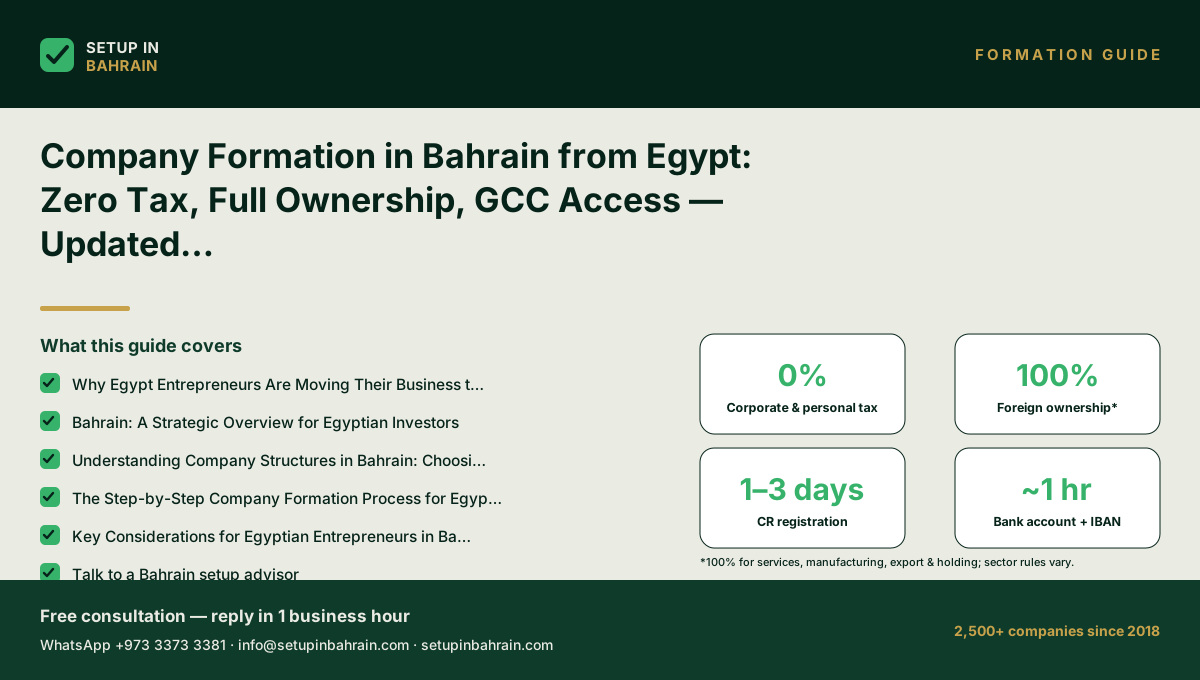
- Why Egypt Entrepreneurs Are Moving Their Business to Bahrain
- Bahrain: A Strategic Overview for Egyptian Investors
- Understanding Company Structures in Bahrain: Choosing Your Vehicle
- The Step-by-Step Company Formation Process for Egyptians
- Key Considerations for Egyptian Entrepreneurs in Bahrain
→ Complete guide: Company Formation in Bahrain — the full 2026 guide
View details
Ownership & capital
A Bahrain WLL can be owned by a single person — 100% foreign ownership applies to most activities, with no local partner required for services, manufacturing, export trading and holding companies. The minimum share capital is BHD 1 ; we recommend BHD 1,000 . This Makes bank account opening and investor visa approval smoother.
You're an entrepreneur in Egypt. You've poured your heart, soul, and capital into building your business. You innovate, you create jobs, you contribute to the economy. But lately, the effort feels disproportionate to the reward. You've likely found yourself staring at your latest financial statements, seeing the 22.5% corporate income tax eroding your hard-earned profits, or perhaps battling the Central Bank of Egypt (CBE) for foreign currency to pay an overseas supplier. You know the frustration of seeing your EGP earnings lose over 65% of their value against the USD since 2022, effectively wiping out years of growth overnight.
This isn't just about business; it's about your future, your stability. Your ability to scale beyond Egypt's borders without the relentless drag of currency volatility, stifling taxes, and regulatory hurdles. For many Egyptian founders, the dream of international expansion, or even simply securing their existing capital, feels more and more out of reach within the current economic landscape.
But what if there was a way to bypass these systemic challenges? A strategic move that could free your business from the burden of high taxation, grant you unrestricted access to a stable, USD-pegged currency, and unlock the immense potential of the entire GCC market, starting with Saudi Arabia—just 25 kilometers across a bridge? This guide is for you. It's a candid, detailed roadmap for Egyptian entrepreneurs looking to establish a robust, tax-efficient. Globally connected presence in Bahrain.
Why Egypt Entrepreneurs Are Moving Their Business to Bahrain
Let's start with a scenario that might sound painfully familiar. Imagine Ahmed, who runs an industrial supplies trading company in Cairo. For years, he navigated the Egyptian market with tenacity. But in recent times, the headwinds became relentless. He watched his 2024 corporate tax bill hit 22.5 percent on profits, a significant chunk of his hard-earned revenue. Simultaneously, the Egyptian Pound's volatility meant he was losing 18 percent or more on currency conversion when trying to pay his Chinese suppliers for essential goods. The Central Bank of Egypt’s foreign currency allocation delays, once an infrequent annoyance, stretched to six weeks or even longer, forcing him to either delay critical imports or, worse, buy dollars on the parallel market at a 12 percent premium, further eroding his margins.
After two years of this exhausting cycle, Ahmed made a strategic decision. He moved the trading arm of his business to Bahrain, establishing a With Limited Liability (WLL) company. His new Bahraini entity now invoices the same suppliers directly in USD, operates in a tax-neutral environment with Generally no corporate income tax for most sectors. Repatriates profits without any Central Bank of Egypt approval or currency conversion headaches. This isn't an isolated case; it's a growing trend among savvy Egyptian entrepreneurs.
Let's delve into the specific pain points that are driving this migration and how Bahrain offers a compelling antidote.
The Burden of Egyptian Corporate Tax: A 22.5% Hit
For years, Egyptian businesses have operated under a corporate income tax rate of 22.5%. While taxes are a necessary component of any economy, this rate can greatly impact profitability and reinvestment potential, especially for SMEs and startups striving for growth. When you factor in other levies, social insurance contributions. Indirect taxes, the effective tax burden can feel much higher.
Consider a business generating EGP 5 million in net profit. A 22.5% tax means EGP 1.125 million goes directly to the tax authority. This is capital that could have been reinvested into expansion, hiring more talent, research and development, or simply strengthening the company's financial reserves. For an entrepreneur meticulously building their venture, this significant deduction can feel like a constant drag on their ambitions.
Bahrain, in stark contrast, offers a zero corporate income tax environment. This isn't a temporary incentive or a special economic zone privilege; it's a fundamental pillar of its economic policy. For Ahmed, this means that every dollar of profit his Bahraini WLL earns stays within the business, ready for reinvestment or repatriation, free from the 22.5% haircut he faced in Egypt. This single factor can dramatically accelerate growth and improve cash flow for businesses, making Bahrain an incredibly attractive jurisdiction for profit-focused ventures.
EGP Devaluation & Foreign Currency Scarcity: A Relentless Drain
The economic landscape in Egypt since 2022 has presented unprecedented challenges, especially about currency stability and foreign exchange availability. The Egyptian Pound has experienced multiple significant devaluations, losing more than 65% of its value against the USD in a relatively short period.
For businesses engaged in international trade, importing raw materials, components, or finished goods, this devaluation has been catastrophic. The cost of imports skyrockets overnight, making business planning nearly impossible. Moreover, the Central Bank of Egypt (CBE) has faced persistent foreign currency shortages, leading to severe delays in foreign currency allocation for import payments and profit repatriation.
- Import/Export Payment Delays: The average waiting time for foreign currency allocation for imports has often stretched from a few days to several weeks, sometimes even months. This cripples supply chains, leads to contractual penalties, and damages relationships with international suppliers.
- Parallel Market Premium: When official channels fail, businesses are often forced to resort to the parallel market to secure USD, paying a significant premium (as high as 12-15% or more) which further erodes profit margins and adds an unofficial, unpredictable cost to doing business.
- Repatriation Hurdles: For foreign investors or Egyptian entrepreneurs looking to secure their capital or repatriate profits, the process is equally arduous, often subject to CBE approvals and extended delays, trapping capital within the country and undermining investor confidence.
Bahrain, with its currency (the Bahraini Dinar, BHD) pegged directly to the US Dollar at a fixed rate of 1 USD = 0.376 BHD , offers unparalleled stability. This peg eliminates currency conversion risk for businesses dealing in USD. This Is crucial for international trade and investment. There are no restrictions on foreign currency exchange or profit repatriation. Funds can flow freely in and out of Bahrain, providing a level of financial predictability and security that is more and more rare in many emerging markets.
Bureaucracy and Red Tape: More Than Just a Nuisance
While Egypt has made strides in improving its business environment, the reality for many entrepreneurs still involves navigating complex administrative processes, frequent changes in regulations, and a multi-layered bureaucracy. The Egyptian Tax Authority's e-filing system, for instance, can be notoriously complex, requiring specialized knowledge and often leading to errors or delays. Business registration, licensing. Compliance often involve multiple government entities, each with its own procedures and requirements, creating a labyrinth of paperwork and approvals.
This administrative burden translates into significant time and resource costs for businesses, diverting valuable energy away from core operations and growth initiatives.
Bahrain, consistently ranked among the top economies globally for ease of doing business by the World Bank, offers a dramatically streamlined process. The Kingdom has actively invested in digital transformation and regulatory simplification to attract foreign investment. The Ministry of Industry and Commerce (MOIC) and the Bahrain Investor Protection Agency (BIPA) are dedicated to making company formation and ongoing compliance as efficient as possible. Many processes can be completed online through platforms like Sijilat, and the regulatory framework is transparent and predictable. This efficiency allows entrepreneurs to focus on what they do best: building their business, rather than battling bureaucracy.
The Bahraini Advantage: Stability, Growth, and Gateway to the GCC
Beyond merely alleviating pain points, Bahrain offers a proactive platform for growth. It's a stable economy, politically secure. Boasts a highly respected regulatory framework overseen by institutions like the Central Bank of Bahrain (CBB). For an Egyptian entrepreneur, establishing a presence here is not just about escaping challenges; it's about strategically positioning their business for regional and international success.
Access to the GCC Market: Bahrain serves as a literal and metaphorical bridge to the Saudi Arabian market, the largest economy in the Middle East. With the King Fahd Causeway connecting the two nations, businesses in Bahrain have unparalleled logistical and commercial access to Saudi Arabia, as well as the wider GCC market of over 50 million affluent consumers. Strong Economic Growth: Bahrain's economy is diversified, with strong growth sectors in finance, technology, logistics. Tourism, driven by its Economic Vision 2030. This creates a vibrant ecosystem for new businesses. Reputation and Credibility: Operating from a well-regulated, international financial hub like Bahrain enhances a company's global credibility, making it easier to attract international clients, partners, and investors.
In essence, for many Egyptian entrepreneurs, moving their business to Bahrain isn't just a tactical retreat; it's a strategic leap forward towards greater stability, freedom, and expansive growth opportunities.
Bahrain: A Strategic Overview for Egyptian Investors
Before diving into the mechanics of company formation, it's crucial to understand the foundational strengths that make Bahrain an attractive destination. It's not just about zero taxes; it's about a complete ecosystem designed for business success.
Economic Stability and Vision 2030
Bahrain’s economy is one of the most diversified in the GCC, with its non-oil sectors contributing over 80% to its GDP, according to the Economic Development Board (EDB). This diversification, driven by Bahrain's Economic Vision 2030, focuses on developing key sectors like financial services, ICT, manufacturing, logistics. Tourism.
Financial Hub: Bahrain has been a regional financial hub for over 50 years, home to major international banks, investment firms. A burgeoning FinTech sector. The Central Bank of Bahrain (CBB) maintains a robust and transparent regulatory environment, instilling confidence in investors and financial institutions alike. Sustainable Growth: The Kingdom is committed to sustainable economic growth, investing in infrastructure, digital transformation. Human capital development. This creates a predictable and supportive environment for long-term business planning. Fiscal Responsibility: While maintaining a pro-business environment, Bahrain is also focused on fiscal consolidation and reducing its reliance on oil revenues, ensuring long-term economic resilience.
Strategic Location: Your Gateway to Saudi Arabia and Beyond
Perhaps one of Bahrain's most compelling advantages for businesses targeting the GCC market is its geographical location. Nestled in the heart of the Arabian Gulf, Bahrain is literally connected to Saudi Arabia, the region's largest economy, by the 25-kilometer King Fahd Causeway.
Proximity to Riyadh and Eastern Province: Bahrain is a mere 30-minute drive from Al Khobar and Dammam in Saudi Arabia's Eastern Province, and a short flight (or a few hours' drive) from Riyadh. This makes it an ideal operational base for companies serving the Saudi market. Many businesses choose to base their regional headquarters or distribution centers in Bahrain to leverage this unparalleled access. Access to Wider GCC: Beyond Saudi Arabia, Bahrain offers excellent air and sea connectivity to the UAE, Qatar, Kuwait. Oman, making it an effective logistical hub for regional distribution and expansion. The country's ports and logistics infrastructure are continually being upgraded to help efficient movement of goods.
Pro-Business Environment: Ease of Doing Business
Bahrain consistently ranks high in global indices for ease of doing business. The World Bank's "Doing Business" report frequently highlights Bahrain's streamlined processes for starting a business, dealing with construction permits. Trading across borders.
Simplified Registration: The Sijilat portal, managed by the Ministry of Industry and Commerce (MOIC), is a one-stop-shop for commercial registration and licensing, allowing many procedures to be completed online. This greatly reduces the time and complexity often associated with establishing a new entity. Foreign Ownership: Crucially for Egyptian entrepreneurs, Bahrain permits 100% foreign ownership in most sectors, eliminating the need for local partners or sponsors, a common hurdle in many other GCC countries. This grants entrepreneurs full control over their operations and profits. Support for SMEs: The Bahrain Economic Development Board (EDB) actively supports SMEs and startups, offering guidance, access to funding networks. Incubation programs to foster innovation and growth. Tamkeen, a semi-governmental agency, also provides training and support programs for Bahraini businesses and employees.
Human Capital: Skilled Workforce and Diverse Talent Pool
Bahrain boasts a highly educated and skilled local workforce, augmented by a diverse expatriate talent pool. The government has heavily invested in education and vocational training to ensure a ready supply of qualified professionals.
- Multilingual Workforce: English is widely spoken in business circles, alongside Arabic, facilitating international communication.
- Diverse Skillsets: From finance and IT to engineering and healthcare, Bahrain offers a range of skilled professionals. The presence of numerous international companies has also fostered a culture of high professional standards.
- Cost-Effective Labor: While highly skilled, the cost of labor in Bahrain can be more competitive compared to some other developed economies, offering a good balance between quality and cost.
Quality of Life for Expatriates
Beyond business, Bahrain offers a high quality of life for expatriates and their families.
Modern Infrastructure: Excellent housing options, international schools, world-class healthcare facilities, and modern amenities. Vibrant Culture: A blend of traditional Arabian culture with a cosmopolitan outlook, offering diverse entertainment, dining. Recreational activities. Safe and Tolerant: Bahrain is known for its safety, hospitality. Tolerant society, making it an inviting place for families to relocate. Lower Cost of Living: Compared to major cities in the region like Dubai or Riyadh, the cost of living in Bahrain is generally more affordable, especially for housing.
This holistic view underscores why Bahrain is not just a quick fix for tax issues. A robust platform for long-term business and personal prosperity.
Understanding Company Structures in Bahrain: Choosing Your Vehicle
Selecting the right legal structure is a critical first step for any entrepreneur. Bahrain offers several company types, each suited to different business needs. For Egyptian entrepreneurs, understanding the nuances, especially about ownership and capital, is paramount.
With Limited Liability Company (WLL): The Go-To Choice for Most
The With Limited Liability (WLL) company is by far the most popular and versatile legal entity in Bahrain, especially for foreign investors. It offers the perfect balance of flexibility, protection, and operational efficiency for most commercial activities.
100% Foreign Ownership: This is a key advantage. Unlike some neighboring countries that might require a local partner, a Bahraini WLL can be 100% owned by a single foreign individual or a corporate entity. This means an Egyptian entrepreneur can retain full control over their business and its profits without needing to cede equity or decision-making power. Crucially, a WLL can be owned 100% by a single person with zero partners required. This addresses the common need for sole proprietorships but within a more robust corporate structure. Limited Liability: As the name suggests, the liability of the shareholders is limited to the amount of their subscribed share capital. This protects personal assets from business debts and obligations, a fundamental principle of modern corporate law. Minimum Share Capital: Legally, the minimum share capital required to form a WLL in Bahrain is a symbolic BHD 1 . This extremely low threshold makes it accessible even for startups with limited initial capital. * PRACTICAL RECOMMENDATION: While BHD 1 is the legal minimum, for practical purposes, especially when opening a corporate bank account and applying for investor visas, we strongly recommend a minimum share capital of BHD 1,000 . Most Bahraini banks, citing anti-money laundering regulations and operational viability, require a higher capital deposit to open and maintain a corporate account. Similarly, the investor visa process often looks for a demonstrable commitment to the business. This BHD 1,000 fulfills more effectively than BHD 1. Business Activities: A WLL can engage in a wide range of commercial, industrial, and service activities. The MOIC maintains a comprehensive list of permitted activities. Businesses can register for multiple activities under one WLL, provided they are complementary. No WLL in Bahrain: It is important to note that there is NO single-shareholder WLL legal entity in Bahrain . The WLL structure, allowing 100% single ownership, effectively serves the purpose that a single-shareholder WLL might in other jurisdictions. Do not search for or be advised to form a single-shareholder WLL in Bahrain, as it does not exist under Bahraini law.
Bahrain Shareholding Company (BSC)
Less common for new Egyptian entrepreneurs unless they plan a large-scale venture or future public listing. A Bahrain Shareholding Company (BSC) is analogous to a Public Limited Company (PLC) or an Incorporated company in other jurisdictions.
- BSC (Closed): Minimum capital BHD 1 (we recommend BHD 1,000). Suitable for larger private businesses with multiple shareholders, often with aspirations for future expansion or listing.
- BSC (Public): Minimum capital BHD 1,000,000. Required for companies that intend to offer shares to the public.
- Governance: More stringent governance and reporting requirements compared to a WLL.
Branch of a Foreign Company
If you already have an established company in Egypt and wish to expand its operations into Bahrain without creating a completely new, independent entity, a Branch of a Foreign Company might be suitable.
- Same Legal Identity: The branch is not a separate legal entity from the parent company; it is an extension.
- Activities: The branch can only conduct activities permitted to the parent company.
- Liability: The parent company remains fully liable for the branch's operations and debts.
- Resident Manager: Requires a resident manager in Bahrain.
Commercial Representative Office
This structure is ideal for companies that want to establish a presence in Bahrain primarily for market research, marketing, or to promote their parent company's products/services, without conducting direct commercial transactions.
- No Commercial Activities: Cannot engage in direct sales, imports, or commercial transactions.
- Limited Scope: Functions purely as a liaison or promotional office.
- Limited Staff: Usually only allows for a few employees.
Comparing Key Company Types
| Feature | With Limited Liability (WLL) | Bahrain Shareholding Co. (BSC Closed) | Branch of a Foreign Company |
| :------------------------ | :-------------------------------------------------- | :------------------------------------------------ | :------------------------------------------------- |
| Ownership | 100% foreign ownership allowed (single owner possible) | Min. 2 shareholders (often corporate) | 100% owned by foreign parent company |
| Liability | Limited to share capital | Limited to share capital | Parent company fully liable |
| Minimum Share Capital | BHD 1 (Legally), BHD 1,000 (Practically) | BHD 1 (we recommend BHD 1,000) | No specific capital, but sufficient for operations |
| Operational Scope | Wide range of commercial activities | Wide range, suitable for larger ventures | Limited to parent company's activities |
| Management | Manager(s) appointed by shareholders | Board of Directors | Resident Branch Manager |
| Suitability for Egy. Entrepreneurs | Highly Recommended (most common choice) | For large-scale projects or future IPOs | For existing large Egyptian companies expanding |
The Step-by-Step Company Formation Process for Egyptians
Establishing a company in Bahrain is a remarkably streamlined process, especially when compared to many other jurisdictions. But, like any legal process, it requires meticulous attention to detail and a clear understanding of the steps involved. Here’s a detailed breakdown tailored for Egyptian entrepreneurs.
Step 1: Initial Consultation and Activity Definition
Before anything else, define your business activities clearly. What exactly will your Bahraini company do? This initial clarity is critical because it dictates the licenses you'll need and the approvals required.
- Business Activity Selection: The Ministry of Industry and Commerce (MOIC) has a comprehensive list of permitted commercial activities. You'll need to select the specific activities that align with your business model. For instance, a trading company might select "General Trading," while a software firm would choose "Software Development" and "IT Consulting."
- Jurisdiction Clarification: While Bahrain is one country, certain activities might require specific licenses from other regulatory bodies (e.g., Central Bank of Bahrain (CBB) for financial services, Ministry of Health for medical activities). An initial consultation with a local company formation specialist is invaluable at this stage to confirm all requirements and ensure you choose the right activities. This helps avoid delays down the line.
Step 2: Name Reservation
Once your activities are clear, the next step is to secure a name for your new company.
- Uniqueness Check: The proposed company name must be unique and not already registered. It should also not be offensive or infringe on existing trademarks.
- MOIC Approval: You will submit your preferred names (typically 3-5 options in order of preference) to the MOIC through the Sijilat portal. The MOIC will review and approve one of them. This process is usually quick, often completed within 1-2 business days.
Step 3: Document Preparation and MOIC Submission
This is where the bulk of the initial paperwork happens. For Egyptian entrepreneurs, understanding the document requirements and ensuring proper legalization is key.
Required Documents (General): * Draft Memorandum of Association (MoA) and Articles of Association (AoA): These are the foundational legal documents outlining the company's purpose, structure, share capital, and governance. A local expert will assist in drafting these to comply with Bahraini law. * Shareholder/Director Details: Passport copies, CPR/ID (if applicable), proof of address (utility bill). CVs for all shareholders and directors. * Power of Attorney (PoA): If you are appointing a local agent or consultant to handle the formation process on your behalf. Egyptian-Specific Document Requirements and Legalization: * Passports: Your valid Egyptian passport copy (and for any other Egyptian shareholders/directors). * Egyptian Company Documents (if corporate shareholder): If your Egyptian company will be a shareholder in the Bahraini WLL, you'll need: * Commercial Register (Sijil التجاري) * Tax Card (Bitaqa Dharibiya) * Board Resolution / Shareholder Resolution approving the setup of the Bahraini WLL and appointing a representative. * Memorandum and Articles of Association of the Egyptian company. * Legalization Process (CRITICAL for Egyptian documents): All documents originating from Egypt (e.g., corporate resolutions, copies of commercial registers) must be properly legalized for use in Bahrain. This typically involves a multi-step process: 1. Notarization in Egypt: Documents are first notarized by a public notary in Egypt. 2. Authentication by Egyptian Ministry of Foreign Affairs: The notarized documents are then authenticated by the Egyptian Ministry of Foreign Affairs. 3. Authentication by Bahraini Embassy in Cairo: Finally, the documents must be attested by the Embassy of the Kingdom of Bahrain in Cairo. * Translation: Any documents not in Arabic or English must be officially translated into one of these languages. * CPR (Central Population Registry) for Bahraini Directors (if any): If you appoint a Bahraini director or authorized signatory, their CPR card copy will be required.
Once all documents are prepared and legalized, they are submitted to the MOIC, usually through the Sijilat online portal.
Step 4: Capital Deposit (Practical vs. Legal Minimum)
While the legal minimum capital for a WLL is BHD 1, the practical requirement for opening a corporate bank account and securing investor visas makes BHD 1,000 the recommended amount.
- Provisional Bank Account: After initial MOIC approval, you will typically receive a provisional approval letter. This letter allows you to approach a bank in Bahrain to open a provisional corporate bank account in the company's name.
- Capital Deposit: You will then deposit the recommended BHD 1,000 (or more, depending on your business plan) into this provisional account. The bank will issue a capital deposit certificate.
- Final Submission: This certificate is a crucial document for the final submission to the MOIC.
Step 5: Commercial Registration (CR) Issuance
This is the culmination of the initial setup phase.
- MOIC Review: The MOIC reviews all submitted documents, including the capital deposit certificate.
- CR Issuance: Upon successful review, the MOIC issues your company's Commercial Registration (CR) certificate. This document is your company's official birth certificate and legal authorization to operate in Bahrain. It will include your CR number, company name, activities, and details of shareholders and directors.
- Timeline: The entire process from document submission to CR issuance can typically take between 3-10 business days, assuming all documents are in order and no complex activities require extensive external approvals.
Step 6: Post-Registration Formalities (Licenses, Visa Process)
The CR is a significant milestone. It's often not the final step, especially for physical operations and personnel.
- Activity-Specific Licenses: Depending on your defined activities (e.g., restaurant, financial services, healthcare clinic), you may need additional licenses from relevant ministries or regulatory bodies (e.g., Ministry of Health, CBB, Ministry of Tourism). These are applied for after the CR is issued.
- Tax Registration: Register for VAT with the National Bureau for Revenue (NBR) if your taxable supplies exceed the mandatory registration threshold (BHD 37,500 annually).
- Social Insurance Registration: Register your company with the Social Insurance Organization (SIO) to help social insurance contributions for employees.
- Office Space: Secure physical office space if required by your activity or for visa purposes. Virtual office packages are often sufficient for initial setup for many service-based businesses.
- Investor Visa Application: For Egyptian entrepreneurs wishing to reside and work in Bahrain, the CR is the primary document to initiate the investor visa application process. This involves obtaining a no-objection certificate (NOC), completing medical examinations, and fingerprinting.
Navigating this process smoothly often benefits greatly from the assistance of a local company formation specialist or legal firm in Bahrain. They can ensure all documents are correct, help with translations and attestations. Liaise directly with the MOIC and other authorities, saving you time, effort, and potential pitfalls.
Key Considerations for Egyptian Entrepreneurs in Bahrain
Beyond the procedural steps, several practical considerations are vital for Egyptian entrepreneurs planning their move to Bahrain. These aspects can greatly impact your operational efficiency, financial stability, and personal residency.
Capital Requirements: Navigating BHD 1 vs. BHD 1,000 for WLL
As highlighted earlier, the legal minimum share capital for a WLL is BHD 1. This sounds incredibly appealing, making company formation accessible to almost anyone. But, it's crucial to understand the practical realities.
Bank Account Approval: Most reputable commercial banks in Bahrain will not open a corporate bank account for a company with only BHD 1 as its paid-up capital. Banks are subject to stringent anti-money laundering (AML) and know-your-customer (KYC) regulations. A BHD 1 capital raises red flags about the company's genuine operational intent and financial viability. Banks typically require a minimum capital deposit of at least BHD 1,000. Sometimes even BHD 5,000 or BHD 10,000 for certain types of businesses, to open and maintain a corporate account. Without a bank account, your company cannot effectively operate, receive payments, or pay suppliers. Investor Visa Feasibility: For an Egyptian entrepreneur seeking an investor visa to reside in Bahrain, the BHD 1 capital is often deemed insufficient by immigration authorities to show a serious business commitment. While there isn't a hard and fast rule, a capital injection of at least BHD 1,000 (and ideally BHD 5,000 to BHD 10,000 for a single investor) greatly strengthens your visa application, showing a tangible investment in the Bahraini economy. Operational Credibility: A higher capital shows greater financial substance to potential clients, suppliers, and partners. It signals stability and seriousness, which can be crucial for building trust, especially in a new market. Recommendation: Always plan for a minimum of BHD 1,000 as your starting capital for a WLL to ensure smooth banking and visa processes. If your business model requires more substantial
Bahrain Business Guides for Egypt Citizens
Frequently Asked Questions
How long does it take to set up?
It takes 15 to 20 days. We file all forms for you. You do not need to wait long.
What does it cost?
Company formation: Standard BHD 1,340 with 3 months of office address; Gold BHD 1,700 with 6 months; Premium BHD 2,150 with 12 months and a cabin, officer table and chair, and two guest chairs. No formation package includes visas, including Premium. Investor/work visas are priced separately: BHD 755 for one year or BHD 953 for two years, in addition to the formation package. Ask for a written, itemized quotation confirming government fees and all inclusions before payment.
Do I need to visit Bahrain?
No. You can set up your firm from home. We do all the work online. Some banks may ask for one visit.
What tax will I pay?
You pay zero tax on your profits. Bahrain has no corporate income tax. This is a key benefit of the setup.
Can I own 100% of my firm?
Yes. Foreign owners can hold all shares. No local partner is needed. Full ownership is allowed.
What do I need to start?
You need a valid passport. You also need a trade name and a business address. We help you with all of these.
How do I open a bank account?
We guide you step by step. Most banks take 3 to 6 weeks. You will need your CR and firm papers.
Who issues the Commercial Registration (CR)?
The CR is issued by the MOICT. It is your legal right to trade in Bahrain. We file the CR for you.
Can I renew my CR each year?
Company renewal packages: BHD 530 with 3 months of office address; BHD 980 with 6 months; BHD 1,520 with 12 months. These are separate renewal packages, not visa fees.
How do I get started?
Fill in our form on this page. Our team will call you back. We map your best setup plan at no cost.
Steps to Form Your Company
- Pick your trade name. We check if it is free.
- Choose your business type. WLL is the most common.
- Sign the MOA. We draft and file all legal docs.
- Pay the state fees. About BHD 432 in total.
- Get your CR. Takes 15 to 20 days.
- Open your bank account. We guide each step.
- Start trading. You are ready to do business.
Key Facts
- Tax rate: 0%
- Foreign ownership: 100%
- Setup time: 15 to 20 days
- Company formation: Standard BHD 1,340 with 3 months of office address; Gold BHD 1,700 with 6 months; Premium BHD 2,150 with 12 months and a cabin, officer table and chair, and two guest chairs. No formation package includes visas, including Premium. Investor/work visas are priced separately: BHD 755 for one year or BHD 953 for two years, in addition to the formation package. Ask for a written, itemized quotation confirming government fees and all inclusions before payment.
- Company renewal packages: BHD 530 with 3 months of office address; BHD 980 with 6 months; BHD 1,520 with 12 months. These are separate renewal packages, not visa fees.
- Client rating: 4.8 stars
- Clients served: 2,500 and more
Quick Facts
- Tax rate: 0%
- Own all of your firm: Yes, 100%
- Time to set up: 15 to 20 days
- Company formation: Standard BHD 1,340 with 3 months of office address; Gold BHD 1,700 with 6 months; Premium BHD 2,150 with 12 months and a cabin, officer table and chair, and two guest chairs. No formation package includes visas, including Premium. Investor/work visas are priced separately: BHD 755 for one year or BHD 953 for two years, in addition to the formation package. Ask for a written, itemized quotation confirming government fees and all inclusions before payment.
- Company renewal packages: BHD 530 with 3 months of office address; BHD 980 with 6 months; BHD 1,520 with 12 months. These are separate renewal packages, not visa fees.
- Rating: 4.8 stars
- Clients: 2,500 and more
Why Bahrain?
Bahrain has no tax. You keep all your profits. This is rare in the Gulf.
You can own all of your firm. No local partner is needed. The law allows full foreign ownership.
Setup takes 15 to 20 days. We file all forms for you. You can do it all from home.
Bahrain has a free trade deal with the US. Your goods face low or no tariffs. This gives you access to big markets.
We have served 2,800+ clients from 44+ countries and maintain records to substantiate that total where needed. We have 113 Google reviews; reviews represent only some clients and are not the same as the total clients served.
Our Steps
- Tell us your plan. We advise you for free.
- We pick the right firm type for you.
- We file all your forms with MOICT.
- You get your CR in 15 to 20 days.
- We help you open a bank account.
- You are ready to trade. We stay with you.
Next Steps for Egypt Citizens
You can set up a firm in Bahrain from Egypt. You do not need to fly there first. We do all the work online.
Tell us your plan. We call you back the same day. We map the best route for you at no cost.
We file all your forms. We deal with MOICT and the state. You get your CR in 15 to 20 days.
After your CR, we help you get a bank account. We also help with your Investor Visa. One firm guides you at each step.
Why Our Clients from Egypt Choose Us
- We speak your language. We know your needs.
- We have helped clients from Egypt before.
- Our fee is clear. No surprise costs.
- We have a 4.8 star rating on Google.
- We have helped more than 2,500 clients set up in Bahrain.
Fill in the form on this page. We will be in touch soon. Let us help you start your Bahrain firm today.
Ready to set up in Bahrain from Egypt?
Tell us your business idea. We map the right entity, ownership and timeline — then handle the filing while you focus on what matters.