
Complete guide for Ecuador entrepreneurs: form a company in Bahrain with generally no corporate income tax for most sectors, 100% foreign ownership. GCC market access. Costs, steps, visas, banking.
Key Takeaways
- Why Ecuador Entrepreneurs Are Moving Their Business to Bahrain
- Understanding Bahrain's Legal Business Structures
- Step-by-Step Guide to Company Formation in Bahrain for Ecuador Entrepreneurs
→ Complete guide: Company Formation in Bahrain — the full 2026 guide
View details
Ownership & capital
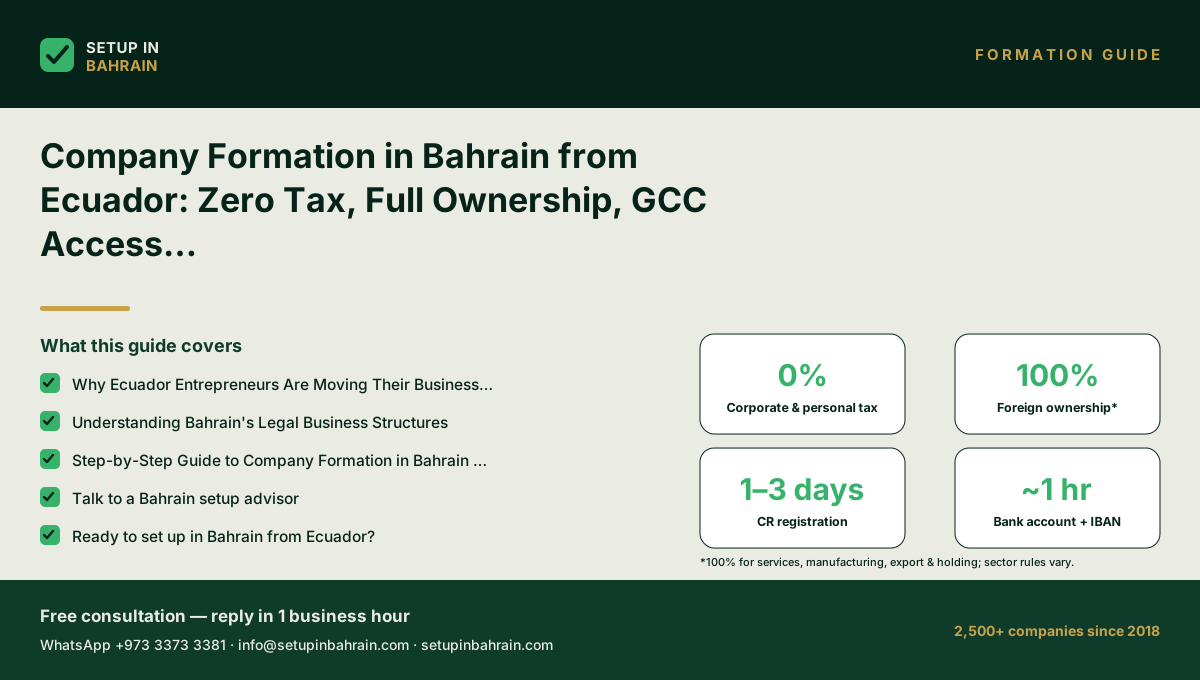
A Bahrain WLL can be owned by a single person — 100% foreign ownership applies to most activities, with no local partner required for services, manufacturing, export trading and holding companies. The minimum share capital is BHD 1 ; we recommend BHD 1,000 . This Makes bank account opening and investor visa approval smoother.
For many years, Ecuador’s vibrant business spirit has been a testament to its people's resilience and ingenuity. From the bustling streets of Guayaquil's bustling commerce to the artisan workshops of Cuenca, business owners continually navigate a complex landscape of regulations, taxes, and economic shifts. Yet, as the global economy continues to flatten, a growing number of savvy entrepreneurs are looking beyond their borders for a more fertile ground to cultivate their ambitions. If you’re an Ecuadorian business owner feeling the squeeze of high taxes and regulatory hurdles, the Kingdom of Bahrain offers a compelling, and surprisingly accessible, alternative.
Imagine a business environment where your hard-earned profits aren't eroded by a hefty 25% corporate income tax, where foreign ownership is not just permitted but actively encouraged, and where your reach extends effortlessly into the burgeoning markets of the Gulf Cooperation Council (GCC) – a market worth an estimated USD 1.6 trillion. This isn't a distant dream; it's the tangible reality for businesses incorporated in Bahrain. This comprehensive guide, specifically crafted for entrepreneurs like you from Ecuador, will unpack exactly why Bahrain is becoming an more and more attractive destination, and precisely how you can make the move, benefiting from its strategic advantages and zero-tax regime.
We understand the unique challenges you face: the ever-present shadow of Ecuador's 25% corporate income tax, the constant battle with mandatory electronic invoicing via the SRI system since 2020, the significant bite of IESS employer contributions at 12.15%, and the lingering uncertainty of regulatory instability, especially following the 2022 sovereign default which impacted access to international bond markets. This guide isn't just about company formation; it's about providing a strategic roadmap to overcome these hurdles and unlock unprecedented growth for your enterprise.
Why Ecuador Entrepreneurs Are Moving Their Business to Bahrain
Let's start with a scenario that might sound all too familiar. Consider the owner of a mid-sized cocoa and banana export operation based in Guayaquil. Each year, after factoring in SENAE tariffs and intricate logistics costs for shipping their high-quality produce abroad, this business clears roughly USD 1.8 million in net profit. At Ecuador’s substantial 25% corporate income tax rate, the owner hands over a staggering USD 450,000 to the tax authorities. Beyond this direct fiscal drain, there's another layer of compliance costs for mandatory electronic invoicing. This Has been rigorously enforced through the SRI system since 2020. This system, while promoting transparency, adds an undeniable administrative burden and an ongoing cost for software and maintenance.
The fact that Ecuador uses the US dollar removes one significant headache – currency mismatch risk for international transactions. But, this stability comes at a profound cost: it strips away the central bank’s ability to adjust monetary policy, such as interest rates or quantitative easing, when global commodity prices swing wildly or when domestic economic conditions demand specific interventions. After the 2022 sovereign default, access to international bond markets remained constrained, making capital more expensive and harder to secure for ambitious growth plans. For businesses looking to scale, innovate. Penetrate new markets, these internal limitations can feel like an invisible ceiling.
This scenario is far from unique. It encapsulates the frustration many Ecuadorian entrepreneurs feel – a feeling that their hard work is disproportionately taxed, their growth potential hampered by regulatory complexity, and their long-term security exposed to external shocks without robust domestic policy tools. This is precisely why more and more forward-thinking business leaders from Ecuador are setting their sights on Bahrain.
The Burden of Ecuador's Business Environment
To fully appreciate Bahrain's appeal, it's crucial to understand the specific pain points that weigh on Ecuadorian businesses:
The 25% Corporate Income Tax: As highlighted, a quarter of your net profits vanish before you can reinvest them. This isn't just a number; it’s lost capital for expansion, research and development, employee training, or simply building a stronger buffer against economic downturns. For a company generating a USD 1 million profit, that's USD 250,000 directly diverted from growth. While certain micro-enterprises and small businesses may qualify for lower rates or simplified regimes, the general corporate rate remains a significant disincentive for scaling. SRI Mandatory Electronic Invoicing (Since 2020): While e-invoicing is a global trend towards modernization, its implementation in Ecuador has added a layer of complexity and cost. Businesses must invest in compatible software, ensure continuous connectivity. Navigate potential system outages or updates, all while training staff and maintaining strict compliance with SRI regulations. This isn't just about printing less paper; it's a technical and administrative overhead that drains resources. Employer IESS Contributions (12.15%): Beyond direct wages, Ecuadorian employers face a substantial 12.15% contribution to the Ecuadorian Social Security Institute (IESS). This adds a significant hidden cost to labor, making it more expensive to hire and expand your workforce. For every USD 1,000 paid in salary, an additional USD 121.50 must be paid to IESS, impacting competitiveness and profitability, especially for labor-intensive industries. USD Adoption: Stability vs. Monetary Policy Flexibility: Ecuador's decision to dollarize in 2000 brought much-needed stability, eliminating local currency devaluation risks and making international trade more predictable. But, this stability comes at a strategic cost. The Central Bank of Ecuador cannot print money, adjust interest rates independently, or devalue its currency to stimulate exports or mitigate economic shocks. This lack of monetary policy autonomy leaves the economy vulnerable to external factors, such as global oil price fluctuations or changes in U.S. monetary policy, without the tools to cushion the blow. This can lead to boom-and-bust cycles that are harder to manage domestically. Regulatory Instability and Access to International Capital: Ecuador has a history of policy shifts and economic volatility. The 2022 sovereign default. Since restructured, left a lasting mark on investor confidence and the country’s credit ratings. This directly impacts the cost and availability of international capital for Ecuadorian businesses. Lenders and investors perceive higher risk, leading to higher interest rates and more stringent lending conditions, hindering growth and expansion plans that rely on external financing. SENAE Tariffs and Logistics Costs: For businesses involved in import/export, the tariffs imposed by the National Customs Service of Ecuador (SENAE) and the inherent logistics costs of operating in a challenging geographical terrain can greatly eat into profit margins. While these are part of any international trade, the cumulative effect with other taxes and contributions makes the overall cost of doing business in Ecuador relatively high.
These factors combine to create a challenging environment where growth is hard-won. A significant portion of success is siphoned off or consumed by compliance. This is where Bahrain offers a breath of fresh air.
Bahrain's Unparalleled Business Advantages
In stark contrast to these challenges, Bahrain presents a compelling proposition for entrepreneurs seeking efficiency, growth, and stability.
Zero Corporate and Personal Income Tax: This is arguably Bahrain's most significant draw. The Kingdom boasts a zero-corporate income tax regime for most business activities, alongside zero personal income tax. Imagine the cocoa exporter from Guayaquil, retaining that full USD 450,000 annually, free to reinvest, innovate, or distribute. This translates directly into higher profitability, greater capital for reinvestment, and an immediate competitive edge. While VAT at 10% was introduced in 2019 and some specific industries like oil and gas or certain financial activities have exceptions, for the vast majority of businesses, the core promise of zero corporate income tax holds true. 100% Foreign Ownership: Unlike many jurisdictions where foreign investors are required to have a local partner or surrender a majority stake, Bahrain champions full foreign ownership. This means you, as an Ecuadorian entrepreneur, can own 100% of your company, especially a Limited Liability Company (WLL), without the need for a Bahraini sponsor or partner. This provides complete control over your business, its strategy. Its profits, eliminating potential disputes or dilution of ownership. Strategic Gateway to the GCC Market: Bahrain's geographic location is a significant strategic asset. It sits at the heart of the Gulf Cooperation Council (GCC), providing direct access to a wealthy market of over 50 million consumers with a combined GDP exceeding USD 1.6 trillion. The King Fahd Causeway links Bahrain directly to Saudi Arabia, the largest economy in the GCC, offering seamless overland access to a massive consumer base. This isn't just about proximity; it's about established trade routes, free trade agreements within the GCC. A shared economic vision. Pro-Business Regulatory Framework: The Bahrain Economic Development Board (EDB) is a proactive government agency dedicated to attracting foreign investment and fostering a business-friendly environment. They act as a one-stop shop, streamlining processes and offering guidance. The Ministry of Industry and Commerce (MOIC) oversees company registration. The Central Bank of Bahrain (CBB) regulates the financial sector, known for its progressive approach, especially in FinTech. This commitment to ease of doing business is reflected in global rankings. For instance, the World Bank's Ease of Doing Business report consistently highlights Bahrain's efforts in areas like starting a business, getting credit, and enforcing contracts. While the World Bank has discontinued this specific report series, Bahrain’s ongoing reforms continue to enhance its business environment, as evidenced by its robust regulatory bodies and investor protection frameworks. Highly Skilled and Cost-Effective Workforce: Bahrain boasts a well-educated, multilingual workforce, with a significant number of young professionals educated to international standards. The government has invested heavily in education and vocational training, creating a pool of talent that is both skilled and, relative to many Western economies, cost-effective. This means you can find competent staff to support your operations without incurring exorbitant labor costs, a stark contrast to the IESS contributions in Ecuador. Modern Infrastructure: From its state-of-the-art Bahrain International Airport and the strategically important Khalifa bin Salman Port to its robust digital infrastructure with widespread 5G connectivity, Bahrain offers the logistical and technological backbone necessary for modern businesses. This infrastructure facilitates efficient global trade, seamless digital operations, and reliable communication, all critical for international expansion. Stable Political and Economic Environment: Bahrain offers a stable political landscape and a transparent legal system based on English common law principles, providing certainty and security for investors. The government is committed to economic diversification, moving beyond oil. This Means a sustained focus on fostering non-oil sectors like finance, logistics, ICT, and tourism. This long-term vision creates a predictable and supportive environment for foreign direct investment.
By moving your business to Bahrain, you are not just changing your address; you are fundamentally transforming your operational economics, unlocking new markets, and positioning your enterprise for accelerated, tax-efficient growth in a stable, supportive ecosystem.
Understanding Bahrain's Legal Business Structures
Navigating the legal landscape of a new country is often one of the most daunting aspects of international expansion. For Ecuadorian entrepreneurs considering Bahrain, understanding the available business structures is paramount. The Kingdom offers a range of options, each suited to different business needs. One structure stands out as the most versatile and commonly chosen for foreign investors: the Limited Liability Company.
The Limited Liability Company (WLL) – Your Primary Choice
The With Limited Liability Company, or WLL (pronounced "double-U-L-L"), is the workhorse of Bahraini corporate structures for foreign investors. For good reason. It offers a balance of flexibility, protection. Straightforward compliance that aligns perfectly with the needs of an expanding Ecuadorian enterprise.
Liability Protection: The core benefit of a WLL is the limitation of liability for its owners (shareholders). Your personal assets are legally separate from the company's debts and obligations. This means that, should the business face financial difficulties, creditors can only pursue the assets of the company, not your personal savings, home, or other individual investments. This is a critical safeguard for entrepreneurs venturing into new markets. 100% Foreign Ownership: This is a game-changer. Crucially, a Bahraini WLL can be 100% owned by a single foreign individual or corporate entity. There is absolutely no requirement to have a local Bahraini partner, shareholder, or sponsor. This empowers you, as the Ecuadorian entrepreneur, with complete autonomy and control over your business, its decision-making. Its profits. You won't face the complexities or potential conflicts that can arise from mandatory local partnerships often found in other developing economies. Single Owner Possible: To reiterate, a WLL can be established with just one shareholder. This is a significant advantage for individual entrepreneurs or small family businesses who want full control without the administrative burden of managing multiple partners. Purpose and Activities: A WLL is highly versatile and can engage in a broad spectrum of commercial activities, from trading and consulting to manufacturing, e-commerce, and various services. The specific activities your company is licensed for will be detailed in your Commercial Registration (CR). Capital Requirements: BHD 1 Legal Minimum, BHD 1,000 Practical Recommendation: * The Legal Minimum: According to Bahraini law, a Limited Liability Company can be established with a minimum share capital of just BHD 1 (one Bahraini Dinar) . This incredibly low legal threshold makes company formation accessible from a capital perspective. * The Practical Reality: While BHD 1 is legally permissible, we strongly recommend establishing your WLL with a minimum share capital of BHD 1,000 (one thousand Bahraini Dinars) . Why this significant difference? * Bank Account Approval: Opening a corporate bank account in Bahrain is a critical step, and local banks (regulated by the CBB) are more and more diligent in their Know Your Customer (KYC) and Anti-Money Laundering (AML) checks. A company with only BHD 1 in capital can raise red flags for banks, making the account opening process protracted and often unsuccessful. BHD 1,000 shows a more serious commitment and operational viability. * Investor Visa Feasibility: If you, as the owner, intend to reside in Bahrain and get an investor visa, the Directorate of Nationality, Passports & Residence Affairs (NPRA) often looks for a business demonstrating sufficient capital to support operations and justify the investor's presence. BHD 1,000 provides a more convincing foundation for visa approval. * Credibility and Perceived Substance: For potential clients, suppliers, or future investors, a company with negligible capital might be perceived as lacking substance. BHD 1,000 signals a more robust and serious business entity. * Initial Operating Expenses: Even the leanest startup will incur initial expenses for registration fees, office space (even virtual), professional services. Utilities. BHD 1,000 provides a small cushion for these initial operational needs. Governance: A WLL must have at least one director (who can be the sole owner) and a general manager. These roles can often be held by the same person in a single-owner WLL. The company must also maintain a registered office address in Bahrain.
Other Business Structures (Briefly Mentioned)
While the WLL is the most common and recommended structure, Bahrain offers other options for specific scenarios:
Branch of a Foreign Company: If you already have a well-established company in Ecuador and wish to merely extend its operations into Bahrain without creating a separate legal entity, setting up a branch office is an option. The branch is an extension of the parent company and does not have its own legal personality, meaning the parent company remains fully liable for its debts. This is suitable for large corporations entering the market for specific projects or representative functions. Sole Proprietorship: For individuals looking to conduct business under their own name, a sole proprietorship is the simplest structure. But, it offers no liability protection (your personal assets are exposed). It's generally reserved for Bahraini nationals for many activities. For foreign entrepreneurs, a WLL is almost always the more appropriate and secure choice. Public Shareholding Company (BSC - Closed/Public): These are suitable for larger enterprises that intend to raise capital from the public or a wider pool of private investors (BSC Closed). A BSC (Public) can list on the Bahrain Bourse. These structures come with more stringent regulatory requirements, higher capital thresholds. Greater governance obligations, making them less common for initial entry by a typical Ecuadorian entrepreneur.
CRITICAL NOTE: In Bahrain, there is NO SUCH THING as a "Single Person Company" (WLL) as a distinct legal entity type. A WLL can be owned 100% by a single person. Do not be misled by information from other jurisdictions that might refer to a single-shareholder WLL; in Bahrain, your one-person company will be a WLL. This distinction is vital for accurate planning.
Choosing the right legal structure is foundational to your success. For the vast majority of Ecuadorian entrepreneurs, the Limited Liability Company (WLL) offers the optimal blend of flexibility, liability protection, 100% foreign ownership, and ease of setup, especially when capitalized appropriately.
Step-by-Step Guide to Company Formation in Bahrain for Ecuador Entrepreneurs
Embarking on the journey of international company formation might seem daunting, especially when crossing continents from Ecuador to the Middle East. But, Bahrain has greatly streamlined its processes, making it one of the most accessible jurisdictions in the GCC for foreign investors. The key is methodical preparation and often, leveraging local expertise.
Phase 1: Planning and Pre-Registration
This initial stage sets the foundation for a smooth registration process. Thorough planning here can prevent delays down the line.
1. Define Your Business Activity & Licensing: * MOIC Classification: The Ministry of Industry and Commerce (MOIC) categorizes all commercial activities. You need to clearly define what your business will do (e.g., "e-commerce retail," "IT consulting," "import/export of agricultural products"). This will determine the specific Commercial Registration (CR) activities you apply for. Some activities may require additional approvals from other government bodies (e.g., financial services from the CBB, education services from the Ministry of Education, healthcare from the National Health Regulatory Authority (NHRA)). * Research Restrictions: While Bahrain is largely open, some highly sensitive sectors might have specific requirements or restrictions. For instance, activities related to national security or certain professional services might require specific qualifications or higher capital. The EDB and MOIC websites are excellent resources for understanding activity classifications and any associated prerequisites. 2. Trade Name Reservation: * You'll need to propose several potential trade names for your company, in order of preference. The MOIC will check for availability and ensure the name complies with Bahraini regulations (e.g., not offensive, not already registered, not misleading). This can often be done online through the Sijilat portal. A unique, memorable, and relevant name is crucial for your brand identity. 3. Appointing a Local Consultant/Agent (Highly Recommended): * While it's possible to navigate the process independently, especially with online portals, engaging a local business formation consultant or legal firm offers invaluable benefits. They understand the nuances of the MOIC and other government agencies, can advise on optimal structures, prepare documents in Arabic. Follow up on your behalf. For an entrepreneur based in Ecuador, having a trusted local representative on the ground can greatly expedite the process and prevent costly errors. They can also assist with translations, notarizations, and power of attorney requirements. 4. Due Diligence (KYC/AML): * As a foreign investor, you will undergo Know Your Customer (KYC) and Anti-Money Laundering (AML) checks. This involves providing certified copies of passports, proof of address. Sometimes a professional CV or bank reference for the individual shareholders and directors. These are standard procedures aimed at ensuring transparency and combating illicit financial activities. Prepare these documents well in advance.
Phase 2: Registration with MOIC
This is the core legal registration phase, primarily with the Ministry of Industry and Commerce.
1. Document Preparation: * Memorandum and Articles of Association (M&AA): This is the foundational legal document for your WLL, outlining its purpose, share capital, governance structure, and shareholder rights. Your consultant can draft this to comply with Bahraini law and your specific requirements. It must be in Arabic, or a bilingual version, and notarized. * Shareholder/Director Documents: Certified copies of passports (or national IDs for Bahrainis), proof of address (utility bill, bank statement). A declaration of acceptance of appointment for directors. * Business Plan (Optional but Recommended): For certain complex activities or higher capital companies, a concise business plan outlining your objectives, market analysis. Financial projections can strengthen your application and help bank account opening. * Power of Attorney (if applicable): If you are using a consultant, you will grant them a Power of Attorney to act on your behalf. 2. MOIC Application Submission: * All prepared documents are submitted to the MOIC, typically through their online Sijilat portal. The MOIC reviews the application for completeness and compliance with commercial laws. This stage involves paying the initial registration fees. * Initial Approval: Once the MOIC is satisfied, they issue an initial approval for your company registration. This is a crucial milestone. 3. Capital Deposit (After Initial Approval): * After receiving initial approval, you will need to deposit the share capital of your company into a temporary holding account at a Bahraini bank. As discussed, while BHD 1 is the legal minimum, we strongly recommend BHD 1,000 for practical reasons related to bank account opening and investor visa approval. The bank will issue a capital deposit certificate, which is then submitted back to the MOIC. 4. Commercial Registration (CR) Issuance: * Upon verification of the capital deposit and final review, the MOIC will issue your Commercial Registration (CR) certificate. This document is your company's official birth certificate in Bahrain, bearing your unique CR number. It confirms your company's legal existence and outlines its permitted activities. This marks the successful completion of legal incorporation.
Phase 3: Post-Registration & Operations Setup
Once your CR is issued, the focus shifts to operational setup, allowing your business to truly begin functioning.
1. Corporate Bank Account Opening: * This is often perceived as a bottleneck. With proper preparation, it can be smooth. You will need your CR, M&AA, shareholder/director KYC documents, and proof of your registered office. The BHD 1,000 recommended share capital greatly aids this process. Banks will perform their own enhanced due diligence. You might need to be physically present in Bahrain for this step, or a specific Power of Attorney might suffice for some banks for initial setup, with personal verification required later. Choose a bank that aligns with your business needs – traditional banks (e.g., National Bank of Bahrain, Ahli United Bank) or newer digital-first banks. The CBB oversees this robust banking sector. 2. Visa & Residency for Owners/Employees: * Investor Visa: As a 100% owner of a WLL, you are eligible to apply for an investor visa. This is typically a multi-year residence permit. You will need to provide your CR, passport, medical check, and possibly proof of funds/investment. The process involves applications to the NPRA and potentially the Ministry of Health. Your company will sponsor your visa. * Employee Visas: If you plan to hire expatriate employees, your company will need to register with the Labor Market Regulatory Authority (LMRA). LMRA is responsible for issuing work permits and regulating the employment of foreign labor. This involves a clear application process, job offer letters, medical checks, and specific fees. 3. Office Space Registration: * You must have a registered physical address for your company. Options include: * Physical Office: Renting commercial space. * Virtual Office: Provided by business centers, offering a registered address and administrative services (e.g., mail handling). This is a popular and cost-effective option for startups and smaller operations, especially those whose primary client base is outside Bahrain. * Co-working Spaces: Combining flexibility with a professional environment. * Your address must be documented and accessible for official correspondence. 4. Labor Market Regulatory Authority (LMRA) Registration: * Even if you are the sole director/shareholder, if you intend to be an "employee" of your company and receive a salary, you will need to register with LMRA. This is mandatory for all employers and ensures compliance with labor laws, including social insurance for local employees and work permits for expatriates. 5. Tax Registration (VAT): * While Bahrain has zero corporate income tax, it introduced a Value Added Tax (VAT) in 2019, currently at 10% . If your business's annual revenue exceeds the mandatory registration threshold (BHD 37,500 for a 12-month period), you must register with the National Bureau for Revenue (NBR) and comply with VAT regulations (charging, collecting, and remitting VAT). 6. Ongoing Compliance: * Annual Returns: Your company must file annual financial statements with the MOIC. * AML/CFT: Adhere to anti-money laundering and combating financing of terrorism regulations as overseen by the CBB and Financial Intelligence Directorate.
Bahrain Business Guides for Ecuador Citizens
Frequently Asked Questions
How long does it take to set up?
It takes 15 to 20 days. We file all forms for you. You do not need to wait long.
What does it cost?
Company formation: Standard BHD 1,340 with 3 months of office address; Gold BHD 1,700 with 6 months; Premium BHD 2,150 with 12 months and a cabin, officer table and chair, and two guest chairs. No formation package includes visas, including Premium. Investor/work visas are priced separately: BHD 755 for one year or BHD 953 for two years, in addition to the formation package. Ask for a written, itemized quotation confirming government fees and all inclusions before payment.
Do I need to visit Bahrain?
No. You can set up your firm from home. We do all the work online. Some banks may ask for one visit.
What tax will I pay?
You pay zero tax on your profits. Bahrain has no corporate income tax. This is a key benefit of the setup.
Can I own 100% of my firm?
Yes. Foreign owners can hold all shares. No local partner is needed. Full ownership is allowed.
What do I need to start?
You need a valid passport. You also need a trade name and a business address. We help you with all of these.
How do I open a bank account?
We guide you step by step. Most banks take 3 to 6 weeks. You will need your CR and firm papers.
Who issues the Commercial Registration (CR)?
The CR is issued by the MOICT. It is your legal right to trade in Bahrain. We file the CR for you.
Can I renew my CR each year?
Company renewal packages: BHD 530 with 3 months of office address; BHD 980 with 6 months; BHD 1,520 with 12 months. These are separate renewal packages, not visa fees.
How do I get started?
Fill in our form on this page. Our team will call you back. We map your best setup plan at no cost.
Steps to Form Your Company
- Pick your trade name. We check if it is free.
- Choose your business type. WLL is the most common.
- Sign the MOA. We draft and file all legal docs.
- Pay the state fees. About BHD 432 in total.
- Get your CR. Takes 15 to 20 days.
- Open your bank account. We guide each step.
- Start trading. You are ready to do business.
Key Facts
- Tax rate: 0%
- Foreign ownership: 100%
- Setup time: 15 to 20 days
- Company formation: Standard BHD 1,340 with 3 months of office address; Gold BHD 1,700 with 6 months; Premium BHD 2,150 with 12 months and a cabin, officer table and chair, and two guest chairs. No formation package includes visas, including Premium. Investor/work visas are priced separately: BHD 755 for one year or BHD 953 for two years, in addition to the formation package. Ask for a written, itemized quotation confirming government fees and all inclusions before payment.
- Company renewal packages: BHD 530 with 3 months of office address; BHD 980 with 6 months; BHD 1,520 with 12 months. These are separate renewal packages, not visa fees.
- Client rating: 4.8 stars
- Clients served: 2,500 and more
Quick Facts
- Tax rate: 0%
- Own all of your firm: Yes, 100%
- Time to set up: 15 to 20 days
- Company formation: Standard BHD 1,340 with 3 months of office address; Gold BHD 1,700 with 6 months; Premium BHD 2,150 with 12 months and a cabin, officer table and chair, and two guest chairs. No formation package includes visas, including Premium. Investor/work visas are priced separately: BHD 755 for one year or BHD 953 for two years, in addition to the formation package. Ask for a written, itemized quotation confirming government fees and all inclusions before payment.
- Company renewal packages: BHD 530 with 3 months of office address; BHD 980 with 6 months; BHD 1,520 with 12 months. These are separate renewal packages, not visa fees.
- Rating: 4.8 stars
- Clients: 2,500 and more
Why Bahrain?
Bahrain has no tax. You keep all your profits. This is rare in the Gulf.
You can own all of your firm. No local partner is needed. The law allows full foreign ownership.
Setup takes 15 to 20 days. We file all forms for you. You can do it all from home.
Bahrain has a free trade deal with the US. Your goods face low or no tariffs. This gives you access to big markets.
We have served 2,800+ clients from 44+ countries and maintain records to substantiate that total where needed. We have 113 Google reviews; reviews represent only some clients and are not the same as the total clients served.
Our Steps
- Tell us your plan. We advise you for free.
- We pick the right firm type for you.
- We file all your forms with MOICT.
- You get your CR in 15 to 20 days.
- We help you open a bank account.
- You are ready to trade. We stay with you.
Next Steps for Ecuador Citizens
You can set up a firm in Bahrain from Ecuador. You do not need to fly there first. We do all the work online.
Tell us your plan. We call you back the same day. We map the best route for you at no cost.
We file all your forms. We deal with MOICT and the state. You get your CR in 15 to 20 days.
After your CR, we help you get a bank account. We also help with your Investor Visa. One firm guides you at each step.
Why Our Clients from Ecuador Choose Us
- We speak your language. We know your needs.
- We have helped clients from Ecuador before.
- Our fee is clear. No surprise costs.
- We have a 4.8 star rating on Google.
- We have helped more than 2,500 clients set up in Bahrain.
Fill in the form on this page. We will be in touch soon. Let us help you start your Bahrain firm today.
Ready to set up in Bahrain from Ecuador?
Tell us your business idea. We map the right entity, ownership and timeline — then handle the filing while you focus on what matters.