Complete guide for Dominican Republic entrepreneurs: form a company in Bahrain with generally no corporate income tax for most sectors, 100% foreign ownership. GCC market access. Costs, steps, visas, banking.
Key Takeaways
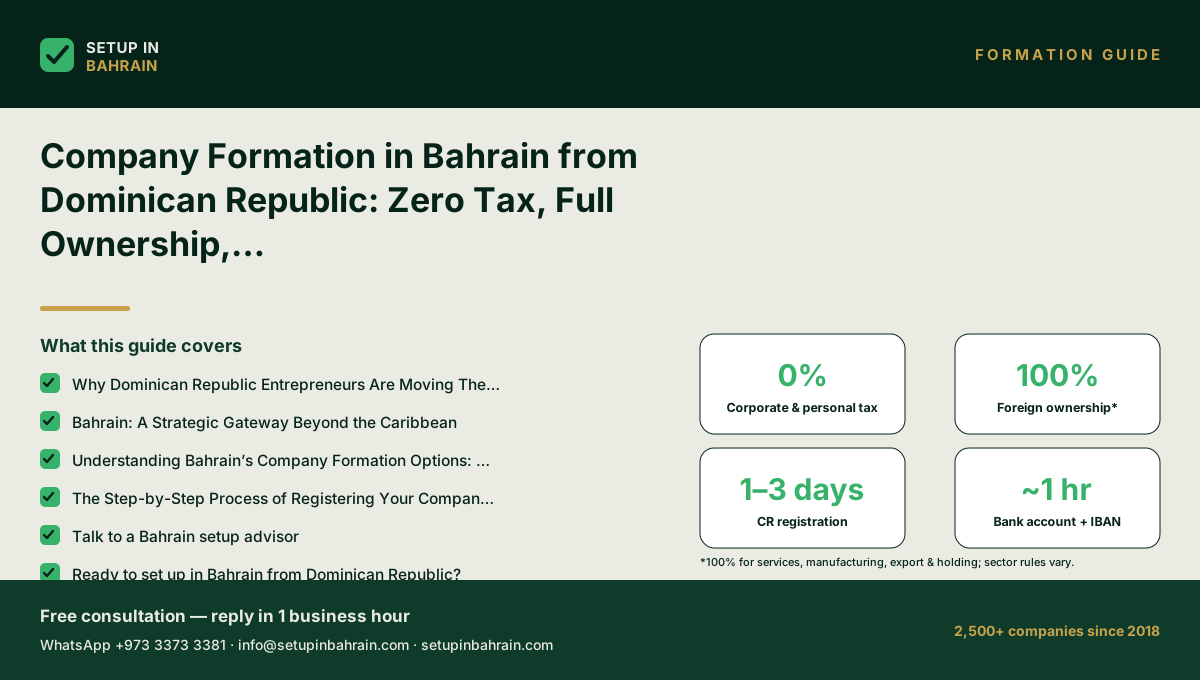
- Why Dominican Republic Entrepreneurs Are Moving Their Business to Bahrain
- Bahrain: A Strategic Gateway Beyond the Caribbean
- Understanding Bahrain’s Company Formation Options: WLL, Single Shareholder, and Beyond
- The Step-by-Step Process of Registering Your Company in Bahrain
→ Complete guide: Company Formation in Bahrain — the full 2026 guide
View details
Ownership & capital
A Bahrain WLL can be owned by a single person — 100% foreign ownership applies to most activities, with no local partner required for services, manufacturing, export trading and holding companies. The minimum share capital is BHD 1 ; we recommend BHD 1,000 . This Makes bank account opening and investor visa approval smoother.
Picture this: you’ve just closed a significant deal, celebrated a milestone. Now it’s time to settle up with the Dirección General de Impuestos Internos (DGII). You're staring at an invoice, calculating your corporate income tax, which, for most businesses in the Dominican Republic, hovers at a daunting 27%. But it’s not just the headline number that stings; it’s the complex dance of advance payments, the mandatory three annual installments, the 11.71% employer share for TSS social security contributions, the additional National Workers Fund pension payments, and the gradual, almost imperceptible erosion of your capital as the Dominican Peso (DOP) depreciates 5 to 8% against the USD each year.
For many dedicated Dominican Republic entrepreneurs – the innovators in Santiago, the exporters from Santo Domingo, the service providers across the country – this isn't just a cost of doing business; it’s a constant weight, a structural barrier to growth and global competitiveness. You dream of expanding beyond the Caribbean, perhaps into the booming markets of the Middle East. The logistical hurdles and financial drain at home make that vision feel distant. Your hard-won margins evaporate before you can even consider a strategic global move.
What if there was a place where your business could operate with 0% corporate income tax, own 100% of your venture with a single shareholder, and have direct, unrestricted access to a $2 trillion GCC market, all while your capital remains stable, pegged to the US Dollar? A place where bureaucracy is minimal, and the government speaks your international language of business: English.
Welcome to Bahrain – a vibrant, strategically located island nation that has quietly become the preferred gateway for international businesses entering the Gulf Cooperation Council (GCC). This isn't about escaping your responsibilities; it's about optimizing your potential and unlocking unprecedented growth. This comprehensive guide, crafted specifically for Dominican Republic entrepreneurs like you, will demystify the process of establishing a company in Bahrain, illuminating the unparalleled advantages and providing a clear roadmap for your international expansion.
Why Dominican Republic Entrepreneurs Are Moving Their Business to Bahrain
The decision to establish a company in a new jurisdiction is rarely taken lightly. It involves careful consideration of legal frameworks, economic stability, market access, and, crucially, the tax environment. For Dominican Republic entrepreneurs, the comparative advantages of Bahrain present a compelling case for relocation or expansion. Let's delve into the specific pain points you might be facing in the DR and how Bahrain offers a clear solution.
Navigating the Dominican Republic's Fiscal Landscape: A Burden on Growth
As a Dominican entrepreneur, you are intimately familiar with the fiscal realities that shape your business’s profitability and growth trajectory.
- High Corporate Income Tax: The most prominent challenge is the 27% corporate income tax rate. This significant portion of your net profits goes to the DGII, immediately reducing your reinvestment capacity and ultimately your ability to scale. Imagine the difference if that 27% remained within your company, ready to fund innovation, expand operations, or hire more talent.
- Complex Advance Payment System: Beyond the headline rate, the DGII’s advance payment system adds a layer of complexity and cash flow strain. Your business is obligated to make three annual installments towards your projected tax liability, often before you've even fully realized those profits. This forces careful financial planning and can tie up capital that could otherwise be used for operational needs or strategic investments. It’s a constant administrative overhead, demanding vigilant reconciliation. Mandatory Social Security Contributions: The costs don't stop at corporate tax. Employers in the Dominican Republic bear a substantial burden for social security. The mandatory TSS (Tesorería de la Seguridad Social) social security contributions amount to an 11.71% employer share on employee salaries, in addition to employee contributions. This, combined with contributions to the National Workers Fund pension payments, greatly increases the cost of employment, making it harder to expand your team or offer competitive salaries without eroding margins. For many, the effective* tax burden, including these contributions, can push well beyond 30%, sometimes even touching 38% for certain business types, truly stifling economic agility.
- Currency Depreciation and Capital Erosion: Perhaps one of the most insidious challenges is the gradual depreciation of the Dominican Peso (DOP). Historically, the DOP has lost 5 to 8% of its value against the US Dollar each year. While it might seem small on a daily basis, over time, this erosion chips away at your retained earnings, makes international transactions more expensive, and diminishes the real value of your capital. For businesses with international aspirations or those dealing in imports/exports, this instability creates immense uncertainty and risk.
These factors combine to create an environment where a significant portion of your hard-earned revenue is diverted, your cash flow is strained, and your capital's value is constantly under threat. This leaves many Dominican entrepreneurs feeling that their efforts are disproportionately taxed and their potential unfairly limited.
Bahrain: A Beacon of Fiscal Freedom and Strategic Advantage
In stark contrast to these challenges, Bahrain presents a uniquely attractive proposition:
0% Corporate Income Tax: The most celebrated advantage of Bahrain is its zero corporate income tax policy. For the vast majority of businesses, this means that every cent of your net profit stays within your company. Imagine the immediate and profound impact on your profitability, your ability to reinvest. Your competitive pricing in global markets. This isn't a temporary incentive; it's a foundational pillar of Bahrain's economic strategy. 100% Foreign Ownership and Single Shareholder: Unlike many jurisdictions that mandate local partners or impose restrictions on foreign equity, Bahrain offers 100% foreign ownership across most sectors. Also, a single individual can fully own and operate a company (specifically a WLL) , eliminating the need to find local partners or dilute your ownership. This provides unparalleled control and streamlines decision-making, a significant relief for entrepreneurs used to more restrictive environments. Currency Stability Pegged to the US Dollar: The Bahraini Dinar (BHD) is pegged to the US Dollar at a fixed rate of BHD 0.376 per USD 1 . This provides rock-solid currency stability, protecting your capital from depreciation and making international financial planning predictable and secure. For an entrepreneur accustomed to the DOP's fluctuations, this stability is a game-changer, fostering confidence in long-term investments. Gateway to a $2 Trillion GCC Market: Bahrain is strategically positioned as the most cost-effective and efficient entry point into the Gulf Cooperation Council (GCC) market. This economic bloc, comprising Saudi Arabia, UAE, Qatar, Kuwait, Oman. Bahrain, represents a massive consumer base and a combined GDP exceeding $2 trillion. Establishing your company in Bahrain provides seamless access to this affluent and rapidly growing market, a market far larger and more diverse than the entire Caribbean. Streamlined Business Environment: The Kingdom of Bahrain, through entities like the Economic Development Board (EDB) and the Ministry of Industry and Commerce (MOIC), has made significant strides in simplifying company registration and compliance. The Sijilat 3.0 portal offers a digitized, user-friendly platform for most business processes, dramatically reducing administrative burden and time-to-market. According to the World Bank's Ease of Doing Business reports, Bahrain consistently ranks among the top countries globally for its pro-business environment.
For a Dominican Republic entrepreneur, moving your business to Bahrain isn't just a geographical shift; it's a strategic pivot towards fiscal optimization, market expansion, and enhanced operational efficiency. It’s about retaining more of what you earn, operating with greater autonomy. Accessing a global market with confidence and stability.
Bahrain: A Strategic Gateway Beyond the Caribbean
Bahrain's appeal goes far beyond its favorable tax regime and ease of ownership. Its strategic location, robust infrastructure, and forward-thinking regulatory environment position it as an ideal launchpad for Dominican entrepreneurs seeking to globalize their operations and tap into new revenue streams.
Economic Stability and Currency Peg: A Haven for Capital
One of the most immediate and profound benefits for any international business is financial stability. Bahrain excels in this regard, offering a level of certainty that contrasts sharply with the currency fluctuations experienced in many emerging markets, including the Dominican Republic.
The Bahraini Dinar (BHD) - US Dollar Peg: The Central Bank of Bahrain (CBB) maintains a fixed exchange rate between the Bahraini Dinar and the US Dollar. Since 2001, the rate has been steadfastly set at BHD 0.376 per USD 1 . This peg is not merely an administrative decision; it's backed by robust foreign exchange reserves and a commitment from the CBB to maintain this stability. For Dominican entrepreneurs, this means: * Predictable Cash Flow: No more worrying about the DOP depreciating against the dollar, eroding your international purchasing power or the value of your retained earnings. Your profits in BHD hold their value relative to the world's primary reserve currency. * Simplified International Trade: Importing and exporting become less risky when currency exchange rates are stable. Pricing in USD or BHD offers clarity and removes a major variable from your financial forecasting. * Investment Security: Capital invested in Bahrain maintains its value, encouraging long-term planning and greater confidence in reinvestment. This stability, overseen by a reputable institution like the CBB, provides a secure foundation for your financial operations.
This unparalleled currency stability is a cornerstone of Bahrain's appeal, offering a tangible financial advantage that directly impacts your bottom line and peace of mind.
Access to the $2 Trillion GCC Market: Unlocking Regional Potential
Bahrain is not just an island nation; it's a crucial node within one of the world's wealthiest and fastest-growing economic blocs: the Gulf Cooperation Council (GCC).
What is the GCC? The GCC is a political and economic union of six Arab states: Bahrain, Kuwait, Oman, Qatar, Saudi Arabia. The United Arab Emirates. Established in 1981, it aims to foster cooperation and integration across various sectors, including economic, social. Cultural affairs. A Massive Consumer Base: With a combined population exceeding 50 million people and a collective GDP of over $2 trillion , the GCC represents a colossal market. These nations boast high disposable incomes, significant government spending on infrastructure and diversification projects. A growing demand for diverse goods and services. Bahrain as the Gateway: Bahrain is often referred to as the "Gateway to the GCC" for several compelling reasons: * Geographic Proximity: It's physically connected to Saudi Arabia, the largest GCC economy, via the King Fahd Causeway, allowing for direct overland access for goods and people. * Cost-Effectiveness: Setting up a business in Bahrain is generally more cost-effective than in some other GCC nations, with lower operational costs and a competitive labor market. * Liberal Business Environment: Bahrain has a long-standing reputation for its open economy, progressive regulations. Welcoming stance towards international businesses. The Economic Development Board (EDB) actively promotes foreign investment, acting as a crucial bridge for new entrants. * Free Trade Zones: While Bahrain doesn't strictly categorize "free zones" in the same way some other GCC nations do (as the entire country is essentially a free market with low duties), specific areas like the Bahrain International Investment Park (BIIP) offer additional incentives and streamlined processes for industrial and manufacturing activities, providing strategic bases for re-exporting across the GCC.
For a Dominican entrepreneur looking to expand beyond the Americas, Bahrain offers a low-risk, high-reward entry point into a vibrant, affluent, and technologically advanced regional market.
World-Class Infrastructure and Connectivity: Ready for Global Business
A modern business needs modern infrastructure, and Bahrain delivers. The Kingdom has invested heavily in developing advanced physical and digital infrastructure to support international commerce.
Logistics and Shipping: Bahrain boasts a sophisticated logistics network, including: * Khalifa Bin Salman Port: A deep-water port capable of handling large cargo vessels, offering efficient sea freight connections to global markets. * Bahrain International Airport (BIA): A modern airport undergoing significant expansion, serving as a regional hub for air cargo and passenger travel, connecting Bahrain to major cities worldwide. * Road Network: Excellent road networks within Bahrain and the King Fahd Causeway ensure smooth transportation of goods and people across borders. Digital Infrastructure: In today's digital economy, reliable internet and connectivity are non-negotiable. Bahrain offers: * High-Speed Internet: Widespread availability of high-speed fiber optic and 5G networks, ensuring seamless digital operations. * Data Centers: Growing number of secure data centers, catering to cloud computing and data storage needs. * Fintech Hub: Bahrain has positioned itself as a leading FinTech hub in the region, with a supportive regulatory sandbox (CBB) and infrastructure for digital finance. Human Capital and Professional Services: The country has a well-educated, bilingual (Arabic and English) workforce. Also, a wide array of international professional services firms – legal, accounting, consulting – have established a presence, providing essential support for foreign businesses.
This robust infrastructure ensures that your business in Bahrain will operate efficiently, connect globally. Leverage modern technological advancements.
Business-Friendly Regulations and Digital Transformation: Ease of Doing Business
Bahrain has consistently ranked high in global indices for ease of doing business, a testament to its commitment to creating an attractive environment for foreign investment.
Streamlined Regulatory Framework: The government, primarily through the Ministry of Industry and Commerce (MOIC), continually reviews and updates its commercial laws to be transparent, predictable, and aligned with international best practices. This commitment reduces regulatory uncertainty, a common concern for businesses expanding internationally. The EDB and BIPA: Your Partners in Success: * Economic Development Board (EDB): The EDB acts as a strategic investment promotion agency, providing extensive support to foreign investors. They offer guidance on market entry, connect businesses with local partners, assist with licensing. Provide insights into specific sector opportunities. Think of them as your first point of contact and an invaluable resource. * Bahrain Investors and Business Protection Agency (BIPA): BIPA works to safeguard investor interests and ensure a fair and transparent business environment. Sijilat 3.0: The Digital Revolution of Company Registration: A standout feature of Bahrain's pro-business approach is the Sijilat 3.0 portal . This comprehensive online platform, managed by the MOIC, allows entrepreneurs to: * Register new companies. * Renew commercial registrations. * Manage licenses and permits. * Submit various corporate filings. * All digitally, greatly reducing the need for physical visits to government offices. This digital transformation dramatically cuts down on processing times and bureaucratic hurdles, making the company formation process remarkably efficient. For entrepreneurs accustomed to the manual processes and paperwork often found in the Dominican Republic, Sijilat 3.0 is a breath of fresh air.
This combination of political stability, economic openness, advanced infrastructure. A digitally-enabled regulatory environment makes Bahrain an exceptionally attractive destination for Dominican entrepreneurs ready to expand their horizons.
Understanding Bahrain’s Company Formation Options: WLL, Single Shareholder, and Beyond
Choosing the right legal structure for your business is a foundational decision with long-term implications. Bahrain offers several company types. For most Dominican entrepreneurs seeking 100% foreign ownership and flexibility, the With Limited Liability (WLL) company will be your primary focus.
The WLL (With Limited Liability) Company: Your Most Likely Choice
The WLL company is by far the most popular and versatile legal entity for foreign investors in Bahrain. It strikes an excellent balance between limited liability protection, ownership flexibility, and a straightforward setup process.
100% Foreign Ownership: This is a crucial differentiator. As a Dominican entrepreneur, you can own 100% of your WLL company in Bahrain across a vast majority of sectors, without the requirement of a Bahraini partner or sponsor. This ensures complete control over your business operations and profits. Single Shareholder Permitted: A significant advantage, especially for sole entrepreneurs or small business owners, is that a WLL can be established with just one shareholder . You do not need to find multiple partners to register this type of company. This directly addresses the needs of entrepreneurs who prefer complete autonomy. Limited Liability Protection: As the name suggests, the liability of the shareholders is limited to their capital contribution to the company. This means your personal assets are protected from the company's debts and obligations, offering a critical layer of financial security. Minimum Share Capital: BHD 1 (Legal) vs. BHD 1,000 (Practical): * Legal Minimum: Legally, the Commercial Companies Law of Bahrain states that a WLL company can be registered with a minimum share capital of just BHD 1 . This extremely low threshold makes company formation accessible. * Practical Minimum: But, it is strongly recommended for new companies to deposit a minimum share capital of BHD 1,000 into a corporate bank account. Why the discrepancy? * Bank Account Approval: While BHD 1 is legal, most reputable commercial banks in Bahrain, adhering to stringent Know Your Customer (KYC) and Anti-Money Laundering (AML) regulations, will require a more substantial initial deposit (typically BHD 1,000 or more) to open a corporate account. This shows genuine business intent and financial viability. Without a bank account, your company cannot operate effectively. * Investor Visa: If you, as the business owner, intend to reside in Bahrain and get an investor visa, having a tangible capital contribution of BHD 1,000 or more greatly strengthens your visa application and shows a serious commitment to the Bahraini economy. * So, while BHD 1 is the letter of the law, aim for at least BHD 1,000 as your starting capital for practical operational efficiency and successful ancillary processes like banking and visas. Management: A WLL must have at least one director (who can be a shareholder) and a company secretary. There are no residency requirements for directors or shareholders, offering further flexibility.
For Dominican entrepreneurs, the WLL offers a robust, flexible. Investor-friendly structure that aligns perfectly with the goal of expanding into a new, stable market.
Other Company Types (Briefly Mentioned for Context)
While the WLL is the most common choice, it's helpful to be aware of other legal structures available in Bahrain, though they might be less suitable for initial foreign investment:
Setup (Sole Proprietorship): This is for a single individual carrying out commercial activities. While simple, it does not offer limited liability protection, making the owner personally responsible for all business debts. For foreign investors, an Setup often has more restrictions on activities and requires local residency. It's generally not recommended for significant foreign investment due to the lack of limited liability. Branch of a Foreign Company: This allows an existing foreign company to establish a presence in Bahrain without creating a separate legal entity. It acts as an extension of the parent company and does not have its own legal personality. This might be suitable for large corporations with existing global operations looking to set up a representative office or a service delivery arm. Partnership Company: This involves two or more partners sharing profits and losses. There are various types, including General Partnerships (unlimited liability for partners) and Limited Partnerships (some partners have limited liability). These are less common for direct foreign investment seeking full ownership and limited liability for a single individual. Public Shareholding Company (B.S.C.): Reserved for larger entities planning to raise capital from the public, requiring a much higher minimum capital and more stringent regulatory compliance. single-shareholder WLL: Crucially, it is important to note that Bahrain does NOT have a distinct "Single Person Company" (WLL) legal structure. The WLL (With Limited Liability) company serves this purpose, allowing a single individual to be the sole shareholder and owner. Still benefiting from limited liability. Do not be misled by information from other jurisdictions that may reference a single-shareholder WLL; in Bahrain, a WLL fulfills this requirement perfectly.
By understanding these options, you can confirm that the WLL is almost certainly the optimal choice for your venture, providing the benefits of 100% foreign ownership, single shareholder flexibility, and limited liability, all within a progressive regulatory framework.
The Step-by-Step Process of Registering Your Company in Bahrain
Registering a company in Bahrain has been greatly streamlined thanks to digital initiatives like Sijilat 3.0. While the process is efficient, understanding each phase will help you navigate it smoothly.
Phase 1: Pre-Registration & Planning
Thorough preparation is key to a swift registration. This phase involves critical decisions and information gathering.
1. Business Activity Selection (MOIC Classification): * Before anything else, you need to clearly define your business activities. The Ministry of Industry and Commerce (MOIC) has a standardized classification system (the "Commercial Registration Activities List"). You'll need to select the specific activities that your company will undertake. Insight for DR Entrepreneurs:* Think broadly about your current Dominican business and how it might expand in the GCC. Are you in consulting, trading, technology, manufacturing, or services? Be precise, as your chosen activities will determine the licenses and permits required. Some activities might be regulated by specific ministries (e.g., financial services by the CBB, education by the Ministry of Education), requiring additional approvals. 2. Company Name Reservation: * You'll need to propose a few names for your company, in order of preference. The MOIC will check for availability and compliance with naming conventions (e.g., no offensive terms, no names too similar to existing companies). Tip:* Aim for uniqueness and ensure the name reflects your brand and is available for relevant domain names as well. 3. Legal Structure Choice (WLL Focus): * As discussed, for most Dominican entrepreneurs, the With Limited Liability (WLL) company will be the ideal choice due to 100% foreign ownership and single-shareholder flexibility. Reconfirm this decision based on your specific business goals and shareholder structure. 4. Due Diligence and Document Preparation: * Gather all necessary personal and corporate documents. This typically includes: * Passport copies of all shareholders and directors. * National ID card (Cédula) for Dominican nationals. * Proof of residential address for shareholders/directors (e.g., utility bill from the last three months). * Curriculum Vitae (CV) or resume for directors/shareholders. A clear, concise business plan outlining your proposed operations, market analysis, financial projections, and operational strategy. While not always a mandatory submission* for simple registrations, it’s often requested by banks for account opening and shows serious intent. * For corporate shareholders (if applicable): Certificate of Incorporation, Memorandum and Articles of Association. Board Resolution from the parent company, all duly apostilled/legalized. Comparison:* This might be more extensive than what's required for a simple Registro Mercantil in the DR. It's standard for international compliance and to meet CBB's stringent KYC requirements. 5. Memorandum of Association (MOA): * This is the foundational legal document for your WLL company. It outlines the company's name, registered address, business activities, share capital, and details of shareholders. While templates are available, it's advisable to have it drafted or reviewed by a local legal expert to ensure it accurately reflects your business structure and complies with Bahraini law.
Phase 2: Application Submission via Sijilat 3.0
Once your planning is complete and documents are ready, the actual application process is largely digital.
1. Online Application through Sijilat 3.0: * Access the Sijilat 3.0 portal (www.sijilat.bh). This is the single online gateway for all commercial registration services. * You will create an account and then initiate a new Commercial Registration (CR) application. * Follow the guided steps, inputting all required company and shareholder details. * Upload all prepared documents digitally. Ensure they are clear, legible, and in the correct format (typically PDF). 2. Fee Payment: * The system will calculate the applicable government fees based on your selected activities and legal structure. You can pay these fees securely online using a credit/de
Bahrain Business Guides for Dominican Republic Citizens
Frequently Asked Questions
How long does it take to set up?
It takes 15 to 20 days. We file all forms for you. You do not need to wait long.
What does it cost?
Company formation: Standard BHD 1,340 with 3 months of office address; Gold BHD 1,700 with 6 months; Premium BHD 2,150 with 12 months and a cabin, officer table and chair, and two guest chairs. No formation package includes visas, including Premium. Investor/work visas are priced separately: BHD 755 for one year or BHD 953 for two years, in addition to the formation package. Ask for a written, itemized quotation confirming government fees and all inclusions before payment.
Do I need to visit Bahrain?
No. You can set up your firm from home. We do all the work online. Some banks may ask for one visit.
What tax will I pay?
You pay zero tax on your profits. Bahrain has no corporate income tax. This is a key benefit of the setup.
Can I own 100% of my firm?
Yes. Foreign owners can hold all shares. No local partner is needed. Full ownership is allowed.
What do I need to start?
You need a valid passport. You also need a trade name and a business address. We help you with all of these.
How do I open a bank account?
We guide you step by step. Most banks take 3 to 6 weeks. You will need your CR and firm papers.
Who issues the Commercial Registration (CR)?
The CR is issued by the MOICT. It is your legal right to trade in Bahrain. We file the CR for you.
Can I renew my CR each year?
Company renewal packages: BHD 530 with 3 months of office address; BHD 980 with 6 months; BHD 1,520 with 12 months. These are separate renewal packages, not visa fees.
How do I get started?
Fill in our form on this page. Our team will call you back. We map your best setup plan at no cost.
Steps to Form Your Company
- Pick your trade name. We check if it is free.
- Choose your business type. WLL is the most common.
- Sign the MOA. We draft and file all legal docs.
- Pay the state fees. About BHD 432 in total.
- Get your CR. Takes 15 to 20 days.
- Open your bank account. We guide each step.
- Start trading. You are ready to do business.
Key Facts
- Tax rate: 0%
- Foreign ownership: 100%
- Setup time: 15 to 20 days
- Company formation: Standard BHD 1,340 with 3 months of office address; Gold BHD 1,700 with 6 months; Premium BHD 2,150 with 12 months and a cabin, officer table and chair, and two guest chairs. No formation package includes visas, including Premium. Investor/work visas are priced separately: BHD 755 for one year or BHD 953 for two years, in addition to the formation package. Ask for a written, itemized quotation confirming government fees and all inclusions before payment.
- Company renewal packages: BHD 530 with 3 months of office address; BHD 980 with 6 months; BHD 1,520 with 12 months. These are separate renewal packages, not visa fees.
- Client rating: 4.8 stars
- Clients served: 2,500 and more
Quick Facts
- Tax rate: 0%
- Own all of your firm: Yes, 100%
- Time to set up: 15 to 20 days
- Company formation: Standard BHD 1,340 with 3 months of office address; Gold BHD 1,700 with 6 months; Premium BHD 2,150 with 12 months and a cabin, officer table and chair, and two guest chairs. No formation package includes visas, including Premium. Investor/work visas are priced separately: BHD 755 for one year or BHD 953 for two years, in addition to the formation package. Ask for a written, itemized quotation confirming government fees and all inclusions before payment.
- Company renewal packages: BHD 530 with 3 months of office address; BHD 980 with 6 months; BHD 1,520 with 12 months. These are separate renewal packages, not visa fees.
- Rating: 4.8 stars
- Clients: 2,500 and more
Why Bahrain?
Bahrain has no tax. You keep all your profits. This is rare in the Gulf.
You can own all of your firm. No local partner is needed. The law allows full foreign ownership.
Setup takes 15 to 20 days. We file all forms for you. You can do it all from home.
Bahrain has a free trade deal with the US. Your goods face low or no tariffs. This gives you access to big markets.
We have served 2,800+ clients from 44+ countries and maintain records to substantiate that total where needed. We have 113 Google reviews; reviews represent only some clients and are not the same as the total clients served.
Our Steps
- Tell us your plan. We advise you for free.
- We pick the right firm type for you.
- We file all your forms with MOICT.
- You get your CR in 15 to 20 days.
- We help you open a bank account.
- You are ready to trade. We stay with you.
Next Steps for Dominican Republic Citizens
You can set up a firm in Bahrain from Dominican Republic. You do not need to fly there first. We do all the work online.
Tell us your plan. We call you back the same day. We map the best route for you at no cost.
We file all your forms. We deal with MOICT and the state. You get your CR in 15 to 20 days.
After your CR, we help you get a bank account. We also help with your Investor Visa. One firm guides you at each step.
Why Our Clients from Dominican Republic Choose Us
- We speak your language. We know your needs.
- We have helped clients from Dominican Republic before.
- Our fee is clear. No surprise costs.
- We have a 4.8 star rating on Google.
- We have helped more than 2,500 clients set up in Bahrain.
Fill in the form on this page. We will be in touch soon. Let us help you start your Bahrain firm today.
Ready to set up in Bahrain from Dominican Republic?
Tell us your business idea. We map the right entity, ownership and timeline — then handle the filing while you focus on what matters.