Complete guide for Djibouti entrepreneurs: form a company in Bahrain with generally no corporate income tax for most sectors, 100% foreign ownership. GCC market access. Costs, steps, visas, banking.
Key Takeaways
- Why Djibouti Entrepreneurs Are Moving Their Business to Bahrain
- Understanding Bahrain's Business Landscape: A Strategic Overview
- Choosing Your Legal Structure: The Right Fit for Your Vision
- Step-by-Step Company Formation Process in Bahrain
- Navigating Banking and Finance in Bahrain
→ Complete guide: Company Formation in Bahrain — the full 2026 guide
View details
Ownership & capital
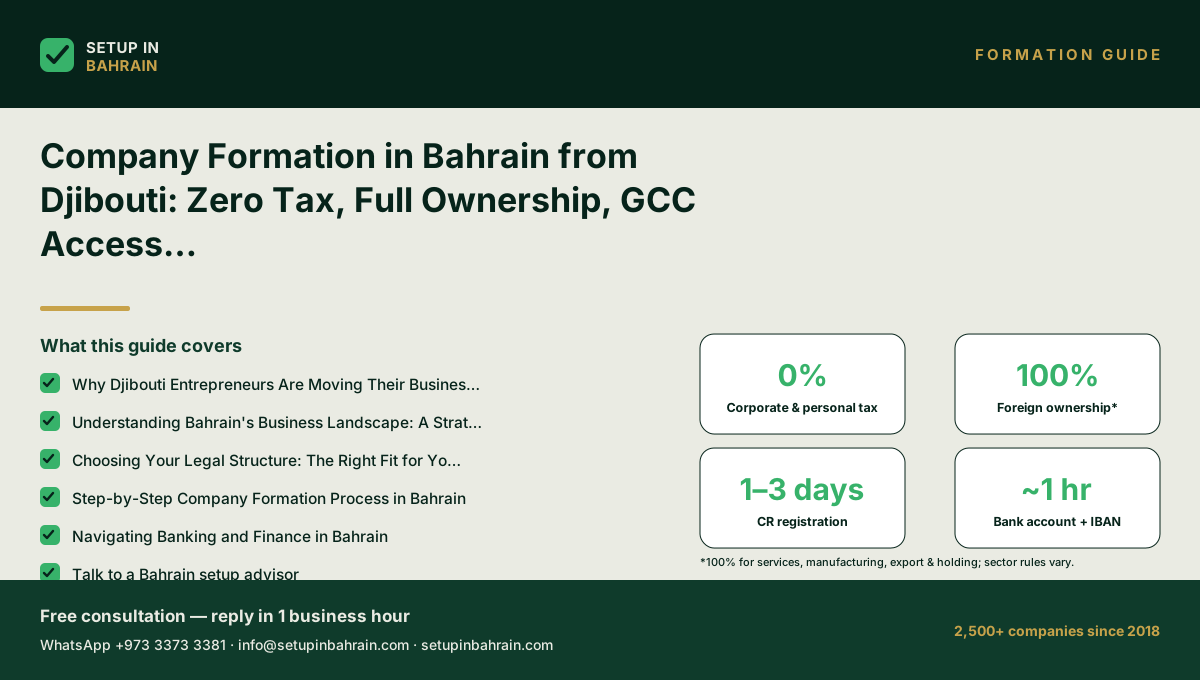
A Bahrain WLL can be owned by a single person — 100% foreign ownership applies to most activities, with no local partner required for services, manufacturing, export trading and holding companies. The minimum share capital is BHD 1 ; we recommend BHD 1,000 . This Makes bank account opening and investor visa approval smoother.
Entrepreneurship in Djibouti is a testament to resilience, foresight, and a keen understanding of regional dynamics. Your vision, grit, and tireless effort have built businesses that navigate a unique economic landscape. Yet, even the most dedicated founders in Djibouti eventually confront an unavoidable reality: the 25% corporate income tax rate, coupled with a small domestic market and persistent bureaucratic hurdles, places a significant ceiling on growth and profitability.
Imagine for a moment Amina, a seasoned logistics entrepreneur in Djibouti. Her company has expertly leveraged the port's strategic location for years, moving goods across the Horn of Africa. But every quarter, when tax season rolls around, she sees a quarter of her hard-earned profits vanish into government coffers. That's capital that could have been reinvested in new trucks, expanded warehousing, or even an innovative tracking system. She also grapples with the protracted delays from ANPI (National Investment Promotion Agency) when trying to diversify her portfolio, the limited global reach of her local banks, and the sheer cost of doing business in a market heavily reliant on port and military base revenues, pushing her operational expenses 30-40% higher than regional alternatives. Amina isn't just paying taxes; she’s paying a premium on every aspect of her business's potential.
This isn't a unique struggle. Many Djibouti entrepreneurs, like Amina, feel the pinch. They're successful within their existing framework, but they instinctively know there's more potential elsewhere. They're looking for a jurisdiction that rewards their drive, rather than taxing their ambition.
Enter Bahrain. A dynamic island nation in the Arabian Gulf, just a 2-hour flight from Djibouti, Bahrain offers a compelling alternative for founders ready to transcend their current limitations. Picture this: a 0% corporate income tax rate , 100% foreign ownership of your company. Direct access to a $1.6 trillion GCC market of over 50 million consumers. It’s a jurisdiction designed not just for growth. For maximizing your hard-earned profits and enabling unparalleled expansion.
This article is your definitive guide to understanding why Bahrain is the strategic next step for your Djiboutian enterprise. We'll delve into the specific advantages, demystify the company formation process, navigate the banking landscape. Outline the pathway to residency, all while addressing the unique pain points you face as an entrepreneur from Djibouti.
Why Djibouti Entrepreneurs Are Moving Their Business to Bahrain
For years, Djibouti has carved out a niche as a critical logistics and military hub. The Djiboutian Franc (DJF) being pegged to the US Dollar provides a degree of currency stability, which is beneficial for international trade. This also limits monetary policy flexibility and can expose businesses to the vagaries of US economic policy. This stability, but, doesn't translate into broad-based economic diversification or significant relief from the burdens of operating in a highly concentrated economy.
Let's break down the core challenges that are prompting successful Djiboutian entrepreneurs to cast their gaze towards Bahrain:
The Weight of the 25% Corporate Income Tax
This is, arguably, the single largest driver. For any profitable venture in Djibouti, a quarter of your net earnings is simply not yours to keep or reinvest. This isn't just a number on a balance sheet; it's a direct inhibitor of growth, innovation. Competitiveness.
Consider the logistics operator in Djibouti I spoke with. He moves containers through the port and told me his company consistently paid 25% corporate income tax on every profitable year. Then, he watched another 8-10% disappear in social contributions and compliance filings that dragged on for months at ANPI. The business clears roughly USD 180,000 in annual profit after port fees, yet he still struggles to secure larger credit lines because Djibouti’s banking sector has thin correspondent networks outside the Horn of Africa. He estimated that if he could retain that 25% tax, he could invest in expanding his fleet by two new trucks every three years or greatly upgrade his port handling equipment, boosting efficiency by 15-20%. Instead, that capital is effectively locked away.
Bahrain's Solution: Bahrain stands out with its 0% corporate income tax on most business activities. This isn't a temporary incentive; it's a fundamental pillar of its economic policy, designed to attract foreign direct investment and stimulate economic growth. Imagine retaining 100% of your profits, redirecting that capital towards expansion, R&D, talent acquisition, or simply strengthening your balance sheet. This immediate and substantial financial advantage fundamentally shifts your business's growth trajectory.
Bureaucracy and ANPI Delays: A Test of Patience
Djibouti's National Investment Promotion Agency (ANPI) is tasked with facilitating investment. The reality for many entrepreneurs is a protracted and often opaque process. Diversifying business activities, acquiring permits, or securing approvals can involve significant delays, often stretching from weeks into months, resulting in lost opportunities and increased operational overhead. This administrative friction consumes valuable time and resources that could otherwise be dedicated to core business functions.
Bahrain's Solution: Bahrain has consistently been ranked highly for its ease of doing business by the World Bank. The Ministry of Industry and Commerce (MOIC) has greatly streamlined company registration, with many processes now digitized through the "Sijilat" portal. What might take months in Djibouti can often be completed in a matter of weeks, sometimes even days, in Bahrain, especially with the right guidance. This efficiency translates directly into faster market entry and quicker returns on your investment.
Limited Global Banking Reach and Connectivity
While the Djiboutian banking sector serves local needs, its global correspondent networks are often thin, especially outside the Horn of Africa. This can pose significant challenges for international transactions, securing diverse financing options. Managing cross-border financial flows efficiently. Many regional Islamic banks dominate the landscape. This Is beneficial for Sharia-compliant finance but can limit choice for those seeking conventional banking products with extensive international reach.
Bahrain's Solution: Bahrain boasts one of the most sophisticated and diverse financial sectors in the Middle East. Regulated by the Central Bank of Bahrain (CBB), it hosts a multitude of international and regional banks, offering both conventional and Islamic banking services. These institutions have robust correspondent networks worldwide, facilitating seamless international transactions, competitive foreign exchange services. Access to a broader range of financial products, including trade finance, corporate lending, and wealth management. This banking ecosystem is precisely what an internationally ambitious Djiboutian entrepreneur needs.
Small Domestic Market and Economic Concentration
Djibouti's economy. Strategically vital, is relatively small and heavily concentrated around port activities and the presence of foreign military bases. This limits the domestic market for many goods and services, forcing entrepreneurs to look regionally or internationally from day one. But, the infrastructure and support to do so from Djibouti are often lacking.
Bahrain's Solution: Bahrain serves as a gateway to the entire GCC market, a consumer base of over 50 million people with a combined GDP exceeding $1.6 trillion. This access is facilitated by the King Fahd Causeway, linking Bahrain directly to Saudi Arabia. Excellent air and sea connectivity across the Gulf. By establishing your company in Bahrain, you immediately position yourself to serve this vast, affluent market, tapping into unprecedented growth opportunities far beyond Djibouti's borders. Bahrain's own economy is also greatly more diversified, with strong sectors in financial services, ICT, logistics, manufacturing. Tourism, offering a more resilient and dynamic local market.
High Operational Expenses
Beyond taxes, the cost of doing business in Djibouti can be high due to import reliance, infrastructure limitations outside the port. A smaller, less competitive service sector. This pushes up everything from utility costs to professional fees, impacting overall profitability.
Bahrain's Solution: Bahrain offers a highly competitive operating environment. While not the cheapest in the world, it is often more cost-effective than its immediate GCC neighbors for factors like office rents, staffing, and utilities. Its efficient logistics infrastructure, readily available skilled labor, and pro-business regulatory environment help reduce overheads. The government, through entities like the Economic Development Board (EDB), actively works to create an attractive investment climate, ensuring that your operational expenses are optimized, allowing more capital to flow back into your business.
By addressing these core pain points, Bahrain positions itself not just as an alternative. As a strategic upgrade for any Djiboutian entrepreneur ready to scale their vision on a regional and global stage.
Understanding Bahrain's Business Landscape: A Strategic Overview
Bahrain has meticulously crafted an environment designed for international business, emphasizing ease, efficiency, and growth. Its approach is underpinned by a clear national vision and robust institutional support.
Bahrain Vision 2030: A Blueprint for Diversification
At the heart of Bahrain's economic strategy is Vision 2030, an ambitious plan launched in 2008 to transform the kingdom into a more diversified, knowledge-based economy less reliant on oil. This vision emphasizes sustainability, competitiveness, and fairness, creating a fertile ground for foreign direct investment (FDI). Key pillars include fostering a world-class regulatory environment, investing in human capital. Developing advanced infrastructure, especially in digital and logistics sectors. For you, this means investing in a country with a clear, forward-looking economic roadmap that aligns with business growth. The Economic Development Board (EDB) plays a crucial role in attracting and facilitating these investments, acting as a one-stop shop for foreign companies.
Key Economic Sectors: Opportunities Beyond Oil
While historically an oil producer, Bahrain has aggressively diversified its economy. For Djibouti entrepreneurs, this opens up a range of sectors ripe for investment:
- Financial Services: As the oldest financial hub in the Gulf, Bahrain boasts a mature and innovative financial sector, including conventional and Islamic banking, FinTech, insurance, and asset management. Its regulatory sandbox for FinTech is a testament to its forward-thinking approach. If your business involves financial technology or services, Bahrain offers unparalleled infrastructure and talent.
- Information and Communication Technology (ICT): With high internet penetration (over 99% in 2023, World Bank) and a commitment to digital transformation, Bahrain is emerging as a regional tech hub. Data centers, cloud computing, cybersecurity, and e-commerce are thriving. This provides a robust digital backbone for any modern business.
- Logistics: Leveraging its strategic location as a gateway to the GCC, Bahrain has developed excellent logistics infrastructure, including world-class air and sea ports (Bahrain Logistics Zone - BLZ) and efficient customs processes. This is especially relevant for Djiboutian entrepreneurs already experienced in logistics, offering an opportunity to expand into a larger, more sophisticated supply chain network. The Bahrain International Investment Park (BIIP) also offers ready-to-use industrial land with excellent connectivity.
- Manufacturing: Bahrain encourages light manufacturing and assembly, especially in sectors that leverage its strong logistics and skilled workforce.
- Tourism: A growing sector, offering opportunities in hospitality, entertainment, and related services.
A Transparent and Efficient Regulatory Environment
Bahrain consistently ranks high in global indices for ease of doing business. The government, through the Ministry of Industry and Commerce (MOIC), has implemented robust, transparent, and streamlined regulations. This reduces administrative burden, minimizes red tape, and provides legal certainty for investors. Compared to the often-opaque bureaucratic processes encountered in some other regions, Bahrain offers a refreshing degree of clarity and predictability. The legal system is based on civil law, with clear commercial codes, providing a stable framework for dispute resolution.
Free Zones vs. Onshore: Choosing Your Operational Model
Bahrain offers options for company registration, each with distinct advantages:
- Onshore: The majority of companies register onshore, allowing them to conduct business directly within Bahrain and across the GCC, without geographical restrictions. This provides maximum flexibility for market access.
- Free Zones: Specific zones like the Bahrain Logistics Zone (BLZ) and Bahrain International Investment Park (BIIP) offer dedicated infrastructure and sometimes additional incentives for specific types of businesses (e.g., logistics, manufacturing). While these zones offer duty-free benefits and dedicated services, for broader market access, an onshore company is usually preferred. For most Djiboutian entrepreneurs aiming for GCC-wide reach, an onshore WLL will be the optimal choice.
By understanding these facets of Bahrain’s business environment, you can better position your venture for sustainable growth and leverage the country’s strengths to your advantage.
Choosing Your Legal Structure: The Right Fit for Your Vision
Selecting the appropriate legal structure is a foundational decision that impacts everything from liability to taxation and operational flexibility. Bahrain offers several company types, but for most Djiboutian entrepreneurs seeking to establish a robust, fully foreign-owned entity, two stand out: the With Limited Liability (WLL) company and, for larger ventures, the Bahrain Shareholding Company (BSC).
The WLL (With Limited Liability): Your Go-To Option
For the vast majority of small and medium-sized enterprises (SMEs) and even larger private businesses, the With Limited Liability (WLL) company is the most popular and practical choice in Bahrain. It offers a perfect balance of flexibility, liability protection, and ease of setup.
100% Foreign Ownership: This is a critical advantage for Djiboutian entrepreneurs. Unlike some other jurisdictions where local partners might be required, Bahrain allows a WLL to be 100% owned by foreign individuals or entities . You maintain full control over your business. Single Shareholder Permitted: You don't need partners. A WLL can be legally owned and operated by a single person . This empowers solo entrepreneurs or those who prefer full autonomy. Crucially, this means there is NO need for a separate "Single Person Company" (WLL) structure in Bahrain; the WLL already caters to this. Avoid any advice that suggests otherwise. Limited Liability: As the name suggests, the personal liability of the owners is limited to the amount of capital they have invested in the company. Your personal assets are protected from the company's debts and obligations. Minimum Share Capital: BHD 1 (Legal Minimum), BHD 1,000 (Practical Recommendation) * Legally, the Ministry of Industry and Commerce (MOIC) allows a WLL to be registered with a share capital as low as BHD 1 . This shows Bahrain’s commitment to making company formation accessible. * But, here's a crucial practical insight: While BHD 1 is legally acceptable, most commercial banks in Bahrain will require a higher initial deposit to open a corporate bank account. Experience shows that a practical minimum for bank account approval and to help an investor visa for the owner is around BHD 1,000 . Depositing BHD 1,000 shows a more serious commitment and helps streamline administrative processes. Always aim for BHD 1,000 as your practical starting capital. Suitability: WLLs are ideal for a wide range of business activities, including trading, consulting, services, IT, logistics. Light manufacturing. They offer excellent operational flexibility and are the backbone of Bahrain's private sector.
Bahrain Shareholding Company (BSC): For Larger Ventures
For larger enterprises, especially those seeking to raise capital from the public or requiring a more complex governance structure, the Bahrain Shareholding Company (BSC) is the appropriate choice.
Types: * BSC Closed: For private companies with a limited number of shareholders, typically not offering shares to the public. Minimum capital requirement is BHD 250,000 . * BSC Public: For companies planning to list on a stock exchange and offer shares to the public. Minimum capital requirement is BHD 1,000,000 . Governance: BSCs have more stringent corporate governance requirements, including a board of directors, regular shareholder meetings. Audited financial statements, aligning with international best practices. Suitability: Best suited for large-scale projects, financial institutions, insurance companies, or businesses with significant capital needs and multiple investors.
Comparison: WLL vs. BSC
To help you make an informed decision, here's a comparison:
| Feature | WLL (With Limited Liability) | BSC (Bahrain Shareholding Company) |
| :------------------ | :---------------------------------------------------- | :------------------------------------------------------ |
| Ownership | 100% foreign ownership permitted | 100% foreign ownership permitted |
| Shareholders | Minimum 1, Maximum 50 | Minimum 2 (Public), Minimum 2 (Closed) |
| Capital (Legal) | BHD 1 (Legal minimum) | BHD 1,000,000 (Public), BHD 250,000 (Closed) |
| Capital (Practical) | BHD 1,000 (Recommended for banking/visa) | As per legal minimum |
| Liability | Limited to share capital | Limited to share capital |
| Governance | Simpler structure, typically managed by owner/director | More complex, requires a Board of Directors |
| Audit | Annual audit required | Annual audit required, more stringent reporting |
| Suitability | SMEs, startups, consulting, trading, services, logistics | Large corporations, financial institutions, IPO aspirations |
Step-by-Step Company Formation Process in Bahrain
Establishing your company in Bahrain is a structured and efficient process, especially when compared to the bureaucratic hurdles you might be accustomed to in Djibouti. The Ministry of Industry and Commerce (MOIC) oversees commercial registration, with much of the process streamlined through its online portal, "Sijilat."
Phase 1: Planning and Pre-Approval
This initial stage involves defining your business and getting preliminary clearances.
- Define Your Business Activities: Clearly articulate the exact nature of your business. This will determine the appropriate commercial activities code under the MOIC classification system. It’s crucial to be precise as your CR (Commercial Registration) will only allow you to operate within these specified activities. For example, if you're a logistics company, you might need codes for "cargo handling," "freight forwarding," and "warehousing."
- Name Reservation: Choose a unique company name that complies with Bahraini regulations. You'll apply to reserve this name via the Sijilat portal. It must not be similar to existing companies or contain offensive language.
- Initial Approval: Once your activities are classified and your name reserved, you'll submit an application for initial approval. This involves providing details about the shareholders, directors (if applicable), and the proposed business. Some regulated activities (e.g., financial services, healthcare, education) may require pre-approvals from specific ministries or regulatory bodies like the Central Bank of Bahrain (CBB) before MOIC grants final approval. This is where a local consultant can be invaluable in navigating specific sectoral requirements.
Phase 2: Documents and Registration
With initial approval in hand, you move to formalizing your company.
Drafting Memorandum of Association (MOA) and Articles of Association (AOA): These legal documents define the company's purpose, structure, share capital, ownership. Internal governance rules. For a WLL, this is a relatively straightforward document. It must be prepared in Arabic and English, and notarized. Share Capital Deposit: As discussed, while the legal minimum for a WLL is BHD 1, it is highly recommended to deposit BHD 1,000 into a temporary bank account opened in the company's name. This deposit is crucial for bank account activation and investor visa processing. The bank will issue a letter confirming the deposit, which is required for MOIC. Office Space Lease Agreement: You will need a physical or virtual office address in Bahrain. Many entrepreneurs start with a serviced office or a virtual office provider. This Offers a physical mailing address and meeting facilities without the overhead of a traditional office. A valid lease agreement for this address is a mandatory requirement for your Commercial Registration (CR). Submission of Documents: Gather all required documents: notarized MOA/AOA, shareholder passports, visa copies (if applicable), proof of address, bank deposit letter. The lease agreement. These are submitted electronically via the Sijilat portal to the MOIC Commercial Registration Directorate. CR Issuance: Upon successful review and approval of all documents, the MOIC will issue your Commercial Registration (CR) certificate. This is the legal document that officially recognizes your company's existence in Bahrain.
Phase 3: Post-Registration Compliance
Your CR is issued, but there are a few more steps to become fully operational.
- Get Municipality License: Depending on your business activity and physical location, you will need a municipality license from the relevant municipal authority. This typically involves an inspection of your premises (even if virtual, sometimes a verification of the lease) to ensure compliance with local regulations.
- Sectoral Licenses (If Applicable): If your business operates in a regulated sector (e.g., healthcare, education, financial services, specific types of manufacturing), you will need to get additional licenses from the respective governmental bodies. For instance, financial institutions are licensed by the Central Bank of Bahrain (CBB).
- VAT Registration: While Bahrain has 0% corporate income tax, it does implement a Value Added Tax (VAT) at a standard rate of 10%. If your annual taxable supplies exceed BHD 37,500 (mandatory registration threshold), you must register for VAT with the National Bureau for Revenue (NBR). Voluntary registration is also possible for businesses exceeding BHD 18,750.
- Employing Staff (LMRA): If you plan to hire employees (including yourself as an investor), you will need to register with the Labour Market Regulatory Authority (LMRA) and get work permits and residence permits.
Typical Timeline: The entire company formation process, from initial application to CR issuance, can typically take 2 to 4 weeks if all documents are in order and no complex sectoral approvals are required. Engaging a reputable business setup consultant can greatly streamline this process, ensuring all requirements are met accurately and promptly. This efficiency is a stark contrast to the months-long delays often experienced with ANPI in Djibouti.
Navigating Banking and Finance in Bahrain
One of the significant pain points for Djiboutian entrepreneurs is the limited global reach of their domestic banking sector. In Bahrain, you'll find a world-class financial ecosystem that addresses these challenges head-on.
The Contrast: From Limited Networks to Global Connectivity
In Djibouti, your banking options are constrained. The concentration of regional Islamic banks. Serving a specific market segment, often means thinner correspondent networks for international transfers and a narrower range of conventional financing products. Securing substantial credit lines or facilitating complex international trade finance can be an uphill battle, often involving higher fees and slower processing times due to reliance on intermediary banks. The DJF's peg to the USD provides stability. The lack of independent monetary policy can sometimes limit responses to local economic conditions.
Bahrain offers a stark contrast.
Bahrain's Sophisticated Banking Sector
Bahrain boasts the oldest and most established financial services sector in the Gulf, regulated by the highly respected Central Bank of Bahrain (CBB). The CBB maintains stringent oversight, ensuring stability, transparency, and adherence to international best practices.
Diverse Options: You'll find a wide array of banks, including major international players (e.g., HSBC, Standard Chartered, Citi), large regional banks (e.g., National Bank of Bahrain, Ahli United Bank, Arab Bank). Specialized Islamic banks. This diversity offers you choice in services, products, and fees. Robust Correspondent Networks: Bahraini banks have extensive correspondent banking relationships globally. This means your international payments and receipts will be processed efficiently, securely, and often at more competitive rates. This is a game-changer for businesses involved in international trade, imports, or exports. Advanced Digital Banking: Many Bahraini banks offer sophisticated digital platforms, allowing you to manage your accounts, make transfers. Access services remotely, enhancing operational efficiency.
Opening a Corporate Bank Account in Bahrain
Opening a corporate bank account is a crucial step after obtaining your Commercial Registration (CR). While straightforward, it requires careful preparation:
Required Documents: * Company's Commercial Registration (CR) certificate. * Memorandum and Articles of Association (MOA/AOA). * Passports and CPR (Central Population Register ID) copies of all authorized signatories and shareholders. * Proof of address for signatories/shareholders. * A detailed business plan outlining your company's activities, expected transaction volumes, and source of funds. * Board resolution authorizing the account opening and specifying signatories. The "Practical Capital" Advantage (BHD 1,000): As mentioned earlier, while the MOIC legally permits a WLL with BHD 1 capital, depositing BHD 1,000 as your initial share capital will greatly ease the bank account opening process. Banks are inherently risk-averse and prefer to see a more substantial initial deposit. This Also aids in processing your investor visa later. A bank may delay or even reject an application if the capital is too low, perceiving it as insufficient for genuine business operations. KYC (Know Your Customer) and AML (Anti-Money Laundering) Compliance: Be prepared for thorough due diligence. Banks in Bahrain adhere to strict international KYC and AML regulations. You'll need to clearly articulate the source of your funds and the nature of your business operations. Access to Funding and Financial Support
Beyond day-to-day banking, Bahrain offers a supportive
Bahrain Business Guides for Djibouti Citizens
Frequently Asked Questions
How long does it take to set up?
It takes 15 to 20 days. We file all forms for you. You do not need to wait long.
What does it cost?
Company formation: Standard BHD 1,340 with 3 months of office address; Gold BHD 1,700 with 6 months; Premium BHD 2,150 with 12 months and a cabin, officer table and chair, and two guest chairs. No formation package includes visas, including Premium. Investor/work visas are priced separately: BHD 755 for one year or BHD 953 for two years, in addition to the formation package. Ask for a written, itemized quotation confirming government fees and all inclusions before payment.
Do I need to visit Bahrain?
No. You can set up your firm from home. We do all the work online. Some banks may ask for one visit.
What tax will I pay?
You pay zero tax on your profits. Bahrain has no corporate income tax. This is a key benefit of the setup.
Can I own 100% of my firm?
Yes. Foreign owners can hold all shares. No local partner is needed. Full ownership is allowed.
What do I need to start?
You need a valid passport. You also need a trade name and a business address. We help you with all of these.
How do I open a bank account?
We guide you step by step. Most banks take 3 to 6 weeks. You will need your CR and firm papers.
Who issues the Commercial Registration (CR)?
The CR is issued by the MOICT. It is your legal right to trade in Bahrain. We file the CR for you.
Can I renew my CR each year?
Company renewal packages: BHD 530 with 3 months of office address; BHD 980 with 6 months; BHD 1,520 with 12 months. These are separate renewal packages, not visa fees.
How do I get started?
Fill in our form on this page. Our team will call you back. We map your best setup plan at no cost.
Steps to Form Your Company
- Pick your trade name. We check if it is free.
- Choose your business type. WLL is the most common.
- Sign the MOA. We draft and file all legal docs.
- Pay the state fees. About BHD 432 in total.
- Get your CR. Takes 15 to 20 days.
- Open your bank account. We guide each step.
- Start trading. You are ready to do business.
Key Facts
- Tax rate: 0%
- Foreign ownership: 100%
- Setup time: 15 to 20 days
- Company formation: Standard BHD 1,340 with 3 months of office address; Gold BHD 1,700 with 6 months; Premium BHD 2,150 with 12 months and a cabin, officer table and chair, and two guest chairs. No formation package includes visas, including Premium. Investor/work visas are priced separately: BHD 755 for one year or BHD 953 for two years, in addition to the formation package. Ask for a written, itemized quotation confirming government fees and all inclusions before payment.
- Company renewal packages: BHD 530 with 3 months of office address; BHD 980 with 6 months; BHD 1,520 with 12 months. These are separate renewal packages, not visa fees.
- Client rating: 4.8 stars
- Clients served: 2,500 and more
Quick Facts
- Tax rate: 0%
- Own all of your firm: Yes, 100%
- Time to set up: 15 to 20 days
- Company formation: Standard BHD 1,340 with 3 months of office address; Gold BHD 1,700 with 6 months; Premium BHD 2,150 with 12 months and a cabin, officer table and chair, and two guest chairs. No formation package includes visas, including Premium. Investor/work visas are priced separately: BHD 755 for one year or BHD 953 for two years, in addition to the formation package. Ask for a written, itemized quotation confirming government fees and all inclusions before payment.
- Company renewal packages: BHD 530 with 3 months of office address; BHD 980 with 6 months; BHD 1,520 with 12 months. These are separate renewal packages, not visa fees.
- Rating: 4.8 stars
- Clients: 2,500 and more
Why Bahrain?
Bahrain has no tax. You keep all your profits. This is rare in the Gulf.
You can own all of your firm. No local partner is needed. The law allows full foreign ownership.
Setup takes 15 to 20 days. We file all forms for you. You can do it all from home.
Bahrain has a free trade deal with the US. Your goods face low or no tariffs. This gives you access to big markets.
We have served 2,800+ clients from 44+ countries and maintain records to substantiate that total where needed. We have 113 Google reviews; reviews represent only some clients and are not the same as the total clients served.
Our Steps
- Tell us your plan. We advise you for free.
- We pick the right firm type for you.
- We file all your forms with MOICT.
- You get your CR in 15 to 20 days.
- We help you open a bank account.
- You are ready to trade. We stay with you.
Next Steps for Djibouti Citizens
You can set up a firm in Bahrain from Djibouti. You do not need to fly there first. We do all the work online.
Tell us your plan. We call you back the same day. We map the best route for you at no cost.
We file all your forms. We deal with MOICT and the state. You get your CR in 15 to 20 days.
After your CR, we help you get a bank account. We also help with your Investor Visa. One firm guides you at each step.
Why Our Clients from Djibouti Choose Us
- We speak your language. We know your needs.
- We have helped clients from Djibouti before.
- Our fee is clear. No surprise costs.
- We have a 4.8 star rating on Google.
- We have helped more than 2,500 clients set up in Bahrain.
Fill in the form on this page. We will be in touch soon. Let us help you start your Bahrain firm today.
Ready to set up in Bahrain from Djibouti?
Tell us your business idea. We map the right entity, ownership and timeline — then handle the filing while you focus on what matters.