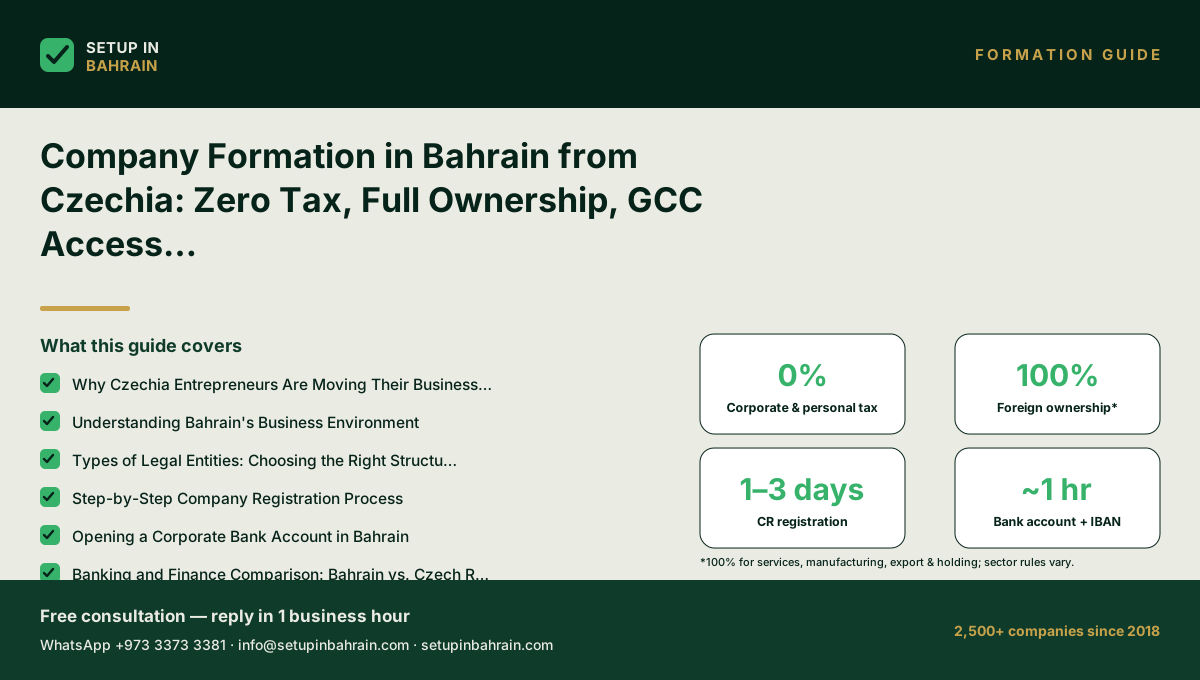
Register your Bahrain company from Czechia and enjoy generally no corporate income tax for most sectors. Fast setup, full support for Czech entrepreneurs expanding to the Gulf.
Key Takeaways
- Why Czechia Entrepreneurs Are Moving Their Business to Bahrain
- Understanding Bahrain's Business Environment
- Types of Legal Entities: Choosing the Right Structure
- Step-by-Step Company Registration Process
- Opening a Corporate Bank Account in Bahrain
→ Complete guide: Company Formation in Bahrain — the full 2026 guide
View details
Ownership & capital
A Bahrain WLL can be owned by a single person — 100% foreign ownership applies to most activities, with no local partner required for services, manufacturing, export trading and holding companies. The minimum share capital is BHD 1 ; we recommend BHD 1,000 . This Makes bank account opening and investor visa approval smoother.
Pavel sits in his Brno office on a grey Tuesday morning, staring at the final calculations from his accountant. His software development consultancy has just closed its best year ever—CZK 18.4 million in revenue, contracts with German automotive giants. A promising new lead from a Saudi infrastructure company. By any measure, he should be celebrating.
Instead, he's watching CZK 3.5 million evaporate.
The 19% corporate tax takes the first bite. Then come the mandatory social and health contributions—sociální pojištění and zdravotní pojištění—adding another 31.5% on top of what he pays himself. The quarterly DPH filings consumed 47 hours of his team's time last year. His external accountant charges CZK 84,000 annually just to navigate the 42-page daňové přiznání correctly. And every time his German clients pay in euros, he loses 1.5-3% on the CZK conversion, with another hit when he pays his Arabic-speaking contractors.
When all the dust settles, Pavel keeps roughly 49% of what his company actually earned.
This isn't a hypothetical scenario I've constructed to make a point. This is the reality I hear described, with minor variations, from Czech entrepreneurs every single week. The specific numbers change—sometimes it's CZK 8 million in revenue, sometimes CZK 45 million—but the fundamental story remains identical. Czech business owners who've built something valuable find themselves on a compliance treadmill that extracts nearly half their profits while demanding hundreds of hours of administrative labour.
What if there was a jurisdiction where corporate tax was genuinely 0%? Where you could own 100% of your company without a local sponsor? Where the government actively wants foreign entrepreneurs to succeed and has built an entire economic development infrastructure to help them?
For a growing community of Czech entrepreneurs, that jurisdiction is Bahrain. And this guide exists to show you exactly how to make that move—practically, legally. With your eyes wide open about both the opportunities and the challenges.
Why Czechia Entrepreneurs Are Moving Their Business to Bahrain
The decision to relocate a business internationally is never purely mathematical. But let's start with the mathematics anyway, because for Czech entrepreneurs, the numbers are genuinely striking.
The Real Cost of Operating from Czechia
Most Czech business owners know their corporate tax rate is 19%. What they often underestimate is their actual tax burden when all mandatory contributions are calculated.
Consider a Czech s.r.o. (společnost s ručením omezeným) generating CZK 15 million in annual profit. Here's what the real extraction looks like:
Corporate Income Tax: CZK 2,850,000 (19% of profit)
Owner's Salary and Contributions: If you pay yourself CZK 1.2 million annually—a modest figure for a company of this size—you're looking at about CZK 378,000 in social insurance (sociální pojištění at 31.5% of gross, split between employer and employee portions) plus CZK 162,000 in health insurance (zdravotní pojištění at 13.5% total). That's CZK 540,000 in mandatory contributions on a single salary.
DPH Administration: While VAT itself is theoretically neutral—you collect it and remit it—the quarterly filing requirements consume real time. Czech entrepreneurs I work with report spending 12-18 hours per quarter on DPH compliance, even with accounting software. At a conservative CZK 2,000/hour opportunity cost, that's CZK 96,000-144,000 annually in lost productive time.
Accounting and Compliance: A competent external accountant for a CZK 15 million company typically charges CZK 60,000-120,000 annually. Add the cost of any tax advisory services, and you're easily at CZK 150,000.
Currency Conversion Costs: If you're billing international clients—and more and more, Czech tech and consulting businesses are—you're converting EUR, USD, or GBP to CZK. Bank spreads typically run 1.5-2.5%. On CZK 10 million in international revenue, that's CZK 150,000-250,000 in conversion friction.
Add it all together. The effective extraction rate for a profitable Czech company with international revenue easily exceeds 35%. In some cases I've analysed, it approaches 42%.
What Bahrain Actually Offers
Bahrain's value proposition isn't subtle. The Kingdom has made a strategic decision to attract foreign businesses through a combination of zero taxation and minimal bureaucracy. Here's the core offer, verified against official sources:
0% Corporate Income Tax: This isn't a temporary incentive or a special zone benefit. Bahrain has no corporate income tax for most business activities. The only exception is oil and gas companies operating under specific concession agreements, which pay 46%. If you're running a consultancy, e-commerce business, technology company, or professional services firm, your corporate tax rate is zero. (Source: Bahrain Economic Development Board, National Tax Policy 2025)
0% Personal Income Tax: Bahrain does not tax personal income. Period. No progressive brackets, no social contributions structured as income tax, nothing. What you earn, you keep.
0% Capital Gains Tax: Sell your company, sell shares, sell property—there is no capital gains tax in Bahrain.
0% Withholding Tax: Dividends, royalties, and interest payments leaving Bahrain are not subject to withholding tax. This matters enormously for Czech entrepreneurs who want to repatriate profits.
100% Foreign Ownership: Since the 2020 Commercial Companies Law reform, foreign nationals can own 100% of Bahraini companies in nearly all sectors without requiring a local partner or sponsor. This applies both inside and outside free zones. (Source: Ministry of Industry and Commerce, MOIC, 2025 Investor Guide)
No Minimum Capital Requirements: For most company types, there is no mandatory paid-up capital requirement. You can start a W.L.L. (With Limited Liability, Bahrain's equivalent of an s.r.o.) with minimal capitalisation.
English as Business Language: While Arabic is the official language, English is universally used in business, banking. Government dealings. All company registration documents, contracts, and banking relationships can be conducted entirely in English.
The Strategic Location Advantage
For Czech entrepreneurs who've never visited the Gulf, Bahrain's geography might seem abstract. Let me make it concrete.
Bahrain sits in the Persian Gulf, connected to Saudi Arabia by the 25-kilometre King Fahd Causeway. You can drive from Bahrain to the Saudi Eastern Province—home to Aramco's headquarters and a construction boom that dwarfs anything in European history—in about 45 minutes.
Saudi Arabia alone is investing over $1 trillion in Vision 2030 projects. The UAE, Qatar, Kuwait, and Oman are executing similarly massive infrastructure, technology, and diversification programmes. The total GCC (Gulf Cooperation Council) economy exceeds $2 trillion in GDP.
A Bahrain-registered company can:
- Bid on Saudi government contracts that require local GCC presence
- Access GCC free trade agreements that eliminate or reduce tariffs
- Establish banking relationships with institutions that serve the entire region
- Position itself as a regional hub rather than a distant European supplier
For a Czech software consultancy, engineering firm, or professional services company, the difference between "we're based in Brno and work remotely with Gulf clients" and "we're a Bahrain-registered company with regional operations" can be the difference between losing and winning contracts worth millions.
Understanding Bahrain's Business Environment
Before diving into the mechanics of company formation, you need to understand what you're actually stepping into. Bahrain is not Dubai. It's not a tax haven in the historical sense. And it's definitely not the Wild West.
A Brief Economic Context
Bahrain is a constitutional monarchy with a population of about 1.5 million, of which roughly 55% are expatriates. The country was the first Gulf state to discover oil (in 1932) and, so, the first to face oil depletion. This early resource constraint forced Bahrain to diversify decades before its neighbours.
The result is an economy that's genuinely diversified. Financial services contribute about 17% of GDP, with Bahrain hosting over 400 licensed financial institutions. Manufacturing, logistics, and tourism each contribute significant shares. Unlike some Gulf states where oil revenue allows the government to operate largely independently of the private sector, Bahrain has genuine economic interdependence between government policy and business success.
This matters for you as an entrepreneur because it means Bahrain's business-friendly policies aren't a temporary measure—they're a structural necessity. The government needs foreign investment and foreign businesses to succeed because the country's economic model depends on it.
Regulatory Framework and Oversight
Czech entrepreneurs often ask me: "Is Bahrain legitimate? Or is this some kind of grey-zone jurisdiction where anything goes?"
The answer is unambiguous: Bahrain is a well-regulated, OECD-compliant jurisdiction with robust financial oversight.
The Central Bank of Bahrain (CBB) supervises all financial services activities and is widely regarded as one of the most sophisticated regulators in the Middle East. Bahrain was the first Gulf state to introduce comprehensive fintech regulation, the first to create a regulatory sandbox for innovation. Maintains standards that meet Basel III requirements.
Bahrain is a member of the Financial Action Task Force (FATF) and complies with international anti-money laundering standards. The country participates in the OECD's Common Reporting Standard (CRS) for automatic exchange of financial information, meaning your Bahrain bank accounts will be reported to Czech tax authorities if you remain a Czech tax resident.
This regulatory robustness actually benefits legitimate entrepreneurs. Banks in Bahrain are willing to open accounts for properly structured businesses because they're not worried about regulatory crackdowns. Professional service providers operate openly and competitively. The legal system, based on a combination of civil law and Islamic law for personal matters, provides enforceable contract rights.
The Bahrain Investment Protection Agreement Context
Czechia and Bahrain have a Bilateral Investment Treaty (BIT) that provides legal protections for Czech investments in Bahrain. While this treaty predates current economic conditions, it establishes important principles including:
- Fair and equitable treatment of investments
- Protection against expropriation without compensation
- Free transfer of returns and capital
- Access to international arbitration for dispute resolution
The Bahrain Investors' Protection Authority (BIPA) specifically exists to handle investor grievances and ensure that foreign business owners have recourse if they encounter problems with government agencies or local partners.
Types of Legal Entities: Choosing the Right Structure
Bahrain offers several corporate structures, each with distinct characteristics. Choosing the right one isn't about finding the "best" structure—it's about matching structure to strategy.
With Limited Liability Company (W.L.L.)
The W.L.L. is Bahrain's most common business structure and the closest equivalent to the Czech s.r.o. It offers:
- Limited liability for shareholders (your personal assets are protected from company debts)
- a single shareholder (one person can own 100%), maximum of 50
- No minimum capital requirement for most activities
- 100% foreign ownership permitted since 2020 reforms
- Suitable for trading, services, manufacturing, and most commercial activities
Best for: Czech entrepreneurs planning to operate actively in Bahrain, hire local staff. Build a genuine regional presence.
Practical consideration: The two-shareholder minimum can be handled by having yourself and a family member, or yourself and a holding company, as the two shareholders. This is standard practice and creates no complications.
Single Person Company (S.P.C.)
Introduced more recently, the S.P.C. allows a single shareholder to establish a limited liability company:
- Single shareholder permitted (individual or corporate)
- Limited liability protection
- Minimum capital of BHD 1 (we recommend BHD 1,000) (about CZK 3.2 million) for most activities
- 100% foreign ownership permitted
Best for: Czech entrepreneurs who prefer complete individual control and don't want to involve a second shareholder. Who have sufficient capital to meet the minimum requirement.
Practical consideration: The BHD 1 minimum capital (we recommend BHD 1,000) requirement makes this structure less accessible for smaller operations. But, the capital can be used as working capital—it's not a fee or frozen amount.
Branch Office
A Branch Office allows a Czech company to establish a direct presence in Bahrain:
- Not a separate legal entity—it's an extension of the parent company
- Parent company remains fully liable for branch activities
- Registered with MOIC and authorized to conduct parent company's business in Bahrain
- Profits can be remitted to parent company without restriction
Best for: Czech companies that want to test the Bahraini market before committing to a full subsidiary, or that need local presence for specific contracts while maintaining Czech operational headquarters.
Practical consideration: Branch profits attributed to Bahraini operations are subject to 0% Bahrain tax. May be taxable in Czechia as part of the parent company's global income. This requires careful tax structuring.
Holding Company
Bahrain permits the setup of holding companies that own shares in other Bahraini or foreign companies:
- Can own 100% of subsidiary companies
- Minimal operational requirements
- Useful for regional group structures
- Benefits from Bahrain's treaty network
Best for: Czech entrepreneurs with multiple operating entities who want to consolidate ownership under a tax-efficient structure, or who are planning acquisitions in the GCC region.
Free Zone Companies
Bahrain operates two primary free zones: the Bahrain International Investment Park (BIIP) and the Bahrain Logistics Zone (BLZ). Also, the Bahrain FinTech Bay offers special licensing for financial technology companies.
Free zone benefits include:
- 100% foreign ownership (now also available outside free zones)
- generally no corporate income tax for most sectors (same as mainland)
- 0% import duties on goods remaining in free zone
- Streamlined licensing for specific activities
- Enhanced infrastructure and logistics facilities
Best for: Manufacturing companies that import raw materials and export finished goods; logistics and distribution companies; fintech companies seeking regulatory sandbox access.
Practical consideration: The 2020 reforms that enabled 100% foreign ownership nationwide have reduced the relative advantage of free zones for service businesses. Free zones now primarily benefit companies with heavy import/export or manufacturing operations.
Comparison Table: Bahrain Entity Types for Czech Entrepreneurs
| Feature | W.L.L. | S.P.C. | Branch | Free Zone |
| Foreign Ownership | 100% | 100% | 100% | 100% |
| Minimum Shareholders | 2 | 1 | N/A | 1 |
| Minimum Capital | None* | BHD 1 (we recommend BHD 1,000) | None | Varies |
| Corporate Tax | 0% | 0% | 0% | 0% |
| Separate Legal Entity | Yes | Yes | No | Yes |
| Best For | Active operations | Single owners | Market testing | Manufacturing/Logistics |
| Setup Time | 2-4 weeks | 2-4 weeks | 3-6 weeks | 2-4 weeks |
Step-by-Step Company Registration Process
Let me walk you through exactly what's involved in registering a Bahrain company as a Czech entrepreneur. I'll focus on the W.L.L. structure since it's most commonly appropriate, but the principles apply broadly.
Step 1: Business Activity Selection and Name Reservation (Week 1)
Bahrain requires you to define your commercial activities using their standardised classification system. This isn't a bureaucratic formality—your Commercial Registration (CR) will list specific permitted activities. Operating outside these activities can create regulatory problems.
Action items:
- Define your primary and secondary business activities in English
- Check that your activities don't fall into restricted categories (defence, oil extraction, media broadcasting, and certain professional services require special licensing)
- Submit three name choices to MOIC for availability check
- Pay name reservation fee (BHD 15, about CZK 950)
Czech-specific consideration: If your business involves technical consulting, software development, or engineering services, you'll want to select activities broad enough to cover your full service range. Changing CR activities later is possible but requires additional processing.
Step 2: Document Preparation and Legalisation (Week 1-2)
Bahrain requires several documents to establish your identity and corporate authority. As a Czech citizen, you'll need:
Personal documents:
- Valid passport (minimum 6 months validity)
- Passport-size photographs
- Proof of address (utility bill or bank statement from Czechia)
- Police clearance certificate from Czech Republic
Corporate documents (if using a Czech company as shareholder):
- Czech company registration extract from Obchodní rejstřík
- Memorandum and Articles of Association
- Board resolution authorising Bahrain company formation
- Shareholder register
Legalisation process:
All Czech documents must be apostilled through the Czech Ministry of Justice (Ministerstvo spravedlnosti) and then translated into Arabic by a certified translator. This process typically takes 5-10 business days.
Pro tip: Use a Czech translator certified by the Bahrain Embassy rather than translating in Bahrain. It's typically faster and cheaper, and the translations are readily accepted.
Step 3: Memorandum of Association Drafting (Week 2)
You'll need a Memorandum of Association (MoA) that complies with Bahrain Commercial Companies Law. This document specifies:
- Company name and registered address
- Shareholders and their ownership percentages
- Authorised and paid-up capital
- Business objectives
- Management structure and signing authority
- Fiscal year and accounting provisions
Czech-specific consideration: Unlike Czech s.r.o. formation where template zakladatelská listina documents work for most situations, Bahrain MoAs benefit from professional drafting that addresses your specific situation. Budget about BHD 300-500 (CZK 19,000-32,000) for quality legal drafting.
Step 4: MOIC Registration and CR Issuance (Week 2-3)
Submit your complete application to the Ministry of Industry and Commerce. The Sijilat online system handles most processing, though physical signatures may be required for certain documents.
Application includes:
- Completed CR application form
- Approved company name reservation
- Memorandum of Association (notarised)
- Shareholder documents (as listed above)
- Registered office lease agreement
- Activity-specific approvals (if required for your business type)
Fees:
- CR registration: BHD 100-300 depending on activities
- Notarisation fees: BHD 50-100
- Various stamps and administrative fees: BHD 50-100
Timeline: MOIC processing typically takes 5-7 business days for standard applications. Complex applications or those requiring ministry referrals may take 2-3 weeks.
Step 5: Municipality Registration and Signboard (Week 3)
After CR issuance, you must register with the local municipality (Capital Governorate for most Manama-based companies). This involves:
- Obtaining municipal licence
- Installing company signboard at registered address
- Paying annual municipal fees (BHD 200-500 depending on activity)
Step 6: Social Insurance Registration (Week 3-4)
If you plan to hire employees (Bahraini or foreign), you must register with the Social Insurance Organisation (SIO). Employer contributions are:
- 12% for Bahraini employees
- 3% for foreign employees
These contributions are greatly lower than Czech mandatory contributions and are the only "payroll tax" equivalent in Bahrain.
Step 7: Bank Account Opening (Week 3-5)
Opening a Bahraini corporate bank account is one of the more time-consuming steps, not because of bureaucracy but because of enhanced due diligence requirements.
Required documents:
- Commercial Registration
- Memorandum of Association
- Passport copies of all shareholders and signatories
- Board resolution appointing signatories
- Proof of company address
- Business plan or company profile
- Reference letters from existing bank (your Czech bank)
- Source of funds documents
Bank selection considerations:
Bahrain hosts over 80 banking institutions. For Czech entrepreneurs, I typically recommend:
- Local banks (Bank of Bahrain and Kuwait, National Bank of Bahrain): Faster account opening, more flexible with new businesses, competitive fees for regional transactions
- International banks (HSBC, Standard Chartered, Citi): Stronger European correspondent banking relationships, better for EUR/CZK transactions, but stricter due diligence
- Islamic banks (Bahrain Islamic Bank, Al Baraka): Relevant if your business involves Islamic finance or you prefer Sharia-compliant banking
Timeline: Allow 2-3 weeks from application to operational account. Some banks may require an in-person interview with account signatories.
Total Timeline and Cost Summary
Realistic timeline: 4-6 weeks from document preparation to operational company with bank account
Estimated costs:
| Item | Cost (BHD) | Cost (CZK)* |
| Name reservation | 15 | 950 |
| Legal drafting (MoA) | 400 | 25,500 |
| CR registration fees | 250 | 16,000 |
| Notarisation and stamps | 100 | 6,400 |
| Municipality registration | 300 | 19,200 |
| Bank account opening | 100 | 6,400 |
| Registered office (annual) | 1,200-2,400 | 77,000-154,000 |
| Professional service fees | 1,500-3,000 | 96,000-192,000 |
| Total first year | 3,865-6,565 | 247,000-420,000 |
This compares favourably with the CZK 150,000+ annual compliance costs many Czech entrepreneurs already pay. Delivering transformative tax benefits.
Opening a Corporate Bank Account in Bahrain
I'm dedicating a full section to banking because it's the area where Czech entrepreneurs most frequently encounter unexpected challenges—and where proper preparation makes the most difference.
The Enhanced Due Diligence Reality
Post-2016 global banking reforms have made corporate account opening more rigorous everywhere, and Bahrain is no exception. Banks aren't being difficult; they're complying with international anti-money laundering standards and facing significant penalties if they onboard problematic clients.
For a Czech entrepreneur without existing Bahrain relationships, you should expect:
Identity verification: Banks will verify your passport against international databases, check for politically exposed person (PEP) status. May request additional identification documents.
Source of wealth documents: You'll need to explain how you accumulated the funds you're bringing to Bahrain. Tax returns from Czechia, property ownership records, investment statements, and business sale documents all serve this purpose.
Business purpose clarity: Banks want to understand what your company actually does, who your clients are. How money will flow through the account. Vague descriptions like "international consulting" trigger additional questions.
Reference letters: A letter from your existing Czech bank confirming you've been a client in good standing is nearly essential. Request this before you begin the Bahrain process.
Banking for Specific Business Types
E-commerce and online businesses: Banks are accustomed to these models but will want to understand your payment processing arrangements. If you're using PayPal, Stripe, or similar processors, be prepared to explain how funds flow from customers to your Bahrain account.
Consultancies and professional services: Generally straightforward. Banks will want client examples and may ask about your invoicing currency mix.
Trading companies: Expect more questions about suppliers, inventory, and logistics. Banks are especially careful about trading businesses due to historical compliance issues in the sector.
Cryptocurrency-related businesses: This remains challenging. While Bahrain has progressive crypto regulation, most retail banks are cautious. Specialised institutions like Rain (Bahrain's licensed crypto exchange) may be more appropriate partners.
Multi-Currency Account Considerations
For Czech entrepreneurs, currency management deserves careful thought. You'll likely be receiving payments in EUR from European clients, potentially USD from American or Gulf clients. Spending in BHD locally.
Recommendation: Open accounts in BHD (required) and EUR at minimum. If you have significant USD revenue, add a USD account. The Bahraini Dinar is pegged to the US Dollar at BHD 1 = USD 2.65, providing stability against dollar-denominated transactions.
Avoiding CZK conversion friction: One significant advantage of operating from Bahrain is breaking free from constant EUR/CZK conversion. If you keep your operating funds in EUR and BHD, you eliminate the conversion drag that plagues Czech businesses with international revenue.
Banking and Finance Comparison: Bahrain vs. Czech Republic
Understanding the practical differences between Bahraini and Czech banking helps you plan your financial operations effectively.
Transaction Costs
Czech Republic:
- SWIFT international transfers: CZK 250-600 per transaction
- EUR/CZK conversion spread: 1.5-2.5% at most banks
- Monthly account fees: CZK 200-800 for business accounts
Bahrain:
- SWIFT international transfers: BHD 5-15 (CZK 320-960)
- EUR/BHD conversion spread: 0.5-1.0% (more competitive due to Gulf's international trade orientation)
- Monthly account fees: BHD 10-50 (CZK 640-3,200)
Correspondent Banking
Bahraini banks have well-established correspondent relationships with European banks due to the Gulf's significant trade with Europe. Transfers to and from Czech banks typically settle in 1-2 business days via SWIFT, comparable to transfers within Europe.
Digital Banking Capabilities
Both jurisdictions offer modern online banking, but Bahrain has invested heavily in fintech infrastructure. Mobile banking, instant domestic transfers, and digital onboarding are standard. The Central Bank of Bahrain's open banking framework is among the most advanced in the region.
Financing Availability
If you need business financing, both jurisdictions offer options, but the terms differ:
Czech Republic: Lower interest rates (reflecting ECB proximity) but significant documents requirements and often personal guarantees
Bahrain: Higher interest rates (typically 6-9% for business loans) but potentially more flexible collateral arrangements and faster decisions
For most Czech entrepreneurs establishing in Bahrain, the priority is efficient international treasury management rather than local borrowing.
Tax Implications and Compliance
Let's be completely clear about the tax situation. This is because This is where offshore marketing often creates confusion that leads to legal problems.
Bahrain's Tax Regime
Bahrain imposes essentially no direct taxes on most businesses:
- Corporate Income Tax: 0% (except oil companies)
- Personal Income Tax: 0%
- Capital Gains Tax: 0%
- Withholding Tax: 0%
- VAT: 10% (introduced 2019, applies to most goods and services)
The VAT is the only significant tax most businesses encounter. Standard rate is 10%, with zero-rating for exports and exemptions for certain financial services and real estate.
VAT registration is mandatory for businesses with annual taxable supplies exceeding BHD 37,500 (about CZK 2.4 million). Businesses with taxable supplies between BHD 18,750 and BHD 37,500 may register voluntarily.
For service businesses primarily serving international clients, most revenue is zero-rated as exported services, meaning you charge 0% VAT and can reclaim VAT on local purchases.
Czech Tax Implications—This Is Critical
Here's where many entrepreneurs make costly mistakes: Moving your business to Bahrain does not automatically end your Czech tax obligations.
Czech tax residency rules determine whether you remain liable for Czech taxation:
Corporate tax residency: A company is Czech tax resident if it has its registered office or place of effective management in Czechia. If you establish a Bahrain company but make all decisions from your apartment in Prague, Czech tax authorities can argue the company is effectively managed in Czechia and so subject to Czech corporate tax.
Personal tax residency: You are a Czech tax resident if you have:
- A permanent home in Czechia, OR
- You spend 183 or more days in Czechia during a calendar year
Czech tax residents are taxed on worldwide income, including foreign-sourced income.
Practical implications:
If you remain living in Czechia:
- Your Bahrain company's profits may be taxable in Czechia as Controlled Foreign Corporation (CFC) income
- Dividends you receive from your Bahrain company are taxable as personal income
- The 0% Bahrain tax becomes largely irrelevant
If you genuinely relocate to Bahrain:
- You must establish Bahrain tax residency by living there (typically 183+ days annually)
- You must break Czech tax residency by abandoning your permanent home and reducing Czech presence below 183 days
- You should formalise the transition with Czech tax authorities to avoid disputes
The Substance Requirement
International tax rules more and more require "substance"—real economic activity—in the jurisdiction where you claim tax benefits. Bahrain takes this seriously.
Minimum substance indicators:
- Actual office space (not just a registered address)
- Employees or contractors working in Bahrain
- Decisions made in Bahrain (board meetings, contracts signed)
- Bank accounts actively used for business operations
Czech scrutiny: If you claim a Bahrain company is your primary business but have no Bahrain presence, Czech tax authorities can (and do) challenge this structure. The penalty for getting this wrong is back-taxes plus significant fines.
Recommended approach: Either commit to genuine Bahrain relocation with real substance, or use a Bahrain structure as a legitimate regional subsidiary while acknowledging Czech taxation on your share of profits. The latter still provides significant benefits—GCC market access, regional credibility, operational flexibility—without creating tax compliance risks.
Residency Pathways for Czech Entrepreneurs
If you're serious about capturing Bahrain's full tax benefits, you'll need to establish genuine residency. Here are your options:
Investor Residence Visa
The most straightforward path for business owners:
Requirements:
- Own shares in a Bahraini company with minimum capital of BHD 1 (we recommend BHD 1,000) (about CZK 3.2 million)
- Company must be actively operating
- No criminal record
- Health clearance
Benefits:
- 2-year renewable residence visa
- Right to sponsor family members
- Path to long-term residence
- No requirement to be physically present continuously (but remember the tax residency considerations)
Timeline: 4-8 weeks from application
Golden Residence Visa
Introduced in 2022, this premium residence programme offers:
Requirements (one of the following):
- Property ownership worth BHD 200,000+ (about CZK 12.8 million)
- Retirement income of BHD 4,000/month (about CZK 256,000/month)
- Business investor with established track record
Benefits:
- 10-year renewable residence
- No sponsor required
- Family inclusion
- Right to work without separate permit
Self-Sponsored Visa
For entrepreneurs who don't meet investor thresholds:
Requirements:
- Demonstrate sufficient income or savings to support yourself
- Health insurance coverage
- Typically requires BHD 1,000/month provable income
Practical consideration: This visa type has more administrative requirements and may require periodic renewal. It's suitable for testing the waters before committing to larger investment.
Family Considerations
If you have a spouse and children, Bahrain allows you to sponsor their residence once you have a valid investor or employment visa. Dependant visas are generally straightforward to get.
Schooling: Bahrain has numerous international schools following British, American, French, and IB curricula. Annual fees range from BHD 3,000-12,000 (CZK 192,000-768,000) depending on the school and grade level.
Healthcare: Private healthcare in Bahrain is excellent, with several JCI-accredited hospitals. Health insurance is mandatory for residency and typically costs BHD 300-800 annually for comprehensive coverage.
Practical Considerations for Czech Business Owners
Language
As mentioned, English is the business language of Bahrain. Government forms, banking documents, contracts, and most professional interactions are conducted in English. You will not face language barriers in normal business operations.
Arabic language capability is beneficial for deeper social integration and can help with certain government interactions. It's genuinely not required for business success.
Time Zone
Bahrain is UTC+3, meaning it's 2 hours ahead of Czech Republic (which is UTC+1, or UTC+2 during summer time). This has practical implications:
Advantages:
- Same business day overlap with European clients (Bahrain morning = Czech morning)
- Better overlap with Asian clients than working from Czechia
- Convenient for serving Gulf clients in the same time zone
Challenges:
- If you're managing Czech employees or contractors, their afternoon is your evening
- US West Coast clients require late evening calls
Cost of Living
Bahrain's cost of living is moderate by Gulf standards and broadly comparable to Prague for equivalent lifestyle:
Housing (monthly rent):
- 1-bedroom apartment (Manama): BHD 350-500 (CZK 22,000-32,000)
- 3-bedroom villa: BHD 600-1,000 (CZK 38,000-64,000)
Other costs:
- Meal at restaurant: BHD 3-8 (CZK 190-510)
- Utilities: BHD 50-100 monthly
- Domestic help: BHD 200-300 monthly (widely available and common)
- Petrol: BHD 0.16/litre (about CZK
Bahrain Business Guides for Czechia Citizens
Frequently Asked Questions
How long does it take to set up?
It takes 15 to 20 days. We file all forms for you. You do not need to wait long.
What does it cost?
Company formation: Standard BHD 1,340 with 3 months of office address; Gold BHD 1,700 with 6 months; Premium BHD 2,150 with 12 months and a cabin, officer table and chair, and two guest chairs. No formation package includes visas, including Premium. Investor/work visas are priced separately: BHD 755 for one year or BHD 953 for two years, in addition to the formation package. Ask for a written, itemized quotation confirming government fees and all inclusions before payment.
Do I need to visit Bahrain?
No. You can set up your firm from home. We do all the work online. Some banks may ask for one visit.
What tax will I pay?
You pay zero tax on your profits. Bahrain has no corporate income tax. This is a key benefit of the setup.
Can I own 100% of my firm?
Yes. Foreign owners can hold all shares. No local partner is needed. Full ownership is allowed.
What do I need to start?
You need a valid passport. You also need a trade name and a business address. We help you with all of these.
How do I open a bank account?
We guide you step by step. Most banks take 3 to 6 weeks. You will need your CR and firm papers.
Who issues the Commercial Registration (CR)?
The CR is issued by the MOICT. It is your legal right to trade in Bahrain. We file the CR for you.
Can I renew my CR each year?
Company renewal packages: BHD 530 with 3 months of office address; BHD 980 with 6 months; BHD 1,520 with 12 months. These are separate renewal packages, not visa fees.
How do I get started?
Fill in our form on this page. Our team will call you back. We map your best setup plan at no cost.
Steps to Form Your Company
- Pick your trade name. We check if it is free.
- Choose your business type. WLL is the most common.
- Sign the MOA. We draft and file all legal docs.
- Pay the state fees. About BHD 432 in total.
- Get your CR. Takes 15 to 20 days.
- Open your bank account. We guide each step.
- Start trading. You are ready to do business.
Key Facts
- Tax rate: 0%
- Foreign ownership: 100%
- Setup time: 15 to 20 days
- Company formation: Standard BHD 1,340 with 3 months of office address; Gold BHD 1,700 with 6 months; Premium BHD 2,150 with 12 months and a cabin, officer table and chair, and two guest chairs. No formation package includes visas, including Premium. Investor/work visas are priced separately: BHD 755 for one year or BHD 953 for two years, in addition to the formation package. Ask for a written, itemized quotation confirming government fees and all inclusions before payment.
- Company renewal packages: BHD 530 with 3 months of office address; BHD 980 with 6 months; BHD 1,520 with 12 months. These are separate renewal packages, not visa fees.
- Client rating: 4.8 stars
- Clients served: 2,500 and more
Quick Facts
- Tax rate: 0%
- Own all of your firm: Yes, 100%
- Time to set up: 15 to 20 days
- Company formation: Standard BHD 1,340 with 3 months of office address; Gold BHD 1,700 with 6 months; Premium BHD 2,150 with 12 months and a cabin, officer table and chair, and two guest chairs. No formation package includes visas, including Premium. Investor/work visas are priced separately: BHD 755 for one year or BHD 953 for two years, in addition to the formation package. Ask for a written, itemized quotation confirming government fees and all inclusions before payment.
- Company renewal packages: BHD 530 with 3 months of office address; BHD 980 with 6 months; BHD 1,520 with 12 months. These are separate renewal packages, not visa fees.
- Rating: 4.8 stars
- Clients: 2,500 and more
Why Bahrain?
Bahrain has no tax. You keep all your profits. This is rare in the Gulf.
You can own all of your firm. No local partner is needed. The law allows full foreign ownership.
Setup takes 15 to 20 days. We file all forms for you. You can do it all from home.
Bahrain has a free trade deal with the US. Your goods face low or no tariffs. This gives you access to big markets.
We have served 2,800+ clients from 44+ countries and maintain records to substantiate that total where needed. We have 113 Google reviews; reviews represent only some clients and are not the same as the total clients served.
Our Steps
- Tell us your plan. We advise you for free.
- We pick the right firm type for you.
- We file all your forms with MOICT.
- You get your CR in 15 to 20 days.
- We help you open a bank account.
- You are ready to trade. We stay with you.
Next Steps for Czechia Citizens
You can set up a firm in Bahrain from Czechia. You do not need to fly there first. We do all the work online.
Tell us your plan. We call you back the same day. We map the best route for you at no cost.
We file all your forms. We deal with MOICT and the state. You get your CR in 15 to 20 days.
After your CR, we help you get a bank account. We also help with your Investor Visa. One firm guides you at each step.
Why Our Clients from Czechia Choose Us
- We speak your language. We know your needs.
- We have helped clients from Czechia before.
- Our fee is clear. No surprise costs.
- We have a 4.8 star rating on Google.
- We have helped more than 2,500 clients set up in Bahrain.
Fill in the form on this page. We will be in touch soon. Let us help you start your Bahrain firm today.
Ready to set up in Bahrain from Czechia?
Tell us your business idea. We map the right entity, ownership and timeline — then handle the filing while you focus on what matters.