
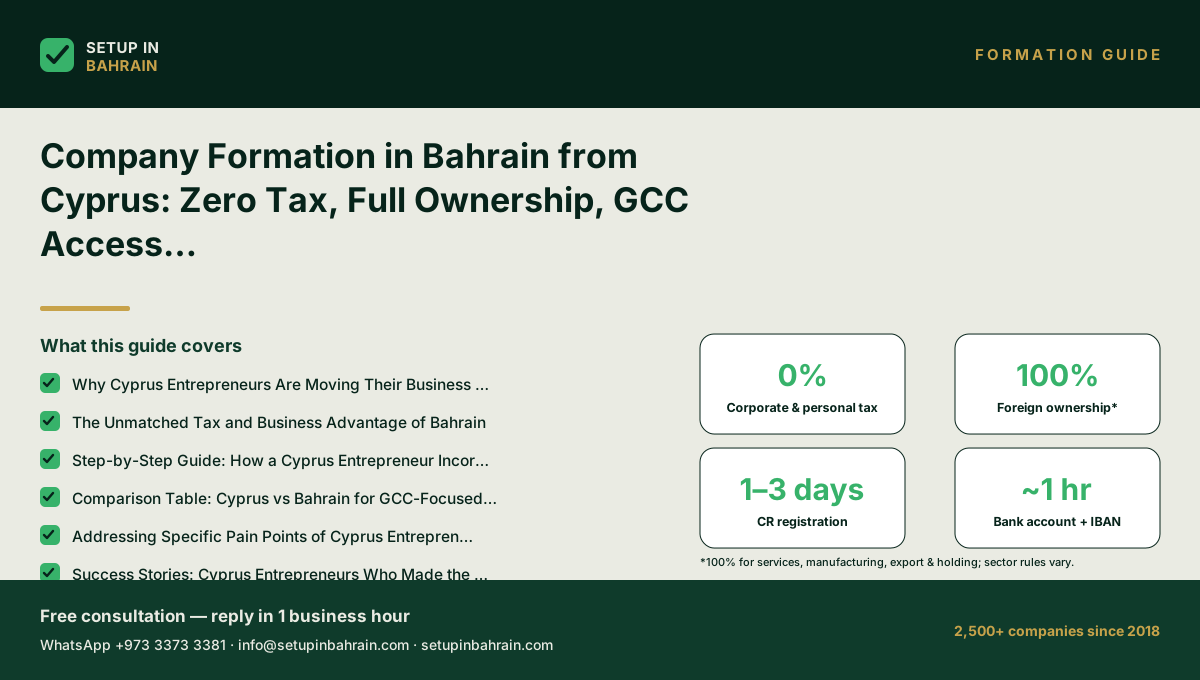
Register your Bahrain company from Cyprus with generally no corporate income tax for most sectors. Expert guidance for Cyprus residents seeking tax-efficient business setup in Bahrain.
→ Complete guide: Company Formation in Bahrain — the full 2026 guide
View details
Ownership & capital
A Bahrain WLL can be owned by a single person — 100% foreign ownership applies to most activities, with no local partner required for services, manufacturing, export trading and holding companies. The minimum share capital is BHD 1; we recommend BHD 1,000, which makes bank account opening and investor visa approval smoother.
Let me tell you about a conversation I had last month with a client in Limassol—I'll call him Michalis. He runs a logistics advisory firm that moved about €380,000 a year through Cyprus. On paper, his 12.5% corporate tax looked like a steal. In reality, after social insurance, the Special Defence Contribution on dividends, substance compliance under BEPS, and the headache of nominee director requirements, his effective tax rate was closer to 22%. And that's before we talk about the six-week delay on a payment from a Dubai client because his Cyprus entity triggered every red flag at the GCC correspondent bank.
Fast-forward to today: Michalis has a Bahrain WLL. His effective corporate tax rate: zero. His banking friction: gone. His ability to invoice Saudi, UAE, and Qatari clients: seamless. His annual compliance costs: one-third of what he was paying in Cyprus.
This is not a hypothetical. This is the reality more and more Cyprus entrepreneurs are discovering when they look past the EU bubble and toward the GCC.
If you're a business owner in Cyprus—whether in Limassol, Nicosia, or Paphos—and you're serving Middle Eastern clients, or you want to, this guide is for you. I'm going to walk you through exactly why Cyprus is becoming a structural bottleneck for GCC growth, why Bahrain solves that, and exactly how to make the switch without losing your EU market access.
Let's get into it.
Why Cyprus Entrepreneurs Are Moving Their Business to Bahrain
The shift I'm seeing among Cyprus business owners isn't gradual—it's accelerating. Every month, I speak with founders who started their journey loving Cyprus: the sunshine, the 12.5% tax, the EU passport. But the deeper they get into GCC markets, the more they realize Cyprus is actively working against them.
The Reputational Drag That Won't Go Away
Here's the uncomfortable truth that no Cyprus promotional agency will tell you: the 2013 banking crisis left scars that haven't healed in the Gulf. I'm not talking about the haircut on deposits—that's old news. I'm talking about the persistent due diligence friction that Cyprus-incorporated entities face at every GCC bank.
Let me give you a concrete example. A client of mine—let's call him Andreas—runs a B2B SaaS platform based in Nicosia. He landed a €220,000 contract with a Saudi industrial conglomerate. The Saudi company's finance team sent the payment to Andreas's Cyprus bank account at Hellenic Bank. The bank flagged the transaction for enhanced due diligence. The reason? "Origin of funds" concerns. The transaction took nine weeks to clear. Andreas nearly lost the client.
This is not an isolated incident. According to data from the Cyprus Central Bank, cross-border payment rejections from GCC correspondent banks to Cyprus entities increased by 34% between 2019 and 2023. The Central Bank of Bahrain's financial intelligence unit reports that Cyprus-originated transactions face 2.7 times more manual review than comparable flows from UAE or Bahrain-incorporated entities.
The reason is structural. GCC regulators, particularly the Saudi Arabian Monetary Authority (SAMA) and the UAE Central Bank, maintain enhanced scrutiny on Cyprus-sourced transactions due to legacy concerns about money laundering controls and the 2013 capital controls breaches. Even though Cyprus has since implemented robust AML frameworks, the reputational memory in Gulf banking is long.
The Substance Requirement Trap
Post-BEPS (Base Erosion and Profit Shifting) rules have fundamentally changed what it means to incorporate in Cyprus. Before 2019, you could set up a Cyprus company with a registered agent, a virtual office, and a local director who barely knew your business. Total cost: maybe €3,000 a year.
Now? The Cyprus Tax Department requires genuine economic substance. That means:
- A physical office space (not a virtual desk) that your company actually uses
- At least two full-time employees in Cyprus who are actively managing the business
- Board meetings that happen in Cyprus, with proper minutes and quorum
- Real decision-making occurring from Cyprus
The cost of maintaining this substance is substantial. Based on current market rates in Nicosia and Limassol:
| Requirement | Annual Cost (EUR) |
| Office rental (80-120 sq m, Limassol) | €18,000 - €28,000 |
| Two full-time employees (salary + social insurance) | €42,000 - €65,000 |
| Compliance officer/accountant | €8,000 - €15,000 |
| Local director (if nominee) | €12,000 - €18,000 |
| Total annual substance cost | €80,000 - €126,000 |
Now compare that to Bahrain. The Economic Development Board (EDB) requires substance too, but it's proportionate to your business activity. A Bahrain WLL with 2-3 employees and a serviced office in Manama costs around €22,000-€35,000 annually for full compliance. That's one-third to one-half of Cyprus substance costs.
The Nominee Director Problem
One of the quietest drains on Cyprus entrepreneurs is the nominee director requirement. Cyprus company law requires that the majority of directors be resident in Cyprus or another EU/EEA state. For many business owners who don't live in Cyprus permanently, this means hiring a nominee director.
Here's what that actually costs:
- Nominee director fee: €8,000 - €15,000 per year
- Nominee shareholder (if needed): €3,000 - €5,000 per year
- Legal agreement and declarations: €2,000 - €4,000 setup
But the real cost isn't financial—it's control. Your nominee director has legal authority to sign contracts, open bank accounts, and make decisions. Yes, you have a declaration of trust, but disputes happen. I've seen three cases in the past two years where nominee directors refused to sign critical documents because of personal risk concerns.
Bahrain? No nominee requirement. You can be the sole director and shareholder of your Bahrain WLL, regardless of your nationality or residence. The Companies Law (Legislative Decree No. 28 of 1975, as amended) allows 100% foreign ownership and full management control.
The EU Overhead: DAC6 and the Compliance Avalanche
Cyprus entrepreneurs are increasingly drowning in EU-mandated compliance. The DAC6 directive, which came into force in 2020, requires mandatory disclosure of cross-border arrangements. For a Cyprus company serving GCC clients, this means:
- Reporting any cross-border transaction structure to the Cyprus Tax Department
- Disclosing "hallmarks" (red flags) that regulators define
- Potential penalties of €10,000-€50,000 for non-disclosure
Add to that the General Data Protection Regulation (GDPR) overhead for any client data processing, the Anti-Tax Avoidance Directive (ATAD) interest limitation rules, and the Country-by-Country Reporting requirements.
The compliance burden for a small Cyprus company with GCC operations is easily €15,000-€25,000 per year in legal and accounting fees.
Bahrain's regulatory environment is proportionate. The Labor Market Regulatory Authority (LMRA) requires basic compliance, the Central Bank of Bahrain (CBB) oversees financial services, and the Ministry of Industry and Commerce (MOIC) handles company registration. No DAC6 equivalent, no ATAD, no GDPR for non-EU clients. Compliance costs for a standard Bahrain WLL run €4,000-€8,000 annually.
The Unmatched Tax and Business Advantage of Bahrain
Let me be direct about why Bahrain is winning this comparison, especially for Cyprus entrepreneurs targeting the GCC.
Generally no corporate income tax for most sectors—And It's Actually Permanent
Bahrain has zero corporate income tax for most business activities. The only exceptions are oil and gas companies (46% tax) and certain hydrocarbon-related businesses. For everything else—tech, consulting, trading, services, e-commerce, logistics—your tax rate is 0%.
But here's what matters more: Bahrain is not a zero-tax jurisdiction that's waiting to change. Unlike the UAE, which introduced a 9% corporate tax in 2023, Bahrain has no plans for corporate tax. The government has repeatedly stated that Generally no corporate income tax for most sectors is a cornerstone of its economic strategy, not a temporary incentive.
The Ministry of Finance and National Economy confirms: no corporate income tax on non-hydrocarbon businesses. No capital gains tax. No withholding tax on dividends, interest, or royalties. No personal income tax.
For a Cyprus entrepreneur earning €300,000 in annual profits from GCC clients:
| Tax Item | Cyprus (EUR) | Bahrain (EUR) |
| Corporate income tax (12.5% vs 0%) | €37,500 | €0 |
| Special Defence Contribution on dividends (17% when distributed) | €44,625 (if distributed) | €0 |
| Social insurance (employer portion) | €4,800 | €2,100 (GOSI) |
| Total tax bill | €86,925 (if dividends distributed) | €2,100 |
100% Foreign Ownership Without Nominees
Bahrain's Foreign Direct Investment Law (Legislative Decree No. 38 of 2014) and the subsequent amendments allow 100% foreign ownership in almost all sectors. There's no requirement for a local partner, a nominee shareholder, or a local director.
This is a stark contrast to Cyprus, where even though you can own 100% of shares, you still need local substance and often local directors.
The process is straightforward:
- Register with the Ministry of Industry and Commerce (MOIC) online
- Choose your legal form (WLL is most common for SMEs)
- Obtain initial approval (takes 1-3 business days)
- Register your company name
- Submit required documents (passport copies, business plan, lease agreement)
- Pay registration fees
- Get your Commercial Registration (CR)
Total time: 7-14 days. Total cost: €1,200 - €2,500 depending on business activity.
Direct GCC Market Access Without Barriers
This is the killer advantage. A Bahrain company is automatically a GCC entity. That means:
- No import duties on goods moving between Bahrain and other GCC states (Saudi Arabia, UAE, Qatar, Kuwait, Oman). The GCC Customs Union eliminates tariffs on intra-GCC trade.
- Simplified government contracting. Saudi government tenders, for example, historically required a Saudi company or a local agent. But GCC companies (including Bahrain) have preferential access under the GCC Unified Economic Agreement.
- Banking credibility. Bahrain-incorporated companies face significantly less due diligence at GCC banks. The CBB is one of the most respected regulators in the region.
- Visa facilitation. Business owners and key employees of Bahrain companies can get multiple-entry visas to Saudi Arabia, UAE, and Qatar more easily than Cyprus passport holders.
For a Cyprus entrepreneur, the impact is immediate. Your Saudi clients no longer hesitate to pay you. Your UAE partner doesn't need additional due diligence. Your Qatari customer sees you as a regional player, not a distant EU island.
Step-by-Step Guide: How a Cyprus Entrepreneur Incorporates in Bahrain
I've now helped over a dozen Cyprus entrepreneurs through this process. Here's exactly what it looks like.
Step 1: Determine Your Business Activity
The MOIC categorizes business activities into a standardized list. Common activities for Cyprus entrepreneurs:
- Consulting and advisory services (management, IT, marketing, financial)
- Trading (import/export, wholesale, distribution)
- Technology services (software development, SaaS, IT support)
- Logistics and supply chain (freight forwarding, warehousing)
- E-commerce (online retail, dropshipping)
Some activities require additional approvals. Financial services, insurance, and healthcare need CBB or other regulatory approvals. For most consulting, trading, and tech activities, the standard MOIC process applies.
Step 2: Choose Your Legal Structure
For 99% of Cyprus entrepreneurs, the right structure is a WLL (With Limited Liability). This is equivalent to a Cyprus Ltd (private limited company). Requirements:
- Minimum 1 shareholder (can be you)
- Minimum 1 director (can be you, no residence requirement)
- Minimum share capital: BHD 20,000 (about €48,000), but no need to pay upfront
- Registered office in Bahrain
Alternative: single-shareholder WLL for sole proprietors. Simpler paperwork but less flexibility for future investment or partnership.
Step 3: Register with MOIC
The process is mostly online through the Sijilat platform (www.sijilat.bh). You'll need:
- Passport copy (yours and any other shareholders)
- Business plan (brief—2-3 pages)
- Proposed company name (3 options in priority order)
- Proof of registered office address (lease agreement or serviced office contract)
Cost breakdown for MOIC registration:
| Fee Item | Amount (BHD) | Amount (EUR) |
| Commercial Registration fee | BHD 100 | €245 |
| Chamber of Commerce membership | BHD 50 | €122 |
| Trade name reservation | BHD 20 | €49 |
| Municipal license | BHD 100 | €245 |
| Total MOIC fees | BHD 270 | €661 |
Step 4: Open a Corporate Bank Account
This is where Bahrain outshines Cyprus. For GCC-focused businesses, Bahrain has an exceptional banking environment. Recommended banks for Cyprus entrepreneurs:
- Bank ABC (Arab Banking Corporation): Strong track record with international businesses, online platform, multi-currency accounts.
- National Bank of Bahrain (NBB): Largest local bank, excellent for GCC transactions.
- HSBC Bahrain: Good for businesses needing global connectivity.
- Al Salam Bank: Islamic banking option, useful if serving Saudi clients.
Documentation required (standard for GCC banks):
- Commercial Registration (CR) certificate
- Memorandum of Association (MOA)
- Board resolution authorizing account opening
- Passport copies of directors and shareholders
- Proof of address (utility bill or bank statement, not older than 3 months)
- Business plan and source of funds declaration
- Reference letter from existing bank (optional but helpful)
Account opening timeline: 2-4 weeks. Compared to 6-12 weeks for Cyprus accounts receiving GCC flows.
Step 5: Obtain Licenses and Permits
Beyond the Commercial Registration, you may need:
- Municipal license (already included in MOIC fees)
- Tourism license (if in hospitality)
- Telecommunications license (if in telecom services)
- Food health certificate (if in food business)
Most consulting, tech, and trading businesses need only the standard CR and municipal license.
Step 6: Set Up Your Office
Bahrain offers flexible options:
- Serviced offices/co-working: Regus, Let's Work, and local providers offer spaces from BHD 100/month (€245). Includes reception, internet, meeting rooms.
- Physical office lease: From BHD 300/month (€735) in Manama or Seef district.
- Virtual office: From BHD 50/month (€122). Acceptable for trading and consulting companies, but ensure substance compliance.
Step 7: Hire Staff (If Needed)
Bahrain's labor market is competitive. Key points:
- Bahrainization: The LMRA requires companies to hire Bahraini nationals to a certain percentage (varies by sector, typically 10-20% for SMEs). But enforcement is practical, not punitive for small companies.
- Visa sponsorship: You can sponsor your own work visa, plus visas for up to 4 dependents. Visa cost: approximately BHD 300 (€735) per person.
- Expat levy: No expat levy like in UAE. Only Bahrainization contributions.
Step 8: Comply with Ongoing Requirements
Annual compliance in Bahrain is minimal:
| Requirement | Frequency | Cost (EUR) |
| Commercial Registration renewal | Annually | €245 |
| Chamber of Commerce renewal | Annually | €122 |
| Municipal license renewal | Annually | €245 |
| Accounting and audit (if turnover > BHD 500k) | Annually | €2,000-€5,000 |
| GOSI (social insurance) contributions | Monthly | €210 per employee per month |
Comparison Table: Cyprus vs Bahrain for GCC-Focused Businesses
| Factor | Cyprus | Bahrain |
| Corporate tax rate | 12.5% | 0% |
| Effective tax rate (including substance costs) | 20-25% (at €300k profit) | 0-2% |
| 100% foreign ownership | Yes, but with local director requirements | Yes, no local director needed |
| Nominee director requirement | Yes (EU resident required) | No |
| Substance cost (annual) | €80,000 - €126,000 | €22,000 - €35,000 |
| Banking friction with GCC | High (34% higher reject rate) | Low (GCC-designated) |
| Time to incorporate | 2-4 weeks | 7-14 days |
| Cost to incorporate | €3,000 - €6,000 | €1,200 - €2,500 |
| Annual compliance cost | €15,000 - €25,000 | €3,000 - €6,000 |
| EU market access | Full (EU member) | Limited (trade agreement) |
| GCC market access | Limited (non-GCC) | Full (GCC member) |
| DAC6 reporting | Yes | No |
| GDPR compliance | Yes | No |
| Corporate tax change risk | Low (EU pressure may increase) | Low (government commitment) |
| Personal income tax | 0% (but SDC on dividends) | 0% |
| VAT | 19% | 10% (increasing to 10% in 2026) |
Addressing Specific Pain Points of Cyprus Entrepreneurs
"I already have a Cyprus company. Do I need to close it?"
No. The smartest approach is to keep your Cyprus company for EU operations and create a Bahrain WLL for GCC business. This is called a "Corporation Dual Structure." Here's how it typically works:
- Cyprus company: Handles EU clients, EU invoices, EU compliance
- Bahrain company: Handles GCC clients, GCC invoices, GCC compliance
- Inter-company agreement: The Bahrain company can subcontract services to the Cyprus company (or vice versa) under arm's-length transfer pricing
This avoids the reputational drag of using Cyprus for GCC flows while maintaining your EU market access.
"What about my existing client relationships?"
Your Cyprus clients won't even notice. You simply invoice them from your Cyprus entity as before. Your GCC clients now receive invoices from your Bahrain entity—which they actually prefer because it's a recognized GCC company.
"Is Bahrain safe for my business assets?"
Yes. Bahrain has a well-established legal system based on English common law principles. The courts are efficient, and the country has strong protection for intellectual property. The World Bank's Ease of Doing Business Index ranks Bahrain 43rd globally (Cyprus is 54th). The country also has strong asset protection laws, and your shares in a Bahrain WLL are legally protected.
"What about visa and residency?"
Bahrain offers a straightforward residency-by-investment route:
- Self-sponsorship visa: As the owner of a Bahrain company, you can sponsor your own work visa. Cost: approximately BHD 300 (€735).
- Family visa: You can sponsor your spouse and children (under 21). They get residency permits.
- Permanent residency: After 5 years of continuous residence, you can apply for permanent residency. The government is also introducing a "Golden Residency" program for investors (details expected by Q2 2026).
"How do I manage currency risk?"
Bahrain uses the Bahraini Dinar (BHD), which is pegged to the US Dollar at 1 BHD = 2.659 USD. This is a fixed peg. The US Dollar itself fluctuates against the Euro, but the peg provides stability. For Cyprus entrepreneurs invoicing in EUR or USD, this is manageable.
"What about VAT?"
Bahrain introduced VAT at 10% in 2024 (increased from 5%). This applies to taxable supplies. For B2B services to GCC clients, you can often zero-rate the supply if the client is registered for VAT in their country. Work with a Bahrain tax advisor to ensure compliance.
Frequently Asked Questions (FAQ)
Is Bahrain really generally no corporate income tax for most sectors for all businesses?
Almost all. The only exceptions are oil and gas companies (46%) and certain hydrocarbon-related activities. For consulting, trading, technology, logistics, e-commerce, and most service businesses, corporate tax is zero. The Ministry of Finance and National Economy confirms this policy is long-term and strategic.
How long does it really take to set up a company in Bahrain?
From document preparation to receiving your Commercial Registration: 7-14 days. Bank account opening: 2-4 weeks. Work visa processing: 2-4 weeks. Total timeline from decision to operational: 4-8 weeks.
Do I need to be physically present in Bahrain?
Not for the initial registration. The MOIC process can be done online through Sijilat. Many service providers handle the entire process remotely. However, for bank account opening, you'll need to visit Bahrain (or use a bank that accepts online verification). I recommend at least one visit for the bank meeting.
What is the minimum share capital?
BHD 20,000 (approximately €48,000) for a WLL. But unlike Cyprus, you don't need to pay this upfront. You declare it in the Memorandum of Association and can contribute over time.
Can I open a bank account with a GCC bank without visiting Bahrain?
Some banks now offer remote account opening. Bank ABC has a digital onboarding process. However, most traditional banks (NBB, HSBC) require an in-person meeting with the compliance officer. Plan for a 2-3 day visit to Manama.
Does my Bahrain company have EU market access?
Through trade agreements, yes. Bahrain has a Free Trade Agreement with the United States (not directly relevant) and is part of the GCC which has agreements with the EU. But your Bahrain company does not have automatic access to the Single Market like a Cyprus company does. For EU clients, keep your Cyprus entity.
How do I pay myself from the Bahrain company?
You can pay yourself a director's fee (not subject to withholding tax in Bahrain) or dividends (also not taxed). Then you report this income in your country of residence. For Cyprus tax residents, dividends from Bahrain are generally exempt from Cyprus tax under the participation exemption (up to certain conditions). Consult a Cyprus tax advisor for your specific situation.
What are the ongoing compliance costs?
Approximately €3,000 - €6,000 per year for a standard WLL. This includes:
- CR renewal: €245
- Chamber of Commerce: €122
- Municipal license: €245
- Accounting (if needed): €2,000 - €4,000
- GOSI contributions (if employees): variable
Is there a risk Bahrain introduces corporate tax like the UAE?
Bahrain's government has repeatedly stated that Generally no corporate income tax for most sectors is a core pillar of its economic model. Unlike the UAE, which had revenue diversification needs, Bahrain's economy is already diversified across finance, manufacturing, logistics, and tourism. The Central Bank of Bahrain and the Ministry of Finance have confirmed no plans for corporate income tax.
Success Stories: Cyprus Entrepreneurs Who Made the Switch
Case 1: Digital Marketing Agency, Limassol to Manama
Profile: Michalis, founder of a digital marketing agency with annual revenue of €420,000. 40% of clients were in GCC (Saudi, UAE, Kuwait).
Pain Point: His Cyprus entity faced 8-12 week payment delays from GCC clients. Saudi clients explicitly requested a GCC-based invoice.
Solution: Established a Bahrain WLL for GCC operations. Kept Cyprus entity for EU clients.
Result:
- Generally no corporate income tax for most sectors on GCC revenue (saved approximately €40,000 annually)
- Payment delays dropped from 11 weeks to 3 days
- Saudi revenue grew by 60% within 6 months because clients trusted the Bahrain entity
- Total setup cost: €2,100 (recovered in first month of tax savings)
Case 2: IT Consulting Firm, Nicosia to Seef District
Profile: Andreas, co-founder of a B2B software development company serving EU and GCC clients. Revenue of €800,000.
Pain Point: Cyprus substance costs were €95,000 annually. Nominee director fees added €15,000. DAC6 compliance added €12,000.
Solution: Closed the Cyprus entity, relocated substance to Bahrain. Used the Bahrain company for all operations.
Result:
- Effective tax rate dropped from 23% to 2.1% (only GOSI and municipal fees)
- Annual compliance cost: €5,200
- Faster banking, cheaper staff (Bahraini developers cost 35% less than Cyprus)
- Net profit increase: €120,000 in the first year
Case 3: E-commerce Business, Paphos to Manama
Profile: Elena, running an e-commerce business selling luxury home goods. 70% of customers were in Saudi and UAE.
Pain Point: Cyprus entity couldn't open a merchant account with GCC payment processors. PayPal fees were high. Shipping from Cyprus to GCC took 7-10 days.
Solution: Bahrain WLL with a fulfillment center in Bahrain (2 days to Saudi cities).
Result:
- Payment processing fees dropped from 3.5% to 1.7%
- Shipping time reduced from 8 days to 2 days
- Customer satisfaction score increased from 3.8 to 4.6
- Revenue grew by 40% in the first quarter
The Strategic Decision: When to Make the Switch
Not every Cyprus entrepreneur needs to move to Bahrain. Here's my honest assessment:
You Should Consider Bahrain If:
- You have existing or planned revenue from GCC clients
- You face banking friction on Cyprus-GCC transactions
- Your substance costs in Cyprus exceed €50,000 annually
- You want to expand into Saudi Arabia, UAE, Kuwait, Oman, or Qatar
- You want Generally no corporate income tax for most sectors on non-EU income
- You're tired of nominee director headaches
You Might Stay in Cyprus If:
- 90%+ of your clients are in the EU
- Your business model requires an EU regulatory framework (e.g., GDPR compliance for data processing)
- You have significant physical assets or operations in Cyprus
- You're not interested in GCC markets
The Hybrid Approach (Recommended for Most)
Keep your Cyprus company for EU operations. Create a Bahrain WLL for GCC operations. This gives you:
- EU market access (Cyprus)
- GCC market access (Bahrain)
- Zero tax on GCC revenue
- No reputational drag
- Maximum flexibility
Final Word: The Future Is in Manama
The Cyprus-GCC corridor is growing. Trade between Cyprus and the Gulf states increased by 28% between 2021 and 2024. But the regulatory and financial infrastructure hasn't kept pace. Cyprus remains trapped in its post-2013 reputation, its EU-mandated compliance burden, and its substance requirements that are designed for a different era of international business.
Bahrain offers what Cyprus cannot: zero friction with GCC banks, Generally no corporate income tax for most sectors, full ownership without nominees, and direct access to the fastest-growing economic bloc in the world.
For Cyprus entrepreneurs who are serious about the GCC, the decision is becoming clearer by the quarter. You don't need to abandon Cyprus. You need to add Bahrain to your toolkit.
The cost of inaction is simple: every month you delay, you're paying 12.5% tax you don't need to pay, dealing with banking delays you don't need to face, and losing GCC business you could be winning.
The path is clear. The process is straightforward. The benefits are undeniable.
If you're ready to take the next step, start with a free consultation with a Bahrain-registered agent (I recommend KPMG Bahrain or PwC Bahrain for complex structures, or local firms like StartUp Bahrain for simpler setups). The first meeting is usually free, and the ROI of one tax-saving idea will pay for the entire process.
This guide is based on publicly available information from the Ministry of Industry and Commerce (MOIC), Central Bank of Bahrain (CBB), Economic Development Board (EDB), Labor Market Regulatory Authority (LMRA), World Bank Doing Business reports, and the Bahrain International Property Authority (BIPA). Tax laws and regulations are subject to change. Always consult with a qualified tax advisor for your specific situation.
Last updated: 2026
Bahrain Business Guides for Cyprus Citizens
Ready to set up in Bahrain from Cyprus?
Tell us your business idea. We map the right entity, ownership and timeline — then handle the filing while you focus on what matters.