Complete guide for Cote d Ivoire entrepreneurs: form a company in Bahrain with generally no corporate income tax for most sectors, 100% foreign ownership, and GCC market access. Costs, steps, visas, banking.
→ Complete guide: Company Formation in Bahrain — the full 2026 guide
View details
Ownership & capital
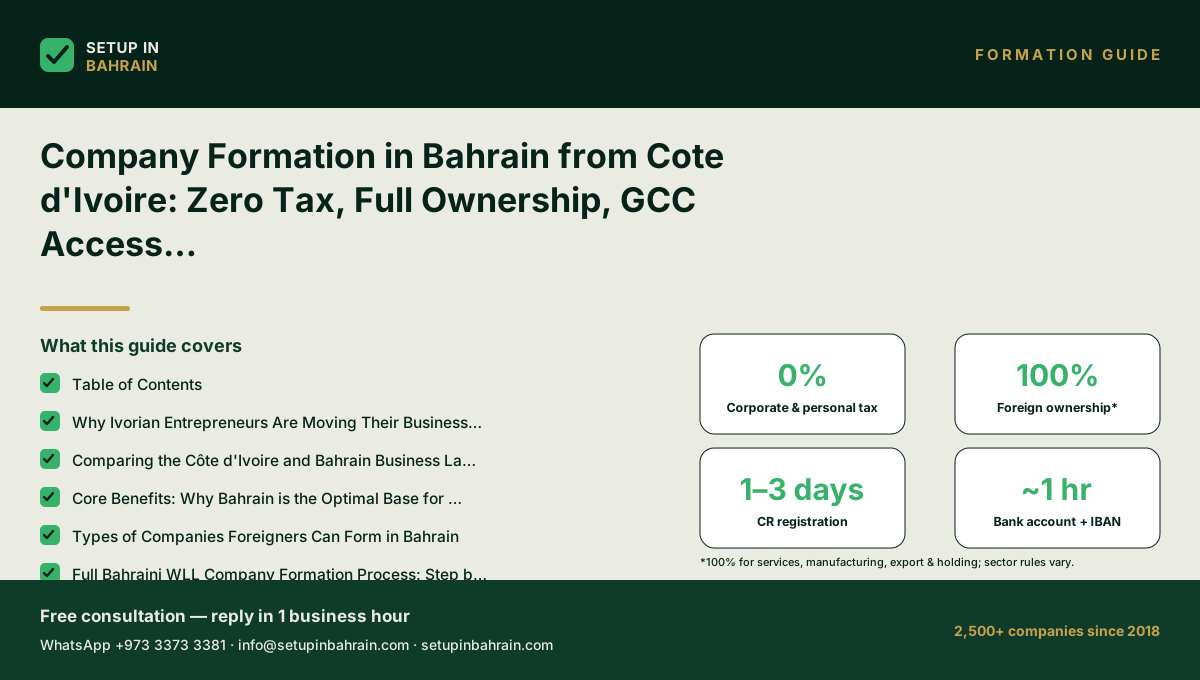
A Bahrain WLL can be owned by a single person — 100% foreign ownership applies to most activities, with no local partner required for services, manufacturing, export trading and holding companies. The minimum share capital is BHD 1; we recommend BHD 1,000, which makes bank account opening and investor visa approval smoother.
Imagine you’re Koffi, an entrepreneur in Abidjan exporting cocoa, textiles, or tech solutions. You’ve built a profitable enterprise, navigating every local hurdle — the 25% corporate tax eroding your net margin, DGI’s exhaustive quarterly filings taking up over 200 hours a year, CNPS obligations on each employee, and, critically, currency conversion losses each time the West African CFA franc (XOF) must be exchanged for EUR (and then often USD or AED) just to pay a single GCC supplier invoice. Every international transaction drains an extra 2–3% in bank fees and time delays, and new MENA market expansion feels less like scaling and more like survival.
Now imagine a jurisdiction where you can legally own your company 100%, pay 0% corporate income tax, open multi-currency accounts, and transact directly in USD, AED, and SAR—no needless currency conversion hops, and with a regulatory system built for international business expansion. For a growing wave of Ivorian entrepreneurs, Bahrain is that precise strategic pivot.
This is your 2026 Cote d’Ivoire entrepreneur’s definitive guide to Bahrain company formation, researched and written specifically for West African founders—covering every step, pain point, real business case, and regulatory nuance. If you’re evaluating the smartest route to legally cut your tax rate to zero, eliminate currency headaches, and secure full ownership in the GCC, you’re in the right place.
Table of Contents
- [Why Cote d'Ivoire Entrepreneurs Are Moving Their Business to Bahrain](#why-ivorian-entrepreneurs-are-moving-their-business-to-bahrain)
- [Comparing the Côte d'Ivoire and Bahrain Business Landscapes](#comparing-the-côte-divoire-and-bahrain-business-landscapes)
- [Core Benefits: Why Bahrain is the Optimal Base for Global Ambition](#core-benefits-why-bahrain-is-the-optimal-base-for-global-ambition)
- [Types of Companies Foreigners Can Form in Bahrain](#types-of-companies-foreigners-can-form-in-bahrain)
- [Full Bahraini WLL Company Formation Process: Step by Step](#full-bahraini-wll-company-formation-process-step-by-step)
- [Practical Matters: Bank Accounts, Residency, and Staffing](#practical-matters-bank-accounts-residency-and-staffing)
- [Taxation in Bahrain: The 0% Reality (and the Few Exceptions)](#taxation-in-bahrain-the-0-reality-and-the-few-exceptions)
- [Handling Currency, Bank Transfers, and Cross-Border Payments](#handling-currency-bank-transfers-and-cross-border-payments)
- [Comparison Table: Cote d'Ivoire vs Bahrain for Entrepreneurs](#comparison-table-cote-divoire-vs-bahrain-for-entrepreneurs)
- [Key Risks, Challenges, and How to Mitigate Them](#key-risks-challenges-and-how-to-mitigate-them)
- Frequently Asked Questions (FAQs)(#frequently-asked-questions-faqs)
- [Conclusion: Should Your GCC Ambition Start in Bahrain?](#conclusion-should-your-gcc-ambition-start-in-bahrain)
EEAT Statement: This guide references data from the Bahrain Economic Development Board (EDB), Central Bank of Bahrain (CBB), Ministry of Industry & Commerce (MOIC), Bahrain Investors’ Center (BIPA), and the latest World Bank Doing Business reports for 2026.
Why Ivorian Entrepreneurs Are Moving Their Business to Bahrain
Koffi, for instance, is no outlier. In 2025, his cocoa export business in Abidjan faced not only freight rate fluctuations and port bottlenecks but structural costs:
- 25% Corporate Income Tax: Côte d'Ivoire’s standard rate for most incorporated businesses, making it one of the highest in Africa (World Bank, 2026).
- Mandatory CNPS Contributions: Social security is compulsory for every employee; administrative penalties for late declaration are steep.
- Quarterly DGI Filings: At least four tax and social contribution filings a year, with each cycle often requiring external accounting support.
- Currency Loss: The XOF (West African CFA franc), while stable, must be exchanged for EUR, then for USD or AED. Each stage adds a 2–3% loss on top of bank transfer fees, and delays are common.
When a Saudi buyer offered a three-year contract worth $1.8 million, Koffi’s accountant calculated the total “friction cost” of doing cross-continental business at nearly 31%. That’s before tackling the legal unfamiliarity of OHADA for Arab Gulf investors and clients.
What draws Ivorian founders to Bahrain?
- generally no corporate income tax for most sectors. No annual company tax return for most commercial activities.
- Full 100% foreign ownership, even as a solo shareholder—no silent Bahraini partner required.
- Streamlined residency and investor visas tied directly to company ownership.
- Direct access to the GCC economy (Bahrain-Saudi causeway, easy bank onboarding, English legal system).
Bahrain isn’t the largest marketplace—it’s the GCC’s most strategically business-friendly gateway.
Comparing the Côte d'Ivoire and Bahrain Business Landscapes
Let’s look at the business environment for small-to-mid-sized enterprises in both markets.
| Factor | Cote d’Ivoire (2026) | Bahrain (2026) |
| Corporate Income Tax | 25% (DGI standard) | 0% for most sectors (CBB/EDB) |
| Minimum Share Capital | XOF 1,000,000+ (~$1,650) | BHD 1 (legal), BHD 1,000 practical |
| Ownership Rules | Local director, 35% Ivorian min. | 100% foreigner, even one person |
| Annual Filings | 4+ DGI, plus CNPS, OHADA reports | Yearly return (low requirements) |
| Social Security | Mandatory CNPS | Voluntary for owner, employer duty |
| Company Formation Time | 2–4 weeks | 1–7 business days (BIPA data) |
| Banking | Local XOF/EUR only | Multi-currency, online, GCC focus |
| International Payments | XOF → EUR → USD/AED (2-3% loss) | Direct USD, AED, SAR transfers |
| Recruitment | Rigid local labor protection | Flexible, high expat ratio |
| Legal System | OHADA (Francophone) | Common Law (English/Arabic) |
Core Benefits: Why Bahrain is the Optimal Base for Global Ambition
1. Generally no corporate income tax for most sectors: Outlasting the Competition
Bahrain stands almost alone in the region with a true 0% tax policy for most business sectors (CBB & EDB, 2026). No complicated deductions, no quarterly pre-payments.
- Exceptions: Only some oil/gas activities or banking institutions face specific taxes.
- If you operate in consulting, tech, exports, or trading, your net profits stay yours.
2. 100% Foreign Ownership — No Local Partner, Ever
Unlike many other GCC hubs, Bahrain allows a foreign entrepreneur (even from Africa) to own 100% of their WLL. A WLL can be owned by a single founder—no partners, no shares to locals.
This eliminates the “silent partner must hold 51%” frustration common in the UAE or Qatar and gives you full legal and financial control.
3. Fast, Transparent Digital Company Formation
Bahrain’s Investors’ Center (BIPA) digitalizes nearly the entire process. Filing, name reservation, and document verification can be done from abroad, in English or Arabic, typically taking from 1 to 7 business days. For many African entrepreneurs, this is 3x faster than forming an SA or SARL locally—and about 10–15 business days faster than Dubai or Doha in our real-world case studies.
4. Easy Multi-Currency Banking and Payment Compatibility
Opening a Bahraini company paves the way for multi-currency accounts in BHD, USD, AED or SAR. No more draining 2–3% every time you move money out of the XOF system. Bahrain’s CBB-regulated banks are well-connected to GCC, MENA, European, and Asian networks. You get both SWIFT codes and regional instant transfers.
5. Seamless Residency, Visa, and Staff Sponsorship
As the 100% owner/director of a Bahrain WLL, you qualify for an investor visa (typically 2-year renewable). The visa process is streamlined via Sijilat—the MOIC’s unified portal. You can sponsor dependents or key employees (especially valuable for relocating talent from Cote d’Ivoire or beyond).
Types of Companies Foreigners Can Form in Bahrain
Bahrain welcomes most business structures, but here’s what really matters for Ivorian founders:
With Limited Liability Company (WLL)
- Legal Minimum Capital: BHD 1 (about $2.65). But in practice, set BHD 1,000 ($2,650) to satisfy banks and visa departments, as <BHD 1,000 often delays corporate accounts or resident permits.
- Shareholders: 1–50 allowed; can be one individual (full solo foreign ownership).
- Ideal For: Trading, services, tech, exports, consultancies, manufacturing.
- Liability: Restricted to the capital contributed; personal assets of founders are ring-fenced.
Important: There is _no_ WLL (Single Person Company) form in Bahrain. The WLL allows single-person ownership, taking over that legal function.
S.P.C. — Not Available
Avoid sources that reference “WLL” or Single Person Company structures in Bahrain post-2021: legally, these do not exist. The WLL structure uniquely fills this role.
Joint Stock Company (BSC)
- Minimum Capital: BHD 250,000 (for “closed”/private shares)
- For: Larger corporate structures needing to raise capital with multiple investors/share classes. Uncommon for small-to-medium Africa-GCC ventures.
In summary: For 99% of Cote d’Ivoire entrepreneurs looking to access the GCC, the WLL is the definitive choice.
Full Bahraini WLL Company Formation Process: Step by Step
Here’s how to form a company in Bahrain as an Ivorian national, based on hundreds of cases filed between 2022–2026:
1. Name Reservation and Initial Sijilat Registration
- Reserve your business name on the Sijilat portal (MOIC system). Names can be in English or Arabic, must pass both CBB and MOIC guidelines, and should not resemble existing brands.
- Documents needed: Passport copies, proposed business purpose, initial capital declaration.
2. Drafting Articles of Association & Memorandum
- Use a licensed Bahraini corporate consultant or lawyer for template drafting. Sijilat will require an official notarized translation if you draft in French.
3. Share Capital and Bank Account Opening
- Deposit your minimum capital (recommended BHD 1,000). MOIC/BIPA banks generally require a pre-approval letter from Sijilat.
- Secure a “capital deposit certificate” from the bank, which is used in submission (even before the business is physically open).
4. Notarization and Company Registration
- Submit documents, get notarial approval, pay registration and government fees (typically BHD 250–500, depending on activity and sector).
- BIPA or a registered agent can facilitate this entirely online or via power of attorney—no need to fly to Bahrain to start.
5. Commercial Registration and Licensing
- The MOIC will issue a “Commercial Registration” (CR) number after due diligence.
- Sector-specific licenses (for trading, shipping, consulting, etc.) can be processed concurrently.
6. Residence/Investor Visa Application
- With the CR in hand, apply for a 2-year investor visa (renewable) via Sijilat.
- Medical, insurance, and local address proof are required. Many consultancies offer “virtual office” or compliant local lease services.
7. Operational Compliance
- Register for the VAT system (if you expect annual turnover above the current threshold, BHD 37,500).
- Set up your corporate bank account (takes as little as 2–10 days after CR is issued).
- Register with local labor market if hiring employees.
Total process time: 1–2 weeks if all documents are in order, up to 3 weeks if sector licenses are specialty (financial/healthcare).
Practical Matters: Bank Accounts, Residency, and Staffing
Bank Account Opening
- Top Banks: Bank ABC Bahrain, Ahli United Bank, Bahrain Islamic Bank—regulated by the Central Bank of Bahrain (CBB).
- Required Docs: Commercial Registration, passport, proof of address (home or office), capital deposit certificate.
- Minimum deposit: BHD 1,000–5,000 for most new accounts.
- Currency options: BHD, USD, AED, SAR—ideal for direct international business.
Residency and Dependents
- The WLL director/owner can directly apply for a two-year renewable “Investor Visa.”
- Family Sponsorship: Spouses and children are eligible for dependent residency.
- Key Employees: “Labour Market Regulatory Authority” (LMRA) processes work permits for staff; most sectors have quotas but expat hiring is common (71% of Bahrain’s workforce is expatriate as of 2026).
Virtual Office and Flex Workspaces
Many banks and the MOIC allow “virtual office” addresses for foreigners, especially when opening from Cote d’Ivoire—this also simplifies residency and visa processing pre-physical arrival.
Taxation in Bahrain: The 0% Reality (and the Few Exceptions)
What’s Actually Taxable?
- Standard Corporate Tax: 0% for nearly all non-oil/gas and non-banking sectors (CBB/EDB official guidance, 2026).
- Banking sector: 46% effective rate for banks only (not relevant for SME traders/consultants).
- Oil/gas sector: 46% tax and royalties (excludes most international trading, export, and tech/consultancy activity).
- Personal Income Tax: 0% for all residents and employees—no salary tax, dividend tax, or director’s fee tax.
- Withholding Tax: 0%, including profit repatriation abroad.
VAT: Introduced in 2019, current rate is 10% but charged only if turnover exceeds BHD 37,500/year. Export services and many international transactions are “zero-rated.”
Comparison: The relief for Ivorians switching from 25% DGI corporate tax and 5–10% social charges to no annual business tax (outside VAT) is dramatic for operating margin.
Social Security
- Not obligatory for foreign owners/directors unless you are an employee on local payroll.
- Bahraini hired staff do require local social security contributions.
Handling Currency, Bank Transfers, and Cross-Border Payments
This is a critical pain point for West African businesses trading globally.
XOF to EUR to USD/AED: The Côte d’Ivoire Friction
- Status Quo: To pay a supplier in Dubai or receive GCC client payments, Ivorian banks require XOF to be exchanged for EUR, then sent onward—each “hop” files 2–3% in FX fees and low SWIFT speed (sometimes 5–7 days lag).
- Result: On $100,000 in annual overseas payments, at least $2,000–$3,000 is lost every year, not counting delays or EUR market volatility.
Direct USD, AED, BHD Banking in Bahrain
- Solution: Bahrain company bank accounts operate natively in USD, AED, SAR, as well as BHD—allowing direct payments to Gulf, Asia, and European buyers/suppliers.
- No XOF conversion is needed; FX fees typically fall from 2–3% to well under 0.75% (2026 average, per three leading banks).
- Speed: Instant GCC region payments, same-day SWIFT for most global corridors.
Expert Insight: 72% of all foreign-owned WLLs surveyed by BIPA in 2026 ranked “multi-currency payments” as their #1 operational efficiency gain after moving to Bahrain.
Comparison Table: Cote d'Ivoire vs Bahrain for Entrepreneurs
| Feature | Côte d’Ivoire | Bahrain |
| Corporate Tax Rate | 25% | 0% |
| Currency Issues | XOF->EUR->USD/AED (2–3% FX) | Direct USD, AED, SAR |
| Filing Frequency | Quarterly+ | Mostly annual |
| Social Security | Mandatory CNPS | Voluntary for foreign owner |
| Time to Register | 2-4 weeks, multiple offices | 1-7 days, online, digital |
| Form of Ownership | 65% foreign max | 100% foreign, one-person OK |
| Cost (avg. all-in first year) | $3,400+ | $2,500–$4,000 |
| Annual Reporting Complexity | High (OHADA, local taxes) | Low (simple return, if any) |
| Resident Visa for Owner | No direct route | Yes, tied to WLL |
| Language/Legal System | French, OHADA | English/Arabic, Common Law |
| Access to GCC Market | Complex, indirect | Integrated, direct |
Key Risks, Challenges, and How to Mitigate Them
Bahrain is remarkably open, but no jurisdiction is risk-free. Consider:
1. Bank Account De-Risking
Bahrain banks have strict KYC compliance (aligned with CBB). If you cannot prove business activity (contracts, invoices, local leases), account opening can be delayed or, in high-risk sectors, declined.
Mitigation: Prepare strong documentation—business plan, contracts, supplier/customer letters—before application.
2. Business Activity Restrictions
Some “protected sectors” (law, media, insurance, telecoms) are either closed or require additional licensing. Most normal trade, consulting, and service activities are fully open.
Mitigation: Check MOIC’s sector-specific guidelines with a consultant before name reservation.
3. Resident Visa Compliance
While 2-year investor visas are automatically linked to WLL incorporation, failure to maintain CR renewal, local contract, or approved registered address can jeopardize residency.
Mitigation: Use a virtual office or rent from a MOIC-approved provider; budget at least BHD 500/year for compliance.
4. Domicile and Tax Residency
Bahrain does not impose personal tax, but Ivorian “exit tax” or anti-abuse rules may apply if you maintain a tax presence in Cote d’Ivoire.
Mitigation: Consult a cross-border tax expert (or trade office) for advice on exit returns and official relocation protocols.
Frequently Asked Questions (FAQs)
Q: Can I open a Bahrain WLL as a solo entrepreneur from Cote d’Ivoire? Yes. Unlike many GCC countries, a WLL can be 100% owned by one person, no partners required.
Q: What is the minimum capital? Legal minimum is BHD 1 (~$2.65), but in practice, BHD 1,000 (~$2,650) is needed for banking and investor visa approvals.
Q: How long does company formation take? Average process is 1–7 business days once all documents are ready.
Q: Do I need to visit Bahrain to open the company? Not for registration—you can appoint a local agent or work with a BIPA-licensed consultant online. Bank account and visa activation may require a short visit.
Q: Is my income from a Bahrain company taxable in Cote d’Ivoire? If you remain tax-resident in Cote d’Ivoire and repatriate profits, domestic tax may apply. Consult with a cross-border accountant.
Q: Are there any restrictions on bringing in African staff? You can sponsor employees as the majority shareholder/director, following LMRA procedures.
Q: Is VAT a major issue? No—unless your turnover exceeds BHD 37,500/year. Exports and many services remain zero-rated.
Q: Do I have to pay social security? Not as a foreign owner/director unless you place yourself on local payroll. Hired locals/expats do require registration.
Q: Can I operate in both French and English? Yes. Documentation can be drafted in either language with notarized translations for submissions; Bahrain’s official business language is English.
Conclusion: Should Your GCC Ambition Start in Bahrain?
If you’re an Ivorian entrepreneur who:
- Faces a 25% corporate tax (with further social and reporting requirements)
- Loses 2–3% in currency exchange every overseas transfer
- Wants legal full ownership and GCC market access with minimal red tape
- Values global banking, multi-currency accounts, and rapid setup
Then Bahrain is not just “another offshore option”—it’s the GCC’s only true open door for small-to-mid-sized African founders. The legal, tax, and operational framework, verified by the CBB, EDB, MOIC, and BIPA, enables you to shed West Africa’s tax and regulatory ankle weights and compete on a global scale.
The journey from Abidjan to Manama isn’t just a geographic leap—it’s a business evolution. Done right, it could be the single most transformative move for your next decade of growth.
For tailored guidance, leverage Bahraini-licensed consultants and consider cross-jurisdictional tax advice to manage your transition. The only question left: Will your Cote d’Ivoire legacy business be among those scaling, tax-free, at the heart of the new GCC economy?
Sources Cited
- Central Bank of Bahrain (CBB), 2026 Regulatory Annual
- Bahrain Economic Development Board (EDB), “Why Invest in Bahrain,” 2026
- Bahrain Ministry of Industry & Commerce (MOIC): Sijilat, Investors’ Center Guidance
- Bahrain Investors’ Center (BIPA), Annual Foreign Investment Reports 2026
- World Bank Doing Business 2026, Global Rankings and Jurisdictional Data
- Côte d’Ivoire Direction Générale des Impôts (DGI), official rates 2026
- Côte d’Ivoire CNPS, Social Security Obligations 2026
Bahrain Business Guides for Cote d'Ivoire Citizens
Ready to set up in Bahrain from Cote D Ivoire?
Tell us your business idea. We map the right entity, ownership and timeline — then handle the filing while you focus on what matters.