
Complete guide for Costa Rica entrepreneurs: form a company in Bahrain with generally no corporate income tax for most sectors, 100% foreign ownership. GCC market access. Costs, steps, visas, banking.
Key Takeaways
- Why Costa Rica Entrepreneurs Are Moving Their Business to Bahrain
- Understanding Bahrain's Business Landscape: A Strategic Overview
- Choosing the Right Legal Entity in Bahrain
- The Step-by-Step Company Formation Process in Bahrain
- Key Regulatory Bodies and Support Ecosystem
→ Complete guide: Company Formation in Bahrain — the full 2026 guide
View details
Ownership & capital
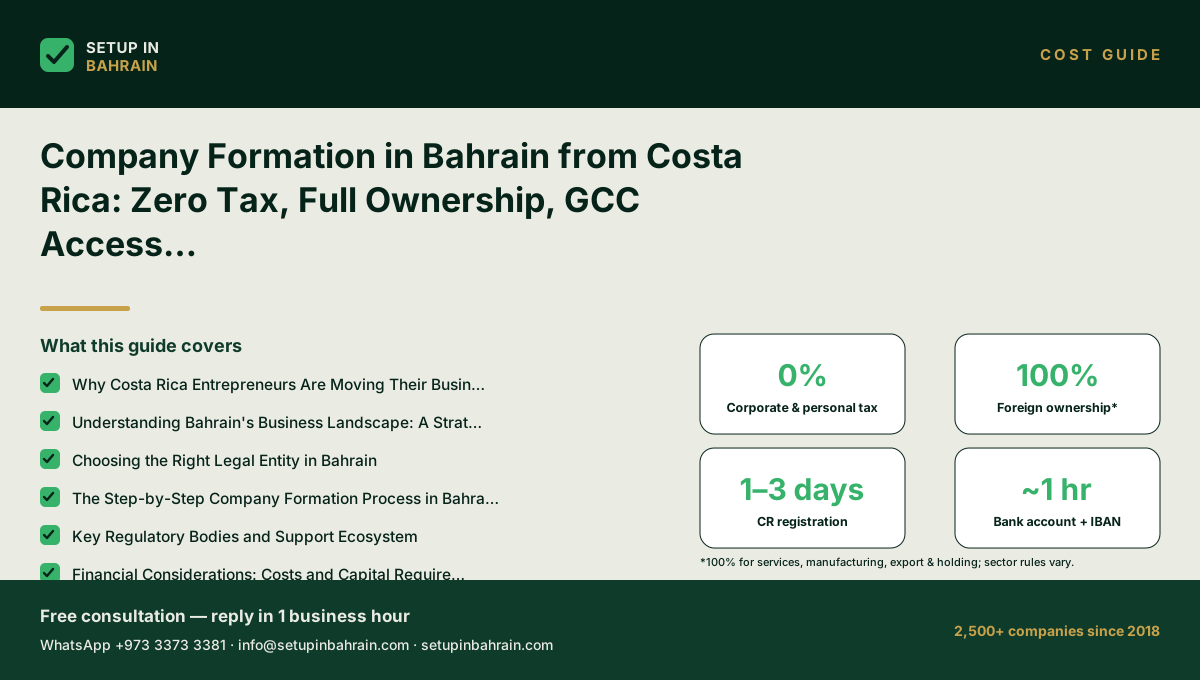
A Bahrain WLL can be owned by a single person — 100% foreign ownership applies to most activities, with no local partner required for services, manufacturing, export trading and holding companies. The minimum share capital is BHD 1 ; we recommend BHD 1,000 . This Makes bank account opening and investor visa approval smoother.
For many entrepreneurs in Costa Rica, the dream of scaling a business often comes with a persistent, nagging question: "Is there a better way?" A way to escape the heavy tax burden, the ever-present currency volatility, and the labyrinthine regulations that can stifle innovation and growth. You’ve poured your heart and soul into building something valuable, yet a significant portion of your hard-earned profits seems to vanish before it ever truly reaches your pocket, swallowed by taxes and mandatory contributions.
Imagine a business environment where the corporate income tax rate isn't 30% – or even 15% for smaller entities below a specific threshold – but a flat 0%. A place where you, as a foreign investor, can own 100% of your company without needing a local partner. A country whose currency is rock-solid, pegged directly to the US Dollar, eliminating the anxiety of constant depreciation. This isn't a distant fantasy; it's the reality offered by Bahrain, an island nation strategically positioned at the heart of the Arabian Gulf.
This comprehensive guide, specifically tailored for you, the Costa Rican entrepreneur, will unpack why Bahrain is fast becoming the preferred destination for visionary business owners seeking a truly growth-friendly ecosystem. We’ll cut through the noise, compare the realities of doing business in San José with the opportunities in Manama. Provide a clear, step-by-step roadmap to establishing your company in Bahrain in 2026 and beyond.
Why Costa Rica Entrepreneurs Are Moving Their Business to Bahrain
Let's start with a common scenario that resonates deeply with many Costa Rican business owners. Meet Carlos, a dynamic software developer from Escazú who built a thriving SaaS startup focused on sustainable tourism solutions. For years, Carlos has navigated the vibrant but challenging Costa Rican business landscape. His team is brilliant, his product is innovative, and his client base is growing internationally. Yet, despite his global success, a significant portion of his company's hard-earned revenue remains trapped within a system that seems to penalize growth.
Carlos recently described his situation: "After paying the standard 30% corporate income tax – or 15% for smaller entities below the threshold – and the mandatory 26.67% CCSS employer contribution, plus the Fondo de Capitalización Laboral severance fund, my effective take-home rate on profits hovered around 48%. Then, currency depreciation of the Costa Rican Colón (CRC), which has seen fluctuations of 5–8% annually against the US dollar in recent years, eroded whatever remained when I tried to hold reserves or plan for international expansion." This constant battle against tax erosion and currency volatility is a familiar refrain for many 'Pura Vida' entrepreneurs.
Now, contrast this with the landscape in Bahrain. Here, businesses enjoy a 0% corporate income tax rate. There are no mandatory employer social security contributions for foreign employees in the same vein as CCSS, greatly reducing the cost of retaining talent and expanding your team. The Bahraini Dinar (BHD) is firmly pegged to the US Dollar at a rate of 1 BHD = 2.6596 US Dollars, offering unparalleled financial stability and predictability for international transactions and capital preservation. This isn't just a marginal improvement; it's a fundamental shift that empowers businesses to reinvest more of their profits into innovation, talent, and market expansion, rather than watching them dissipate into various coffers.
The Stark Contrast: Taxes, Social Security, and Economic Stability
The divergence in fiscal and economic environments between Costa Rica and Bahrain is stark. It directly impacts the bottom line of any business.
Corporate Income Tax: In Costa Rica, the standard corporate income tax rate is a substantial 30%. While there's a reduced rate of 15% for small entities with gross income below a certain threshold (which can change. Was around CRC 109 million in previous years), many growing businesses quickly outgrow this. In Bahrain, the rate is a flat 0% across the board for most business activities, offering an immediate and profound advantage in terms of retained earnings and cash flow. This difference isn't merely theoretical; it can mean hundreds of thousands, if not millions, of dollars in additional capital available for your business to grow over its lifetime.
- Mandatory Social Security Contributions: For Costa Rican employers, the mandatory social security contributions to the Caja Costarricense de Seguro Social (CCSS) are a significant burden, currently standing at around 26.67% of an employee's salary. This adds a substantial overhead to every hire. While Bahrain does have social security contributions for Bahraini nationals and some requirements for employer contributions to the General Organization for Social Insurance (GOSI) for GCC nationals, these are typically not applicable to foreign expatriate employees. This translates into much lower operational costs for international teams and offers greater flexibility in workforce planning.
- Currency Depreciation and Volatility: The Costa Rican Colón (CRC) has experienced periods of significant depreciation against major international currencies, especially the US Dollar. As Carlos highlighted, annual depreciation of 5-8% can severely erode the value of reserves and impact the profitability of businesses dealing in international trade or holding foreign assets. This instability adds a layer of risk and complexity to financial planning. Bahrain, in contrast, offers the rock-solid stability of the Bahraini Dinar (BHD), pegged to the US Dollar. This eliminates currency risk for international transactions and provides certainty for financial projections, allowing entrepreneurs to focus on growth rather than hedging against currency fluctuations.
Digital Tax Platform Complexity (ATV): Costa Rica's digital tax platform, ATV (Administración Tributaria Virtual). An effort towards modernization, often presents a complex interface and compliance challenges for businesses. Navigating various forms, declarations. Updates can be time-consuming and require dedicated resources, especially for international businesses not fully familiar with the local nuances. Bahrain's regulatory environment, spearheaded by the Ministry of Industry, Commerce and Tourism (MOIC) and supported by the Economic Development Board (EDB), is streamlined and designed to be user-friendly for foreign investors. The Bahrain Investors Center (BIC) provides a single window for most business registration processes, minimizing bureaucratic hurdles.
Unlocking Market Access: The GCC Advantage
Beyond the immediate financial benefits, Bahrain offers a crucial strategic advantage that is virtually inaccessible from Costa Rica: direct and preferential access to the burgeoning markets of the Gulf Cooperation Council (GCC).
Carlos, the entrepreneur from Escazú, had no realistic path into Saudi Arabia’s massive $800 billion Vision 2030 projects because Costa Rica maintains almost no bilateral trade agreements or significant economic ties with the Kingdom. The logistical hurdles, visa requirements, and lack of established business networks make market entry prohibitively difficult.
Bahrain, but, is not just geographically close to Saudi Arabia (connected by the 25-kilometer King Fahd Causeway, one of the busiest land borders in the Middle East); it's an integral part of the GCC economic bloc. This membership grants businesses established in Bahrain preferential access to a market of over 57 million affluent consumers across Saudi Arabia, UAE, Qatar, Kuwait, and Oman.
Saudi Arabia's Vision 2030: This ambitious national transformation program, with its mega-projects like NEOM, Qiddiya. The Red Sea Project, represents an unprecedented opportunity for businesses in technology, construction, tourism, logistics, and many other sectors. Operating from Bahrain places you at the doorstep of this economic powerhouse, allowing for easier travel, networking. Direct engagement with Saudi businesses and government entities.
- GCC Common Market: The GCC offers a common market with free movement of goods, services, and capital. This means a company incorporated in Bahrain can often trade and operate across the GCC with greatly fewer barriers than a company based outside the bloc. For a Costa Rican entrepreneur, this opens up an entirely new revenue stream and a vast landscape for expansion that would otherwise be out of reach.
Bahrain as a Gateway: The Economic Development Board (EDB) actively promotes Bahrain as the ideal "gateway to the GCC" for international businesses. Its robust logistics infrastructure, strategic location. Business-friendly policies make it a perfect hub for regional operations, distribution, and service delivery across the entire Gulf. This isn't just about reducing costs; it's about unlocking entirely new growth avenues previously beyond your reach.
Understanding Bahrain's Business Landscape: A Strategic Overview
Bahrain has meticulously cultivated an environment that champions economic freedom, innovation, and ease of doing business. It's not just about tax incentives; it's about a holistic approach to attracting and retaining high-value businesses and talent.
Why Bahrain? Key Advantages for Foreign Investors
Beyond the compelling tax and market access points, Bahrain presents a suite of advantages that position it as a premier destination for international entrepreneurs:
100% Foreign Ownership: This is a cornerstone of Bahrain's appeal. Unlike some jurisdictions where local partners are mandatory, in Bahrain, you can own 100% of your company in most sectors. This gives you complete control over your business strategy, profits. Intellectual property – a crucial factor for any entrepreneur. For Costa Rican business owners accustomed to complex local ownership regulations, this simplicity is a breath of fresh air. No Personal Income Tax: While we’ve covered corporate tax, it’s worth reiterating that Bahrain also imposes zero personal income tax on salaries, wages, and other forms of personal income. This greatly increases the take-home pay for you and your employees, making Bahrain an attractive location for talent. Low Operating Costs: Compared to other major business hubs in the GCC and globally, Bahrain offers highly competitive operating costs. This includes commercial rents, utilities. A generally lower cost of living, which translates into reduced overhead for your business. The EDB frequently highlights Bahrain's cost-effectiveness as a key differentiator. Highly Skilled Workforce: Bahrain has a well-educated, bilingual (Arabic and English-speaking) workforce, with a strong emphasis on developing local talent in technology, finance, and other key sectors. The government, through initiatives like Tamkeen (the Labor Fund), actively invests in training and upskilling its citizens, ensuring a ready supply of qualified professionals. Regulatory Transparency and Efficiency: The government is committed to maintaining a transparent and efficient regulatory framework. The Bahrain Investors Center (BIC) exemplifies this, providing a single point of contact for company registration and licensing, greatly simplifying bureaucratic processes. The Central Bank of Bahrain (CBB) maintains a world-class regulatory framework for financial services, fostering trust and stability. Support for Startups and SMEs: Bahrain has a vibrant startup ecosystem, supported by various incubators, accelerators. Government initiatives. Organizations like the Bahrain Economic Development Board (EDB) and Tamkeen actively promote entrepreneurship and provide funding, mentorship. Support services to new and growing businesses.
Economic Freedom and Openness
The Heritage Foundation's Index of Economic Freedom consistently ranks Bahrain highly, recognizing its commitment to open markets, property rights. Regulatory efficiency. This translates into a business environment where entrepreneurs can operate with confidence, knowing their investments are secure and the rules are clear. The government actively engages with the private sector to refine policies and remove barriers to growth.
Strategic Location and Connectivity
Located at the heart of the Arabian Gulf, Bahrain acts as a natural hub for regional and international trade. Its well-developed port (Khalifa Bin Salman Port), international airport (Bahrain International Airport). Advanced telecommunications infrastructure ensure seamless connectivity. The King Fahd Causeway to Saudi Arabia further solidifies its position as a logistical gateway. For businesses serving clients across the Middle East, North Africa. Even parts of Asia, Bahrain's location is an undeniable asset.
Digital Transformation and Innovation Hub
Bahrain is aggressively pursuing digital transformation across all sectors. It was among the first in the region to adopt cloud-first policies and embrace emerging technologies like FinTech, blockchain. AI. Initiatives such as the FinTech Bay and numerous tech parks provide a fertile ground for innovation. This focus on digital advancement means that businesses operating in Bahrain benefit from cutting-edge infrastructure, a digitally literate workforce. A supportive ecosystem for technological development.
Quality of Life and Expat Experience
Beyond business, Bahrain offers a high quality of life for expatriates. It's known for its welcoming culture, multicultural society, safety, and excellent healthcare and education systems. The cost of living, especially for housing and amenities, is generally lower than in neighboring GCC countries like the UAE or Qatar. Certainly more affordable than many parts of Western Europe or North America, while still offering a cosmopolitan lifestyle. This makes it an attractive place for entrepreneurs to relocate themselves and their families.
Choosing the Right Legal Entity in Bahrain
Navigating the various legal structures is a crucial first step. For most foreign entrepreneurs from Costa Rica, the With Limited Liability Company (WLL) will be the most suitable and recommended option.
The Workhorse: With Limited Liability Company (WLL)
The WLL is the most popular choice for foreign investors in Bahrain, offering a robust and flexible structure.
Ownership: A key advantage of the WLL in Bahrain is that it can be 100% owned by a single individual , with zero partners required . This is a critical distinction that provides sole entrepreneurs complete control and eliminates the need to find or manage local shareholders. This Can be a complex requirement in other jurisdictions. This means you, as a Costa Rican entrepreneur, can be the sole owner and director of your Bahraini company.
- Capital: Legally, the minimum share capital for a WLL in Bahrain is a symbolic BHD 1. But, it is crucial to understand that while BHD 1 meets the bare legal requirement, it is practically insufficient for establishing a functioning business. For practical purposes, such as successfully opening a corporate bank account and securing an investor visa, we strongly recommend a minimum practical starting capital of BHD 1,000. This amount signals serious intent and financial stability to banks and immigration authorities, greatly smoothing the post-registration processes.
- Liability: As the name suggests, the liability of shareholders in a WLL is limited to their share capital contributions. This protects your personal assets from the company's debts and obligations, a fundamental benefit of incorporation.
Activities: A WLL can engage in a wide range of commercial, industrial. Service activities, subject to specific licensing requirements for regulated sectors (e.g., financial services, healthcare).
- No single-shareholder WLL: It is important to reiterate: there is NO single-shareholder WLL legal entity in Bahrain. While a WLL can be 100% owned by a single person, you should always refer to it as a WLL, not a single-shareholder WLL, to avoid confusion and ensure compliance with Bahraini company law.
Other Options: Partnership Company, Branch of a Foreign Company
While less common for individual entrepreneurs setting up a new venture, other legal structures exist:
Partnership Company: Suitable if you are forming a business with one or more partners and desire a simpler structure. It generally involves unlimited liability for partners. Not typically recommended for foreign investors seeking limited liability. Branch of a Foreign Company: If you already have an established company in Costa Rica and wish to extend its operations into Bahrain, a branch office might be an option. A branch has no independent legal personality and is fully dependent on the parent company. This can be complex and is usually considered for larger corporations. Holding Company: Bahrain is also an attractive jurisdiction for establishing holding companies due to its favorable tax regime and legal framework for corporate structures.
For the vast majority of Costa Rican entrepreneurs aiming for full ownership, limited liability. Ease of setup, the WLL remains the clear front-runner.
The Step-by-Step Company Formation Process in Bahrain
The process of company formation in Bahrain has been greatly streamlined by the Ministry of Industry, Commerce and Tourism (MOIC) and the Bahrain Investors Center (BIC) to be investor-friendly. While specific steps can vary slightly based on your business activity, here’s a general roadmap:
Phase 1: Pre-Registration and Planning
This initial phase involves strategic decisions and gathering necessary documents.
- 1. Business Activity Classification:
- 2. Company Name Reservation:
3. Required Documents for Costa Rican Nationals: * For the Individual Shareholder/Director (You): * Passport copy (valid for at least 6 months) * National ID card copy (Cédula de Identidad, if applicable) * Curriculum Vitae (CV) / Resume * Bank reference letter (from your personal bank in Costa Rica, confirming good standing) * Proof of residential address (e.g., utility bill from Costa Rica) * Personal bank statement (past 3-6 months) * No Objection Certificate (NOC) if employed in Bahrain (not applicable if you're coming directly from Costa Rica to set up a new venture) * For the Company (if a corporate shareholder): * Certificate of Incorporation / Commercial Registration from Costa Rica * Memorandum and Articles of Association from Costa Rica * Board Resolution approving the setup of a Bahraini company * Power of Attorney for the signatory in Bahrain * Audited financial statements (if applicable) * Other Documents: * Proposed Memorandum of Association (MOA) and Articles of Association (AOA) for the Bahraini WLL (drafted by a legal professional). * Lease agreement for your office space (or a virtual office agreement if applicable and permitted for your activity). Important Note:* All non-English documents will need to be officially translated into Arabic or English and notarized/attested by the Bahraini Embassy in Washington D.C. or your nearest Bahraini Consulate, and then by the Ministry of Foreign Affairs in Bahrain. This can be a time-consuming step, so plan ahead.
Phase 2: Registration and Licensing
This is where your company officially comes to life.
4. MOIC Application Submission: * Submit all compiled documents, along with the proposed MOA/AOA, to the MOIC via the Bahrain Investors Center (BIC) portal. The BIC is designed as a 'single window' service to simplify applications. * The MOA/AOA will detail the company's structure, share capital (remember the BHD 1,000 practical recommendation). Operational guidelines.
- 5. Commercial Registration (CR) Issuance:
- 6. Activity-Specific Licenses:
Phase 3: Post-Registration Essentials
Once your CR is issued, there are critical steps to ensure your company is fully operational and compliant.
- 7. Bank Account Opening:
8. Visa and Residency for Entrepreneurs and Employees: * Once your company is registered and you have a bank account, you can apply for an investor visa/residency permit for yourself and, then, work permits for any employees you hire. * This process involves the Labour Market Regulatory Authority (LMRA) and the Nationality, Passports & Residence Affairs (NPRA). LSI Keyword:* Bahrain entrepreneur visa. Bahrain offers streamlined visa processes, especially for investors.
- 9. Leasing Office Space (or Virtual Office Considerations):
10. Compliance and Annual Requirements: * Ongoing compliance includes renewing your Commercial Registration annually, submitting audited financial statements (for most WLLs). Adhering to any activity-specific regulatory requirements. E-E-A-T Signal:* Regular reporting to the MOIC and, for specific sectors, the CBB, ensures transparency and good governance.
Key Regulatory Bodies and Support Ecosystem
Bahrain’s business-friendly environment is a direct result of well-defined roles among its key institutions, all working to help investment and growth.
Ministry of Industry, Commerce and Tourism (MOIC): This is your primary point of contact for company registration, commercial licensing. General business regulations. The MOIC oversees the Commercial Companies Law and ensures fair trade practices. Its online portal and the Bahrain Investors Center (BIC) are central to the registration process. Economic Development Board (EDB): The EDB is Bahrain's national investment promotion agency. Their role is to attract foreign direct investment, advise investors on setting up in Bahrain. Help them navigate the ecosystem. They are an invaluable resource for Costa Rican entrepreneurs, offering strategic advice, market insights. Connections to local partners. Think of them as your strategic partner in Bahrain. Central Bank of Bahrain (CBB): The CBB is the single regulator for Bahrain’s entire financial sector. If your business involves any financial services (FinTech, banking, insurance, investment), you will be directly regulated by the CBB. They are renowned for their progressive and clear regulatory framework that fosters innovation while maintaining stability. Bahrain Investors Center (BIC): As mentioned, the BIC functions as a "one-stop shop" for investors, centralizing most government services related to company registration, licensing, and approvals. This greatly reduces red tape and simplifies the process. Tamkeen (Labor Fund): Tamkeen is a semi-governmental organization established to support the development of Bahrain's private sector and to position Bahrain as a leading regional business hub. It offers various programs to businesses, including training and development, enterprise support, and co-financing for projects. While primarily focused on Bahraini nationals, some programs and initiatives benefit the broader business ecosystem. Labour Market Regulatory Authority (LMRA): The LMRA is responsible for regulating the labor market, issuing work permits. Ensuring fair labor practices for both Bahraini and expatriate workers. All visa and residency applications for your employees will pass through the LMRA.
Financial Considerations: Costs and Capital Requirements
Understanding the financial outlay is paramount for any entrepreneur planning international expansion.
Formation Costs (Government Fees, Legal Fees)
We have served 2,800+ clients from 44+ countries and maintain records to substantiate that total where needed. We have 113 Google reviews; reviews represent only some clients and are not the same as the total clients served.
Minimum Share Capital vs. Practical Capital
- Legal Minimum Share Capital: As discussed, for a WLL, the legal minimum is just BHD 1.
- Recommended Practical Starting Capital: This is crucial. For seamless bank account approval and to help investor visa applications, we strongly advise showing BHD 1,000 as your initial paid-up capital. While not legally mandated beyond BHD 1, this amount shows serious intent and greatly smooths administrative processes. Banks, in particular, look for evidence of operational viability.
Ongoing Operating Costs (Rent, Salaries, Administrative)
Rent: Office rents in Bahrain are generally lower than in Dubai or Riyadh. A decent office space could range from BHD 300-1,000 per month depending on size, location. Facilities. Salaries: Salaries for skilled professionals in Bahrain are competitive. While there's no personal income tax, you'll need to account for competitive wages. For example, a mid-level IT professional might earn BHD 800-1,500 per month. Administrative Costs: This includes utilities, internet, stationery, and potentially local transport. Budget around BHD 100-300 per month for these general overheads. Visa Costs: Obtaining an investor visa and residency permit will involve government fees. This Are generally a few hundred Bahraini Dinars and are renewable annually. Work permits for employees also carry fees.
Navigating the Bahraini Tax and Legal Environment
The tax and legal framework in Bahrain is one of its most compelling attributes for foreign investors.
The Generally no corporate income tax for most sectors Reality
Let's re-emphasize this: Bahrain applies a 0% corporate income tax rate on most businesses. This is not a temporary incentive; it is a fundamental aspect of its economic policy. Unlike Costa Rica’s 30% standard rate, or even the 15% for small entities, Bahrain allows businesses to retain 100% of their profits (after expenses) before distribution. This massive difference is perhaps the single most significant financial advantage for establishing your company here.
- Exceptions: It's important to note that a few specific sectors are subject to corporate taxation, primarily oil and gas companies and certain petroleum contractors. But, for the vast majority of commercial and industrial activities pursued by entrepreneurs (e.g., IT, consulting, trading, e-commerce, manufacturing), this tax does not apply.
VAT in Bahrain (5%)
Bahrain introduced Value Added Tax (VAT) on January 1, 2019, at a standard rate of 5%. This rate applies to most goods and services, with some specific exemptions and zero-rated supplies (e.g., international transport, certain food items, financial services).
Registration Threshold: Businesses with annual supplies exceeding BHD 37,500 are generally required to register for VAT. Those with supplies between BHD 18,750 and BHD 37,500 can voluntarily register. Compliance: If your business meets the threshold, you will need to register with the National Bureau for Revenue (NBR), maintain proper records. File regular VAT returns. This is standard practice in many developed economies and is generally straightforward to manage with proper accounting software.
Social Security Contributions (for employees)
While foreign employees typically do not contribute to Bahrain's social security system, employers do have obligations for Bahraini and GCC national employees. Bahraini Nationals: Employers contribute 14% of a Bahraini employee's salary to social insurance. The employee contributes 7%. GCC Nationals: Employers contribute 12% of a GCC employee's salary to social insurance. The employee contributes 6%. Clarification:* For a Costa Rican entrepreneur hiring other foreign expatriates, these contributions generally do not apply, further reducing overhead.
Legal Compliance and Governance
Bahrain operates under a civil law system, with a clear Commercial Companies Law (Law No. 21 of 2001, as amended) that governs the setup and operation of businesses. The legal framework is designed to be transparent, predictable, and supportive of international investment.
- Data Protection: Bahrain has a comprehensive Personal Data Protection Law (PDPL) that aligns with international standards, crucial for businesses handling customer data.
- Intellectual Property: Strong intellectual property rights protection is in place, covering trademarks, patents, and copyrights, safeguarding your innovations.
- Anti-Money Laundering (AML) / Counter-Financing of Terrorism (CFT): The CBB and other regulatory bodies enforce robust
Bahrain Business Guides for Costa Rica Citizens
Frequently Asked Questions
How long does it take to set up?
It takes 15 to 20 days. We file all forms for you. You do not need to wait long.
What does it cost?
Company formation: Standard BHD 1,340 with 3 months of office address; Gold BHD 1,700 with 6 months; Premium BHD 2,150 with 12 months and a cabin, officer table and chair, and two guest chairs. No formation package includes visas, including Premium. Investor/work visas are priced separately: BHD 755 for one year or BHD 953 for two years, in addition to the formation package. Ask for a written, itemized quotation confirming government fees and all inclusions before payment.
Do I need to visit Bahrain?
No. You can set up your firm from home. We do all the work online. Some banks may ask for one visit.
What tax will I pay?
You pay zero tax on your profits. Bahrain has no corporate income tax. This is a key benefit of the setup.
Can I own 100% of my firm?
Yes. Foreign owners can hold all shares. No local partner is needed. Full ownership is allowed.
What do I need to start?
You need a valid passport. You also need a trade name and a business address. We help you with all of these.
How do I open a bank account?
We guide you step by step. Most banks take 3 to 6 weeks. You will need your CR and firm papers.
Who issues the Commercial Registration (CR)?
The CR is issued by the MOICT. It is your legal right to trade in Bahrain. We file the CR for you.
Can I renew my CR each year?
Company renewal packages: BHD 530 with 3 months of office address; BHD 980 with 6 months; BHD 1,520 with 12 months. These are separate renewal packages, not visa fees.
How do I get started?
Fill in our form on this page. Our team will call you back. We map your best setup plan at no cost.
Steps to Form Your Company
- Pick your trade name. We check if it is free.
- Choose your business type. WLL is the most common.
- Sign the MOA. We draft and file all legal docs.
- Pay the state fees. About BHD 432 in total.
- Get your CR. Takes 15 to 20 days.
- Open your bank account. We guide each step.
- Start trading. You are ready to do business.
Key Facts
- Tax rate: 0%
- Foreign ownership: 100%
- Setup time: 15 to 20 days
- Company formation: Standard BHD 1,340 with 3 months of office address; Gold BHD 1,700 with 6 months; Premium BHD 2,150 with 12 months and a cabin, officer table and chair, and two guest chairs. No formation package includes visas, including Premium. Investor/work visas are priced separately: BHD 755 for one year or BHD 953 for two years, in addition to the formation package. Ask for a written, itemized quotation confirming government fees and all inclusions before payment.
- Company renewal packages: BHD 530 with 3 months of office address; BHD 980 with 6 months; BHD 1,520 with 12 months. These are separate renewal packages, not visa fees.
- Client rating: 4.8 stars
- Clients served: 2,500 and more
Quick Facts
- Tax rate: 0%
- Own all of your firm: Yes, 100%
- Time to set up: 15 to 20 days
- Company formation: Standard BHD 1,340 with 3 months of office address; Gold BHD 1,700 with 6 months; Premium BHD 2,150 with 12 months and a cabin, officer table and chair, and two guest chairs. No formation package includes visas, including Premium. Investor/work visas are priced separately: BHD 755 for one year or BHD 953 for two years, in addition to the formation package. Ask for a written, itemized quotation confirming government fees and all inclusions before payment.
- Company renewal packages: BHD 530 with 3 months of office address; BHD 980 with 6 months; BHD 1,520 with 12 months. These are separate renewal packages, not visa fees.
- Rating: 4.8 stars
- Clients: 2,500 and more
Why Bahrain?
Bahrain has no tax. You keep all your profits. This is rare in the Gulf.
You can own all of your firm. No local partner is needed. The law allows full foreign ownership.
Setup takes 15 to 20 days. We file all forms for you. You can do it all from home.
Bahrain has a free trade deal with the US. Your goods face low or no tariffs. This gives you access to big markets.
We have served 2,800+ clients from 44+ countries and maintain records to substantiate that total where needed. We have 113 Google reviews; reviews represent only some clients and are not the same as the total clients served.
Our Steps
- Tell us your plan. We advise you for free.
- We pick the right firm type for you.
- We file all your forms with MOICT.
- You get your CR in 15 to 20 days.
- We help you open a bank account.
- You are ready to trade. We stay with you.
Next Steps for Costa Rica Citizens
You can set up a firm in Bahrain from Costa Rica. You do not need to fly there first. We do all the work online.
Tell us your plan. We call you back the same day. We map the best route for you at no cost.
We file all your forms. We deal with MOICT and the state. You get your CR in 15 to 20 days.
After your CR, we help you get a bank account. We also help with your Investor Visa. One firm guides you at each step.
Why Our Clients from Costa Rica Choose Us
- We speak your language. We know your needs.
- We have helped clients from Costa Rica before.
- Our fee is clear. No surprise costs.
- We have a 4.8 star rating on Google.
- We have helped more than 2,500 clients set up in Bahrain.
Fill in the form on this page. We will be in touch soon. Let us help you start your Bahrain firm today.
Ready to set up in Bahrain from Costa Rica?
Tell us your business idea. We map the right entity, ownership and timeline — then handle the filing while you focus on what matters.