
Start your Bahrain company from China with generally no corporate income tax for most sectors. Fast registration, full foreign ownership, and easy access to Gulf markets for Chinese entrepreneurs.
Key Takeaways
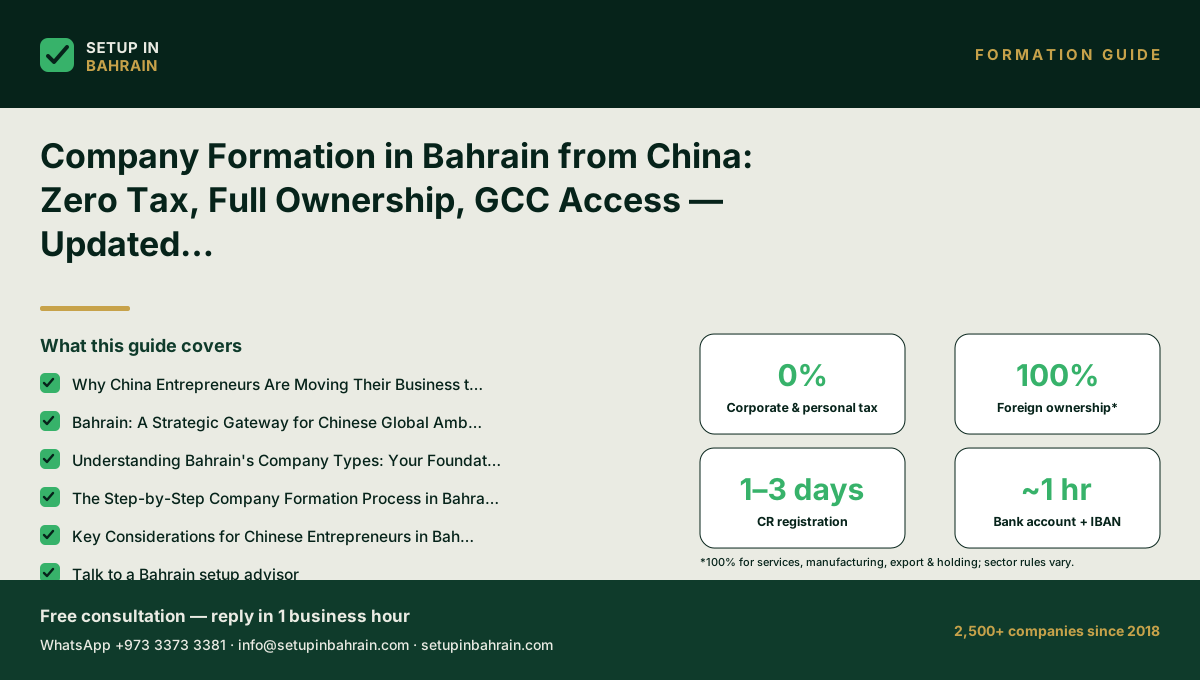
- Why China Entrepreneurs Are Moving Their Business to Bahrain
- Bahrain: A Strategic Gateway for Chinese Global Ambitions
- Understanding Bahrain's Company Types: Your Foundation Options
- The Step-by-Step Company Formation Process in Bahrain
- Key Considerations for Chinese Entrepreneurs in Bahrain
→ Complete guide: Company Formation in Bahrain — the full 2026 guide
View details
Ownership & capital
A Bahrain WLL can be owned by a single person — 100% foreign ownership applies to most activities, with no local partner required for services, manufacturing, export trading and holding companies. The minimum share capital is BHD 1 ; we recommend BHD 1,000 . This Makes bank account opening and investor visa approval smoother.
Why China Entrepreneurs Are Moving Their Business to Bahrain
Imagine you’re a successful tech entrepreneur in Shenzhen, or perhaps a manufacturing exporter from Guangzhou. For years, you've navigated the complexities of the domestic market with remarkable resilience. Your team has poured countless hours into innovation, market penetration, and building a formidable presence. But every quarter, as you review your financials, a significant portion of your hard-earned profit — a full 25% of your enterprise income, or even 15% if you’ve achieved certified high-tech status — evaporates into corporate taxes. This isn't just a deduction; it’s capital that could have been reinvested into R&D, expanded your global footprint, or rewarded your dedicated employees.
Consider the founder of a Shenzhen-based SaaS company who spent three years building an AI analytics platform. In 2024, his enterprise income tax bill hit 25% on profits, dropping to 15% only after he secured high-tech certification. Yet the real friction came from SAFE approvals every time he needed to convert CNY into USD for overseas servers and marketing. Each application required stacks of invoices, board resolutions, and weeks of waiting. By the time funds cleared, exchange rates had moved, and critical contract deadlines slipped.
This scenario isn’t unique. Across China, entrepreneurs like you are grappling with a business reality that. Familiar, more and more feels like a constraint on true global ambition. You look at market opportunities beyond the Great Wall, especially the booming economies of the Middle East, Africa. Even the West. But then you encounter the hurdles: the strict SAFE forex capital controls that complicate converting your hard-earned CNY into USD for international ventures, the intricate dance of Variable Interest Entity (VIE) structures if you consider foreign investment, the ever-present shadow of CSRC regulations for capital market access, and the mandatory Chinese-language audits under CAS standards that add another layer of complexity. Even daily operational efficiency is hampered by the Golden Tax System’s e-invoicing compliance and the Great Firewall, which. Serving its purpose, limits seamless access to global digital tools essential for competitive international business.
This is precisely why a growing number of forward-thinking Chinese entrepreneurs are turning their gaze towards the Kingdom of Bahrain. Bahrain removes that entire layer of domestic friction. The kingdom levies no corporate income tax, no capital gains tax, and no personal income tax. This isn't merely a tax break; it's a fundamental shift in your business's financial architecture, freeing up capital for growth and innovation.
The Weight of Domestic Compliance: Taxation and Regulatory Hurdles
The intricate web of regulations and taxes within China. Designed to manage a vast economy, can often feel stifling to a globally ambitious entrepreneur. The 25% enterprise income tax is a significant burden, especially for businesses with high revenue but tight margins. Even the reduced 15% for certified high-tech enterprises. A welcome relief, still represents a substantial portion of profits that could otherwise fuel expansion. This contrasts sharply with Bahrain’s zero-tax environment, where every dollar earned by your company remains available for reinvestment or distribution.
Beyond taxation, the regulatory environment presents its own set of challenges. The mandatory Chinese-language audits under CAS (Chinese Accounting Standards) standards, for instance, add a layer of specificity and potential complexity when dealing with international financial reporting. While robust, these requirements necessitate a dedicated compliance effort that can divert resources from core business activities. Also, the ever-evolving landscape of CSRC (China Securities Regulatory Commission) regulations can make navigating capital market access a delicate and time-consuming endeavor, especially for companies with foreign investment aspirations. For entrepreneurs seeking simpler, more globally aligned compliance frameworks, Bahrain offers a streamlined and internationally recognized legal and financial system.
Navigating International Transactions: The Forex Control Conundrum
Perhaps one of the most significant pain points for Chinese entrepreneurs operating internationally is the strict foreign exchange control regime managed by the State Administration of Foreign Exchange (SAFE). Converting large sums of CNY into USD or other foreign currencies for overseas investments, operational expenses, or even profit repatriation can be an arduous process. Each transaction often requires extensive documents, justification. Can be subject to delays or even rejections based on policy interpretations.
Imagine you're trying to pay for cloud servers in Ireland, marketing campaigns in the US, or acquire components from Germany. The need for SAFE approvals, the meticulous gathering of invoices and contracts, board resolutions. The weeks of waiting can lead to missed opportunities, increased costs due to currency fluctuations, and significant operational friction. In a fast-paced global economy, agility is key, and these controls can severely hamper it. In Bahrain, there are no such capital controls. Funds can be freely moved in and out of the country, converted between major currencies at market rates. Repatriated without bureaucratic hurdles, offering unparalleled financial freedom and flexibility.
Operational Friction: The Great Firewall and Digital Divide
In today's interconnected world, seamless access to global digital tools and platforms is not a luxury. A necessity. Cloud computing, SaaS applications, global communication platforms, and international data sharing are the backbone of modern business. But, the Great Firewall of China. Serving its national purpose, undeniably creates operational friction for companies aiming for global reach. Accessing certain international websites, collaborating on global platforms, or even utilizing standard communication tools can require VPNs, adding layers of cost, complexity. Potential instability.
This digital divide can impede efficient collaboration with international partners, limit access to cutting-edge global software. Slow down critical business processes. For a tech-focused entrepreneur, this can be a competitive disadvantage. Bahrain, in contrast, boasts an open internet environment and world-class digital infrastructure, ensuring your business has unfettered access to all global tools and communication channels. This enables faster decision-making, smoother international collaboration, and a truly global operational footprint.
The Geopolitical Context: Diversification and Stability
Beyond the immediate financial and operational advantages, Chinese entrepreneurs are more and more seeking diversification and stability in their global strategies. Geopolitical shifts, trade tensions, and the desire to access new growth markets are all powerful motivators. Relying solely on a single market, even one as vast as China, carries inherent risks.
Establishing a base in Bahrain offers a strategic hedge. It provides access to a stable, business-friendly jurisdiction with strong rule of law, operating independently of the geopolitical complexities that can impact business operations elsewhere. For entrepreneurs looking to de-risk their international operations, diversify their market access. Secure a stable platform for future growth, Bahrain presents an attractive and pragmatic choice. It's about securing a foothold in a neutral, prosperous region. Ensuring business continuity regardless of external dynamics.
Bahrain: A Strategic Gateway for Chinese Global Ambitions
Bahrain isn't just an alternative; it's a strategically crafted platform designed for international business success. Its value proposition for Chinese entrepreneurs extends far beyond tax benefits, encompassing market access, a world-class operating environment. An unparalleled ease of doing business.
Unparalleled Tax Advantages: A Profit-First Approach
The cornerstone of Bahrain's appeal is its remarkably favorable tax regime. For entrepreneurs whose primary goal is to maximize their return on investment and reinvest profits, Bahrain offers an irresistible environment:
Zero Corporate Income Tax: Unlike China's 25% (or 15% for high-tech), companies in Bahrain pay no tax on their profits. This means 100% of your earnings are available for expansion, innovation, or distribution to shareholders. This is a game-changer for profitability and capital accumulation. Zero Personal Income Tax: As a business owner or an employee in Bahrain, you will not pay income tax on your earnings. This enhances personal wealth accumulation and makes Bahrain an attractive place for your team to relocate. Zero Capital Gains Tax: If your business grows and you eventually sell assets or your entire company, you won't incur capital gains tax. This greatly increases the net proceeds from any successful exit. No Withholding Tax: Dividends, interest. Royalties paid out from Bahraini companies are not subject to withholding tax, further boosting the efficiency of profit repatriation. VAT (Value Added Tax): The only significant tax is a 10% VAT, introduced in 2019. This Applies to goods and services. This is a consumption tax, similar to sales tax. Most businesses are able to reclaim VAT on their input costs. This is a standard global practice and is transparently managed.
This robust zero-tax framework (with the exception of VAT) transforms your financial model, allowing you to retain greatly more capital for growth compared to jurisdictions with high corporate taxation. The Central Bank of Bahrain (CBB) and the Ministry of Industry and Commerce (MOIC) oversee this transparent and predictable fiscal environment, ensuring consistency and investor confidence.
Full Foreign Ownership: Complete Control, No Local Partner Mandate
For many international investors, especially from China, the requirement for local partners or joint ventures can be a source of apprehension. It often entails sharing control, profits, and potentially intellectual property. Bahrain eliminates this concern entirely.
100% Foreign Ownership: Most business activities in Bahrain allow for 100% foreign ownership. This means you, as the Chinese entrepreneur, retain full control over your company's strategy, operations. Profits without the need for a Bahraini sponsor or partner. No Local Director Requirement: While a local company secretary or legal representative might be advisable, there is no blanket requirement for a Bahraini national to be a director of your company. This empowers you to staff your board and management purely based on merit and strategic fit.
This level of autonomy is especially valuable for protecting proprietary technology, maintaining brand consistency. Executing global strategies without local interference. It offers peace of mind and complete strategic flexibility.
Gateway to the GCC and Beyond: Market Access Amplified
Bahrain’s geographical location is one of its most compelling assets. Situated at the heart of the Arabian Gulf, it offers unparalleled access to the lucrative markets of the Gulf Cooperation Council (GCC) and the wider Middle East and North Africa (MENA) region.
GCC Market Access: As a member of the GCC (which includes Saudi Arabia, UAE, Qatar, Kuwait. Oman), Bahrain provides a free trade gateway to a market of over 50 million affluent consumers. With a combined GDP exceeding US$1.6 trillion, the GCC is one of the fastest-growing economic blocs globally. Establishing your company in Bahrain allows you to serve this entire region from a central, cost-effective hub without facing significant trade barriers. Connectivity to Saudi Arabia: The 25-kilometer King Fahd Causeway directly connects Bahrain to Saudi Arabia, the largest economy in the GCC. This provides an invaluable logistical and commercial link, allowing for seamless movement of goods and people, making it an ideal base for companies targeting the Saudi market. For a Chinese entrepreneur focused on logistics, e-commerce, or distribution, this direct connection is a game-changer. Strategic Time Zone: Bahrain's time zone (GMT+3) offers an advantageous overlap with both Asian and European markets, facilitating real-time collaboration and expanding your operational window compared to operating solely from China. Open Trade Policy: Bahrain has free trade agreements with key global economies, including the United States, Singapore. A growing network of bilateral agreements, enhancing its role as a global trading hub. This positions your Bahraini entity to leverage these agreements for international trade.
The Economic Development Board (EDB) actively promotes Bahrain as a regional business hub, emphasizing its strategic location and excellent connectivity as key advantages for international investors.
World-Class Infrastructure and Digital Readiness
Bahrain has made significant investments in developing a modern, reliable. Digitally advanced infrastructure, crucial for attracting global businesses.
Logistics and Connectivity: Bahrain International Airport is a modern, efficient hub. The Khalifa Bin Salman Port is a deep-water port capable of handling large cargo vessels, offering efficient sea freight connections. Its road network is excellent, connecting seamlessly to the Saudi Causeway. This makes Bahrain an attractive location for logistics, distribution, and e-commerce businesses. Digital Infrastructure: Bahrain boasts one of the highest internet penetration rates in the region and continuously invests in 5G technology and data centers. The government's "Cloud First" policy underscores its commitment to digital transformation. This robust digital backbone is critical for tech companies, SaaS providers. Any business relying on high-speed, reliable internet access, a stark contrast to the challenges posed by the Great Firewall. Financial Hub: As a long-standing financial hub in the Middle East, Bahrain offers a sophisticated banking sector, advanced payment systems. A supportive regulatory environment for fintech innovation, regulated by the CBB. This means access to stable, international banking services without the forex controls faced in China.
Ease of Doing Business: A Welcoming Ecosystem
Bahrain consistently ranks highly in global indices for ease of doing business, reflecting its commitment to creating a streamlined and investor-friendly environment. The World Bank's Ease of Doing Business report consistently highlights Bahrain's efficiency in areas like starting a business, getting electricity. Enforcing contracts.
- Streamlined Registration (Sijilat 2.0): The MOIC's Sijilat portal is a single online platform designed for registering and licensing businesses. This digitized process greatly reduces bureaucracy, allowing entrepreneurs to complete many registration steps online, often within days. This is a welcome change for those accustomed to complex, multi-agency processes.
- Supportive Government Bodies: The EDB acts as a single point of contact for foreign investors, offering comprehensive support from initial inquiry through setup and beyond. Their mandate is to help foreign investment and ensure a smooth transition for businesses.
- Open Regulatory Environment: Bahrain's regulatory framework is transparent, predictable, and aligned with international best practices. The CBB, for instance, is known for its progressive approach, especially in areas like fintech and digital assets. This certainty helps entrepreneurs plan and operate with confidence.
- Skilled Workforce: Bahrain has a highly educated and skilled local workforce, augmented by a diverse expatriate talent pool. Government initiatives like Tamkeen support workforce development and training, ensuring a ready supply of talent for various industries.
Understanding Bahrain's Company Types: Your Foundation Options
Choosing the right legal structure is foundational to your success in Bahrain. While several options exist, one particular type stands out for Chinese entrepreneurs due to its flexibility, full foreign ownership. Ease of setup: the With Limited Liability Company (WLL).
The Workhorse: With Limited Liability Company (WLL)
The WLL is the most popular and versatile company structure in Bahrain, especially for foreign investors. It strikes an excellent balance between limited liability protection and operational flexibility.
Key Features and Benefits of a WLL:
- Limited Liability: As the name suggests, the liability of shareholders is limited to their share capital contributions. Your personal assets are protected from business debts and obligations.
- 100% Foreign Ownership: This is a crucial advantage for Chinese entrepreneurs. A WLL can be entirely owned by foreign individuals or corporate entities. Crucially, a WLL can be owned 100% by a single person with zero partners required. This allows for complete control and avoids the complexities of finding a local partner. This directly addresses the pain point of forced local partnerships often seen in other jurisdictions.
- Minimum Share Capital: The legal minimum share capital for a WLL is BHD 1. But, this legal minimum is purely symbolic. For practical purposes, and especially for securing a corporate bank account and an investor visa, we strongly recommend a minimum practical share capital of BHD 1,000. Many banks require this higher amount to open a corporate account, viewing it as a sign of genuine business intent and solvency. Without a bank account, your company cannot operate effectively.
- Flexibility: WLLs are suitable for a wide range of business activities, from trading and services to manufacturing and technology.
- Perpetual Existence: The company's existence is independent of its owners, ensuring continuity even if ownership changes.
- Simpler Management: Compared to public shareholding companies, WLLs have less stringent corporate governance requirements, making them easier to manage. Typically, a minimum of one director is required.
- Tax Efficiency: As with all Bahraini entities, a WLL benefits from the zero corporate income tax environment.
Suitable Activities for a WLL:
- Technology and IT services (SaaS, AI, cybersecurity, software development)
- Trading and e-commerce (import/export, online retail)
- Consulting services (management, marketing, financial)
- Logistics and distribution
- Manufacturing (subject to industrial licensing)
- Real estate activities
- Financial services (with specific CBB licensing)
For a Chinese entrepreneur looking to establish a robust, fully controlled. Legally sound presence in the GCC, the WLL is almost always the recommended vehicle.
Other Relevant Structures (Briefly)
While the WLL is primary, other structures might suit specific, less common scenarios:
Closed Shareholding Company (BSC Closed): Suitable for larger enterprises, often with more shareholders. Offers the ability to raise capital through private placement of shares. It has higher capital requirements (minimum BHD 25,000) and more stringent corporate governance rules. Branch of a Foreign Company: Allows an existing foreign company to establish a direct presence in Bahrain. The branch is considered an extension of the parent company and does not have a separate legal personality. It can conduct activities similar to the parent company. This might be suitable if you already have a very established Chinese parent company and wish to simply extend its operations without creating a new separate legal entity. Representative Office: Primarily for marketing, promotional, and liaison activities. It cannot conduct any commercial or revenue-generating activities. This is generally suitable for initial market research or building relationships before committing to full commercial operations.
Crucial Note: No single-shareholder WLL in Bahrain
It is absolutely vital to understand that Bahrain does NOT offer a "Single Person Company" (WLL) as a distinct legal entity type. While a With Limited Liability (WLL) company can be owned by a single individual (making it effectively a single-person operation), it is still legally registered as a WLL, not a single-shareholder WLL. Be wary of any information suggesting a single-shareholder WLL option; it does not exist under Bahraini commercial law. The ability for a single person to own 100% of a WLL already provides the flexibility and limited liability protection that a single-shareholder WLL might offer in other jurisdictions.
The Step-by-Step Company Formation Process in Bahrain
Setting up a company in Bahrain is designed to be efficient and straightforward, thanks to digitized processes like the Sijilat portal. Here’s a typical breakdown for a WLL, which will be the most relevant for most Chinese entrepreneurs:
Phase 1: Planning and Pre-Approval
This initial phase focuses on defining your business and ensuring it aligns with Bahraini regulations.
Define Your Business Activities: Clearly articulate the specific commercial activities your company will undertake. Bahrain has a comprehensive list of activities, and each requires a specific commercial registration (CR) classification. Some activities (e.g., financial services, healthcare, education) require special licenses from specific regulatory bodies (e.g., CBB, Ministry of Health, Ministry of Education) in addition to MOIC approval. Expert Tip:* Be precise. The commercial activities listed on your CR dictate what your company is legally allowed to do. Changing or adding activities later requires an amendment, which takes time. Choose Your Company Name: Select a unique name that complies with Bahraini naming conventions. It must not be offensive, misleading, or already in use. You can submit several options, and the MOIC will approve one. This step can often be done online via the Sijilat portal. Gather Initial Documents: Prepare the necessary documents. For a WLL owned by a single individual (Chinese national): * Passport copy of the proposed shareholder(s) and director(s). * National ID card (if applicable, though typically not for foreign nationals). * CV/Resume of shareholder(s) and director(s). * Proposed Memorandum of Association (MOA) and Articles of Association (AOA) – a legal template usually provided by your company formation agent. * Proof of residence (utility bill or bank statement) for shareholder(s) and director(s). * If a corporate entity is the shareholder: Certificate of Incorporation, Memorandum and Articles of Association of the parent company, Board Resolution approving the Bahrain entity, and a Power of Attorney for the representative in Bahrain. These documents often require notarization and apostille/legalization in China and potentially Arabic translation. Secure a Registered Office Address: You will need a physical office address in Bahrain for your company registration. This can be a leased office space, a co-working space, or a virtual office (though banks often prefer a physical presence for corporate accounts). Expert Tip:* Many company formation agents can help you secure a suitable office address temporarily or permanently.
Phase 2: Registration with MOIC and Commercial Registration
This is the core legal registration phase, handled primarily through the MOIC's Sijilat portal.
Application Submission via Sijilat: * Log in to Sijilat and initiate a new commercial registration application. * Upload all prepared documents. * Input company details (name, activities, share capital – remember to recommend BHD 1,000 for practical purposes). * Submit the draft MOA and AOA for approval. Fee Payment: Pay the registration fees to the MOIC. These fees vary based on company type and activities but are generally transparent and relatively low compared to many other jurisdictions. Initial Approval: Once documents are reviewed and fees paid, the MOIC will issue an initial approval for your company name and activities. Commercial Registration (CR) Issuance: Upon final review and approval, your Commercial Registration (CR) certificate will be issued. This is the official document confirming your company's legal existence in Bahrain. It will include your CR number, legal name, activities, and registered address.
Phase 3: Post-Registration Formalities
Once your CR is issued, there are several critical steps to make your company fully operational.
Bank Account Opening (CRITICAL for Chinese entrepreneurs): * This is often the most time-consuming step and can be a source of frustration if not managed correctly. * You will need your company's CR, MOA, AOA, proof of address, and personal identification of shareholders/directors. * Banks will typically require a practical share capital of at least BHD 1,000 (or sometimes more, like BHD 5,000-10,000 depending on the bank and nature of business) to open a corporate account. This capital needs to be deposited. * Be prepared for extensive Know Your Customer (KYC) and Anti-Money Laundering (AML) checks. This Can be more rigorous for foreign individuals, especially those from China, due to global compliance standards. Expert Tip:* Engage a reputable local company formation agent or legal firm. They have relationships with banks and can guide you through the process, potentially pre-vetting your application to minimize delays. Be prepared to travel to Bahrain in person for the bank account opening, as most banks require a physical presence. Visa Application (Investor Visa): * As a foreign owner/director, you will likely need an investor visa and a residence permit. * This requires sponsorship by your Bahraini company. * Documents typically include your passport, CR copy, medical check-up, and possibly educational certificates. The EDB can often assist in fast-tracking investor visa applications for significant investors. * You may also apply for dependent visas for your family members. Office Space & Utilities: Finalize your physical office space (if not already done) and set up utilities (electricity, water, internet). Get Additional Licenses (if applicable): If your business activities require specific sector-specific licenses (e.g., CBB for financial services, Ministry of Health for medical clinics), ensure these are applied for and obtained. Register with Social Insurance (SLRB): If you plan to hire employees (Bahraini or expatriate), your company must register with the Social Insurance Organization (SIO). VAT Registration: If your projected annual taxable supplies exceed BHD 37,500, you must register for VAT with the National Bureau for Revenue (NBR).
The entire process, from initial application to receiving your CR, can take as little as 3-5 working days for a straightforward WLL, provided all documents are in order. But, the post-registration steps, especially bank account opening and visa processing, can extend the overall timeline to 4-8 weeks.
Key Considerations for Chinese Entrepreneurs in Bahrain
Transitioning your business from China to Bahrain involves more than just legal registration. It requires careful consideration of cultural, financial, and operational nuances.
Bridging the Cultural and Language Divide
While Bahrain is a very open and cosmopolitan country, understanding the local culture is key to smooth operations.
Language: Arabic is the official language, but English is widely spoken and used in business. All official government documents are in Arabic, but English translations are readily available. Most government agencies have English-speaking staff. You won't face mandatory Chinese-language audits here; international accounting standards are the norm. Business Etiquette: Relationships are important. Patience, respect, and face-to-face meetings are valued. Be aware of local customs and religious practices, especially during Ramadan. Work Culture: Working hours are generally 8:00 AM to 5:00 PM, Sunday to Thursday (the weekend is Friday-Saturday). This differs from the typical Monday-Friday week in China, requiring some
Bahrain Business Guides for China Citizens
Frequently Asked Questions
How long does it take to set up?
It takes 15 to 20 days. We file all forms for you. You do not need to wait long.
What does it cost?
Company formation: Standard BHD 1,340 with 3 months of office address; Gold BHD 1,700 with 6 months; Premium BHD 2,150 with 12 months and a cabin, officer table and chair, and two guest chairs. No formation package includes visas, including Premium. Investor/work visas are priced separately: BHD 755 for one year or BHD 953 for two years, in addition to the formation package. Ask for a written, itemized quotation confirming government fees and all inclusions before payment.
Do I need to visit Bahrain?
No. You can set up your firm from home. We do all the work online. Some banks may ask for one visit.
What tax will I pay?
You pay zero tax on your profits. Bahrain has no corporate income tax. This is a key benefit of the setup.
Can I own 100% of my firm?
Yes. Foreign owners can hold all shares. No local partner is needed. Full ownership is allowed.
What do I need to start?
You need a valid passport. You also need a trade name and a business address. We help you with all of these.
How do I open a bank account?
We guide you step by step. Most banks take 3 to 6 weeks. You will need your CR and firm papers.
Who issues the Commercial Registration (CR)?
The CR is issued by the MOICT. It is your legal right to trade in Bahrain. We file the CR for you.
Can I renew my CR each year?
Company renewal packages: BHD 530 with 3 months of office address; BHD 980 with 6 months; BHD 1,520 with 12 months. These are separate renewal packages, not visa fees.
How do I get started?
Fill in our form on this page. Our team will call you back. We map your best setup plan at no cost.
Steps to Form Your Company
- Pick your trade name. We check if it is free.
- Choose your business type. WLL is the most common.
- Sign the MOA. We draft and file all legal docs.
- Pay the state fees. About BHD 432 in total.
- Get your CR. Takes 15 to 20 days.
- Open your bank account. We guide each step.
- Start trading. You are ready to do business.
Key Facts
- Tax rate: 0%
- Foreign ownership: 100%
- Setup time: 15 to 20 days
- Company formation: Standard BHD 1,340 with 3 months of office address; Gold BHD 1,700 with 6 months; Premium BHD 2,150 with 12 months and a cabin, officer table and chair, and two guest chairs. No formation package includes visas, including Premium. Investor/work visas are priced separately: BHD 755 for one year or BHD 953 for two years, in addition to the formation package. Ask for a written, itemized quotation confirming government fees and all inclusions before payment.
- Company renewal packages: BHD 530 with 3 months of office address; BHD 980 with 6 months; BHD 1,520 with 12 months. These are separate renewal packages, not visa fees.
- Client rating: 4.8 stars
- Clients served: 2,500 and more
Quick Facts
- Tax rate: 0%
- Own all of your firm: Yes, 100%
- Time to set up: 15 to 20 days
- Company formation: Standard BHD 1,340 with 3 months of office address; Gold BHD 1,700 with 6 months; Premium BHD 2,150 with 12 months and a cabin, officer table and chair, and two guest chairs. No formation package includes visas, including Premium. Investor/work visas are priced separately: BHD 755 for one year or BHD 953 for two years, in addition to the formation package. Ask for a written, itemized quotation confirming government fees and all inclusions before payment.
- Company renewal packages: BHD 530 with 3 months of office address; BHD 980 with 6 months; BHD 1,520 with 12 months. These are separate renewal packages, not visa fees.
- Rating: 4.8 stars
- Clients: 2,500 and more
Why Bahrain?
Bahrain has no tax. You keep all your profits. This is rare in the Gulf.
You can own all of your firm. No local partner is needed. The law allows full foreign ownership.
Setup takes 15 to 20 days. We file all forms for you. You can do it all from home.
Bahrain has a free trade deal with the US. Your goods face low or no tariffs. This gives you access to big markets.
We have served 2,800+ clients from 44+ countries and maintain records to substantiate that total where needed. We have 113 Google reviews; reviews represent only some clients and are not the same as the total clients served.
Our Steps
- Tell us your plan. We advise you for free.
- We pick the right firm type for you.
- We file all your forms with MOICT.
- You get your CR in 15 to 20 days.
- We help you open a bank account.
- You are ready to trade. We stay with you.
Next Steps for China Citizens
You can set up a firm in Bahrain from China. You do not need to fly there first. We do all the work online.
Tell us your plan. We call you back the same day. We map the best route for you at no cost.
We file all your forms. We deal with MOICT and the state. You get your CR in 15 to 20 days.
After your CR, we help you get a bank account. We also help with your Investor Visa. One firm guides you at each step.
Why Our Clients from China Choose Us
- We speak your language. We know your needs.
- We have helped clients from China before.
- Our fee is clear. No surprise costs.
- We have a 4.8 star rating on Google.
- We have helped more than 2,500 clients set up in Bahrain.
Fill in the form on this page. We will be in touch soon. Let us help you start your Bahrain firm today.
Ready to set up in Bahrain from China?
Tell us your business idea. We map the right entity, ownership and timeline — then handle the filing while you focus on what matters.