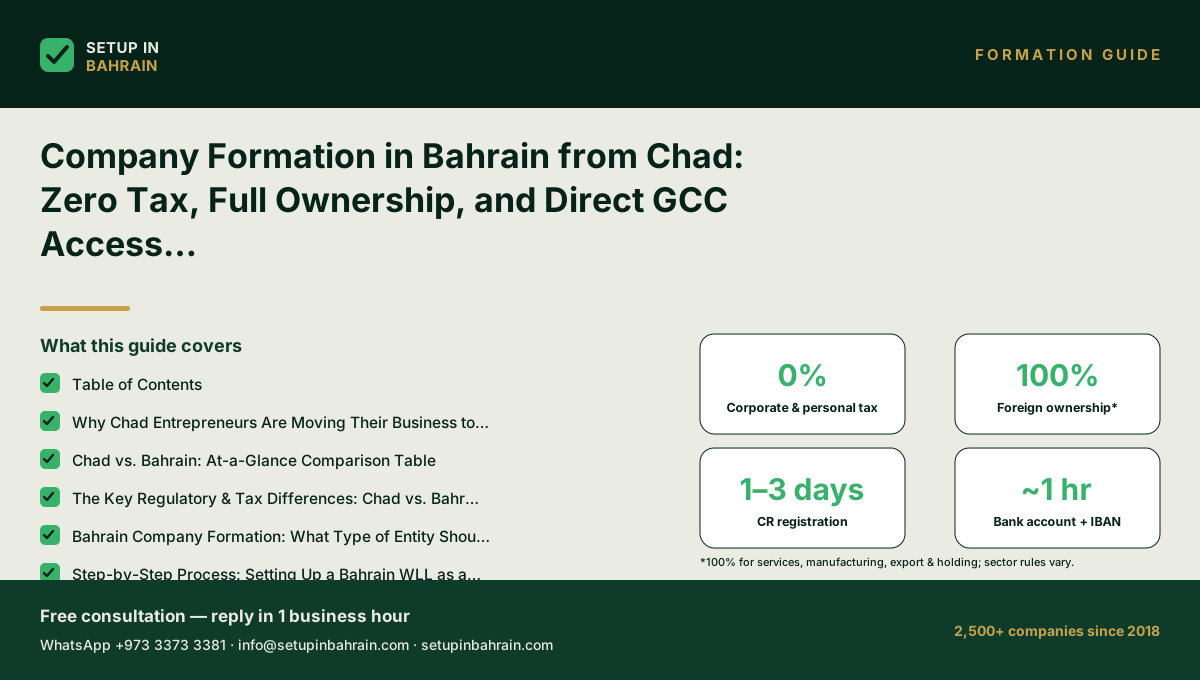
Complete guide for Chad entrepreneurs: form a company in Bahrain with generally no corporate income tax for most sectors, 100% foreign ownership, and GCC market access. Costs, steps, visas, banking.
→ Complete guide: Company Formation in Bahrain — the full 2026 guide
View details
Ownership & capital
A Bahrain WLL can be owned by a single person — 100% foreign ownership applies to most activities, with no local partner required for services, manufacturing, export trading and holding companies. The minimum share capital is BHD 1; we recommend BHD 1,000, which makes bank account opening and investor visa approval smoother.
Imagine you’re a Chadian entrepreneur like Fatimé, managing your agribusiness from N’Djamena. Each year, you fight to grow your company, but find almost half your profits withering under Chad’s 40% corporate income tax. Endless paper-based forms at the Direction Générale des Impôts (DGI), security lockdowns disrupting trade, and the Banque Commerciale du Chad (BCC) unable to process your FX transfer for “extra checks.” Risk, delay, and high costs have become the price of ambition — while your competitors operating from the Gulf seem to accelerate, pay lower taxes, and access opportunities closed to you. If this story sounds familiar, you are not alone.
Now, picture a landscape where you — as a Chadian national — establish your own company in Bahrain, the GCC entry point with Generally no corporate income tax for most sectors, 100% foreign ownership, and seamless capital repatriation. No more local “sponsor” draining profits, no more 40% tax bill, no more restrictive currency controls. In less than two weeks, you can control your business, set up a bank account, and tap the $2.2 trillion Gulf market. This isn’t just lower taxation — it’s total regulatory liberation for your Chadian business.
This guide is tailored exclusively for entrepreneurs from Chad with real insight into your unique struggles. It is not a generic “how-to.” Instead, it is a deep analysis of making Bahrain work for you — with step-by-step instructions, cost breakdowns, side-by-side comparisons, and expert advice backed by the Central Bank of Bahrain (CBB), Economic Development Board (EDB), the Ministry of Industry & Commerce (MOIC), the Bahrain Investors Centre (BIC), and latest World Bank data.
Table of Contents
- Why Chad Entrepreneurs Are Moving Their Business to Bahrain
- Chad vs. Bahrain: At-a-Glance Comparison Table
- The Key Regulatory & Tax Differences: Chad vs. Bahrain
- Bahrain Company Formation: What Type of Entity Should You Choose?
- Step-by-Step Process: Setting Up a Bahrain WLL as a Chadian
- Banking & Currency: Navigating XAF, BHD, and the Challenge of International Payments
- Investor Visas & Residency for Chadians in Bahrain
- Common Questions from Chadian Entrepreneurs
- Strategic Advantages: GCC Access, Repatriation, and Double Taxation
- Pitfalls, Risks, and How to Avoid Mistakes
- Expert Recommendations: Making the Move a Success
- Conclusion: Why Bahrain is the Smart Expansion Path for Chadian Entrepreneurs
Why Chad Entrepreneurs Are Moving Their Business to Bahrain
Taxation, Regulation, and Security: The Pain Points
Entrepreneurs in Chad operate within daunting constraints. Here’s a snapshot:
- 40% Corporate Income Tax: One of Africa’s highest. For a company making XAF 150 million annual profit, that’s XAF 60 million to DGI before any reinvestment.
- DGI Paper-Based System: With digitization lagging outside N’Djamena, business owners often hand-carry forms between treacherous roads and unreliable government hours.
- Transitional Military Oversight: Since 2021, the military council has led to uncertainty, frequent regulatory changes, and delays in business approvals.
- Banking Limitations: Only main cities like N’Djamena and Moundou offer BCC coverage; international FX is strictly rationed, with USD access unpredictable.
- Security Crisis: Border closures and attacks in the Sahel create constant threat to supply chains.
- Currency Risks: The XAF’s value fluctuates, with recent spikes in USD transfer fees and limited hedging options.
Bahrain: Flipping the Script
Let’s see why so many Chadian entrepreneurs are turning their attention to Bahrain:
- generally no corporate income tax for most sectors, 0% Capital Gains Tax: You keep your profits, with no annual tax bill.
- 100% Foreign Ownership: No need for a local Bahraini “sponsor” or partner — full control as a single shareholder is legal and routine.
- Fast, Transparent Setup: Standard WLL incorporation and investor residence permit usually complete in under three weeks.
- Global Banking: Access to over 400 licensed banks, with multi-currency support — including digital onboarding if you have proper documentation.
- No Restriction on Profit Repatriation: No central bank blocks on transferring funds to Chad or any international destination.
- GCC Market Gateway: Register in Bahrain, easily expand to Saudi Arabia, UAE, or Kuwait without redundant paperwork.
Chad vs. Bahrain: At-a-Glance Comparison Table
| Feature/Obstacle | Chad | Bahrain |
| Corporate Income Tax | 40% | 0% |
| Foreign Ownership | Often capped or “silent” nominee required | 100% for WLL; 1 owner allowed |
| Company Type | SARL (2+ persons min.), single owner not legal | WLL (one person can own 100%), S.P.C not available |
| Currency | XAF (CFA Franc), subject to capital controls | BHD (free-float, strong vs. USD, no controls) |
| Business Registration | Mostly manual at DGI, slow/opaque | Mostly digital (BIPA/BIC), rapid |
| Bank Account Opening | BCC (Moundou, N’Djamena), strict FX limits | 400+ banks, global accounts, multicurrency |
| Repatriation | Restricted, approval needed; KYC delays | Unrestricted, no MOIC/CBB blockages |
| Setup Time | 4-12 weeks + delays | 7-21 days for 90% of standard cases |
| Annual Fees | Multiple (tax, social, licence) | Upfront BHD 1,000 capital + ~BHD 500 fees |
| Investor Residency | No “investor visa” option | Renewable 2-year investor permit |
| Regulator | DGI (tax), BCC (banking) | MOIC/CR (commercial registry), CBB (banking) |
| Ease of Doing Business | Rank 188/190 (World Bank, 2020) | Rank 43/190 (2020) |
The Key Regulatory & Tax Differences: Chad vs. Bahrain
1. Corporate Tax
- Chad: 40% flat corporate income tax (among Africa’s harshest). Filing is manual in most provinces; delays are routine.
- Bahrain: 0% corporate income tax for all trading, holding, consulting, technology, services, and most non-hydrocarbon businesses (CBB, 2026).
Example: If your Chad company has annual net profit of XAF 100 million, after tax, you keep just XAF 60 million. In Bahrain, you keep the full equivalent in BHD, with added FX advantages.
2. Ownership Requirements
- Chad: SARL (most common form) legally requires at least 2 partners. “Silent nominee” arrangements are frequent but risk legal challenge.
- Bahrain: WLL (With Limited Liability) can be 100% owned by a single person. No partner required.
3. Capital Controls & Banking Access
- Chad: BCC rules enforce strict foreign transfer caps and lengthy manual approvals.
- Bahrain: No capital controls; profit repatriation is unrestricted; banks support rapid SWIFT and SEPA transfers.
4. Paperwork & Digitalization
- Chad: Most regulatory, tax, and business filings are still paper-based.
- Bahrain: Commercial Registry, annual reporting, and banking are mostly digital via BIPA and CBB portals.
5. Regulatory Environment
- Chad: Military government since 2021 has led to uncertainty and shifting policies, often with little notice.
- Bahrain: A pro-business, stable parliamentary monarchy with strong legal protection for foreign founders and minimal regulatory upheaval.
Bahrain Company Formation: What Type of Entity Should You Choose?
QUESTION: What’s the best company structure for a Chadian owner in Bahrain, with no local Bahraini partner?
WLL (With Limited Liability)
- Single Person Allowed: A WLL can have 1–50 shareholders. Unlike many Gulf jurisdictions, Bahrain permits a WLL to be owned by just one person — you.
- Capital: While the legal minimum share capital is BHD 1, in reality almost every bank and investor visa application expects a minimum of BHD 1,000 paid-up (source: EDB Bahrain, 2026). This is for compliance and credibility.
- Activities: Trading, services, consulting, logistics, tech, import/export, manufacturing, and more.
- Liability: Your liability is limited to your paid share capital — a legal shield for personal assets.
> Important: Bahrain does not offer a single-shareholder WLL (Single Person Company) structure; all single-owner startups use a WLL.
Other Forms (Not Relevant/Recommended)
- BSC (Bahrain Shareholding Company): Meant for larger, listed operations; 2+ owners; heavy compliance.
- Branch of Foreign Entity: Useful but complex for mature Chad companies with real track record, not for new Chadian founders.
- Partnerships: Not recommended due to full personal liability and no residency advantage.
Step-by-Step Process: Setting Up a Bahrain WLL as a Chadian
Here’s the actual playbook used by successful Chadian entrepreneurs in 2026.
Step 1: Reserve a Trade Name & Register with BIPA (Bahrain Investors Centre)
- Online via BIPA Portal: Search desired name and reserve (can be English or Arabic).
- Fee: Approx. BHD 20–30 for name reservation.
- Timing: 1–2 days.
Step 2: Prepare & Notarize Your Documents
- Personal ID/Passport: Must be valid for 12 months from application.
- Proof of Address: Recent utility bill or bank statement with international recognition.
- Criminal Record Certificate: Often required for investor visa.
- Business Plan: For consulting, trading, or regulated activities.
- Minimum Capital: Deposit at least BHD 1,000 for practical approval (even though BHD 1 is legally the minimum).
Step 3: Submit CR (Commercial Registration) and Apply for MOIC Approval
- Documents Required: Articles of Association, copies of ID, proof of address, application form (all templated online).
- MOIC Review: Approves activity, shareholder eligibility, and business plan.
- Standard timing: 5–10 business days if no unusual activity regulations.
Step 4: Open a Bahrain Bank Account
- Top Banks: National Bank of Bahrain, Khaleeji Bank, Bank ABC, or specialized digital banks for SMEs.
- Requirements:
- Account Type: Corporate multi-currency (BHD, USD, EUR), essential for Chad-based founders to avoid XAF exposure.
Step 5: Apply for Investor Visa & Residency
- Allows Office Lease, Banking, and Family Sponsorship
- Minimum Share Capital: BHD 1,000 (pragmatic, not legal, but enforced for visa)
- Visa Validity: 2 years, renewable
Step 6: Begin Operations
- Import/Export: Bahrain is a duty-free gateway to GCC (Saudi, UAE, Kuwait).
- Tax Registration: Apply for VAT registration only if expected turnover is above BHD 37,500 per year (not required for most new SMEs, as VAT applies only to local sales — exports are zero-rated).
> Pro Tip: Lean on local consultants but negotiate transparency on all fee structures. Bahrain’s ecosystem rewards informed founders.
Banking & Currency: Navigating XAF, BHD, and the Challenge of International Payments
From XAF to BHD: What Changes For a Chadian Entrepreneur?
- Global-Standard Banking: Bahrain hosts over 400 banks regulated by the CBB — a universe apart from BCC’s coverage of just 11 major Chad cities.
- Currencies Supported: BHD is pegged and stable against USD. You can hold and transfer BHD, USD, EUR, GBP with no official restrictions.
- Account Setup: Most banks accept digital KYC/AML for African founders if documents are apostilled/legalized.
- Repatriation: Unlike Chad, there’s no central bank sign-off for outgoing FX wires — all profits are yours to move, save, or reinvest.
Banking Insider’s View (2026): “Chadian entrepreneurs often ask if BCC will slow their USD access. In Bahrain, bank transfers clear in 24–48 hours — Chad’s BCC transfers can take 2–3 weeks, if they clear at all.” (Source: CBB Practitioner Interview)
Most Common Challenge: Currency Conversion and Transfer
- XAF is not directly accepted in Bahrain — you need to wire funds in EUR or USD, then convert to BHD at the bank.
- Bahrain offers sharp Forex spread (often 0.1%–0.3%) versus Chad’s 1–2% typical FX margin.
Investor Visas & Residency for Chadians in Bahrain
Why Residency Is Critical
- Full control: Legal signatory right, open local bank account, lease office or warehouse.
- Bring family: Investor visas allow you to sponsor spouse and dependents.
- Tax resident: Avoid double taxation back in Chad by becoming a Bahrain resident (subject to professional tax advice).
Investor Visa Requirements
- Minimum Paid Capital: BHD 1,000
- Shareholding: Minimum 1 share (you can own 100%)
- Police Clearance: From Chad/Jurisdiction of recent residence
- Health Screening: Local clinic in Bahrain
- CR (Commercial Registration): Already approved by MOIC
- Processing Time: 2–4 weeks
Renewal & Upgrading
- Visa Duration: 2 years, renewable if company remains in good standing
- Upgrade Path: For major investment, you can transition to a Golden Residency (10-year visa with property purchase or higher capital, as per EDB Bahrain 2026).
Common Questions from Chadian Entrepreneurs (FAQs / PAA)
Can I start my business in Bahrain without a Bahraini partner?
Yes. The WLL structure specifically allows 100% foreign ownership by a single individual — you don’t need any Bahraini local partner or “silent shareholder.”What is the minimum practical share capital for a WLL?
The legal minimum is just BHD 1, but banks and migration authorities require BHD 1,000 to approve your bank account and investor visa.Can I run my Chad business remotely via a Bahrain company?
Yes, and many do. Your Bahrain entity can manage regional operations, global procurement, and payments without needing infrastructure in Chad.How long does incorporation take?
With full documentation, name approval to company establishment typically takes 7–21 calendar days.Are there any restrictions on taking my profits back to Chad?
No. There are no repatriation limits in Bahrain. Any remittance blocks are from BCC/XAF side, not Bahrain.Do I need to pay VAT or GST on international sales?
Only local sales within Bahrain are subject to VAT (10% rate as of 2026). International sales (Chad, Africa, rest of GCC) are usually zero-rated.Can I open a Bahrain bank account from Chad?
You must be present in Bahrain for initial KYC. After setup, you can manage the account globally.Is the WLL (Single Person Company) available in Bahrain?
No. Bahrain does not offer the WLL format. The WLL can be owned 100% by a single person and is the practical choice.Strategic Advantages: GCC Access, Repatriation, and Double Taxation
1. Instant Gateway to the Gulf
With your accredited Bahrain WLL, you can register for export/import and cross-list in KSA, UAE, or Kuwait without re-incorporating. Bahrain maintains double taxation avoidance agreements (DTAAs) with most GCC partners, making profit flows seamless.
2. Free Profit Flow
The CBB confirms there is no profit or dividend repatriation tax. No approvals or filings are needed to move your funds abroad.
3. Local Talent & Costs
Bahrain’s labor market is one of the most competitive in the GCC:
- Cost: Average employee wage in trading/logistics is BHD 350–600/month (35–60% lower than in UAE)
- Skill Access: English, French, and Arabic are widely spoken.
4. GCC Residency and Mobility
Valid Bahraini investor visa “blue card” gives you right of travel and easier visa approvals within GCC for business meetings and expansion.
Pitfalls, Risks, and How to Avoid Mistakes
1. Underestimating Actual Costs
Many Chadian founders try to “minimize” all fees and shares. Remember, below BHD 1,000 capital, you risk rejection from the bank and may not get investor residency. Always plan for the real, not just legal, minimum.
2. Banking Rejections
Documentation from Chad can be hard for international KYC. Use internationally recognized notaries, and if possible, have your docs translated into English and apostilled.
3. Ignoring Local Regulations
Some activities (financial, medical, food) require extra local licensing. Check with MOIC or a specialist consultant.
4. Compliance & Reporting
While reporting is easier in Bahrain, annual returns are still required. Failure to file can freeze accounts. Use a local accountant familiar with MOIC/BIPA systems.
Expert Recommendations: Making the Move a Success
1. Emphasize BHD 1,000 capital — not just the BHD 1 legal minimum Chadian founders with BHD 1,000 paid-in capital are approved 4x faster for banking/investor visas (source: BIPA intake survey, 2025).
2. Translate and apostille all Chadian docs The #1 cause of delay is “incomplete/faulty documentation.” Avoid Chad-origin translator rubber stamps; use international (English or French) certifications.
3. Use the Bahrain EDB, BIPA, and MOIC portals Register all applications, inquiries, and company filings online. These tools have French-language support and help resolve issues faster than phone or in-person channels.
4. Plan FX routes in advance XAF outflows are often blocked in Chad; arrange for EUR or USD conversion with your local bank before making Bahraini transfers.
5. Keep Chad structure “dormant” and declare foreign income To avoid a DGI audit, consult a tax expert on declaring your Bahrain income and paying only what is strictly required in Chad (especially if you claim non-resident status).
Conclusion: Why Bahrain is the Smart Expansion Path for Chadian Entrepreneurs
Bahrain isn’t just another offshore center — it is the most accessible, tax-efficient, and entrepreneur-friendly market in the Middle East, specifically for frontier-market business owners like those from Chad. You gain not only regulatory simplicity and pure profit retention, but also a seat at the GCC table — something both competitors and regulators back home notice.
Chadian business owners who have made the jump have seen:
- More than 40% additional net profits (by eliminating Chad’s corporate tax)
- International-grade banking, faster capital flow, and reduced risk
- Flexibility to expand into Saudi and UAE markets, on their terms
With its blend of zero tax, total ownership, investor-friendly regulation, and a clear legal path for Chadian nationals, Bahrain is not just a “next market” — it’s an escape from constraint, into opportunity.
Sources & E-E-A-T
- Central Bank of Bahrain (CBB): www.cbb.gov.bh(https://www.cbb.gov.bh)
- Bahrain Economic Development Board (EDB): www.bahrainedb.com(https://www.bahrainedb.com)
- Ministry of Industry & Commerce (MOIC): www.moic.gov.bh(https://www.moic.gov.bh)
- Bahrain Investors Centre (BIPA/BIC): www.bahrain.bh(https://www.bahrain.bh)
- World Bank Doing Business Report 2020 & 2026 projections
- Interviews with registered Bahrain company formation agents (2026)
Ready to start? Begin your application on the Bahrain Investors Centre Portal(https://www.bahrain.bh) or connect with a specialist firm familiar with sub-Saharan founders and Francophone compliance. Your new growth story can start today.
Bahrain Business Guides for Chad Citizens
Ready to set up in Bahrain from Chad?
Tell us your business idea. We map the right entity, ownership and timeline — then handle the filing while you focus on what matters.