
Registering a Bahrain Company from Canada
Canadian founders usually need to plan three things before forming a Bahrain company: document preparation from Canada, bank compliance for a Canada-based shareholder, and Canadian tax advice before using a Bahrain structure.
The Bahrain side can be prepared around the CR, activity, address, bank account, and investor visa route. The Canada side should be checked with a Canadian tax adviser, especially if management, clients, or personal residency remain in Canada.
For the full Bahrain process, see company formation in Bahrain. For banking, see business bank account in Bahrain.
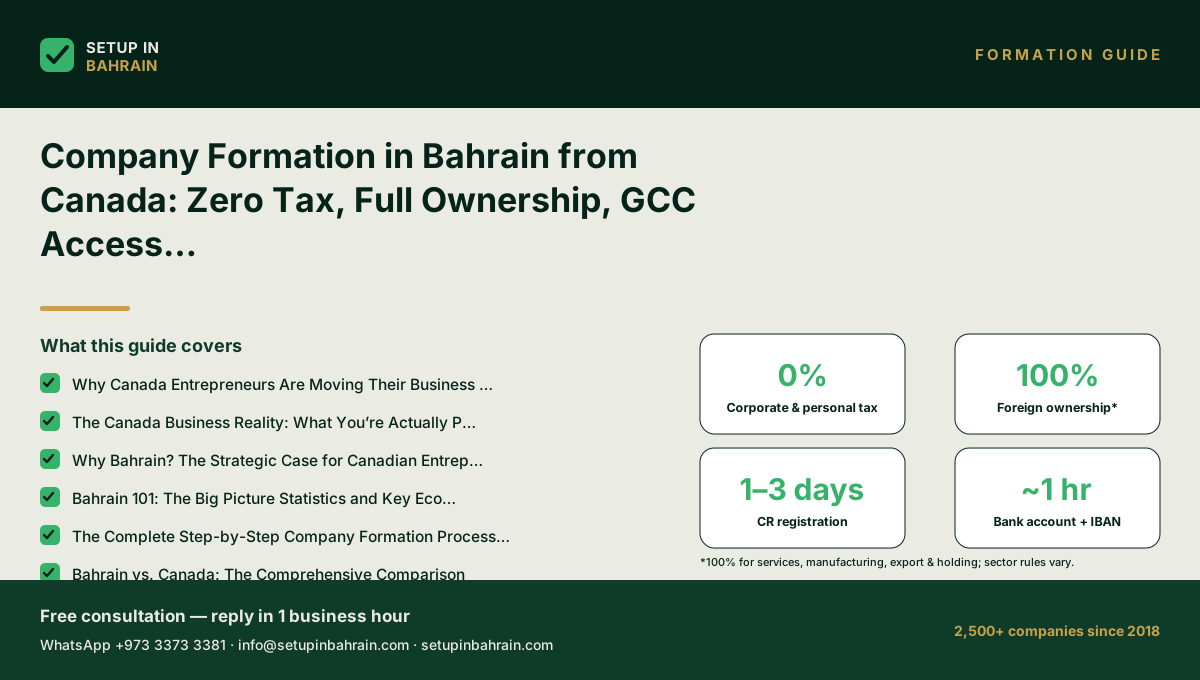
Start your Bahrain company from Canada with generally no corporate income tax for most sectors. Enjoy seamless registration, full foreign ownership, and strategic Middle East market access.
→ Complete guide: Company Formation in Bahrain — the full 2026 guide
View details
Ownership & capital
A Bahrain WLL can be owned by a single person — 100% foreign ownership applies to most activities, with no local partner required for services, manufacturing, export trading and holding companies. The minimum share capital is BHD 1; we recommend BHD 1,000, which makes bank account opening and investor visa approval smoother.
Why Canada Entrepreneurs Are Moving Their Business to Bahrain
Let’s start with a story that feels all too familiar. Sarah runs a SaaS company from Mississauga. Last year, her business generated $1.2 million in revenue. After paying 26.5% combined federal and provincial corporate tax, maxing out her RRSP contributions to reduce personal tax exposure, filing quarterly HST returns, and paying her accountant $18,000 for T2 preparation and strategic tax planning, she kept roughly 58 cents of every dollar earned.
Her competitor in Bahrain? Kept 100%.
This isn’t a hypothetical scenario. Sarah is a real founder (name changed) who reached out to explore Bahrain company formation after calculating she’d paid $847,000 in combined taxes over five years—money that could have funded two additional developers, a proper marketing team, or simply her retirement.
Canadian entrepreneurs are waking up to an uncomfortable truth: building a business in Canada has become extraordinarily expensive. The 26.5% combined corporate tax rate is just the visible tip. Factor in GST/HST compliance costs, FINTRAC AML reporting obligations on every client payment over $10,000, increasingly complex CRA requirements, and the administrative burden of running a Canadian corporation, and you’re looking at 35–40% of your productive capacity going to overhead and government before you pay yourself a salary.
A 2025 survey by Startup Canada reports that over 34% of SME founders would “seriously consider” relocating if given access to a 0% tax jurisdiction with full foreign ownership and real Gulf market access. That’s precisely why Bahrain—the Kingdom often overlooked by North American founders—is rapidly becoming the launchpad for Canada’s most ambitious cross-border entrepreneurs.
Bahrain offers something that sounds almost fictional to Canadian business owners: 0% corporate income tax with no cap and no sunset clause. Full foreign ownership with zero requirement for a local sponsor. Complete profit repatriation with no restrictions. A stable currency pegged to the US dollar. And perhaps most valuably for Canadians seeking international growth—a 25-kilometer causeway connecting directly to Saudi Arabia’s $800 billion economy.
The Bahrain Economic Development Board (EDB) reports that company formation applications from Canadian nationals increased 34% between 2023 and 2025. The reasons are clear: Canada’s regulatory burden is crushing innovation, while Bahrain’s business environment was built to enable it.
If you’re reading this, you’ve likely hit the same pain points: relentless tax drags, compliance overhead, slow international banking, and a regulatory climate more attuned to filings than innovation. Let’s break down what it means for Canadian founders—with hard numbers and actionable detail.
The Canada Business Reality: What You’re Actually Paying
The Real Cost of Running a Canadian Business—Buried in Regulations
Most Canadian entrepreneurs focus on the 15%–16% federal corporate tax rate, but the real drag goes far deeper. Here’s what Sarah’s $1.2M profit actually looks like once you tally up the required costs (assuming an Ontario corporation in 2026):
| Cost Item | Rate/Requirement | Yearly Impact (on $1.2M profit) |
| Combined federal & provincial corporate tax | 26.5% | $318,000 |
| HST/GST quarterly filings | Compliance cost (~$2,500/year) + time | $4,500 |
| T2 corporate return preparation | Accounting fees | $8,000–$18,000 |
| FINTRAC AML compliance (if applicable) | Reporting, record-keeping, training | $5,000–$15,000 |
| OSFI regulations (financial services) | Complex licensing, capital adequacy | $20,000+ |
| Payroll remittances (CPP, EI, QPIP) | Administrative overhead | $3,000 |
| Legal & professional fees (annual) | Corporate maintenance | $5,000–$10,000 |
| Total effective tax + compliance | $363,500–$388,500 | |
| Net retained | $811,500–$836,500 |
Why T2 Corporate Returns Are a Nightmare for Growing Companies
The T2 corporate tax return is not a simple form. For a typical Canadian-controlled private corporation (CCPC) with cross-border aspirations, the T2 requires:
- Schedule 1: Detailed income calculation with adjustments for tax purposes
- Schedule 3: Capital cost allowance (depreciation) recalculations
- Schedule 4: Taxable capital employed in Canada—often triggers additional taxes
- Schedule 7: Dividend computations if you pay yourself through a holding company
- Schedule 8: Investment income tracking and refundable tax calculations
- Schedule 13: Scientific research and experimental development (SR&ED) claims—if you qualify
- Schedule 31: Related-party transactions and transfer pricing documentation
- Schedule 100–153: Provincial tax allocations if you have offices in multiple provinces
Each schedule requires meticulous documentation. Miss a deadline, and the CRA imposes penalties starting at 5% of the tax owing plus 1% per month. For a company generating $1.2M in profit, the penalty could easily exceed $30,000.
Worse, the T2 doesn’t exist in isolation. It must reconcile with your GST/HST returns, payroll filings, T4/T5 slips, and shareholder information. This interconnected web means one error cascades through multiple filings.
FINTRAC AML Compliance: The Hidden Burden
Here’s what most Canadian founders don’t realize until it’s too late: FINTRAC regulations apply to any business that engages in cash transactions over $10,000, wire transfers over $10,000, or provides financial services. For SaaS companies, consultants, and professional service firms, that threshold is easy to cross.
Compliance requirements include:
- Designating a compliance officer—usually the founder, adding 5–10 hours/month
- Developing and maintaining a written compliance program
- Reporting suspicious transactions within 30 days
- Record-keeping for 7 years on all transactions over $10,000
- Training employees on AML protocols
- Submitting annual reports to FINTRAC
The CRA and FINTRAC are increasingly sharing data. A 2024 audit revealed that 38% of small businesses were non-compliant with at least one FINTRAC requirement. Penalties range from $1,000 to $500,000 per violation.
OSFI Regulations for Financial Services: A Brick Wall
If your business touches financial services—even peripherally, like providing payment processing software or alternative lending—you’re subject to OSFI (Office of the Superintendent of Financial Institutions) rules. This means:
- Capital adequacy requirements: Minimum capital ratios that can tie up 8–12% of revenue
- Liquidity coverage: Must hold high-quality liquid assets equal to 30 days of net cash outflows
- Operational risk management: Extensive documentation and stress testing
- Supervisory review: OSFI exams that cost $50,000–$200,000 in preparation
- Cybersecurity standards: Proportional to size but still material for SMEs
For a Canadian fintech startup with $2M in revenue, OSFI compliance can easily consume 15–20% of operating budget. Bahrain’s regulatory framework, by contrast, is built for innovation—not bureaucratic obstruction.
The High Barriers to Gulf Market Access
Even if you’re willing to pay the Canadian tax and compliance costs, accessing the Gulf market from Canada is nearly impossible without a physical presence. The GCC (Gulf Cooperation Council) states—Saudi Arabia, UAE, Qatar, Kuwait, Oman, and Bahrain—have strict rules:
- Local sponsor requirements: Most GCC countries require a 51% local partner (except Bahrain, which offers 100% foreign ownership)
- Commercial presence: You must have a registered office in the country to win government contracts or sell to local businesses
- Currency restrictions: Multiple countries have capital controls or repatriation limits
- Cultural barriers: Business relationships in the Gulf are built on trust and face-to-face meetings
- Logistics: Time zone differences (7–10 hours ahead of Canada) make coordination challenging
Canadian companies without a GCC presence lose an estimated 60–70% of potential Gulf revenue opportunities, according to the Canada-Arab Business Council. Bahrain eliminates all these barriers.
Why Bahrain? The Strategic Case for Canadian Entrepreneurs
Generally no corporate income tax for most sectors—Not a Temporary Holiday, Permanent Law
Bahrain’s generally no corporate income tax for most sectors is not a promotional gimmick. It’s enshrined in law and applies to all business activities except hydrocarbon extraction (which is taxed at a negotiated rate for oil companies). There’s no minimum revenue threshold, no expiration date, and no “economic substance” test that forces you to employ a certain number of locals.
For Canadian entrepreneurs, this means:
- Tax savings that compound: Every dollar of profit stays in your business for reinvestment
- No tax-driven decision-making: You choose business strategies based on ROI, not tax implications
- Simplified accounting: No need for complex tax provisions, deferred tax assets, or quarterly tax installments
Compare this to the UAE, which introduced 9% corporate tax in 2023. Or Malta, which has a 35% corporate tax rate (refundable). Or Singapore, which taxes at 17%. Bahrain is genuinely unique in offering permanent generally no corporate income tax for most sectors with no conditions.
100% Foreign Ownership and Full Profit Repatriation
In most GCC countries, foreign investors must partner with a local sponsor who owns 51% of the business. This creates significant risks—the sponsor can block decisions, demand excessive dividends, or refuse to transfer their share.
Bahrain rejected this model. Under the 2002 Economic Development Board law, foreigners can own 100% of a Bahraini company with no local partner. The process is straightforward:
- Choose your business activity (most are permitted)
- Reserve your company name
- Submit incorporation documents to the Ministry of Industry and Commerce (MOIC)
- Open a corporate bank account
- Apply for business licenses
Profit repatriation: Canadian entrepreneurs can transfer all profits to Canada without restrictions. There are no withholding taxes on dividends, no capital gains taxes, and no exchange controls. You can send money to your Canadian bank account the same day.
Comparison of Gulf jurisdictions for Canadian entrepreneurs:
| Factor | Bahrain | UAE Dubai | Saudi Arabia | Qatar |
| Corporate tax rate | 0% | 9% (from 2023) | 20% | 10% |
| Foreign ownership | 100% | 100% (free zones) | 100% (some activities) | 100% (some zones) |
| Local sponsor required | No | No (free zones) | Yes (mainland) | Yes (mainland) |
| Profit repatriation | Unlimited | Unlimited | Subject to tax | Limited |
| Currency stability | Pegged to USD | Pegged to USD | Pegged to USD | Pegged to USD |
| Ease of banking | High | High | Moderate | Moderate |
| Living costs | Moderate | High | Low | High |
| GCC market access | Direct (causeway to Saudi) | Via Saudi land bridge | Direct | Direct |
Direct GCC Market Access via the King Fahd Causeway
This is Bahrain’s secret weapon. The King Fahd Causeway is a 25-kilometer bridge connecting Bahrain to Saudi Arabia’s Eastern Province—the industrial heartland of the kingdom. The drive from Bahrain’s financial district in Manama to Dhahran takes about 45 minutes.
For context: that’s shorter than Sarah’s commute from Mississauga to downtown Toronto, which takes 60–90 minutes depending on traffic.
This causeway gives Bahrain-based companies:
- Same-day access to Saudi Arabia’s 36 million consumers with an $800 billion economy
- Gateway to the GCC customs union (no tariffs on goods traded between member states)
- Logistical hub for distributing products to Qatar, Kuwait, Oman, and UAE
- Integrated supply chain with Saudi manufacturing and logistics zones
The causeway handled 4.2 million passengers and 1.1 million vehicles in 2024. For a Canadian entrepreneur, it means your Bahrain office is effectively your Saudi office—without the Saudi regulatory complexity.
Stable Currency Pegged to the US Dollar
The Bahraini Dinar (BHD) has been pegged to the US dollar at 1 BHD = 2.655 USD since 2001. This peg provides:
- Exchange rate certainty: No currency risk when repatriating profits to Canada (assuming CAD/USD stability)
- No capital controls: Free movement of capital in and out of Bahrain
- Predictable business planning: No sudden currency devaluations
Compare this to Canada’s floating dollar, which fluctuates based on commodity prices, interest rates, and global market sentiment. The CAD lost 8% against the USD in 2024 alone, eroding profit margins for Canadian exporters.
Bahrain 101: The Big Picture Statistics and Key Economic Indicators
Economic Stability and Growth
Bahrain’s economy is stable and diversified, with a GDP of $44.5 billion in 2025 (World Bank). Key sectors include:
- Financial services: 16.5% of GDP—Bahrain is the oldest financial center in the Gulf, with 400+ financial institutions
- Oil and gas: 19% of GDP—declining as diversification accelerates
- Manufacturing: 14.5% of GDP—aluminum, petrochemicals, and construction materials
- Tourism: 5–7% of GDP—growing as visa reforms attract visitors
- ICT and fintech: 4% of GDP—fastest-growing sector, driven by regulatory innovation
The International Monetary Fund (IMF) praised Bahrain’s fiscal consolidation efforts, projecting 3.2% GDP growth in 2026.
Business Environment Rankings
- World Bank Ease of Doing Business: Ranked 43rd globally (2020 index), ahead of Italy, Greece, and India
- Heritage Foundation Economic Freedom Index: Ranked 23rd globally—higher than Canada (16th) in overall freedom
- Global Innovation Index: Ranked 22nd in the MENA region
- Corruption Perceptions Index: Ranked 78th (improving, though less transparent than Canada’s 14th)
Bahrain is not perfect—bureaucracy in government services exists, and the legal system is civil law (not common law). But for business formation, it’s remarkably efficient: a company can be registered in 2–7 days.
Regulatory Framework
The Central Bank of Bahrain (CBB) regulates financial services, while the Ministry of Industry and Commerce (MOIC) oversees non-financial businesses. The Bahrain Economic Development Board (EDB) acts as the investment promotion agency, offering:
- One-stop shop for company registration
- Investment licensing for foreign companies
- Aftercare services for established businesses
- Sector-specific incentives for tech, manufacturing, and logistics
The CBB’s regulatory framework is modeled on UK and European standards, making it familiar to Canadian financial professionals.
BIPA and Canadian Market Access
The Bahrain-India Bilateral Investment Promotion Agreement (BIPA) is one of many Investment Promotion and Protection Agreements (IPPAs) Bahrain has signed with other countries. For Canadian entrepreneurs, the relevant treaty is the Canada-Bahrain Bilateral Investment Treaty (BIT) , signed in 1999 and still in effect. This treaty:
- Protects Canadian investments from expropriation without fair compensation
- Guarantees free transfer of capital and profits
- Provides for international arbitration in case of disputes
- Offers most-favored-nation treatment (you get the same rights as investors from any other country)
This legal framework gives Canadian entrepreneurs confidence that their Bahrain-based investments are protected.
The Complete Step-by-Step Company Formation Process for Canadian Entrepreneurs
Step 1: Choose Your Business Activity (and Why It Matters)
Not all business activities are treated equally in Bahrain. The MOIC maintains a list of permitted activities, categorized as:
- Industrial activities: Manufacturing, processing, assembly—often eligible for 10-year tax holidays
- Commercial activities: Trading, distribution, retail—standard licensing
- Professional services: Consulting, IT, healthcare, legal—simplified licensing
- Financial services: Banking, insurance, investment—requires CBB approval
- Holding companies: Passive investment vehicles—easy to set up
For Canadian SaaS founders, the most common classification is “Information Technology Services” or “Software Development and Sale.” This category requires no special approvals and costs BHD 600–1,000 per year for licensing.
Step 2: Reserve Your Company Name
Choose a name that is unique and acceptable under Bahraini regulations (no offensive terms, religious references, or government-related names). The MOIC requires name reservation as a prerequisite to incorporation. This takes 1 business day and costs BHD 50 (~$130 CAD).
Step 3: Prepare Incorporation Documents
For a Bahraini Limited Liability Company (LLC) —the most common structure for Canadian entrepreneurs—you need:
- Memorandum of Association (MOA) : Outlines company name, purpose, registered office, capital, and shareholders
- Articles of Association (AOA) : Details management structure, voting rights, and meeting procedures
- Shareholder details: For corporate shareholders, we need certified copies of incorporation documents from Canada
- Director details: Passport copies, proof of residence, and background checks (if applicable)
If your shareholders are Canadian corporations, we also need:
- Certificate of incorporation
- Certificate of good standing (issued within 6 months)
- Board resolution authorizing the investment in Bahrain
- Passport copies of beneficial owners
All documents must be in Arabic or accompanied by a certified Arabic translation. We handle this.
Step 4: Register with the Ministry of Industry and Commerce
Submit your documents to the MOIC’s Commercial Registration Directorate. This involves:
- Payment of registration fees: BHD 200–500 (~$520–$1,300 CAD) depending on capital
- Verification of documents: The MOIC checks completeness and compliance
- Issuance of Commercial Registration (CR) : Your official business license
This step takes 3–7 business days if all documents are in order.
Step 5: Open a Corporate Bank Account in Bahrain
This is often the most challenging step for Canadian entrepreneurs, but it’s easier in Bahrain than in most Gulf countries. Banks require:
- CR certificate from MOIC
- MOA/AOA of the company
- Passport copies of shareholders and directors
- Business plan (for new companies) or financial statements (for existing)
- Proof of domicile (utility bill or bank statement from Canada)
Leading banks for international businesses include:
- National Bank of Bahrain (NBB) : Good for trade finance
- Ahli United Bank (AUB) : Strong in corporate banking
- HSBC Bahrain: Familiar to Canadians, global reach
- Standard Chartered: Excellent for cross-border payments
Many Canadian entrepreneurs also maintain a multi-currency account that holds CAD, USD, and BHD. This allows you to receive payments from Canadian clients in CAD, convert when rates are favorable, and pay expenses in BHD or USD.
Banking tip: Bahrain has no currency controls, so you can transfer funds to your Canadian bank account anytime. But if you repatriate more than CAD 10,000 equivalent in a single transaction, you may trigger FINTRAC reporting requirements on the Canadian side. Plan to make multiple smaller transfers if needed.
Step 6: Register for Tax (or Not)
There is no corporate income tax to register for. However, if your Bahrain company:
- Imports goods: You must register for customs and pay applicable duties (5% for most goods)
- Has employees: You must register with the Social Insurance Organization (SIO) for pension contributions
- Provides services subject to VAT: Bahrain introduced 10% VAT in 2024 (up from 5%)—if your annual turnover exceeds BHD 375,000 (~$975,000 CAD), you must register for VAT
For most Canadian-owned SaaS companies selling B2B services outside Bahrain, none of these apply.
Step 7: Get Your Office Space
Bahrain requires registered companies to have a physical address. Options include:
- Virtual office: Starting at BHD 150/month (~$400 CAD)—mail forwarding and meeting rooms
- Co-working space: BHD 200–500/month (~$520–$1,300 CAD)—flexible desks and networking
- Serviced office: BHD 500–1,500/month (~$1,300–$3,900 CAD)—private, furnished
- Commercial lease: BHD 3,000–10,000/year (~$7,800–$26,000 CAD)—full office or retail space
For most Canadian entrepreneurs just starting, a virtual office or co-working space is sufficient. Bahrain’s business community is small and connected—you’ll meet potential partners and clients at industry events, not just in formal meetings.
Step 8: Obtain Business Licenses (If Needed)
Depending on your industry, you may need additional licenses:
- Software development: No extra license needed
- Financial services: Must be licensed by the CBB (consult advice)
- Healthcare/medical: Requires approval from National Health Regulatory Authority
- Education/Training: Must register with the Ministry of Education
- Food services: Approval from the Ministry of Health and Municipality
For SaaS founders, IT consultants, and professional services, the standard CR is usually sufficient.
Step 9: Set Up Your Operations
This includes:
- Hiring employees: You can hire Canadian expats or local Bahrainis. For expat employees, you sponsor their work visa. For locals, you contribute to SIO (pension and insurance).
- Registering for VAT: If applicable (as above).
- Opening utility accounts: Electricity, internet, telephone.
- Obtaining a vehicle: Optional—Bahrain is small and well-connected by taxi and ride-hailing apps.
Total timeline for all steps: 2–4 weeks for incorporation, 4–8 weeks for full setup including bank account and licenses.
Step 10: Post-Incorporation Maintenance
Once incorporated, you need to:
- File annual returns with MOIC (simple form, minimal fee)
- Renew CR annually (fee depends on activity)
- File VAT returns quarterly if registered
- Maintain SIO records if you have employees
- Keep minutes of shareholder and director meetings (Bahrain law requires annual general meetings)
There’s no requirement for audited financial statements unless your company exceeds certain thresholds (revenue over BHD 1 million, or shareholders request it). This is dramatically simpler than Canadian requirements.
Bahrain vs. Canada: The Comprehensive Comparison
| Factor | Canada (Ontario Example) | Bahrain |
| Corporate income tax | 26.5% combined | 0% |
| Personal income tax | 33–53% (top rate) | 0% |
| VAT/Sales tax | 13% HST | 10% (on goods) |
| Capital gains tax | 50% inclusion rate | 0% |
| Foreign ownership restrictions | None | 100% allowed |
| Local sponsor required | No | No |
| Profit repatriation | Subject to withholding | No restrictions |
| Currency | Floating CAD | Pegged to USD |
| Banking ease | High | High |
| GCC market access | No | Direct via causeway |
| Company setup time | 1–2 days (online) | 2–7 days |
| Setup cost (LLC) | $300–$1,000 | $1,500–$3,000 |
| Annual compliance cost | $5,000–$20,000+ | $500–$2,000 |
| T2 return required? | Yes | No |
| AML/FINTRAC obligations | Yes | Simplified (CBB-regulated entities) |
Real-World Pain Points and How Bahrain Solves Them
Pain Point 1: High Tax Drag
Canadian reality: 26.5% combined rate means a $1M profit leaves you $735,000 after federal and provincial tax alone. Add HST compliance, payroll taxes (CPP, EI), and you’re at 35–40% effective rate.
Bahrain solution: generally no corporate income tax for most sectors. No provincial equivalent. No HST (unless importing goods). Your $1M profit stays $1M.
Pain Point 2: T2 Return Complexity
Canadian reality: T2 returns require multiple schedules, detailed documentation, and professional preparation costing $8,000–$18,000 annually. Miss a deadline and face 5% monthly penalties.
Bahrain solution: No corporate tax return. File a simple annual return with MOIC (like a Canadian annual return but without the tax component). No professional accounting firm required.
Pain Point 3: FINTRAC AML Overhead
Canadian reality: Every transaction over $10,000 triggers reporting. You need a compliance officer, written policies, training, and recordkeeping for 7 years. Non-compliance penalties up to $500,000.
Bahrain solution: Filing a FINTRAC-style report is not required unless your business is regulated by the CBB (financial services). For standard SaaS or consulting, no AML overhead.
Pain Point 4: OSFI Regulations
Canadian reality: Financial services startups face capital adequacy, liquidity coverage, operational risk management, and supervisory exams. Costs easily $50,000+ annually.
Bahrain solution: The CBB regulates financial services but does so with a lighter touch for fintechs. The CBB sandbox allows startups to test products without full regulatory burden for up to 2 years.
Pain Point 5: High Barriers to GCC Market Access
Canadian reality: Without a physical presence in the Gulf, you miss 60–70% of potential Gulf revenue. Saudi Arabia requires local sponsor (51% ownership). UAE has 9% corporate tax. Border logistics are complex.
Bahrain solution: Full foreign ownership. 0% tax. Direct causeway to Saudi Arabia. GCC customs union means no tariffs on goods moving between member states.
Pain Point 6: Currency Risk
Canadian reality: CAD fluctuates with commodity prices. In 2024, it dropped 8% against USD. For a company earning USD revenue and reporting in CAD, this creates uncertainty.
Bahrain solution: BHD is pegged to USD at 2.655. Stable. No currency risk for USD-denominated transactions. For CAD-denominated income, you convert when rates are favorable.
FAQs: What Canadian Entrepreneurs Ask Most
Q: Can I keep my Canadian citizenship while incorporating in Bahrain?
Yes. Bahrain does not require you to give up Canadian citizenship or residency. You can incorporate a Bahrain company as a non-resident foreigner. Many Canadian entrepreneurs hold both a Canadian corporation (for Canadian clients) and a Bahrain corporation (for international and GCC clients).
Q: Do I need to move to Bahrain to incorporate?
No. You can incorporate entirely remotely. Most service providers (us included) handle the entire process electronically. You may need to visit Bahrain for bank account opening or key meetings, but it’s not mandatory. A 7-day trip can accomplish everything.
Q: What about Canadian tax reporting for my Bahrain company?
The CRA requires Canadian residents to report worldwide income on their personal returns. However, if you structure your Bahrain company correctly (as a foreign corporation with no Canadian source income), you may be able to defer Canadian tax on retained earnings until they are repatriated as dividends. This is a question for a cross-border tax advisor—but many Canadian entrepreneurs incorporate a Canadian holding company that owns the Bahrain subsidiary to optimize this.
Q: Is there a minimum investment requirement?
No. There is no minimum capital requirement for most business types. You can start a Bahrain LLC with as little as BHD 1,000 (~$2,600 CAD) in stated capital.
Q: How long does the entire process take?
In our reported experience, 99% of the bank-account cases we handle are completed on the spot in approximately one hour. Our last 100 bank-account applications handled in 2026 were approved. Cases involving subsidiaries or CIS shareholders typically take 3 days to 2 weeks. This is our service experience; the bank completes its own final review.
Q: What are the ongoing costs after incorporation?
- Company renewal packages: BHD 530 with 3 months of office address; BHD 980 with 6 months; BHD 1,520 with 12 months. These are separate renewal packages, not visa fees.
- Virtual office: BHD 150–300/month ($400–$800 CAD)
- Visa for yourself (if you move): BHD 500 ($1,300 CAD) per year
- Accounting/legal support: BHD 500–2,000 ($1,300–$5,200 CAD) per year
- Bank fees: Varies
Total annual overhead: BHD 3,000–6,000 ($7,800–$15,600 CAD)—a fraction of what you pay in Canada.
Q: Can I hire employees in Canada from my Bahrain company?
Yes. You can hire employees anywhere. For Canadian employees, you’ll need to comply with Canadian labor laws, payroll taxes (CPP/EI) and remit through the Bahrain company. Alternatively, you can set up a Canadian payroll service.
Q: How does the BIPA treaty protect my investments?
The Canada-Bahrain BIT prohibits expropriation without fair compensation and guarantees free transfer of capital and profits. If a dispute arises, you can take it to international arbitration (ICSID or UNCITRAL). No Canadian investor has ever invoked this treaty against Bahrain to date.
Q: What industries are prohibited for foreign ownership?
Foreign ownership is prohibited only in businesses related to national security (defense, intelligence) and certain media (newspapers, television broadcasters). For all standard business activities (tech, consulting, manufacturing, retail), 100% foreign ownership is permitted.
Q: Is Bahrain safe for Canadians?
Extremely. The Global Peace Index ranks Bahrain 143rd—lower than Canada (11th) but still very safe for expatriates. Crime rates are low, and the Canadian Embassy in Riyadh (covering Bahrain) provides consular assistance. Bahrain is also a tourism destination with strong protections for foreign visitors.
Comparative Analysis: The Numbers That Matter
Scenario: SaaS Company with $500,000 Profit
| Expense Item | Canada | Bahrain |
| Gross profit | $500,000 | $500,000 |
| Corporate tax (26.5% Canada; 0% Bahrain) | -$132,500 | $0 |
| Annual compliance (T2, FINTRAC, payroll) | -$12,000 | -$1,500 |
| Accounting fees | -$8,000 | -$1,000 |
| Office/remote costs | -$6,000 | -$3,000 |
| Net retained | $341,500 | $494,500 |
Scenario: Growth Company with $2M Profit
| Expense Item | Canada | Bahrain |
| Gross profit | $2,000,000 | $2,000,000 |
| Corporate tax (26.5% Canada; 0% Bahrain) | -$530,000 | $0 |
| Annual compliance (T2, FINTRAC, payroll) | -$25,000 | -$3,000 |
| Accounting & legal | -$20,000 | -$5,000 |
| Office space | -$30,000 | -$10,000 |
| Net retained | $1,395,000 | $1,982,000 |
Scenario: $500,000 Withdrawn as Personal Income
| Expense Item | Canada | Bahrain |
| Company profit (pre-tax) | $500,000 | $500,000 |
| Corporate tax | -$132,500 | $0 |
| Withdraw as dividend/salary | $367,500 | $500,000 |
| Personal tax (Canada: ~40%; Bahrain: 0%) | -$147,000 | $0 |
| Net to pocket | $220,500 | $500,000 |
The Full List of Benefits for Canadian Entrepreneurs
- generally no corporate income tax for most sectors, permanently—no cap, no sunset, no economic substance test
- Full foreign ownership—100% without local sponsor
- Complete profit repatriation—no restrictions or withholding taxes
- Direct GCC market access—via causeway to Saudi Arabia
- No currency risk—BHD pegged to USD
- Simplified compliance—no T2 return, no FINTRAC (for most)
- Fast company setup—2–7 days for incorporation
- No minimum capital—start with as little as BHD 1,000
- Stable legal framework—BIPA treaty protects Canadian investors
- Strategic location—2–3 hours to Dubai, 1 hour to Doha, 45 minutes to Saudi
- English-speaking business environment—90% of business conducted in English
- Low cost of living—relative to Dubai or Abu Dhabi
- Excellent infrastructure—world-class internet, transport, healthcare
- Visa for family—sponsor spouse and children to live in Bahrain
- No personal income tax—even if you move to Bahrain
- No capital gains tax—sell your company tax-free at exit
- No estate tax—pass wealth without Canadian probate
- VAT only on goods—services to businesses are VAT-free
- Customs duties only 5%—on imports, if applicable
- Supportive regulatory sandbox—for fintech and innovation
- CBB-regulated—but lighter for growth-stage startups
- Business networking—small but high-quality community
- Diversity—expat community of 50%+ population
- No mandatory local employment—no Emiratization quotas
- Access to Islamic finance—for alternative funding
- ICT infrastructure—5G nationwide, fiber-to-home
- No foreign currency restrictions—free movement of capital
- No withholding tax—on dividends, interest, royalties
- Flexible exit strategies—sell to Gulf investors easily
- No annual audit requirement—unless company exceeds BHD 1M revenue
Why Most Canadian Entrepreneurs Should Act in 2026
Timing Is Critical
Several trends make 2026 the ideal time to incorporate in Bahrain:
- Saudi Arabia’s Vision 2030 is in full swing. The kingdom is opening borders, reducing sponsorship requirements, and investing $800 billion in non-oil growth. Bahrain’s causeway makes you a citizen of the GCC.
- Canada’s tax burden is increasing. The 2026 federal budget is expected to raise capital gains inclusion rates and close small business loopholes. The trend is toward higher taxes—not lower.
- UAE’s 9% corporate tax is now in effect. Dubai is no longer tax-free for most businesses. Bahrain remains the last true 0% jurisdiction in the region.
- Bahrain’s economic diversification is accelerating. The EDB is actively recruiting Canadian tech firms with incentives: subsidized office space, fast-track visas, and introductions to local investors.
- Canadian labor costs are rising. The minimum wage is increasing, CPP/QPP rates are climbing, and EI premiums are up. Bahrain offers lower labor costs for admin and support roles.
Common Concerns Addressed
“I’m worried about the distance from Canada.” Bahrain is 11 hours ahead of Toronto (ET). That means mornings are for Gulf business, afternoons for Europe, and evenings for Canada. Many Canadian entrepreneurs find this schedule better than the 8-hour time difference to Europe.
“I don’t know anyone in Bahrain.” You will. The business community is small and interconnected. Join the American Chamber of Commerce in Bahrain, attend events at the EDB, and network at co-working spaces. Canadian entrepreneurs are increasingly present.
“What about banking? Will my money flow freely?” Yes. Bahrain has no currency controls. You can send money to Canada same-day. Many banks offer multi-currency accounts, so you can hold CAD, USD, and BHD.
“What if I want to return to Canada?” You can liquidate your Bahrain company anytime. There are
Bahrain Business Guides for Canada Citizens
Ready to set up in Bahrain from Canada?
Tell us your business idea. We map the right entity, ownership and timeline — then handle the filing while you focus on what matters.