Complete guide for Cambodia entrepreneurs: form a company in Bahrain with generally no corporate income tax for most sectors, 100% foreign ownership. GCC market access. Costs, steps, visas, banking.
Key Takeaways
- Why Cambodian Entrepreneurs Are Moving Their Businesses to Bahrain
- Understanding Business Legal Structures in Bahrain for Cambodian Entrepreneurs
- The Company Formation Process in Bahrain: A Step-by-Step Guide
- Key Considerations for Cambodian Entrepreneurs in Bahrain
- Comparing Cambodia and Bahrain: A Quick Overview for Entrepreneurs
→ Complete guide: Company Formation in Bahrain — the full 2026 guide
View details
Ownership & capital
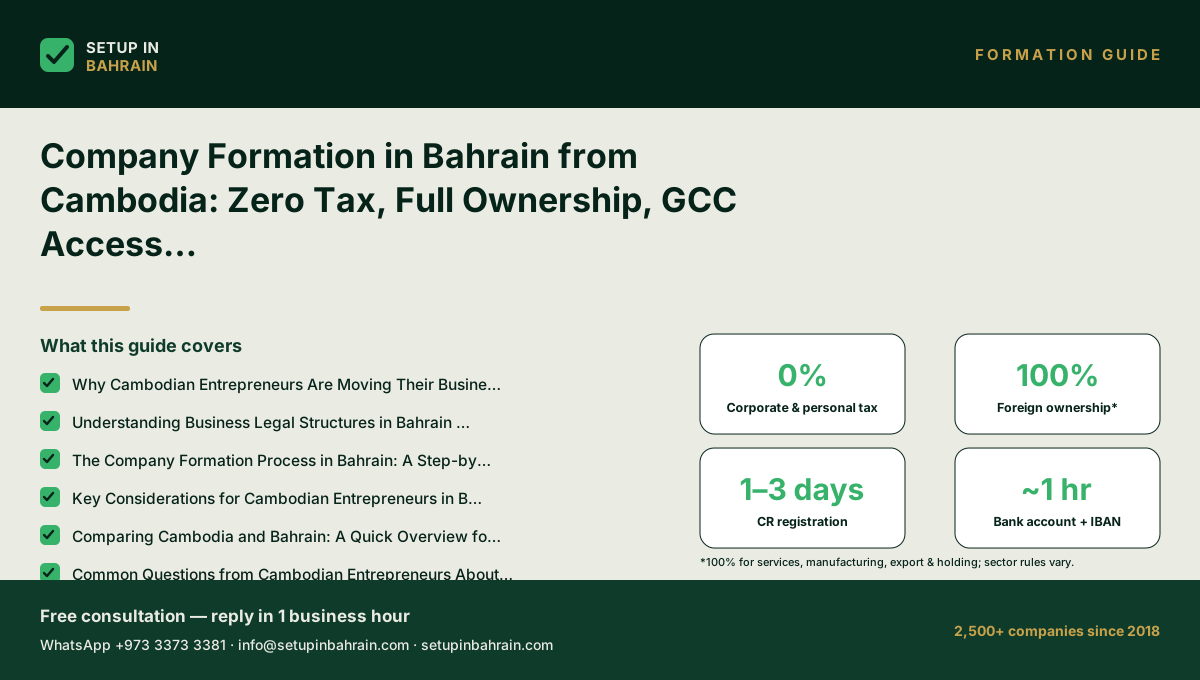
A Bahrain WLL can be owned by a single person — 100% foreign ownership applies to most activities, with no local partner required for services, manufacturing, export trading and holding companies. The minimum share capital is BHD 1 ; we recommend BHD 1,000 . This Makes bank account opening and investor visa approval smoother.
For many visionary entrepreneurs in Cambodia, the story of building a thriving business is often a testament to sheer resilience and ingenuity. You've poured your life into creating a successful venture, perhaps an innovative e-commerce platform connecting rural artisans with global buyers, a bustling garment factory supplying regional markets, or a tech startup revolutionizing the dynamic Phnom Penh landscape. You've navigated the intricate dance of a dual-currency economy, the ever-present demands of the General Department of Taxation (GDT)'s monthly patent tax filings, and the sometimes-protracted pace of local commercial dispute resolution. You’ve achieved success, but with every milestone, a significant portion of your hard-earned profit – a substantial 20% – is siphoned away by corporate tax, year after year.
Imagine Mr. Sopheak, a Cambodian entrepreneur whose online platform, based in Phnom Penh, has seen revenue grow by a consistent 30% year-on-year. His ambition is boundless, yet as his profits swell, so does his tax burden. Each year, he reviews his financial statements, keenly aware that a fifth of his company's hard-won earnings could have been reinvested into scaling operations, hiring more talent, or expanding into new markets. The monthly GDT patent tax filings. Seemingly minor individually, collectively add up to a perpetual administrative headache, frequently distracting his team from core business objectives. He’s also acutely aware of the limitations of Cambodia’s banking infrastructure, especially for seamlessly executing large-volume international transactions outside major hubs like Phnom Penh. His ambitious growth plans, he knows, demand a more agile, tax-efficient, and globally connected base.
Then there’s Sokha, who built a highly successful garment sourcing and export operation in Phnom Penh. Last year, his company cleared roughly USD 1.8 million in profit. After diligently paying the 2generally no corporate income tax for most sectors to the General Department of Taxation, plus managing monthly patent tax filings, social security contributions, and the constant back-and-forth with the Council for the Development of Cambodia (CDC) for any new foreign buyer contracts, his net take-home profit dropped greatly below USD 1.1 million. The reality of commercial life in Cambodia also meant that when a key Thai buyer defaulted on a USD 240,000 invoice, the recovery process through the local commercial court system took a grueling nineteen months, tying up capital and resources.
This isn't just Sopheak or Sokha’s story; it's the shared reality for countless Cambodian business owners who find themselves at a critical juncture. They've proven their resilience and business spirit at home, but the structural challenges of a 2generally no corporate income tax for most sectors, complex and frequent compliance demands, a slower legal system, and limitations in international banking connectivity are more and more becoming barriers to their next phase of global growth.
What if there was a strategic pivot point? A location where your profits could remain entirely yours, where you could own 100% of your business without local partners. Where you could access a multi-trillion-dollar regional market with unparalleled ease? This is precisely the proposition Bahrain offers to Cambodian entrepreneurs. A thriving financial hub at the heart of the Gulf Cooperation Council (GCC), Bahrain provides not just a tax-neutral environment but also a robust, business-friendly ecosystem designed for international success.
This comprehensive guide is crafted specifically for you, the Cambodian entrepreneur, looking to expand your horizons. We'll delve into why Bahrain is an ideal destination, how to establish your company. What to expect every step of the way, providing insights that cut through the noise and offer practical, actionable advice.
Why Cambodian Entrepreneurs Are Moving Their Businesses to Bahrain
The decision to establish a company in a new country is never taken lightly. It involves careful consideration of legal frameworks, economic incentives, market access, and quality of life. For Cambodian entrepreneurs, the contrast between their home market and Bahrain often crystallizes around several key advantages:
Zero Corporate Income Tax: A Game-Changer for Profitability
Let’s be blunt: the 20% corporate income tax in Cambodia is a significant hurdle for scaling businesses. When Sokha’s USD 1.8 million profit is reduced by USD 360,000 in corporate tax alone, the impact on retained earnings and reinvestment potential is profound.
Bahrain's stark contrast: Bahrain operates on a zero corporate income tax regime for most industries. This means that, for a company like Sokha's or Sopheak's, the entire profit – the full 100% – remains within the business, available for reinvestment, expansion, or distribution. This single factor can dramatically accelerate growth, improve cash flow, and enhance overall profitability. Imagine adding that 20% back into your annual budget; it's a massive competitive advantage. This policy, backed by the Bahrain Economic Development Board (EDB), makes the Kingdom a magnet for businesses seeking true tax efficiency.
100% Foreign Ownership: Unfettered Control and Simplicity
In many jurisdictions, including Cambodia, foreign investors might face restrictions on ownership percentages, often requiring local partners for certain business activities or land ownership. Navigating these requirements and ensuring alignment with local partners can add layers of complexity, potential disputes. A dilution of control. The Council for the Development of Cambodia (CDC) often plays a role in approving foreign investments. This Can add administrative time and complexity to business dealings.
Bahrain's liberal approach: One of Bahrain's most compelling features is its allowance for 100% foreign ownership in most sectors. This is not a partial allowance; it means you, as a Cambodian entrepreneur, can wholly own your company, make all strategic decisions. Control every aspect of your operation without the need for a local sponsor or partner. For a Limited Liability Company (WLL), for instance, a single individual can own 100% of the shares. This simplifies governance, reduces administrative burdens, and ensures complete autonomy over your business's destiny, a stark contrast to the often required partnership structures or the CDC's oversight in Cambodia.
Strategic Gateway to the GCC Market: Accessing Trillions
Cambodia's geographic location positions it well for Southeast Asian markets. But, for entrepreneurs eyeing a broader, wealthier consumer base and B2B opportunities, the GCC market represents a colossal opportunity, with a combined GDP exceeding USD 1.6 trillion.
Bahrain's unparalleled connectivity: Bahrain sits strategically at the heart of the Arabian Gulf, serving as a natural gateway to the entire GCC market – Saudi Arabia, UAE, Qatar, Kuwait, and Oman. Its causeway to Saudi Arabia, the King Fahd Causeway, handles millions of crossings annually, facilitating seamless movement of goods and people. This means your business established in Bahrain can efficiently serve a market of over 50 million high-net-worth individuals and rapidly growing economies, often without local distribution hubs in each country. For a Cambodian garment exporter, establishing in Bahrain means direct access to luxury retail markets. For a tech startup, it means tapping into a region investing heavily in digital transformation. The EDB actively promotes Bahrain as a regional hub for a reason – its logistical advantages are undeniable.
Robust and Stable Financial Sector: Beyond SWIFT Limitations
Cambodian entrepreneurs often contend with a banking infrastructure that. Improving, can still present challenges for seamless, large-scale international transactions. The limitations of SWIFT banking infrastructure outside major cities like Phnom Penh can lead to delays, higher costs. Administrative hurdles when dealing with global clients and suppliers. The dual-currency economy (USD and KHR) also adds a layer of accounting complexity, requiring careful management of foreign exchange risk and reconciliation.
Bahrain's global financial pedigree: Bahrain has a long-standing reputation as a mature financial hub in the Middle East. It boasts a sophisticated and well-regulated banking sector, supervised by the Central Bank of Bahrain (CBB). This translates to: Ease of international transactions: Banks in Bahrain offer advanced online banking platforms, efficient SWIFT processing. Seamless multi-currency accounts, making global trade greatly easier. Access to diverse financial products: From trade finance to corporate lending, Bahraini banks provide a comprehensive suite of services catering to international businesses. Stability and security: The CBB's stringent regulations ensure a stable and secure environment for your company's finances. Reduced accounting complexity: While the US Dollar is widely used in Bahrain, the primary currency is the Bahraini Dinar (BHD). This Is pegged to the USD. This simplifies accounting greatly compared to navigating a truly dual-currency system like Cambodia's USD/KHR environment, minimizing foreign exchange reconciliation issues.
Streamlined Business Environment and Regulatory Clarity
Cambodian businesses, as Sokha experienced with the CDC and commercial courts, can sometimes face administrative complexities and lengthy dispute resolution processes.
Bahrain's commitment to ease of doing business: The Kingdom has consistently ranked high globally for its ease of doing business, a testament to its forward-thinking regulatory environment.
- Efficient company registration: The Ministry of Industry and Commerce (MOIC) has digitized much of the company registration process, making it faster and more transparent.
- Clear legal framework: Bahrain operates under a clear, well-defined legal system based on civil law, providing predictability and investor confidence. The World Bank's "Doing Business" reports frequently highlight Bahrain's robust legal protection for investors.
- Proactive government support: Institutions like the EDB actively assist foreign investors in navigating the regulatory landscape and establishing their presence.
- Efficient dispute resolution: While disputes are always a possibility, Bahrain's commercial courts are known for their efficiency and adherence to international best practices, aiming for resolution in a much shorter timeframe than the nineteen months Sokha endured.
High Quality of Life for Expatriates
Beyond business advantages, Bahrain offers an excellent quality of life, especially for expatriates.
- Multicultural society: A diverse population with a welcoming atmosphere.
- Modern infrastructure: World-class healthcare, education, and entertainment facilities.
- Safety and stability: Bahrain is consistently ranked as one of the safest countries in the world.
- Lower cost of living (compared to some GCC counterparts): While not inexpensive, the cost of living in Bahrain, especially for housing and daily expenses, can be more manageable than in Dubai or Doha.
Understanding Business Legal Structures in Bahrain for Cambodian Entrepreneurs
Choosing the right legal structure is foundational for your company's success in Bahrain. While several options exist, some are more common and advantageous for foreign investors, especially those new to the GCC market. It’s crucial to understand that there is no single-shareholder WLL legal structure in Bahrain.
1. With Limited Liability Company (WLL) – The Preferred Choice
For most Cambodian entrepreneurs establishing a new business in Bahrain, the With Limited Liability Company (WLL) is by far the most popular and recommended option.
Key Features & Benefits: 100% Foreign Ownership: This is a critical point. A WLL can be owned 100% by a single foreign individual or corporate entity. You do not* need a Bahraini partner. This offers complete control and simplifies governance greatly.
- Limited Liability: As the name suggests, the personal liability of shareholders is limited to their capital contribution. Your personal assets are protected from business debts and obligations.
- Flexibility: Suitable for a vast range of business activities, from trading and consulting to services and manufacturing.
- Minimum Share Capital: Legally, the minimum share capital for a WLL is only BHD 1. But, for practical purposes, especially when opening a corporate bank account and applying for investor visas, we strongly recommend a starting share capital of BHD 1,000. Most banks will not approve an account with just BHD 1.
- Management: Can be managed by one or more directors, who do not necessarily need to be Bahraini residents initially (though residence will be required for visa purposes).
- Tax Efficiency: Benefits from Bahrain's Generally no corporate income tax for most sectors regime.
Ideal For: Small to medium-sized enterprises (SMEs), startups, consulting firms, trading companies, e-commerce ventures. Any business where 100% foreign ownership and limited liability are priorities. This would be the structure of choice for Mr. Sopheak’s e-commerce platform or Sokha’s garment sourcing business.
2. Bahrain Shareholding Company (BSC) – For Larger Ventures
A Bahrain Shareholding Company (BSC) is analogous to a Public Limited Company (PLC) or a stock corporation. It's designed for larger enterprises with multiple shareholders, often looking to raise capital through public subscription.
Types:
- Closed BSC (B.S.C. Closed): Shares are not offered to the public and are held by a limited number of individuals or entities. Minimum capital BHD 250,000.
- Public BSC (B.S.C. Public): Shares can be offered to the public, requiring stringent regulatory compliance. Minimum capital BHD 1,000,000.
Key Features & Benefits:
- Access to Capital Markets: Public BSCs can raise significant capital through initial public offerings (IPOs).
- Increased Credibility: Often perceived as more prestigious and transparent due to stricter regulatory oversight.
- Limited Liability: Shareholders' liability is limited to their shareholding.
Ideal For: Larger corporations, financial institutions. Companies planning future IPOs or seeking substantial investment from a broad base of shareholders. Less common for initial setup by Cambodian SMEs.
3. Branch of a Foreign Company – For Established International Brands
If your Cambodian company is already well-established and you wish to simply extend its existing operations into Bahrain without creating a separate legal entity, setting up a Branch of a Foreign Company is an option.
Key Features & Benefits:
- Extension of Parent Company: The branch is not a separate legal entity but rather an extension of your Cambodian parent company. This means the parent company bears full liability for the branch’s activities.
- Operational Simplicity: Can be simpler to set up than a new WLL if the parent company's existing structure and brand are to be maintained.
- No Minimum Capital Requirement: Typically, there isn't a specific minimum capital required, though the MOIC might require evidence of financial stability of the parent company.
Ideal For: Large Cambodian corporations, multinational companies, or service providers who want to enter the Bahraini market under their existing brand and operational structure without forming a new subsidiary. For smaller, business ventures like Sopheak's or Sokha's, a WLL usually offers better protection and flexibility.
4. Representative Office – Market Research & Promotion Only
A Representative Office is the most restrictive form of presence. It allows a foreign company to establish a presence in Bahrain for the sole purpose of market research, marketing, or promoting its products/services.
Key Features & Benefits:
- No Commercial Activities: Strictly prohibited from conducting any commercial transactions, selling goods, or earning revenue in Bahrain.
- Limited Scope: Primarily for information gathering, building contacts, and preparing for future commercial expansion.
- Minimal Setup Cost: Generally has lower setup and operational costs compared to other structures.
Ideal For: Companies wanting to test the waters in the Bahraini or GCC market before committing to full commercial operations. It’s a good first step for market exploration but not for direct business activity.
Recommendation for Cambodian Entrepreneurs: For most entrepreneurs transitioning from Cambodia, the With Limited Liability Company (WLL) offers the optimal balance of 100% foreign ownership, limited liability protection, flexibility, and a streamlined setup process, making it the most sensible starting point.
The Company Formation Process in Bahrain: A Step-by-Step Guide
Establishing a company in Bahrain is designed to be efficient, especially compared to some bureaucratic processes you might encounter elsewhere. The Ministry of Industry and Commerce (MOIC) is the primary regulatory body, with the Bahrain Investor Portal (BIPA) being the digital gateway for most procedures.
Here’s a general roadmap:
Step 1: Business Activity and Name Reservation
Define Business Activities (CR Activity): * Clearly articulate the exact nature of your business operations. Bahrain has a classified list of Commercial Registration (CR) activities. You'll need to select codes that match your intended business. This step is crucial, as your CR activities dictate what your company is legally allowed to do. For instance, an "e-commerce retail" activity is different from "wholesale trading." Expert Tip:* Think broadly but specifically. If you plan both online sales and physical distribution, ensure both activities are covered. Some activities might require special approvals (e.g., financial services, education, healthcare). Choose a Company Name: * Select at least three potential company names in order of preference. The name must be unique and not conflict with existing registered businesses. It should also comply with MOIC naming conventions (e.g., no offensive terms, not identical to famous brands, often requiring "W.L.L." at the end for an LLC). * You can check name availability online via the Sijilat portal.
Step 2: Initial Approvals and Documents Preparation
Initial MOIC Approval: Submit your proposed business activities and company names to the MOIC (usually through the Sijilat portal). This typically provides an initial approval in a few days if activities and names are clear. Gather Required Documents: Prepare the following: * Shareholder/Director Details: Copies of passports for all shareholders and directors, residency information. * Memorandum of Association (MOA) and Articles of Association (AOA): These are the foundational legal documents defining your company's structure, objectives, share capital, and internal governance. A local legal consultant will help draft these in Arabic and English. * Proof of Address: For the registered office in Bahrain (usually a lease agreement for office space or a serviced office agreement). * Bank Reference Letter: For shareholders (sometimes required as part of due diligence). * Power of Attorney (POA): If you are using a local agent or consultant to handle the formation process on your behalf. This is highly recommended for efficiency. * No-Objection Certificate (NOC): If any shareholder or director is currently employed in Bahrain, a NOC from their employer might be required. Special Approvals (If Applicable): For certain regulated activities (e.g., financial services, healthcare, education, oil & gas), you will need additional approvals from relevant ministries or regulatory bodies before final MOIC registration. The EDB can provide guidance here.
Step 3: Capital Deposit (For WLL)
Open a Provisional Bank Account: With the initial MOIC approval and drafted MOA/AOA, you can approach a Bahraini bank to open a provisional corporate bank account. Deposit Share Capital: Deposit the required share capital (minimum BHD 1. Practically BHD 1,000 is recommended for bank account activation and visa eligibility). A bank letter confirming the deposit will be issued.
Step 4: Final Commercial Registration (CR)
Submit Final Application: Once all documents are prepared, signed. Attested (if required), and the capital is deposited, submit the complete application package to the MOIC via the Sijilat portal. MOIC Review and Issuance of CR: The MOIC will review the application. If everything is in order, your Commercial Registration (CR) certificate will be issued. This is your company's official license to operate in Bahrain. This process can typically take 3-7 business days after all documents are correctly submitted. Labour Market Regulatory Authority (LMRA) Registration: Once the CR is issued, your company must register with the LMRA to employ staff and get work permits/visas.
Step 5: Post-Registration Formalities
Activate Corporate Bank Account: With the CR, you can finalize the activation of your corporate bank account. This is where the BHD 1,000 practical capital becomes essential for a smooth process. Investor/Employee Visas: Apply for investor visas for shareholders and management. Work visas for employees through the LMRA. Office Setup: Finalize your office space, whether it's a physical office, co-working space, or serviced office. Tax Registration (for specific taxes): While there's no corporate income tax, your company may need to register for Value Added Tax (VAT) if its annual turnover exceeds BHD 37,500. This is done through the National Bureau for Revenue (NBR).
Timeline: The entire company formation process, from initial inquiry to receiving the CR, can typically range from 2 to 4 weeks, assuming all documents are in order and no special approvals are needed. The fastest timelines are often achieved with the assistance of an experienced local corporate service provider.
Key Considerations for Cambodian Entrepreneurs in Bahrain
Beyond the procedural steps, there are several practical considerations that Cambodian entrepreneurs must factor into their plans.
Banking and Finance
Bank Selection: Bahrain has a robust banking sector with international and local banks (e.g., National Bank of Bahrain, Bank ABC, BBK, HSBC, Standard Chartered). Research their services, fees, and digital capabilities to choose the best fit for your business needs. Proof of Funds: Be prepared to provide source of funds documents (e.g., personal bank statements, business financial statements from Cambodia) when opening corporate and personal bank accounts. Banks adhere to strict Anti-Money Laundering (AML) and Know Your Customer (KYC) regulations. Capital Deposit (Again): Reiterate that while BHD 1 is the legal minimum share capital for a WLL, a deposit of BHD 1,000 is the practical benchmark to help bank account approval and investor visa processing. Trying to open with BHD 1 will almost certainly lead to delays and rejections. Dual-Currency Experience: Your experience with the USD/KHR dual-currency economy in Cambodia will be an advantage. While BHD is pegged to the USD. USD is widely accepted, understanding multi-currency operations will simplify your financial management in Bahrain.
Visas and Residency
- Investor Visa: As a shareholder in a Bahraini company (especially a WLL), you will be eligible for an investor visa. This typically grants a multi-year residency permit.
- Employment Visas: For any employees you hire (local or expatriate), your company will need to apply for work permits and visas through the Labour Market Regulatory Authority (LMRA).
- Family Visas: Once you have your investor visa, you can sponsor your dependents (spouse and children) for residency visas.
- Bahrain Investor Placement Agency (BIPA): This agency, often associated with the EDB, can provide valuable assistance and fast-track services for investors seeking residency permits.
Office Space Requirements
Registered Address: Every company in Bahrain must have a registered office address. This can be a physical office, a shared workspace, or a virtual office solution through a serviced office provider. "Substance" Requirements: While Bahrain offers excellent tax efficiency, international regulations on "economic substance" are becoming more prevalent. This means your company should have genuine operations in Bahrain, proportionate to its activities (e.g., a physical office, local employees, active management. Decision-making taking place in Bahrain). This is vital to fully benefit from the tax regime and avoid issues in your home country or other jurisdictions.
Compliance and Reporting
- Annual Renewals: Your Commercial Registration (CR) must be renewed annually with the MOIC.
- Audited Financial Statements: WLLs and other company types are generally required to prepare and submit audited financial statements annually to the MOIC. Engage a reputable local auditor early.
- VAT Filings: If your company is VAT registered, you will need to file VAT returns periodically (usually quarterly) with the National Bureau for Revenue (NBR). Keep accurate records of sales and purchases. Unlike Cambodia's GDT monthly patent tax filing, Bahrain's compliance is often less frequent and focused on actual transactions rather than a fixed monthly levy.
- LMRA Compliance: Ensure timely payment of LMRA fees for employees and compliance with labor laws.
- Sanctions Compliance: Bahrain, as a global financial hub, adheres to international sanctions lists. Ensure your business activities and transactions are compliant.
Cultural and Business Etiquette
Respect Local Culture: Bahrain is a Muslim country. Respecting local customs, traditions, and dress codes (especially during Ramadan) is important for successful business relations. Professionalism: Punctuality, formal attire in business settings, and a polite demeanor are highly valued. Networking: Building relationships is key in the GCC. Attend industry events, chamber of commerce gatherings, and network actively. Comparing Cambodia and Bahrain: A Quick Overview for Entrepreneurs
Let’s put some of the key differences into a direct comparison, highlighting why Bahrain could be the strategic move for your business.
Feature Cambodia Bahrain :--------------------------- :-------------------------------------------------------------------------------------------------------------------------------------------------------------------------------------------------------------------------------------------------------------------------------------------------------------- :--------------------------------------------------------------------------------------------------------------------------------------------------------------------------------------------------------------------------------------------------------------------------------------------------------------------------------------------------------------------------------------------------------------------------------------------------------------------------------------------------------------------------------------------------------------------------------------------------------------------------------------------------------------------------------------------------------------------------------------------------------------------------------------------------------------------------------------------------------------------------------------- Corporate Income Tax 20% on business profits. 0% for most business activities (exceptions for oil & gas and specific financial services). Foreign Ownership Often restricted in certain sectors, may require local partners (e.g., 49% foreign ownership for some businesses), or require CDC investment approvals for foreign companies. 100% foreign ownership allowed in most sectors for WLLs and other structures. No local partner required. Minimum Capital (WLL) Varies by activity (e.g., USD 1,000 for trading company, higher for others). Legally BHD 1 . Practically, BHD 1,000 recommended for bank account & visa. Legal Framework Civil Law system, sometimes perceived as slower with commercial court backlogs (e.g., 19 months for debt recovery for Sokha). Civil Law system, modern and efficient, with a reputable commercial judiciary ensuring predictable and timely dispute resolution, greatly faster than Cambodian courts. Banking Infrastructure Developing, dual-currency (USD/KHR) creates accounting complexity, limited SWIFT banking infrastructure outside major hubs. Highly advanced, mature financial hub regulated by the CBB. Efficient international transfers, multi-currency accounts, and robust digital banking. Primary currency BHD (pegged to USD), simplifying foreign exchange compared to USD/KHR. Compliance Burden Monthly GDT patent tax filings, social security contributions, CDC approvals for foreign investments. Annual CR renewal, annual audited financials, quarterly VAT filings (if applicable). No monthly "patent tax" akin to Cambodia's GDT system. Generally less frequent and more transaction-based. Market Access Primarily Southeast Asian markets. Direct access to the USD 1.6+ Trillion GCC market of 50+ million consumers, with strong connectivity to MENA and wider global markets. Startup Costs Generally lower initial setup costs. Potentially higher initial setup costs (legal fees, office rent) than Cambodia. Offset by significant long-term tax savings and market access benefits. Economic Diversification Heavily reliant on agriculture, garments, and tourism. Actively diversified beyond oil, with strong growth in finance, ICT, logistics, manufacturing. Tourism, creating a dynamic business ecosystem. Visa Process Can be lengthy and complex for long-term foreign residency/investment. Streamlined investor visa process through MOIC/EDB/LMRA, leading to efficient residency permits for business owners and families. WLL Option Not applicable Crucial: NO WLL (Single Person Company) in Bahrain. Do not look for this option. The WLL allows 100% single ownership and offers the same benefits. Common Questions from Cambodian Entrepreneurs About Bahrain Company Formation
Here are some of the frequently asked questions that Cambodian entrepreneurs have when considering Bahrain:
Q: Can I truly own 100% of my company in Bahrain as a Cambodian citizen? A: Absolutely, yes. For a With Limited Liability (WLL) company. This Is the most common structure for foreign investors, you can be the sole owner and hold 100% of the shares. No local partner or sponsor is required.
Q: What is the minimum share capital for a WLL? A: Legally, the minimum required share capital for a WLL is BHD 1. But, for practical purposes, especially when opening a corporate bank account and applying for investor visas, we strongly advise and recommend depositing at least BHD 1,000. Most banks will not process an account application with only BHD 1, leading to significant delays.
Bahrain Business Guides for Cambodia Citizens
Frequently Asked Questions
How long does it take to set up?
It takes 15 to 20 days. We file all forms for you. You do not need to wait long.
What does it cost?
Company formation: Standard BHD 1,340 with 3 months of office address; Gold BHD 1,700 with 6 months; Premium BHD 2,150 with 12 months and a cabin, officer table and chair, and two guest chairs. No formation package includes visas, including Premium. Investor/work visas are priced separately: BHD 755 for one year or BHD 953 for two years, in addition to the formation package. Ask for a written, itemized quotation confirming government fees and all inclusions before payment.
Do I need to visit Bahrain?
No. You can set up your firm from home. We do all the work online. Some banks may ask for one visit.
What tax will I pay?
You pay zero tax on your profits. Bahrain has no corporate income tax. This is a key benefit of the setup.
Can I own 100% of my firm?
Yes. Foreign owners can hold all shares. No local partner is needed. Full ownership is allowed.
What do I need to start?
You need a valid passport. You also need a trade name and a business address. We help you with all of these.
How do I open a bank account?
We guide you step by step. Most banks take 3 to 6 weeks. You will need your CR and firm papers.
Who issues the Commercial Registration (CR)?
The CR is issued by the MOICT. It is your legal right to trade in Bahrain. We file the CR for you.
Can I renew my CR each year?
Company renewal packages: BHD 530 with 3 months of office address; BHD 980 with 6 months; BHD 1,520 with 12 months. These are separate renewal packages, not visa fees.
How do I get started?
Fill in our form on this page. Our team will call you back. We map your best setup plan at no cost.
Steps to Form Your Company
- Pick your trade name. We check if it is free.
- Choose your business type. WLL is the most common.
- Sign the MOA. We draft and file all legal docs.
- Pay the state fees. About BHD 432 in total.
- Get your CR. Takes 15 to 20 days.
- Open your bank account. We guide each step.
- Start trading. You are ready to do business.
Key Facts
- Tax rate: 0%
- Foreign ownership: 100%
- Setup time: 15 to 20 days
- Company formation: Standard BHD 1,340 with 3 months of office address; Gold BHD 1,700 with 6 months; Premium BHD 2,150 with 12 months and a cabin, officer table and chair, and two guest chairs. No formation package includes visas, including Premium. Investor/work visas are priced separately: BHD 755 for one year or BHD 953 for two years, in addition to the formation package. Ask for a written, itemized quotation confirming government fees and all inclusions before payment.
- Company renewal packages: BHD 530 with 3 months of office address; BHD 980 with 6 months; BHD 1,520 with 12 months. These are separate renewal packages, not visa fees.
- Client rating: 4.8 stars
- Clients served: 2,500 and more
Quick Facts
- Tax rate: 0%
- Own all of your firm: Yes, 100%
- Time to set up: 15 to 20 days
- Company formation: Standard BHD 1,340 with 3 months of office address; Gold BHD 1,700 with 6 months; Premium BHD 2,150 with 12 months and a cabin, officer table and chair, and two guest chairs. No formation package includes visas, including Premium. Investor/work visas are priced separately: BHD 755 for one year or BHD 953 for two years, in addition to the formation package. Ask for a written, itemized quotation confirming government fees and all inclusions before payment.
- Company renewal packages: BHD 530 with 3 months of office address; BHD 980 with 6 months; BHD 1,520 with 12 months. These are separate renewal packages, not visa fees.
- Rating: 4.8 stars
- Clients: 2,500 and more
Why Bahrain?
Bahrain has no tax. You keep all your profits. This is rare in the Gulf.
You can own all of your firm. No local partner is needed. The law allows full foreign ownership.
Setup takes 15 to 20 days. We file all forms for you. You can do it all from home.
Bahrain has a free trade deal with the US. Your goods face low or no tariffs. This gives you access to big markets.
We have served 2,800+ clients from 44+ countries and maintain records to substantiate that total where needed. We have 113 Google reviews; reviews represent only some clients and are not the same as the total clients served.
Our Steps
- Tell us your plan. We advise you for free.
- We pick the right firm type for you.
- We file all your forms with MOICT.
- You get your CR in 15 to 20 days.
- We help you open a bank account.
- You are ready to trade. We stay with you.
Next Steps for Cambodia Citizens
You can set up a firm in Bahrain from Cambodia. You do not need to fly there first. We do all the work online.
Tell us your plan. We call you back the same day. We map the best route for you at no cost.
We file all your forms. We deal with MOICT and the state. You get your CR in 15 to 20 days.
After your CR, we help you get a bank account. We also help with your Investor Visa. One firm guides you at each step.
Why Our Clients from Cambodia Choose Us
- We speak your language. We know your needs.
- We have helped clients from Cambodia before.
- Our fee is clear. No surprise costs.
- We have a 4.8 star rating on Google.
- We have helped more than 2,500 clients set up in Bahrain.
Fill in the form on this page. We will be in touch soon. Let us help you start your Bahrain firm today.
Ready to set up in Bahrain from Cambodia?
Tell us your business idea. We map the right entity, ownership and timeline — then handle the filing while you focus on what matters.