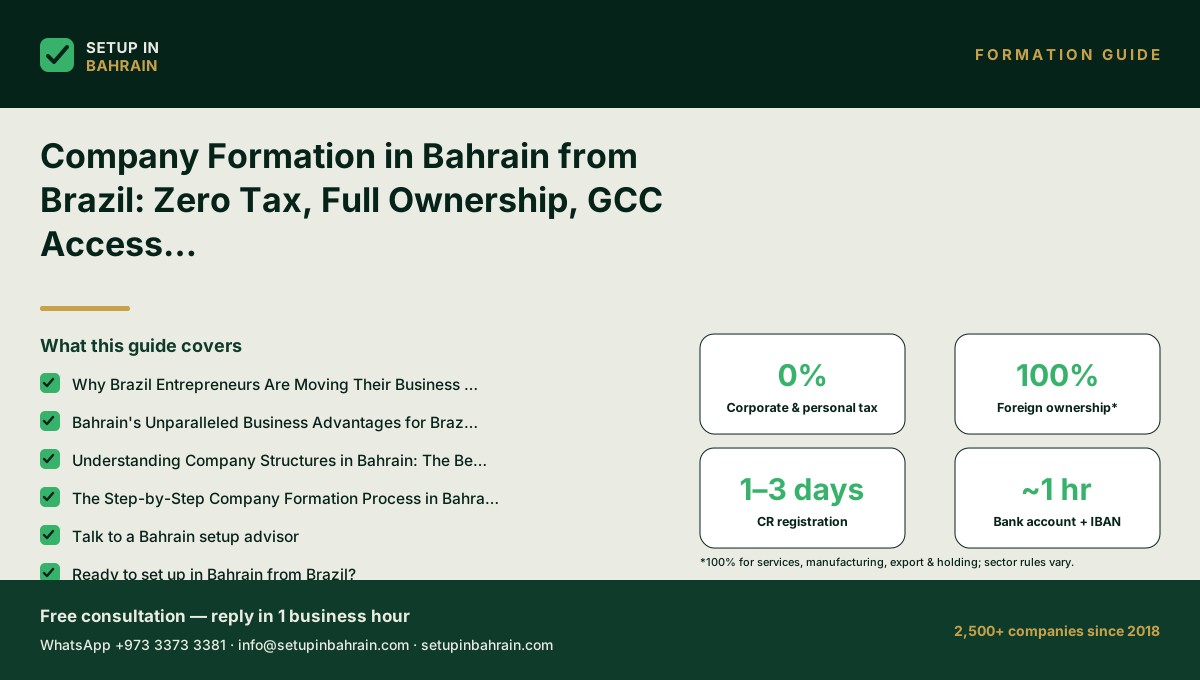
Complete guide for Brazil entrepreneurs: form a company in Bahrain with generally no corporate income tax for most sectors, 100% foreign ownership. GCC market access. Costs, steps, visas, banking.
Key Takeaways
- Why Brazil Entrepreneurs Are Moving Their Business to Bahrain
- Bahrain's Unparalleled Business Advantages for Brazilian Investors
- Understanding Company Structures in Bahrain: The Best Fit for Brazilian Businesses
- The Step-by-Step Company Formation Process in Bahrain for Brazilian Entrepreneurs
→ Complete guide: Company Formation in Bahrain — the full 2026 guide
View details
Ownership & capital
A Bahrain WLL can be owned by a single person — 100% foreign ownership applies to most activities, with no local partner required for services, manufacturing, export trading and holding companies. The minimum share capital is BHD 1 ; we recommend BHD 1,000 . This Makes bank account opening and investor visa approval smoother.
For Brazilian entrepreneurs, the pursuit of scaling a business, expanding internationally, or simply retaining more of their hard-earned profits often feels like navigating a dense, legalistic jungle. The journey is frequently fraught with complex tax codes, relentless bureaucratic hurdles. The constant erosion of capital through an intricate web of contributions and levies. You're working tirelessly to build something remarkable, only to see a significant portion of your efforts dissipate into an inefficient system.
But what if there was a strategic pivot point, a gateway to a more streamlined, profitable future that not only eliminates many of these frustrations but also opens up entirely new markets?
Imagine this: a São Paulo-based software exporter we worked with last year found himself spending nearly 34% of his profits on IRPJ and CSLL alone. His team burned an additional 1,958 hours annually on compliance – a figure the World Bank identifies as the most time-consuming globally. Once payroll contributions pushed total employer costs to 65% above base salaries, he watched his effective tax rate climb even higher. After three months of battling to open a new Nota Fiscal series across two different states, he finally reached a breaking point, asking the same question many Brazilian founders eventually reach: is there a jurisdiction where the numbers actually work without the soul-crushing regulatory drag?
The answer for a growing number of forward-thinking Brazilian entrepreneurs is a resounding yes: Bahrain.
This guide is for you, the Brazilian business owner, the visionary founder, the frustrated entrepreneur looking for a smarter, more efficient path. We're going to dive deep into why Bahrain has emerged as a compelling, often overlooked, alternative for company formation, specifically tailored to address the unique challenges and aspirations of businesses operating out of Brazil. Forget generic advice; this is about your reality, your pain points. A concrete, actionable solution for 2026 and beyond.
Why Brazil Entrepreneurs Are Moving Their Business to Bahrain
Ask any Brazilian entrepreneur about their biggest frustrations. You'll hear a consistent theme: crippling tax rates, unpredictable rule changes, and bureaucratic red tape that drains both money and sanity. The combined IRPJ (Imposto de Renda Pessoa Jurídica) and CSLL (Contribuição Social sobre o Lucro Líquido) corporate taxes often reach an effective rate of 34% —one of the highest effective corporate income tax rates globally. But the real pain is much deeper than a mere percentage.
Consider the data: World Bank studies consistently show that Brazil’s tax compliance burden, at an staggering average of 1,958 hours per year , is not just the worst in Latin America; it’s widely considered the most time-consuming globally. Every Brazilian company, regardless of size, grapples with the complexities of the SPED (Sistema Público de Escrituração Digital) electronic accounting system. This Demands round-the-clock data updates and intricate integrations with state-by-state Nota Fiscal invoicing regulations. This isn't just a cost; it's a massive drain on productivity, diverting valuable resources and business energy away from innovation and growth.
Also, the complexities don't stop at corporate income. Brazil’s employer social liabilities are famously burdensome, pushing total employer costs to an average of 65% above base salaries. This means that for every R$100 paid in salary, a company often expends R$165 in total. This greatly inflates operational costs and acts as a disincentive for job creation and expansion.
Beyond the direct costs, Brazilian businesses contend with:
- Currency Volatility: The unpredictable swings of the Brazilian Real (BRL) against major international currencies create significant financial risk, making long-term planning and international transactions fraught with uncertainty. Investors, both local and foreign, are often reluctant to commit substantial capital due to these currency risks and the threat of ever-higher regulatory costs.
- Slow, Complex Formation Processes: Establishing a new entity or even making significant changes to an existing one in Brazil can be a protracted, multi-stage process involving numerous government agencies at federal, state, and municipal levels, each with its own set of rules and timelines.
- Unpredictable Rule Changes: The constant flux of Brazilian tax laws and regulations creates an environment of instability. What is legal and compliant today might be subject to new interpretations or legislative changes tomorrow, demanding continuous legal and accounting oversight.
In stark contrast, Bahrain offers a dramatically different landscape:
Zero Corporate Income Tax: For most business activities, there is no corporate tax, no personal income tax. No capital gains tax. This is a fundamental game-changer, allowing businesses to retain greatly more of their profits. 100% Foreign Ownership: Unlike many jurisdictions, Bahrain allows full foreign ownership of companies across almost all sectors, eliminating the need for local partners and giving you complete control over your operations. Strategic Access to GCC Markets: Positioned at the heart of the Gulf Cooperation Council (GCC) with a direct causeway to Saudi Arabia, Bahrain serves as a cost-effective gateway to a trillion-dollar regional market of over 50 million affluent consumers. English as the Language of Business: While Arabic is the official language, English is widely spoken and used in business, legal. Administrative contexts, simplifying communication and reducing the need for constant translation. Streamlined Digital-First Processes: Bahrain has invested heavily in digitalizing government services through platforms like Sijilat, making company formation and ongoing compliance remarkably faster and simpler than in Brazil. Stable and Predictable Regulatory Environment: Governed by clear, transparent laws and a pro-business approach, Bahrain offers stability and predictability, allowing entrepreneurs to focus on growth rather than navigating constant regulatory shifts.
For Brazilian entrepreneurs like Mariana from Belo Horizonte, whose SaaS platform Inovatech was gaining traction globally, the shift to Bahrain wasn't just about saving money; it was about regaining control, unlocking potential, and truly scaling without the constant drag of an overly complex domestic system.
Bahrain's Unparalleled Business Advantages for Brazilian Investors
Bahrain’s Economic Development Board (EDB) has meticulously cultivated an environment designed to attract foreign direct investment. Its benefits are especially resonant for Brazilian entrepreneurs seeking agility and global reach.
Zero Corporate Income Tax: A Game-Changer for Profitability
This is arguably Bahrain's most compelling proposition. For the vast majority of commercial activities, companies registered in Bahrain face zero corporate income tax . This isn't a temporary tax holiday or a convoluted incentive scheme; it's a core principle of the kingdom's economic policy. There's also no personal income tax, no capital gains tax. No withholding tax on dividends, interest, or royalties.
Consider the direct impact: Instead of budgeting for a 34% (or higher) corporate tax liability as you would in Brazil, your Bahraini entity retains virtually 100% of its net profits. This capital can then be reinvested into growth, product development, market expansion, or distributed to shareholders, greatly accelerating your business's trajectory. This transparent, zero-tax framework dramatically improves your bottom line and attractiveness to international investors who seek jurisdictions with clear and predictable tax regimes.
100% Foreign Ownership: Full Control, No Local Partner Requirements
A major hurdle in many emerging markets is the requirement for local shareholding or sponsorship. Bahrain eliminates this barrier across nearly all sectors. As a Brazilian entrepreneur, you can establish a company, such as a With Limited Liability (WLL). Retain 100% foreign ownership . This means:
- Complete Control: You maintain full strategic and operational control over your business, without needing to navigate the complexities or potential disagreements with local partners.
- Simplified Decision-Making: All decisions, from operational strategy to profit distribution, rest entirely with the foreign shareholders or directors.
- Faster Setup: Avoiding the search for and negotiation with local partners streamlines the company formation process considerably.
This level of ownership freedom is a powerful enabler for international expansion, providing peace of mind and operational autonomy.
Strategic Gateway to the GCC and MENA Markets
Bahrain is not just a standalone economy; it's a strategic beachhead into the lucrative GCC (Gulf Cooperation Council) and wider MENA (Middle East and North Africa) regions.
- Trillion-Dollar Market: The GCC alone represents a market of over 50 million people with high disposable incomes and a combined GDP exceeding US$1.6 trillion. Bahrain's liberal trade policies and free trade agreements provide unparalleled access to this affluent consumer base.
- Direct Access to Saudi Arabia: Crucially, Bahrain is connected to Saudi Arabia—the largest economy in the GCC—by the 25-kilometer King Fahd Causeway. This allows for seamless logistical and business operations, often enabling companies to service the Saudi market directly from Bahrain, avoiding the complexities of setting up a full entity within Saudi Arabia in the initial stages.
- Logistics Hub: With modern seaports, an international airport, and excellent road networks, Bahrain is rapidly developing as a regional logistics and distribution hub, ideal for businesses involved in trade and e-commerce.
Business-Friendly Ecosystem & Regulatory Agility
The Bahraini government, led by institutions like the EDB and the Ministry of Industry and Commerce (MOIC), is actively committed to fostering a pro-business environment.
Digital-First Government Services: The "Sijilat" portal is a prime example of Bahrain's commitment to digital transformation. This online platform allows entrepreneurs to register their businesses, apply for licenses. Manage ongoing compliance efficiently from anywhere in the world, dramatically reducing bureaucratic delays. English as the Language of Business: All official documents and procedures are available in English. Government officials, banking professionals, and the general business community are proficient in the language. This removes a significant language barrier often faced by Brazilian entrepreneurs entering new markets. Transparent and Predictable Regulations: Bahrain operates under a clear, common-law-inspired legal framework, providing certainty and minimizing the risk of arbitrary policy changes that can plague businesses in other jurisdictions. Strong Regulatory Bodies: The Central Bank of Bahrain (CBB) is a respected and proactive regulator, ensuring stability and integrity in the financial sector, which is critical for investor confidence.
Cost-Effective Operations: Maximize Your ROI
While offering world-class infrastructure and services, Bahrain provides a greatly more cost-effective operational base compared to other major GCC hubs like Dubai or Doha.
Lower Office Rents: Commercial office space, whether physical or virtual, is generally more affordable. Competitive Living Costs: The cost of living for expatriates, including housing, education. Daily expenses, is lower, making it attractive for entrepreneurs considering relocation. Access to Skilled Talent: Bahrain boasts a diverse and well-educated workforce, often at more competitive salary levels than in larger, more saturated markets.
These cost efficiencies translate directly into higher profitability and a faster return on investment for your Bahraini enterprise.
Robust Legal Framework & Modern Infrastructure
Bahrain's legal system is based on civil law principles with strong influences from common law, especially in commercial and financial matters. This hybrid system ensures transparency, fairness, and efficient dispute resolution. The country also boasts:
- World-Class Telecommunications: High-speed internet and reliable connectivity are standard.
- Advanced Logistics: Modern port facilities and a well-connected international airport (Bahrain International Airport - BIA) help global trade and travel.
Quality of Life for Entrepreneurs and Families
Beyond business, Bahrain offers a high quality of life, making it an attractive destination for entrepreneurs considering relocation with their families.
Multicultural & Welcoming Environment: A significant expatriate population contributes to a diverse and inclusive social fabric. Safety & Security: Bahrain is renowned for its low crime rates and political stability. Excellent Healthcare & Education: Access to high-quality healthcare facilities and a wide array of international schools catering to various curricula. Vibrant Lifestyle: A rich cultural scene, modern shopping malls, exquisite dining. Numerous recreational activities ensure a balanced lifestyle.
For Brazilian entrepreneurs seeking not just business success but also a better quality of life and a stable environment for their families, Bahrain presents an incredibly compelling proposition.
Understanding Company Structures in Bahrain: The Best Fit for Brazilian Businesses
Choosing the right legal entity is a foundational decision for your Bahraini venture. While Bahrain offers several company types, one stands out as the overwhelming favorite for foreign entrepreneurs, especially those from Brazil, due to its flexibility and ownership benefits.
With Limited Liability (WLL): The Most Popular Choice
The With Limited Liability (WLL) company structure is by far the most common and recommended choice for Brazilian entrepreneurs. It offers a perfect balance of flexibility, protection, and straightforward compliance.
Key Characteristics of a WLL:
- 100% Foreign Ownership: Crucially, a WLL can be owned 100% by foreign individuals or corporate entities. There are no requirements for local partners or sponsors in the vast majority of business activities. This provides complete control and peace of mind.
- Single Shareholder Permissible: Unlike some jurisdictions, a Bahraini WLL can be incorporated with just one single shareholder, eliminating the need to find multiple partners if you are a sole founder or a single corporate entity.
- Limited Liability: The liability of shareholders is limited to the amount of their capital contribution to the company. This protects your personal assets from business debts and obligations, a fundamental advantage for any entrepreneur.
- Minimum Share Capital: Legally, the minimum share capital for a WLL is BHD 1 (one Bahraini Dinar). But, based on practical experience and to ensure smooth operations, especially about bank account approval and investor visa eligibility, we strongly recommend a practical starting capital of at least BHD 1,000 (one thousand Bahraini Dinars). This shows financial stability to local banks and immigration authorities.
- Suitable for Various Activities: WLLs are highly versatile and suitable for a wide range of business activities, including:
- Management: A WLL must have at least one director, who can also be a foreign national.
- Auditing: WLLs are generally required to conduct an annual audit of their financial statements.
For Brazilian founders looking to launch a new venture or expand existing operations, the WLL offers the ideal blend of autonomy, protection. Operational simplicity.
Foreign Branch Office
If you already have a well-established company in Brazil and wish to have a direct presence in Bahrain without creating a separate legal entity, a Foreign Branch Office might be an option. This structure allows the parent company in Brazil to conduct business in Bahrain.
Key Considerations:
- No Separate Legal Personality: The branch is an extension of the parent company; it is not a separate legal entity. This means the parent company in Brazil is fully liable for the branch's obligations in Bahrain.
- Limited Scope: The branch can only engage in activities permitted by the parent company’s commercial registration in Brazil.
- More Complex Setup: Often involves more detailed documents from the parent company and can be more complex to manage from a compliance perspective, as it ties directly to the Brazilian entity.
Other Company Structures (Briefly)
While less common for the typical Brazilian entrepreneur seeking a flexible setup, Bahrain also offers:
- Public Shareholding Company (BSC): For larger enterprises seeking to raise capital through public subscription. Requires a higher minimum capital and more stringent regulatory oversight.
- Partnership Companies: Including General Partnerships and Limited Partnerships, generally for two or more individuals or entities collaborating.
- Setup: This is a sole proprietorship, typically for Bahraini nationals or GCC citizens, where the owner has unlimited liability. Not generally suitable for foreign entrepreneurs due to liability and ownership restrictions.
Why the WLL is your likely best choice:
For most Brazilian entrepreneurs, the WLL provides the optimal balance. It offers full control and ownership, limited liability for personal asset protection, flexibility in capital. A straightforward setup process, all while being widely accepted and understood by Bahraini regulators and financial institutions. It's truly a structure designed for international business success.
The Step-by-Step Company Formation Process in Bahrain for Brazilian Entrepreneurs
Setting up a company in Bahrain is greatly more streamlined and faster than in Brazil, thanks to the Ministry of Industry and Commerce (MOIC)'s digital "Sijilat" portal. While specific timelines can vary, a WLL can often be registered within 3-4 weeks if all documents is prepared correctly.
Here’s a practical, step-by-step guide:
Step 1: Business Activity & Name Reservation
Before anything else, you need clarity on your core business activities.
- Define Your Activities: Bahrain uses a Standard Industrial Classification (SIC) code system. You'll need to select codes that accurately reflect your proposed business activities (e.g., IT consultancy, general trading, software development). This is crucial as it determines the licenses required.
- Company Name Reservation: You'll submit your preferred company name(s) (usually 3 options in order of preference) via the Sijilat portal. The MOIC will check for availability and uniqueness. Your chosen name must be distinct and not infringe on existing trademarks.
Step 2: Prepare Required Documents
This is often the most time-consuming part, requiring meticulous attention to detail.
For Individual Shareholders/Directors (Brazilian Nationals):
- Passport Copies: Valid for at least 6 months, with sufficient blank pages.
- National ID (RG/CNH): Copy of Brazilian identity document.
- Curriculum Vitae (CV): Detailing professional experience.
- Proof of Address: Utility bill or bank statement (not older than 3 months) showing residential address.
- Bank Reference Letter: From your personal bank in Brazil, confirming you are a customer in good standing.
- Power of Attorney (if using a local consultant): Duly notarized and attested for the representative to act on your behalf.
For Corporate Shareholders (Brazilian Company Owning the Bahraini WLL):
Certificate of Incorporation/Commercial Registration: From the Brazilian company (e.g., Contrato Social or Estatuto Social*).
- Memorandum and Articles of Association (M&AA): The equivalent founding documents.
- Board Resolution: Authorizing the setup of the Bahraini entity, appointing directors, and specifying shareholding.
- Good Standing Certificate: From the Brazilian company registrar.
- Passport Copies & CVs: For the directors and authorized signatories of the Brazilian parent company.
- Audited Financial Statements: Latest financial reports of the parent company.
Important Note on Documents: All Brazilian documents will need to be legalized and attested through the following process:
- Notarized in Brazil.
- Apostilled in Brazil (under the Hague Apostille Convention).
- Translated into Arabic or English by a sworn translator.
- Attested by the Embassy of Bahrain in Brazil (if required, though Apostille often suffices).
A reliable company formation specialist in Bahrain will guide you through this complex attestation process to ensure your documents are accepted.
Step 3: Office Space & Commercial Address
All companies in Bahrain, including WLLs, are required to have a physical commercial address.
- Virtual Offices: For many service-based or consulting businesses, especially during the initial phase, a virtual office provides a cost-effective solution. These often come with a professional address, mail handling, and sometimes access to meeting rooms.
- Physical Offices: For businesses requiring a dedicated space, warehousing, or manufacturing facilities, traditional physical office rentals are available across the kingdom, including in designated Free Trade Zones (e.g., Bahrain International Investment Park, Bahrain Logistics Zone) which offer additional benefits for certain activities.
- Serviced Offices: These provide fully furnished and equipped offices with shared amenities, ideal for immediate setup.
Your chosen service provider can help you secure a suitable commercial address that meets MOIC requirements.
Step 4: MOIC Application & Approval
With documents in hand and a commercial address secured, the formal application begins:
Company formation: Standard BHD 1,340 with 3 months of office address; Gold BHD 1,700 with 6 months; Premium BHD 2,150 with 12 months and a cabin, officer table and chair, and two guest chairs. No formation package includes visas, including Premium. Investor/work visas are priced separately: BHD 755 for one year or BHD 953 for two years, in addition to the formation package. Ask for a written, itemized quotation confirming government fees and all inclusions before payment.
Step 5: Capital Deposit & Bank Account Opening
This step usually follows the MOIC’s initial approval.
Bank Account Opening: You will need to open a corporate bank account with a local Bahraini bank (e.g., National Bank of Bahrain (NBB), Bahrain Commercial Bank (BBK), Ahli United Bank (AUB)). While banks can be hesitant with non-resident owners without a physical presence, having a local consultant who can make introductions and prepare a robust business plan greatly aids this process. A physical visit by the signatory is often required for the initial account opening. Although Some banks may help remote onboarding for established clients or via power of attorney. Capital Deposit: Once the bank account is opened, the recommended share capital of BHD 1,000 (or higher, depending on your business needs) must be deposited. The bank will then issue a bank certificate confirming the capital deposit. This certificate is crucial for the final MOIC registration. CRITICAL NOTE: Remember the legal minimum for a WLL is BHD 1. BHD 1,000 is the practical recommendation to help bank account approval and investor visa processing.
Step 6: Commercial Registration (CR) Issuance
- Final Submission: The bank's capital
Bahrain Business Guides for Brazil Citizens
Frequently Asked Questions
How long does it take to set up?
It takes 15 to 20 days. We file all forms for you. You do not need to wait long.
What does it cost?
Company formation: Standard BHD 1,340 with 3 months of office address; Gold BHD 1,700 with 6 months; Premium BHD 2,150 with 12 months and a cabin, officer table and chair, and two guest chairs. No formation package includes visas, including Premium. Investor/work visas are priced separately: BHD 755 for one year or BHD 953 for two years, in addition to the formation package. Ask for a written, itemized quotation confirming government fees and all inclusions before payment.
Do I need to visit Bahrain?
No. You can set up your firm from home. We do all the work online. Some banks may ask for one visit.
What tax will I pay?
You pay zero tax on your profits. Bahrain has no corporate income tax. This is a key benefit of the setup.
Can I own 100% of my firm?
Yes. Foreign owners can hold all shares. No local partner is needed. Full ownership is allowed.
What do I need to start?
You need a valid passport. You also need a trade name and a business address. We help you with all of these.
How do I open a bank account?
We guide you step by step. Most banks take 3 to 6 weeks. You will need your CR and firm papers.
Who issues the Commercial Registration (CR)?
The CR is issued by the MOICT. It is your legal right to trade in Bahrain. We file the CR for you.
Can I renew my CR each year?
Company renewal packages: BHD 530 with 3 months of office address; BHD 980 with 6 months; BHD 1,520 with 12 months. These are separate renewal packages, not visa fees.
How do I get started?
Fill in our form on this page. Our team will call you back. We map your best setup plan at no cost.
Steps to Form Your Company
- Pick your trade name. We check if it is free.
- Choose your business type. WLL is the most common.
- Sign the MOA. We draft and file all legal docs.
- Pay the state fees. About BHD 432 in total.
- Get your CR. Takes 15 to 20 days.
- Open your bank account. We guide each step.
- Start trading. You are ready to do business.
Key Facts
- Tax rate: 0%
- Foreign ownership: 100%
- Setup time: 15 to 20 days
- Company formation: Standard BHD 1,340 with 3 months of office address; Gold BHD 1,700 with 6 months; Premium BHD 2,150 with 12 months and a cabin, officer table and chair, and two guest chairs. No formation package includes visas, including Premium. Investor/work visas are priced separately: BHD 755 for one year or BHD 953 for two years, in addition to the formation package. Ask for a written, itemized quotation confirming government fees and all inclusions before payment.
- Company renewal packages: BHD 530 with 3 months of office address; BHD 980 with 6 months; BHD 1,520 with 12 months. These are separate renewal packages, not visa fees.
- Client rating: 4.8 stars
- Clients served: 2,500 and more
Quick Facts
- Tax rate: 0%
- Own all of your firm: Yes, 100%
- Time to set up: 15 to 20 days
- Company formation: Standard BHD 1,340 with 3 months of office address; Gold BHD 1,700 with 6 months; Premium BHD 2,150 with 12 months and a cabin, officer table and chair, and two guest chairs. No formation package includes visas, including Premium. Investor/work visas are priced separately: BHD 755 for one year or BHD 953 for two years, in addition to the formation package. Ask for a written, itemized quotation confirming government fees and all inclusions before payment.
- Company renewal packages: BHD 530 with 3 months of office address; BHD 980 with 6 months; BHD 1,520 with 12 months. These are separate renewal packages, not visa fees.
- Rating: 4.8 stars
- Clients: 2,500 and more
Why Bahrain?
Bahrain has no tax. You keep all your profits. This is rare in the Gulf.
You can own all of your firm. No local partner is needed. The law allows full foreign ownership.
Setup takes 15 to 20 days. We file all forms for you. You can do it all from home.
Bahrain has a free trade deal with the US. Your goods face low or no tariffs. This gives you access to big markets.
We have served 2,800+ clients from 44+ countries and maintain records to substantiate that total where needed. We have 113 Google reviews; reviews represent only some clients and are not the same as the total clients served.
Our Steps
- Tell us your plan. We advise you for free.
- We pick the right firm type for you.
- We file all your forms with MOICT.
- You get your CR in 15 to 20 days.
- We help you open a bank account.
- You are ready to trade. We stay with you.
Next Steps for Brazil Citizens
You can set up a firm in Bahrain from Brazil. You do not need to fly there first. We do all the work online.
Tell us your plan. We call you back the same day. We map the best route for you at no cost.
We file all your forms. We deal with MOICT and the state. You get your CR in 15 to 20 days.
After your CR, we help you get a bank account. We also help with your Investor Visa. One firm guides you at each step.
Why Our Clients from Brazil Choose Us
- We speak your language. We know your needs.
- We have helped clients from Brazil before.
- Our fee is clear. No surprise costs.
- We have a 4.8 star rating on Google.
- We have helped more than 2,500 clients set up in Bahrain.
Fill in the form on this page. We will be in touch soon. Let us help you start your Bahrain firm today.
Ready to set up in Bahrain from Brazil?
Tell us your business idea. We map the right entity, ownership and timeline — then handle the filing while you focus on what matters.