Complete guide for Benin entrepreneurs: form a company in Bahrain with generally no corporate income tax for most sectors, 100% foreign ownership, and GCC market access. Costs, steps, visas, banking.
→ Complete guide: Company Formation in Bahrain — the full 2026 guide
View details
Ownership & capital
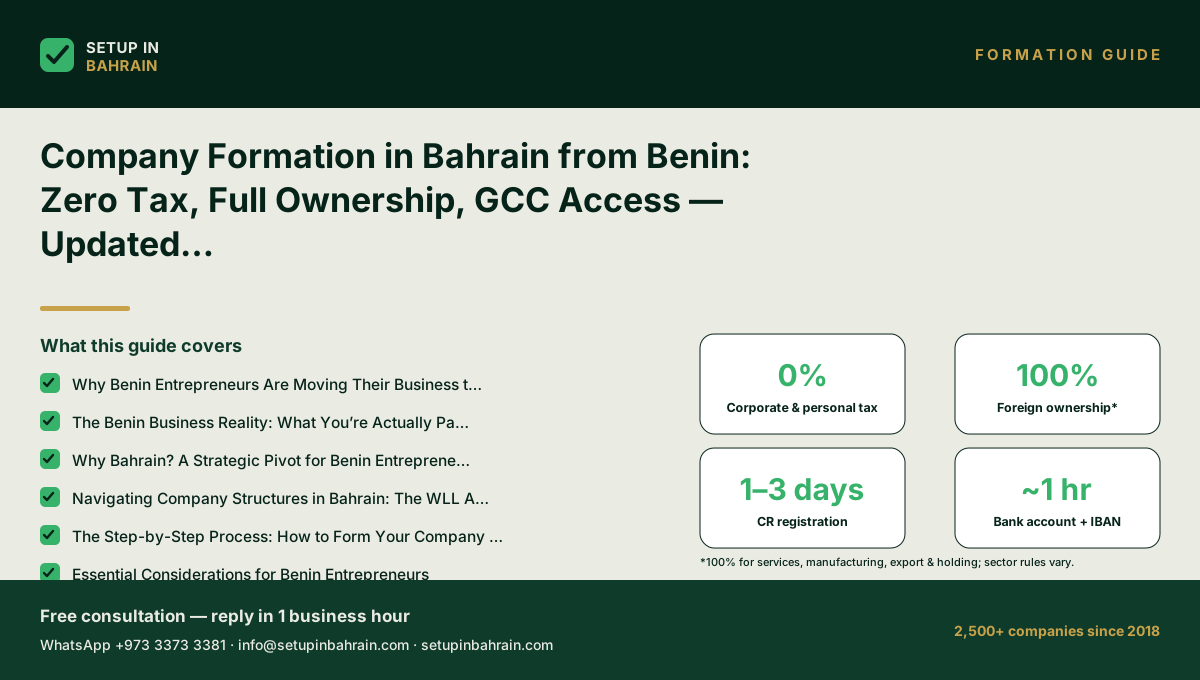
A Bahrain WLL can be owned by a single person — 100% foreign ownership applies to most activities, with no local partner required for services, manufacturing, export trading and holding companies. The minimum share capital is BHD 1; we recommend BHD 1,000, which makes bank account opening and investor visa approval smoother.
Imagine for a moment, Mariam, a visionary entrepreneur from Cotonou. For years, she's meticulously built her import-export business, navigating the bustling markets of Dantokpa and connecting Benin to suppliers across Asia. Her hard work pays off, her revenue grows, but then comes the gnawing frustration: 30% corporate income tax. After every success, a significant portion of her hard-earned profits is siphoned away, limiting her ability to reinvest, expand, and truly thrive. She’s grappling with the complexities of DGI e-filing that’s often clunky outside of major cities, the constant dance with XOF currency fluctuations, and the mandatory 15.4% employer contributions to the CNSS that add substantial fixed costs. Mariam, like many Benin founders, is tired of feeling like her business is running on a treadmill, perpetually trying to outpace the regulatory and fiscal burdens at home.
Koffi Dossou runs a textile re-export operation out of Cotonou. Last year, his company cleared XOF 480 million in turnover, moving fabric from India through Benin into Nigeria. After the 30% corporate income tax, CNSS employer contributions at 15.4%, and the cost of maintaining French-language OHADA filings with the DGI, his net profit landed at roughly XOF 210 million. The same volume run through a Bahrain WLL would have left him with the full amount after Generally no corporate income tax for most sectors and zero withholding on dividends.
What if there was a strategic pivot point, a jurisdiction that offered a radically different environment? A place where your business profits are truly yours, where global markets are at your doorstep, and where the regulatory landscape is designed for growth, not restraint?
This comprehensive guide is written specifically for you, the ambitious entrepreneur from Benin. It’s for those who see beyond the 13 million-person domestic market, who dream of escaping punitive tax rates, and who are ready to build a truly international enterprise. We're going to explore Bahrain, a nation that has quietly become a beacon for international business, offering unparalleled fiscal advantages and a direct gateway to the colossal $1.6 trillion GCC economy. This isn't just about moving your money; it's about fundamentally transforming your business's potential. By the end of this guide, you’ll have a clear roadmap to establishing your company in Bahrain by 2026, understanding every critical step, cost, and strategic advantage.
Why Benin Entrepreneurs Are Moving Their Business to Bahrain
Picture this: Thierry, a textile entrepreneur in Cotonou, checks his latest profit-and-loss sheet. His company, which sources cotton from surrounding West African countries and finishes garments for both regional retail and re-export to Nigeria, finally turned a modest profit after months of hard work. Yet that satisfaction is short-lived. After calculating the 30% corporate income tax, the 15.4% CNSS employer contributions, assorted local levies, and compliance costs, he realizes nearly half his net profit vanishes before it even hits his business account.
Thierry isn’t alone. Over the past two years, Benin founders—especially those whose revenue comes from regional trade, digital services, and export—have started rethinking their default assumption that “you must be based in Benin to serve Africa.” They look at the region’s regulatory headaches—the DGI’s e-filing system working erratically outside Porto-Novo and Cotonou, the OHADA requirements demanding everything in French legalese, and relentless dependence on Nigeria’s trade mood.
Then they hear of Bahrain. No 30% corporate income tax. Zero percent on dividend withholding or royalties. No capital gains tax. 100% foreign ownership with no requirement for a local sponsor. But here’s what catches Beninese attention: set up online in English or Arabic, USD-pegged currency with zero forex surprises, and fast-track company setup—often in as little as three business days.
So why are Benin entrepreneurs increasingly moving their businesses—or their international arms—to Bahrain? It’s about much more than tax. It’s about control, stability, and a platform for truly regional (or even global) ambitions.
The Benin Business Reality: What You’re Actually Paying
Let’s remove the illusions and break down what it really costs to operate a medium-sized company in Benin, especially if you have international aspirations or a significant turnover. These aren't just abstract numbers; they are real barriers to growth and wealth accumulation for Benin's entrepreneurs.
1. The Heavy Hand of Corporate Income Tax: 30%
Benin levies a substantial corporate income tax of 30% on your net profits. For every XOF 1,000,000 your business earns in profit, XOF 300,000 is paid directly to the government. This is a significant chunk that could otherwise be reinvested into your business, used for expansion, technology upgrades, or increasing your working capital. Compare this to Bahrain's zero corporate income tax, and the financial impact is immediately clear. That XOF 300,000 isn’t just money lost; it's missed opportunity.
2. Mandatory CNSS Contributions: 15.4% Employer Share
Beyond corporate tax, employers in Benin are mandated to contribute to the Caisse Nationale de Sécurité Sociale (CNSS) at a rate of 15.4% of employee salaries. This is an additional fixed cost that directly impacts your payroll budget and overall operational expenses. While social security is vital for workers, for a growing business, this represents a substantial burden on top of salaries, benefits, and other employment-related costs. In Bahrain, while there are social insurance contributions, the overall fiscal landscape for businesses is designed to be lighter.
3. DGI E-filing Challenges and Bureaucracy
The Direction Générale des Impôts (DGI) in Benin has implemented e-filing systems, which theoretically should streamline tax compliance. However, the practical reality for many entrepreneurs, especially those operating outside of major hubs like Cotonou and Porto-Novo, is different. The system can be erratic, internet connectivity issues are common, and getting timely support often requires physical visits to overloaded DGI offices. This translates to wasted time, increased administrative costs, and potential penalties for delayed or incorrectly filed returns. It’s a source of constant frustration, diverting precious entrepreneurial energy from core business activities.
4. OHADA Corporate Law: French-Language Compliance Burdens
Benin is a member of the Organisation pour l'Harmonisation en Afrique du Droit des Affaires (OHADA), which aims to standardize business law across Francophone Africa. While noble in intent, OHADA requires all corporate documentation, filings, and legal proceedings to be in French. For Benin entrepreneurs with international aspirations, this creates an additional layer of complexity and cost. Engaging specialized legal translators and consultants becomes a necessity, adding to overhead and potential delays, especially when dealing with foreign partners who operate in English or other languages. This contrasts sharply with Bahrain’s predominantly English business environment and its common law-inspired legal framework.
5. XOF Currency Volatility and Forex Risks
The West African CFA franc (XOF) is pegged to the Euro, which offers some stability but also ties its fate to a currency not always aligned with regional economic realities. For businesses engaged in international trade, operating in XOF introduces currency conversion costs, exposure to exchange rate fluctuations, and the administrative burden of managing foreign currency transactions. Profits earned in XOF can erode when converted to USD or other major currencies for international purchases or investments. Bahrain, with its currency (BHD) pegged directly to the US Dollar, offers unparalleled stability and predictability for international transactions, eliminating a major source of stress and financial risk for global traders.
6. Limited Domestic Market Size and Regional Dependence
With a population of around 13 million, Benin's domestic market, while growing, is relatively small. This often pushes entrepreneurs to look to regional markets, particularly Nigeria, for growth. However, this dependence comes with its own set of risks, including border policies, trade disputes, and logistical challenges that can abruptly impact supply chains and market access. Diversifying into a more globally connected, stable market like Bahrain provides a crucial escape from these regional vulnerabilities and offers a direct springboard to larger, more predictable economies.
These challenges are not mere inconveniences; they are significant impediments to scaling, profitability, and global competitiveness. For ambitious Benin entrepreneurs, the opportunity cost of remaining solely within this framework is increasingly high.
Why Bahrain? A Strategic Pivot for Benin Entrepreneurs
Bahrain isn't just another tax haven; it's a meticulously crafted economic hub designed to attract and nurture international businesses. For an entrepreneur from Benin, it represents a profound strategic shift.
Unparalleled Fiscal Incentives: The Power of Zero Tax
The most immediate and compelling draw for Benin entrepreneurs is Bahrain’s tax regime. It stands in stark contrast to the 30% corporate income tax you're accustomed to.
- Zero Corporate Income Tax: For most businesses, Bahrain imposes no corporate income tax. This means that 100% of your business’s profits stay with your business, available for reinvestment, expansion, or distribution. This alone can fundamentally transform your financial outlook.
- Zero Withholding Tax: There are no withholding taxes on dividends, interest, or royalties paid out of Bahrain. This is crucial for managing your personal finances and for any future international expansion.
- No Capital Gains Tax: If your business sells assets or investments at a profit, there's generally no capital gains tax levied.
- No Personal Income Tax: As a business owner living in Bahrain, you will also benefit from zero personal income tax, further enhancing your overall financial efficiency.
- A Note on VAT: While corporate tax is zero, Bahrain implemented a Value Added Tax (VAT) of 5.3% in January 2022. This is a consumption tax, meaning it's levied on goods and services at various stages of production and distribution, ultimately paid by the end consumer. Businesses act as collectors and remit it to the government. This is a common global standard and much different from a direct corporate profit tax.
This fiscal environment, supported by a clear regulatory framework from the Central Bank of Bahrain (CBB) and the Ministry of Industry and Commerce (MOIC), allows your business to retain significantly more capital, accelerating growth and increasing shareholder value.
100% Foreign Ownership and Control: No Sponsors Required
One of Bahrain’s most significant advantages, and a critical differentiator for entrepreneurs seeking full autonomy, is the allowance for 100% foreign ownership of companies.
- No Local Sponsor Mandate: Unlike some other GCC nations where a local partner or sponsor was historically required, Bahrain abolished this requirement for most business activities years ago. This means you, as a Benin entrepreneur, can own 100% of your Bahraini company.
- Full Operational Control: This complete ownership translates to full operational and strategic control over your business. You make all the decisions, you reap all the rewards, and you don’t have to navigate complex partnership agreements or potential disputes with local partners.
- Simplified Governance: A single-owner company, particularly a WLL, is simpler to govern and manage, reducing administrative overhead and potential bureaucratic hurdles.
This level of control is a powerful incentive, allowing you to replicate your entrepreneurial vision in an international setting without dilution.
Gateway to the $1.6 Trillion GCC Market
Beyond its domestic appeal, Bahrain serves as a strategic launchpad into the broader Gulf Cooperation Council (GCC) market.
- Direct Access: Bahrain is geographically located at the heart of the GCC, offering seamless access to major markets like Saudi Arabia (connected by the King Fahd Causeway), UAE, Qatar, Kuwait, and Oman.
- Massive Purchasing Power: The GCC collectively boasts a GDP of over $1.6 trillion and a consumer market of over 50 million people with high disposable incomes. This dwarfs the 13 million-person market of Benin.
- Diversified Economies: The region is actively diversifying away from oil, creating immense opportunities in logistics, fintech, ICT, tourism, manufacturing, and services—sectors where Benin entrepreneurs can thrive.
- Free Trade Agreements: As part of the GCC, Bahrain benefits from various free trade agreements, further facilitating regional and international trade for your business.
For any Benin entrepreneur with ambitions beyond West Africa, Bahrain provides an unparalleled platform to tap into one of the world's wealthiest and fastest-growing economic blocs.
Business-Friendly Ecosystem & Digital-First Approach
Bahrain consistently ranks high in global indices for ease of doing business. The World Bank’s 'Doing Business' report has repeatedly highlighted Bahrain's efforts to streamline company registration and reduce bureaucratic hurdles.
- Efficient Registration: The Ministry of Industry and Commerce (MOIC) has implemented a robust online portal, Sijilat.bh, which allows entrepreneurs to register their companies, obtain licenses, and manage renewals largely digitally. Many standard company formations can be completed in as little as 3-5 business days.
- English Language Environment: While Arabic is the official language, English is widely used in business, legal, and government contexts, making it highly accessible for international entrepreneurs. This is a welcome change from the OHADA French-language compliance in Benin.
- Dedicated Support: The Bahrain Economic Development Board (EDB) acts as a guiding hand for foreign investors, providing comprehensive support, from initial inquiries to navigating regulatory processes. They are a valuable resource for Benin entrepreneurs.
- Innovation Hub: Bahrain is actively fostering an innovation ecosystem, particularly in FinTech, with supportive regulations (like regulatory sandboxes from the CBB) and infrastructure, making it attractive for digital entrepreneurs.
This supportive environment minimizes the time and resources spent on compliance, allowing you to focus on growing your business.
Political and Economic Stability
Stability is a cornerstone for any sustainable business venture. Bahrain offers a highly stable environment compared to many emerging markets.
- Strong Governance: The Kingdom of Bahrain has a well-established legal and political framework, providing predictability and rule of law for businesses.
- Diversified Economy: While historically oil-dependent, Bahrain has successfully diversified its economy into banking, finance, tourism, and services, creating a resilient economic base.
- Robust Financial Sector: The Central Bank of Bahrain (CBB) is a highly respected regulator, ensuring the stability and integrity of the financial system, which is crucial for secure banking and investment.
- Safe and Secure: Bahrain is known for its safety and high quality of life, offering a comfortable environment for entrepreneurs and their families.
This stability provides a secure foundation for your investment and long-term business planning, a stark contrast to the occasional political and economic uncertainties in some West African nations.
USD-Pegged Currency: Say Goodbye to XOF Volatility
For any entrepreneur engaged in international trade, currency stability is paramount. The Bahraini Dinar (BHD) is pegged directly to the US Dollar at a fixed rate of 1 BHD = 2.659 USD.
- Eliminated Forex Risk: This peg eliminates currency conversion risks and volatility for businesses dealing in USD, which is the primary currency for global trade. For Benin entrepreneurs accustomed to managing XOF fluctuations, this offers immense peace of mind and simplifies financial planning.
- Predictable International Transactions: Whether you're paying international suppliers, receiving payments from global clients, or repatriating profits, the BHD’s stability ensures predictable outcomes.
- Easier Financial Planning: With a stable currency, budgeting and forecasting for international operations become significantly more accurate and straightforward.
The BHD's peg to the USD is a silent but powerful advantage, protecting your hard-earned profits from the erosion that volatile currency markets can inflict.
Navigating Company Structures in Bahrain: The WLL Advantage
Understanding the right legal structure is foundational for your Bahraini venture. While several options exist, for most Benin entrepreneurs, one stands out as the most practical and advantageous: the Limited Liability Company.
Limited Liability Company (WLL): Your Top Choice
The With Limited Liability Company (WLL), or "W.L.L." as it's commonly abbreviated, is the most popular and versatile business entity in Bahrain for foreign investors. Here’s why it's the ideal choice for you:
- 100% Foreign Ownership is Standard: Critically, a Bahraini WLL can be 100% owned by a single foreign shareholder. This is a game-changer for Benin entrepreneurs, as it means you can maintain full control of your business without needing any local partners or sponsors. This is a vital correction to common misconceptions and ensures you understand your autonomy from day one.
- Limited Liability Protection: As the name suggests, a WLL protects your personal assets from business liabilities. Your personal risk is limited to the amount of capital you've invested in the company. This is a fundamental safeguard for any entrepreneur.
- Minimum Shareholders: While it can be owned by a single person, a WLL can also have multiple shareholders, up to 50. This flexibility allows for future growth and partnerships if desired.
- Minimum Share Capital: BHD 1 (Legal), BHD 1,000 (Practical Recommendation):
- No WLL (Single Person Company) in Bahrain: It is crucial to note that Bahrain does not have a specific "Single Person Company" (WLL) legal structure as might be found in some other jurisdictions. The WLL structure, by allowing 100% single ownership, effectively serves the same purpose for solo entrepreneurs without needing a distinct WLL category. Therefore, do not seek or expect to register a single-shareholder WLL in Bahrain. Your structure will be a WLL, even if you are the sole owner.
Other Company Types (Briefly Mentioned for Context)
While the WLL is most likely your best fit, it’s good to be aware of other options:
- Bahraini Shareholding Company (BSC): This is equivalent to a Public Limited Company (PLC) or a stock company. It requires a larger minimum capital and is suitable for larger enterprises that intend to raise capital from the public or have multiple, diverse shareholders. This is typically not for a sole entrepreneur starting out.
- Partnership Company: Requires at least two partners and includes structures like General Partnerships and Limited Partnerships. Partners in a General Partnership have unlimited liability. Generally not recommended for foreign entrepreneurs seeking limited liability.
- Establishment/Sole Proprietorship: For individuals carrying out a professional practice. While it offers simplicity, it does not provide limited liability protection, making it a less secure option for most business ventures.
- Branch of a Foreign Company: If you already have an established company in Benin, you can register a branch office in Bahrain. This maintains the legal identity of your parent company but has specific regulatory requirements.
For the vast majority of Benin entrepreneurs looking for flexibility, full ownership, and limited liability, the WLL is the definitive answer.
The Step-by-Step Process: How to Form Your Company in Bahrain
The journey from Benin to becoming a registered business in Bahrain is streamlined thanks to the Kingdom's digital-first approach. Here's a clear, sequential roadmap.
1. Initial Planning & Due Diligence
Before you even touch an application form, a solid foundation of planning is essential.
- Business Activity Definition: Clearly define your intended business activities. Bahrain’s Ministry of Industry and Commerce (MOIC) classifies activities, and some may require special approvals (e.g., financial services, healthcare, education).
- Jurisdiction Choice (Mainland vs. Free Zone): Decide whether to establish on the mainland or within a free zone. This depends on your specific business model, target market (local vs. international), and operational needs. We'll delve deeper into this later.
- Shareholders & Directors: Identify the shareholder(s) (can be one person, 100% foreign-owned WLL) and at least one director (can be the same person as the shareholder).
- Capital Allocation: Confirm your share capital. While BHD 1 is the legal minimum for a WLL, practically, aim for BHD 1,000 to facilitate banking and visa processes.
- Required Documents: Start gathering necessary documents, which typically include:
2. Reserving Your Company Name (MOIC)
Your first official interaction will be through the MOIC’s online portal, Sijilat.bh (www.sijilat.bh).
- Sijilat Portal: This user-friendly platform allows you to check name availability and submit a reservation request.
- Name Guidelines: The name must be unique, not offensive, and clearly reflect the company's legal status (e.g., "Benin Export Solutions W.L.L."). You may need to propose a few options in order of preference.
- Approval Time: Name reservation is usually quick, often within 1-2 business days.
3. Drafting the Memorandum and Articles of Association (MAA)
The MAA are the foundational legal documents for your company.
- Memorandum of Association (MoA): Outlines the company's purpose, share capital, shareholders, and their liabilities.
- Articles of Association (AoA): Details the internal rules and regulations for the company's operation, including director appointments, meetings, voting rights, and share transfers.
- Assistance: It's highly recommended to engage a local business consultant or legal firm to draft these documents to ensure full compliance with Bahraini commercial law. They will ensure it's in both English and Arabic.
- Notarization: Once drafted, the MAA must be notarized by a public notary in Bahrain.
4. Capital Deposit (For Practical Purposes)
While BHD 1 is the legal minimum for a WLL, depositing your practical recommended BHD 1,000 will come later, after initial registration, when opening a bank account. For the initial registration with MOIC, physical proof of deposit is often not required for lower capital WLLs, but you must declare the capital. The bank will then request the deposit later.
5. Registering with MOIC (Commercial Registration - CR)
This is the core step where your company officially comes into existence.
- Online Submission: All documents, including the approved company name and notarized MAA, are uploaded via the Sijilat portal.
- Review Process: The MOIC reviews your application. This usually takes 3-5 business days for straightforward applications.
- Commercial Registration (CR) Issuance: Upon approval, your Commercial Registration (CR) certificate is issued. This is your company's official birth certificate. It contains your CR number, company name, legal type, activities, and registered address.
6. Licensing and Approvals (Industry-Specific)
Depending on your chosen business activities, you may need additional licenses from specific regulatory bodies.
- General Activities: Most general trading, consulting, or e-commerce activities may not require extensive additional licenses beyond the MOIC CR.
- Regulated Industries: If you're in sectors like financial services (CBB), healthcare (NHRA), education (MOE), or manufacturing, you'll need to apply for specific permits and licenses from the relevant ministries or regulatory authorities. Your business consultant can help identify these.
- Application & Inspection: This process involves submitting further documentation and potentially undergoing inspections. Timelines vary significantly by industry.
7. Post-Registration Formalities
Once your CR is issued and any necessary licenses obtained, there are a few final steps.
- Commercial Address: You must secure a physical commercial address. This can be a traditional office, a co-working space, or for some businesses, a virtual office solution (especially in free zones, but less common for mainland WLLs requiring a physical presence).
- Labor Market Regulatory Authority (LMRA) Registration: If you plan to hire employees (including yourself as a director/investor), your company must register with the LMRA for social insurance contributions and work permits.
- Social Insurance Organization (SIO) Registration: Companies must register with the SIO for employee social security contributions.
- VAT Registration: If your company's annual taxable supplies exceed the mandatory threshold of BHD 37,500 (approximately XOF 60 million), you must register for VAT with the National Bureau for Revenue (NBR). Even if below, voluntary registration is possible.
Essential Considerations for Benin Entrepreneurs
Moving your business to a new country involves more than just company registration. Here are crucial practicalities you’ll need to address.
Banking in Bahrain: Opening Your Corporate Account
This is often one of the most challenging steps for foreign
Bahrain Business Guides for Benin Citizens
Ready to set up in Bahrain from Benin?
Tell us your business idea. We map the right entity, ownership and timeline — then handle the filing while you focus on what matters.