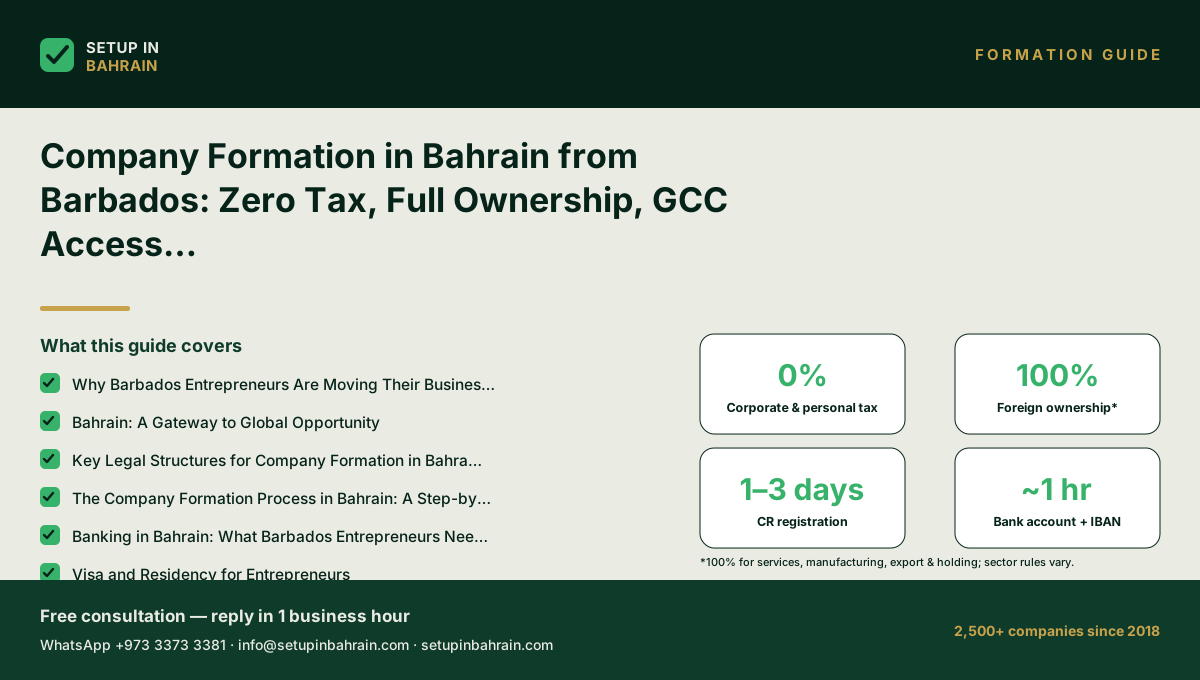
Complete guide for Barbados entrepreneurs: form a company in Bahrain with generally no corporate income tax for most sectors, 100% foreign ownership. GCC market access. Costs, steps, visas, banking.
Key Takeaways
- Why Barbados Entrepreneurs Are Moving Their Business to Bahrain
- Bahrain: A Gateway to Global Opportunity
- Key Legal Structures for Company Formation in Bahrain
- The Company Formation Process in Bahrain: A Step-by-Step Guide
- Banking in Bahrain: What Barbados Entrepreneurs Need to Know
→ Complete guide: Company Formation in Bahrain — the full 2026 guide
View details
Ownership & capital
A Bahrain WLL can be owned by a single person — 100% foreign ownership applies to most activities, with no local partner required for services, manufacturing, export trading and holding companies. The minimum share capital is BHD 1 ; we recommend BHD 1,000 . This Makes bank account opening and investor visa approval smoother.
Imagine this: Ava, a driven fintech entrepreneur from Bridgetown, spends months negotiating USD payments from US clients. Each significant transfer, especially anything over BBD 100,000, requires a meticulous paper trail, a dedicated form at her local bank. Multiple layers of approval from the Central Bank of Barbados (CBB).
Her company pays a "low" 5.5% corporate tax, but after compliance fees, annual International Business Company (IBC) license costs (which can range from USD 3,000 to USD 5,000), and the hidden costs of navigating a complex foreign exchange landscape, her true overhead is much higher. When she finally accumulates enough capital to scale her operations globally, the BBD’s limited international liquidity means she either pays substantial FX conversion fees, endures frustrating delays, or struggles altogether to fund expansion abroad.
After her last USD transfer was held up – again – Ava began to ask, “Isn’t there a more global, tax-efficient. Frictionless home for my company?”
You're not alone if this scenario resonates. Many Barbadian founders wrestle with a familiar set of challenges: the 5.5% to 9% corporate tax eating into hard-earned profits, the BBD currency's 2:1 peg to the USD that. Stable, presents limited liquidity for substantial international transfers, and the CBB's often restrictive foreign exchange rules. Then there's the lingering shadow of Barbados's FATF grey-listing history.
While Barbados was delisted in 2020, the experience left a legacy of correspondent banking pressures, making international transactions more complex and costly for businesses operating from the island.
This guide is designed exclusively for entrepreneurs in Barbados: those navigating the unique constraints of a small island economy, particular banking realities. A regulatory framework shaped by its offshore legacy.
If you’re frustrated by how your “BBD-USD peg” seems to offer stability but not flexibility, or find yourself calculating not just corporate taxes but also banking, compliance, and transfer costs, let’s break down why Bahrain is emerging as the go-to business hub for ambitious Barbadian founders seeking genuinely global opportunities.
Why Barbados Entrepreneurs Are Moving Their Business to Bahrain
Let’s face it. If you run a business in Barbados, you already know the published 5.5%–9% corporate tax is only the start. Your operational reality includes currency controls, limited foreign exchange availability for outward transfers, correspondent banking hesitance (a direct result of the FATF grey-listing years), and the complexity of meeting Financial Services Commission (FSC) demands for entities like IBCs.
While Barbados’ BBD is theoretically pegged to USD 2:1, in practice, transferring anything over BBD 100,000 can trigger significant delays and intensive compliance reviews from the Central Bank of Barbados.
Consider the founder of a financial services support firm in Bridgetown, whose exact moment of decision crystallized after a frustrating year. His company cleared BBD 420,000 in revenue, yet after the 9% corporate tax, the annual IBC license fee of USD 4,200 (about BBD 8,400), and the heightened cost of maintaining correspondent banking relationships strained by Barbados’s past FATF experience, the net amount that could be moved offshore for global expansion sat at just BBD 310,000.
The CBB foreign-exchange approval queue added another three weeks of delay on every transfer above BBD 50,000, severely impacting cash flow and international project timelines. For entrepreneurs like him, serving an international clientele, the advantages of Barbados's offshore framework felt more and more overshadowed by its practical limitations.
For many Barbadian entrepreneurs, especially those in:
Fintech & Digital Services: Developers, SaaS providers, blockchain innovators. Payment processors who need seamless global transactions and access to large digital markets. E-commerce & Trading: Businesses sourcing goods globally and selling to international customers, requiring efficient cross-border payments and logistics. Professional Consulting: Consultants, coaches. Advisory firms serving clients worldwide, who need a neutral, tax-efficient base with strong banking infrastructure.
Asset Management & Investment: Firms looking for a stable, well-regulated jurisdiction with zero capital gains tax and easy access to diverse investment opportunities.
...Bahrain offers not just an alternative, but a significant upgrade.
The True Cost of "Low Tax" in Barbados
Barbados prides itself on its attractive corporate tax rates, ranging from 5.5% down to 0% for some international businesses meeting specific criteria. But, this headline rate often doesn't tell the full story:
IBC License Fees: For many internationally focused businesses, operating as an IBC is common. These licenses are not free and can represent a substantial annual fixed cost, typically between USD 3,000 and USD 5,000. This eats into profits, especially for growing startups. Compliance Burden: The FSC regulations for IBCs can be demanding, requiring regular reporting, audits. Adherence to various substance requirements. This translates into administrative overhead and professional service fees.
Foreign Exchange Restrictions & Costs: The CBB's mandate to maintain the BBD's 2:1 peg to the USD. Providing stability, introduces friction for international transactions. The CBB routinely monitors and approves foreign exchange outflows, leading to: * Delays: Transfers, especially those exceeding BBD 50,000 or BBD 100,000, can take weeks to clear as they navigate the CBB's approval process. This impacts liquidity and operational speed.
* Administrative Fees: Banks may charge fees for processing foreign exchange applications and international wire transfers, eroding the net amount received. * Limited Liquidity: While the BBD is pegged, its global liquidity is low. For large-scale international investments or operational transfers, converting BBD to other major currencies can be challenging, even with the peg, due to the limited size of the foreign exchange market.
Correspondent Banking Pressure: Barbados's past inclusion on the FATF grey-list (from 2020 to 2020) created lasting challenges. Even after delisting, international banks remain cautious, leading to: * Higher Compliance Costs: Banks serving Barbadian entities often impose stricter due diligence requirements, increasing the cost and complexity of maintaining international bank accounts. * Account Closures/Restrictions: Some international banks may be hesitant to onboard or maintain relationships with Barbados-based companies, limiting options for global financial operations.
* Transfer Scrutiny: Transactions from Barbados can face enhanced scrutiny, leading to more frequent holds and requests for additional documents.
The Geographic and Market Constraints
Beyond the financial and regulatory challenges, operating solely from Barbados presents inherent geographic and market limitations:
Small Domestic Market: With a population of about 280,000 people, the Barbadian domestic market offers limited scope for scaling certain types of businesses, pushing entrepreneurs to seek international clients. Distance from Growth Markets: The 11,000-kilometer distance from the booming Gulf Cooperation Council (GCC) markets means that lucrative opportunities like Saudi Vision 2030, with its estimated $800 billion in projects, remain largely out of practical reach for physical engagement and direct market penetration from Barbados.
Bahrain, on the other hand, acts as a direct gateway, facilitating easy access across the causeway to Saudi Arabia and short flights to the UAE, Qatar, Oman, and Kuwait.
This isn't a critique of Barbados; it’s a candid assessment of the economic realities for an ambitious, globally-minded entrepreneur. While Barbados has fostered a resilient business environment, there are strategic moves you can make to elevate your company onto a truly global stage. This is where Bahrain enters the picture.
Bahrain: A Gateway to Global Opportunity
Bahrain, an island nation in the Arabian Gulf, has strategically positioned itself as the most accessible and business-friendly gateway to the $1.6 trillion GCC economy and the broader Middle East and North Africa (MENA) region. Its approach is starkly different from many traditional offshore jurisdictions, focusing on substance, transparency. A vibrant, diversified economy.
Generally no corporate income tax for most sectors on Profits: A Genuine Advantage
Unlike Barbados's "low tax" regime which often comes with hidden costs and regulatory hurdles, Bahrain offers a genuine generally no corporate income tax for most sectors on company profits. This isn't a special incentive or a temporary holiday; it's a fundamental pillar of its economic policy. For Barbadian entrepreneurs, this means:
- 100% Retained Profits: Every dollar your company earns remains within your business for reinvestment, expansion, or distribution. This direct impact on your bottom line is unparalleled.
- Simplified Accounting: No need for complex tax calculations or annual corporate tax filings, greatly reducing administrative burden and professional fees.
- Predictable Financial Planning: Without corporate tax considerations, financial forecasting becomes clearer and more straightforward, allowing for more strategic business development.
This zero-tax environment extends beyond corporate profits to capital gains, making Bahrain an attractive hub for investment firms and those looking to grow their assets without erosion.
100% Foreign Ownership: Unrestricted Control
A significant concern for many international entrepreneurs is maintaining full control over their ventures. Bahrain's Company Law is incredibly progressive in this regard, especially for the most common company type for startups and SMEs: the With Limited Liability (WLL) company.
A Bahrain WLL can be owned 100% by a single individual or a single corporate entity, with absolutely zero requirement for local partners or sponsors. This is a critical distinction and a major draw for Barbadian entrepreneurs who value autonomy and direct ownership. It eliminates the complexities, potential disputes. Additional costs often associated with local partnership requirements in other Gulf nations.
Key features of a Bahrain WLL:
- Single Shareholder: One person can own and operate the entire company.
- Limited Liability: Your personal assets are protected from business debts and obligations.
- Flexibility: Suitable for a wide range of commercial activities.
- No Restrictions on Repatriation: Profits can be freely repatriated back to your home country or any international bank account without restrictions.
Strategic Location: Your Launchpad to GCC & MENA
Bahrain’s geographic position is arguably its strongest strategic asset. Situated in the heart of the Arabian Gulf, it offers:
Direct Access to Saudi Arabia: The King Fahd Causeway, a 25-kilometer bridge, connects Bahrain directly to Saudi Arabia’s Eastern Province. This provides seamless, 24/7 access to the largest economy in the GCC, representing about 70% of the region’s GDP. Imagine the ease of market entry and expansion into a nation undergoing massive economic diversification and infrastructure development.
Regional Hub: Bahrain International Airport (BIA) is a well-connected hub with direct flights to major cities across the GCC (Dubai, Doha, Kuwait City, Riyadh, Jeddah) and beyond. This makes business travel, client meetings, and supply chain management incredibly efficient. Time Zone Advantage: Operating from Bahrain places you in a favorable time zone for connecting with clients and partners in Europe, Africa. Asia, offering a broader window for collaboration compared to the Caribbean.
For a Barbadian entrepreneur looking to tap into the immense wealth and growth of the Gulf region, Bahrain serves as an unparalleled staging post. It greatly reduces the physical and logistical barriers that 11,000 kilometers impose.
Progressive Regulation & Investor-Friendly Ecosystem
Bahrain has a long-standing reputation for being the most liberal economy in the GCC. The government, through entities like the Bahrain Economic Development Board (EDB) and the Ministry of Industry and Commerce (MOIC), is actively committed to fostering a pro-business environment.
Ease of Doing Business: The World Bank’s Ease of Doing Business reports consistently rank Bahrain highly, especially for factors like starting a business, getting credit, and protecting minority investors. This reflects a commitment to streamlining bureaucratic processes. Robust Legal Framework: Bahrain operates under a clear, well-established legal system that provides certainty and protection for investors. English is widely spoken in business and legal circles.
Diversified Economy: Unlike some oil-dependent neighbors, Bahrain has successfully diversified its economy, with strong sectors in financial services, ICT, logistics, manufacturing. Tourism. This creates a resilient and varied business ecosystem. The financial sector alone contributes over 17% to Bahrain's GDP, hosting over 380 financial institutions. Startup Ecosystem: Bahrain boasts a thriving startup ecosystem, supported by accelerators, incubators, venture capital funds (like Al Waha Fund of Funds). Government initiatives designed to attract and nurture innovation, especially in fintech.
A Stable and Secure Environment
Political and economic stability are paramount for any international business. Bahrain offers:
Long-Term Vision: The government has a clear long-term economic vision (Economic Vision 2030) focused on sustainable growth, diversification. Human capital development. Modern Infrastructure: World-class infrastructure, including high-speed internet, reliable utilities. Modern office spaces, supports efficient business operations. High Quality of Life: Bahrain offers an excellent quality of life for expatriates, with diverse housing options, international schools, healthcare facilities. A vibrant cultural scene, all at a relatively lower cost compared to its GCC neighbors like Dubai.
For Barbadian entrepreneurs, choosing Bahrain isn’t just about tax advantages; it’s about strategically positioning your business in a dynamic, growth-oriented region with a supportive, transparent, and stable environment designed for international success.
Key Legal Structures for Company Formation in Bahrain
While Bahrain offers various legal structures, the With Limited Liability Company (WLL) is overwhelmingly the most popular choice for foreign entrepreneurs due to its flexibility, 100% foreign ownership allowance, and limited liability protection. We will focus primarily on the WLL, but it's worth briefly mentioning others.
1. With Limited Liability Company (WLL) – The Entrepreneur's Choice
As highlighted, the WLL is the workhorse of Bahraini company formation for international investors.
Ownership: Can be owned 100% by a single natural person or a single corporate entity. No local partner required. This is a crucial point for Barbadian entrepreneurs seeking full control. Liability: Shareholders' liability is limited to the amount of their share capital contribution. This protects personal assets. Minimum Share Capital: Legally, the minimum share capital for a WLL is BHD 1 (Bahraini Dinar).
* CRITICAL INSIGHT: While BHD 1 is the legal minimum, for practical purposes, especially for securing bank account approval and qualifying for an investor visa, we strongly recommend a minimum share capital of BHD 1,000. This shows financial substance and greatly smooths the banking and visa application processes. Banks are far more likely to open corporate accounts for companies with a tangible capital base. The MOIC often looks for this level of investment for investor visas.
Activities: Suitable for a wide range of commercial, industrial, and service activities. Certain regulated activities (e.g., financial services, insurance) require specific licenses from the Central Bank of Bahrain (CBB – a different CBB than the one in Barbados!) or other regulatory bodies. Directors: A minimum of one director is required. Directors can be of any nationality and do not need to be Bahraini residents initially. Although Physical presence is typically required to open a bank account and manage operations.
Company Name: The name must be unique and approved by the MOIC. It should reflect the company's activities.
2. Bahrain Shareholding Company (BSC)
- Ownership: Suitable for larger enterprises, public offerings, or companies requiring more complex ownership structures. Can be Public (B.S.C.P.) or Closed (B.S.C.C.).
- Minimum Capital: Much higher than a WLL (e.g., BHD 1 million for a Public Shareholding Company).
- Governance: More stringent governance and reporting requirements.
- Use Case: Typically for established businesses planning significant capital raises or public listings. Not usually the first choice for a startup from Barbados.
3. Branches of Foreign Companies
- Ownership: An extension of an existing foreign company, not a separate legal entity.
- Liability: The foreign parent company remains fully liable for the branch's activities.
- Capital: No specific minimum capital, but the parent company must show financial solvency.
- Use Case: Best for established international companies looking to establish a physical presence in Bahrain without forming a new local entity.
4. Representative Offices
- Ownership: Also an extension of a foreign company, but with highly restricted activities.
- Activities: Limited to marketing, market research, and liaison activities. Cannot engage in commercial transactions or generate revenue.
- Use Case: Ideal for foreign companies exploring the Bahraini market before committing to full commercial operations.
Why a WLL is best for most Barbadian entrepreneurs:
For 90% of Barbadian entrepreneurs reading this guide, the WLL offers the perfect balance of control, liability protection, operational flexibility. A straightforward setup process. Its 100% foreign ownership and genuine zero-tax framework make it an unbeatable proposition compared to the complexities and hidden costs of an IBC in Barbados.
People Also Ask: Can I register a single-shareholder WLL in Bahrain? Absolutely not. It’s critical to understand that Bahrain does not have a legal entity known as a single-shareholder WLL. While a WLL can be owned by a single individual (making it functionally a "single-person company"), the legal structure is still a WLL. Any information suggesting a single-shareholder WLL exists in Bahrain is incorrect and should be disregarded to avoid legal complications.
Always refer to the MOIC for accurate legal classifications.
The Company Formation Process in Bahrain: A Step-by-Step Guide
Forming a company in Bahrain is notably streamlined, thanks to government initiatives to enhance business friendliness. The entire process, from initial application to receiving your Commercial Registration (CR), can take as little as 3 to 5 business days for straightforward cases, provided all documents is in order.
Here’s a typical breakdown:
Step 1: Activity Classification & Name Reservation
- Determine Commercial Activities: Clearly define your company's intended commercial activities. These activities must align with the MOIC's approved classifications. For instance, "Fintech Consultancy" or "E-commerce Platform."
- Name Reservation: Submit a proposed company name to the MOIC for approval. The name must be unique and not conflict with existing registered businesses. You usually submit a few options in order of preference. This step can often be done online through the Sijilat portal.
Step 2: MOIC Application & Document Preparation
This is the most critical phase, requiring precise documents. You'll need to prepare:
Application Form: Duly filled and signed. Memorandum of Association (MOA) & Articles of Association (AOA): These are the foundational legal documents for your WLL, outlining its purpose, share capital, ownership, and governance structure. While standard templates exist, it's advisable to have these drafted or reviewed by a local legal expert to ensure compliance and cover your specific business needs. Shareholder/Director Identification: * For Individual Shareholder/Director: Passport copy, national ID (if applicable), and a detailed CV.
* For Corporate Shareholder: Certificate of Incorporation, Memorandum & Articles of Association of the parent company, Board Resolution authorizing company formation in Bahrain. Passport copies of the parent company's directors. All corporate documents from Barbados will need to be attested by the Ministry of Foreign Affairs in Barbados and then legalized by the Bahraini Embassy/Consulate. Proof of Address: For the Bahraini company (e.g., lease agreement for office space or a virtual office agreement from an approved provider).
Initial Capital Deposit Proof: While not always required at the initial MOIC application (depending on the bank), you will eventually need to deposit the recommended BHD 1,000 (or more) into a pre-incorporation bank account, and the bank will provide a letter confirming this deposit to the MOIC.
Step 3: MOIC Approval & Commercial Registration (CR) Issuance
- Review and Approval: The MOIC reviews your application and documents. They may request clarifications or additional information.
- CR Issuance: Once approved, your Commercial Registration (CR) certificate is issued. This is your company's official birth certificate and legal authorization to operate in Bahrain. It will list your company name, CR number, activities, and details of shareholders and directors.
Step 4: Post-Registration Steps (Crucial for Operations)
Company Seal & Letterhead: Create an official company seal and letterhead. Bank Account Opening: * This is a critical step where having a reputable local corporate service provider can be invaluable. * You will need the CR, MOA/AOA, shareholder/director passports. Often, a physical presence of the authorized signatory (the director) in Bahrain for the initial signing. * The BHD 1,000 minimum share capital recommendation comes into play here.
Banks are far more accommodating to companies that show a tangible initial investment. * Be prepared for standard KYC/AML (Know Your Customer/Anti-Money Laundering) checks from the bank. Labour Market Regulatory Authority (LMRA) Registration: If you plan to hire employees (including yourself as an investor/employee), you must register with the LMRA. Value Added Tax (VAT) Registration: If your projected annual taxable supplies exceed BHD 37,500, you are legally required to register for VAT with the National Bureau for Revenue (NBR).
Bahrain's VAT rate is 10% as of 2026. Social Insurance Organization (SIO) Registration: For employee social security contributions.
Timeline:
- MOIC Application & CR: 3-5 business days (can be faster with fully compliant documents and online submission via Sijilat).
- Bank Account Opening: 1-3 weeks (depends on the bank and complexity of your KYC).
- LMRA/VAT/SIO: Can run concurrently or immediately after CR issuance.
Key Insight: While the process is digital and efficient, engaging a local corporate service provider (CSP) or law firm specializing in company formation is highly recommended. They can:
- Navigate Sijilat: The online portal is user-friendly but can be confusing for first-timers.
- Draft MOA/AOA: Ensure legal compliance and tailor to your needs.
- Liaise with Authorities: Expedite approvals and resolve queries with the MOIC, EDB, and CBB.
- Assist with Bank Account Opening: Guide you through the often-strict bank requirements and introduce you to suitable banking partners.
- Provide Registered Office: Many CSPs offer virtual office solutions or serviced offices to meet the physical address requirement.
Banking in Bahrain: What Barbados Entrepreneurs Need to Know
For Barbadian entrepreneurs, the banking experience in Bahrain will feel like a breath of fresh air compared to the CBB's forex restrictions. Bahrain is a mature financial hub with a robust and well-regulated banking sector.
Advantages of Banking in Bahrain:
Free Movement of Capital: No foreign exchange controls. You can freely transfer funds in and out of Bahrain in any major currency. This directly addresses the CBB transfer restrictions you face in Barbados. Diverse Banking Sector: Bahrain hosts over 380 financial institutions, including conventional and Islamic banks, local and international players. This offers a wide range of choices for corporate banking, investment, and trade finance.
Strong Regulation: The Central Bank of Bahrain (CBB – Bahrain's regulatory body, not Barbados') maintains a strong, transparent. Internationally compliant regulatory framework, instilling confidence in the banking system. This means fewer "grey-list" related hesitations from international banks. Multi-Currency Accounts: Most corporate accounts allow you to hold funds in various major currencies (USD, EUR, GBP, AED, SAR, etc.), simplifying international transactions and hedging.
Advanced Digital Banking: Bahraini banks offer sophisticated online and mobile banking platforms, enabling efficient management of your finances from anywhere in the world.
Practical Considerations for Opening a Corporate Bank Account:
Physical Presence: While some banks might offer initial remote applications, the authorized signatory (typically a director) will almost certainly need to be physically present in Bahrain for the final account opening and signing of documents. This is a standard KYC requirement. Proof of Substance: Banks will look for signs of genuine business activity. This is where the recommended BHD 1,000 share capital (or more) plays a crucial role. It shows a commitment and makes your company look more credible.
Business Plan: Be prepared to provide a concise business plan outlining your company's activities, target market, revenue projections. Expected transaction volumes. Banks need to understand your business model to assess risk. KYC Documents: Expect rigorous KYC checks for all shareholders and directors. This includes certified copies of passports, proof of address, and sometimes bank references or professional references. For Barbadian citizens, expect questions about the source of funds and your prior banking relationships.
Due Diligence: The bank will conduct its own due diligence. This can include interviews with the director(s) and a review of your business's background. Timeline: While the MOIC registration is fast, bank account opening can take 1 to 3 weeks, or even longer if documents is incomplete or further clarifications are needed. Start this process as soon as your CR is issued.
Insight for Barbadian Entrepreneurs: Your experience with the Central Bank of Barbados's stringent forex controls will make you appreciate Bahrain's liberal banking environment even more. The ability to move capital freely and efficiently is a fundamental difference that can dramatically improve your business's global agility and cash flow.
Visa and Residency for Entrepreneurs
Establishing your company in Bahrain is often the first step towards obtaining residency for yourself and your family. Bahrain offers attractive visa options for investors and entrepreneurs.
Investor Visa / Self-Sponsorship Visa
Eligibility: Entrepreneurs who own and operate a company in Bahrain are generally eligible for an investor visa. The Ministry of Interior (MOI) and LMRA review these applications. Requirements: * Valid Commercial Registration (CR) for your company. * Proof of sufficient investment (this is another area where the BHD 1,000 minimum share capital recommendation for a WLL helps, demonstrating a tangible investment in the Bahraini economy). * Clean criminal record. * Medical examination in Bahrain.
* Proof of residential address in Bahrain. * Passport copy and passport-sized photos. Benefits: * Allows you to reside in Bahrain for the duration of the visa (typically 2-3 years, renewable). * You can sponsor your dependents (spouse and children) for residency. * You are legally able to manage and operate your business from Bahrain. Application Process: Usually initiated after your company's CR is issued and bank account is open.
The LMRA will be involved as your "employer" (self-employed via your company).
Golden Residency Visa
Launched in 2022, Bahrain's Golden Residency Visa is a long-term renewable residence permit designed to attract talented individuals and investors.
Eligibility Criteria (key pathways relevant to entrepreneurs): * Investors: Must own property in Bahrain worth at least BHD 200,000, OR have a company with capital of at least BHD 100,000, OR be a retired person with a salary of BHD 4,000 per month. * Talented Individuals: Based on specific criteria and endorsement by relevant authorities. Benefits: * Renewable residence permit for 10 years. * Ability to work in Bahrain (self-sponsorship). * Sponsor dependents (spouse, children, and parents).
* Right to exit and re-enter Bahrain without restrictions. * Priority lane access at Bahrain International Airport. Consideration for Barbadian Entrepreneurs: If your business investment grows, or if you acquire property in Bahrain, the Golden Residency Visa offers a stable, long-term solution for you and your family, providing greater peace of mind and integration into the Bahraini community. Comparing Barbados & Bahrain: A Strategic Decision
Let's summarize the key differences and why Bahrain stands out as a strategic choice for ambitious Barbadian entrepreneurs.
| Feature | Barbados (Offshore/IBC Model) | Bahrain (Onshore, Zero-Tax Hub) |
| :--------------------------- | :-------------------------------------------------------------------------------------------------- | :---------------------------------------------------------------------------------------------------- |
Bahrain Business Guides for Barbados Citizens
Frequently Asked Questions
How long does it take to set up?
It takes 15 to 20 days. We file all forms for you. You do not need to wait long.
What does it cost?
Company formation: Standard BHD 1,340 with 3 months of office address; Gold BHD 1,700 with 6 months; Premium BHD 2,150 with 12 months and a cabin, officer table and chair, and two guest chairs. No formation package includes visas, including Premium. Investor/work visas are priced separately: BHD 755 for one year or BHD 953 for two years, in addition to the formation package. Ask for a written, itemized quotation confirming government fees and all inclusions before payment.
Do I need to visit Bahrain?
No. You can set up your firm from home. We do all the work online. Some banks may ask for one visit.
What tax will I pay?
You pay zero tax on your profits. Bahrain has no corporate income tax. This is a key benefit of the setup.
Can I own 100% of my firm?
Yes. Foreign owners can hold all shares. No local partner is needed. Full ownership is allowed.
What do I need to start?
You need a valid passport. You also need a trade name and a business address. We help you with all of these.
How do I open a bank account?
We guide you step by step. Most banks take 3 to 6 weeks. You will need your CR and firm papers.
Who issues the Commercial Registration (CR)?
The CR is issued by the MOICT. It is your legal right to trade in Bahrain. We file the CR for you.
Can I renew my CR each year?
Company renewal packages: BHD 530 with 3 months of office address; BHD 980 with 6 months; BHD 1,520 with 12 months. These are separate renewal packages, not visa fees.
How do I get started?
Fill in our form on this page. Our team will call you back. We map your best setup plan at no cost.
Steps to Form Your Company
- Pick your trade name. We check if it is free.
- Choose your business type. WLL is the most common.
- Sign the MOA. We draft and file all legal docs.
- Pay the state fees. About BHD 432 in total.
- Get your CR. Takes 15 to 20 days.
- Open your bank account. We guide each step.
- Start trading. You are ready to do business.
Key Facts
- Tax rate: 0%
- Foreign ownership: 100%
- Setup time: 15 to 20 days
- Company formation: Standard BHD 1,340 with 3 months of office address; Gold BHD 1,700 with 6 months; Premium BHD 2,150 with 12 months and a cabin, officer table and chair, and two guest chairs. No formation package includes visas, including Premium. Investor/work visas are priced separately: BHD 755 for one year or BHD 953 for two years, in addition to the formation package. Ask for a written, itemized quotation confirming government fees and all inclusions before payment.
- Company renewal packages: BHD 530 with 3 months of office address; BHD 980 with 6 months; BHD 1,520 with 12 months. These are separate renewal packages, not visa fees.
- Client rating: 4.8 stars
- Clients served: 2,500 and more
Quick Facts
- Tax rate: 0%
- Own all of your firm: Yes, 100%
- Time to set up: 15 to 20 days
- Company formation: Standard BHD 1,340 with 3 months of office address; Gold BHD 1,700 with 6 months; Premium BHD 2,150 with 12 months and a cabin, officer table and chair, and two guest chairs. No formation package includes visas, including Premium. Investor/work visas are priced separately: BHD 755 for one year or BHD 953 for two years, in addition to the formation package. Ask for a written, itemized quotation confirming government fees and all inclusions before payment.
- Company renewal packages: BHD 530 with 3 months of office address; BHD 980 with 6 months; BHD 1,520 with 12 months. These are separate renewal packages, not visa fees.
- Rating: 4.8 stars
- Clients: 2,500 and more
Why Bahrain?
Bahrain has no tax. You keep all your profits. This is rare in the Gulf.
You can own all of your firm. No local partner is needed. The law allows full foreign ownership.
Setup takes 15 to 20 days. We file all forms for you. You can do it all from home.
Bahrain has a free trade deal with the US. Your goods face low or no tariffs. This gives you access to big markets.
We have served 2,800+ clients from 44+ countries and maintain records to substantiate that total where needed. We have 113 Google reviews; reviews represent only some clients and are not the same as the total clients served.
Our Steps
- Tell us your plan. We advise you for free.
- We pick the right firm type for you.
- We file all your forms with MOICT.
- You get your CR in 15 to 20 days.
- We help you open a bank account.
- You are ready to trade. We stay with you.
Next Steps for Barbados Citizens
You can set up a firm in Bahrain from Barbados. You do not need to fly there first. We do all the work online.
Tell us your plan. We call you back the same day. We map the best route for you at no cost.
We file all your forms. We deal with MOICT and the state. You get your CR in 15 to 20 days.
After your CR, we help you get a bank account. We also help with your Investor Visa. One firm guides you at each step.
Why Our Clients from Barbados Choose Us
- We speak your language. We know your needs.
- We have helped clients from Barbados before.
- Our fee is clear. No surprise costs.
- We have a 4.8 star rating on Google.
- We have helped more than 2,500 clients set up in Bahrain.
Fill in the form on this page. We will be in touch soon. Let us help you start your Bahrain firm today.
Ready to set up in Bahrain from Barbados?
Tell us your business idea. We map the right entity, ownership and timeline — then handle the filing while you focus on what matters.