
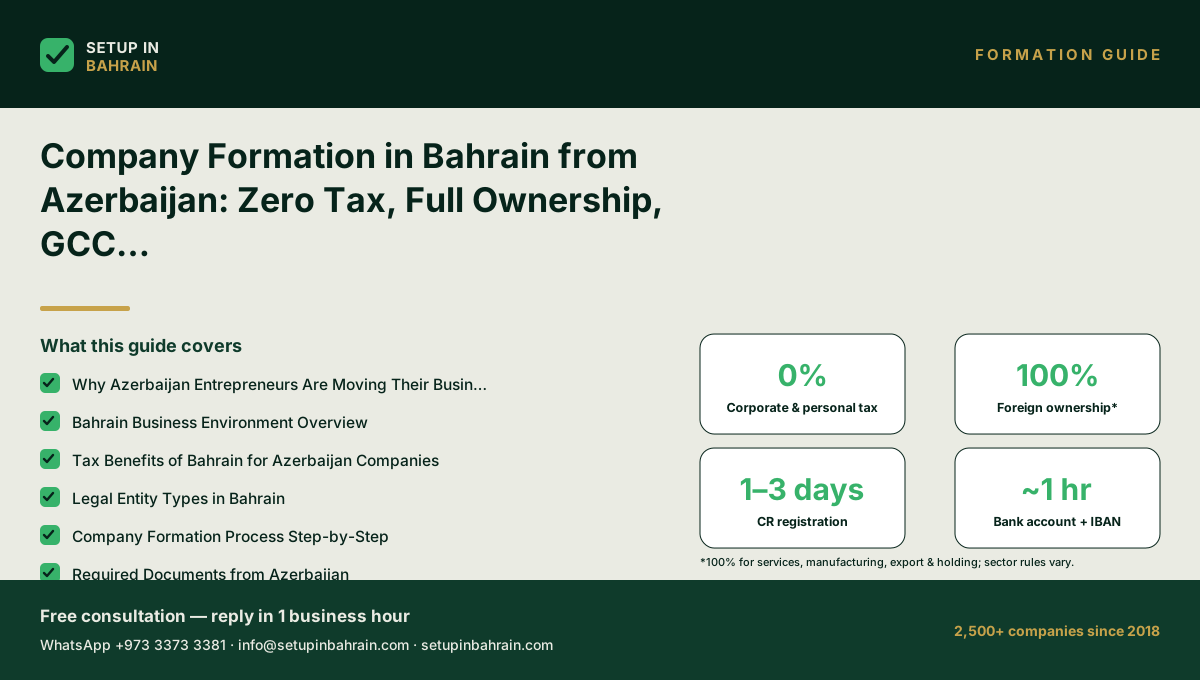
Register your Bahrain company from Azerbaijan with generally no corporate income tax for most sectors. Fast setup, full support for Azerbaijani entrepreneurs. Start your tax-free business today.
Key Takeaways
- Why Azerbaijan Entrepreneurs Are Moving Their Business to Bahrain
- Bahrain Business Environment Overview
- Tax Benefits of Bahrain for Azerbaijan Companies
- Legal Entity Types in Bahrain
- Company Formation Process Step-by-Step
→ Complete guide: Company Formation in Bahrain — the full 2026 guide
View details
Ownership & capital
A Bahrain WLL can be owned by a single person — 100% foreign ownership applies to most activities, with no local partner required for services, manufacturing, export trading and holding companies. The minimum share capital is BHD 1 ; we recommend BHD 1,000 . This Makes bank account opening and investor visa approval smoother.
Last month, I sat across from Elchin, a software development agency owner from Baku who had just completed his 2025 tax filings. His company generated ₼850,000 in revenue—impressive growth for a team of twelve. After paying 2generally no corporate income tax for most sectors, DSMF social insurance contributions that added 22% to every salary he paid, wrestling with MSIS compliance requirements. Watching the 10% dividend withholding eat into what remained, he kept roughly ₼510,000. When I walked him through the mathematics of a Bahrain structure, he went quiet for about thirty seconds. "You're telling me I could have kept an extra ₼170,000 this year alone?"
That conversation is happening across Azerbaijan's business community right now. And it's not about tax evasion or offshore schemes. It's about recognizing that legitimate, OECD-compliant jurisdictions exist where Generally no corporate income tax for most sectors is the law, where 100% foreign ownership is guaranteed, and where the GCC's $1.6 trillion economy sits at your doorstep.
This guide exists because Azerbaijan business owners face challenges that generic "offshore company" articles completely miss. You're dealing with AZN convertibility restrictions that complicate international transactions despite the manat's peg to the dollar. You're watching the State Oil Fund's dominance create unpredictability in the private sector. You're filing through MSIS and wondering why running a legitimate business feels like navigating an obstacle course. And you're paying 2generally no corporate income tax for most sectors in a region where zero-tax jurisdictions sit just a four-hour flight away.
Bahrain isn't a tax haven in the problematic sense. It's a fully regulated jurisdiction ranked in the World Bank's top five MENA economies for ease of doing business, supervised by the Central Bank of Bahrain (CBB), and offering what the Economic Development Board (EDB) calls "the most business-friendly environment in the Gulf." For Azerbaijan entrepreneurs specifically, it solves problems you didn't even know had solutions.
Why Azerbaijan Entrepreneurs Are Moving Their Business to Bahrain
The migration started quietly around 2022, but it's accelerating rapidly. Azerbaijan entrepreneurs discovered something that European and American business owners had known for years: the Gulf Cooperation Council region offers legitimate business structures that eliminate corporate taxation entirely while providing access to markets that Azerbaijan's geographic position makes difficult to reach efficiently.
Here's what's driving Azerbaijan founders specifically:
The Oil Dependency Trap
You know this reality intimately. Azerbaijan's economy remains fundamentally shaped by the State Oil Fund (SOFAZ). This Controls billions in petroleum revenue and creates policy volatility that private sector businesses cannot predict. When oil prices dropped in 2015-2016, the manat lost nearly half its value overnight. While the currency has stabilized through its USD peg, the underlying vulnerability remains. Your business planning happens against a backdrop of structural uncertainty that most Western entrepreneurs never experience.
Bahrain faced the same challenge—and solved it. The kingdom deliberately diversified away from oil dependency. Today petroleum accounts for less than 20% of GDP compared to Azerbaijan's about 50%. The Economic Development Board has spent two decades building financial services, logistics, manufacturing. Technology sectors that provide genuine economic stability. When you incorporate in Bahrain, you're joining an economy designed for private sector growth, not one where private enterprise exists at the margins of state-controlled resource extraction.
The 2generally no corporate income tax for most sectors Burden
Azerbaijan's 20% corporate income tax rate isn't exceptional by global standards—it's actually lower than many European countries. But combined with everything else Azerbaijani entrepreneurs face, it becomes the tipping point that makes relocation attractive.
Consider the real mathematics. On ₼500,000 profit:
- Corporate tax: ₼100,000 (20%)
- Remaining for distribution: ₼400,000
- Dividend withholding (10%): ₼40,000
- Net to founder: ₼360,000
The same profit in Bahrain:
- Corporate tax: ₼0 (0%)
- Dividend withholding: ₼0 (no withholding on distributions)
- Net to founder: ₼500,000
That's ₼140,000 difference annually—money that compounds over years into hundreds of thousands in additional capital for investment, hiring, or personal wealth building.
DSMF Social Insurance: The Hidden Cost Multiplier
Azerbaijan's State Social Protection Fund (DSMF) requires employer contributions of 22% on top of every salary you pay. For a software developer earning ₼3,000 monthly, you're actually paying ₼3,660 when DSMF is included. Multiply that across a team of fifteen. You're spending an additional ₼118,800 annually just on social insurance contributions.
Bahrain's social insurance system (SIO) charges 12% for Bahraini employees—but here's the critical distinction: you'll likely hire foreign workers who face only a 3% contribution rate. For a predominantly expatriate workforce. This Most Azerbaijan-owned companies in Bahrain maintain, social costs drop by over 80% compared to Azerbaijan equivalents.
AZN Convertibility Restrictions
The Azerbaijani manat's peg to the US dollar provides exchange rate stability. It masks a deeper problem: full convertibility remains restricted in numerous scenarios. If you've tried to transfer significant profits abroad, pay international suppliers in dollars, or invest in foreign assets, you've encountered the Central Bank of Azerbaijan's capital controls firsthand.
These restrictions don't exist because Azerbaijan lacks foreign reserves. They exist because the entire monetary system depends on maintaining the peg, which requires controlling currency outflows. For entrepreneurs building international businesses, this creates operational friction that ranges from annoying to business-threatening.
Bahrain's dinar (BHD) is also pegged to the USD—at a rate of about 0.376 BHD per dollar—but without meaningful capital controls. You can receive, hold, transfer, and convert currencies freely. International wire transfers execute in hours, not weeks. The Central Bank of Bahrain explicitly supports the kingdom's role as a regional financial hub. This Requires unrestricted capital movement.
MSIS E-Filing Complexity
Azerbaijan's electronic tax system (MSIS) represents a genuine modernization effort. Anyone who has used it knows the reality: complex filing requirements, unclear guidance, frequent system issues, and penalties that feel arbitrary. Small errors trigger audits. Compliance becomes a part-time job unto itself.
Bahrain's tax administration, handled primarily through the National Bureau for Revenue (NBR), is remarkably simple for corporate taxpayers—because there's almost nothing to file. No corporate income tax means no corporate income tax returns. VAT exists at 10%, but compliance is straightforward and fully digital through the NBR portal. The contrast between spending three days per quarter on MSIS filings versus thirty minutes on Bahrain VAT compliance is stark.
Bahrain Business Environment Overview
Understanding Bahrain's business environment requires moving past the "zero tax haven" perception toward recognizing what the kingdom has actually built over four decades of deliberate economic policy.
Strategic Geographic Position
Bahrain sits in the Arabian Gulf, connected to Saudi Arabia via the 25-kilometer King Fahd Causeway. This physical link to the world's 17th largest economy isn't symbolic—it's operational. Approximately 40,000 vehicles cross the causeway daily. Saudi businesses routinely establish Bahrain operations for banking, licensing, and regulatory purposes. Your Bahrain company has ground-level access to Saudi Arabia's $1 trillion economy without navigating Saudi Arabia's more complex foreign ownership requirements.
Beyond Saudi Arabia, Bahrain provides natural access to the entire GCC market: UAE, Kuwait, Qatar. Oman collectively represent over $1.6 trillion in GDP. Direct flights connect Bahrain International Airport to every major Gulf city within two hours. For Azerbaijan entrepreneurs whose geographic position makes Western Europe accessible but the Gulf somewhat remote, Bahrain reverses that equation entirely.
Regulatory Framework and Institutional Quality
The Central Bank of Bahrain (CBB) regulates financial services with standards that meet or exceed European equivalents. The CBB's regulatory sandbox has attracted fintech companies from across the world. Its Islamic finance regulations are considered global benchmarks. If you're building anything in financial services, payments, or banking-adjacent technology, Bahrain's regulatory framework provides both credibility and clarity.
The Ministry of Industry and Commerce (MOIC) handles company registration through the Sijilat system—an online portal that allows most business types to be registered within days rather than weeks. The Economic Development Board (EDB) provides investment facilitation services, often assigning dedicated account managers to foreign entrepreneurs establishing significant operations.
The Bahrain Investors Centre (BIC) offers one-stop-shop services where you can complete company registration, get trade licenses. Process residency applications in a single location. For Azerbaijan entrepreneurs accustomed to navigating multiple ministries and agencies, this consolidation represents a fundamental operational improvement.
Labor Market and Talent Access
Bahrain's population of about 1.5 million includes over 600,000 expatriate workers, creating a genuinely international talent pool. Unlike some Gulf states with strict emiratization or localization requirements, Bahrain's approach to workforce composition remains relatively flexible.
The Labour Market Regulatory Authority (LMRA) oversees work permit issuance through the Flexi Permit and standard work visa systems. For skilled workers, especially in technology, finance. Professional services, permit processing typically completes within two to three weeks. Salary thresholds for work permits remain lower than UAE equivalents, making it economically viable to build teams that would be prohibitively expensive in Dubai or Abu Dhabi.
Cost Structure Comparison
Operating costs in Bahrain run greatly lower than UAE or Qatar equivalents while maintaining comparable quality:
| Cost Category | Bahrain | Dubai (UAE) | Baku |
| Grade A Office (per sqm/year) | $150-250 | $350-600 | $120-180 |
| Average Professional Salary | $2,500-4,500 | $4,000-7,000 | $800-1,500 |
| Business Setup (LLC equivalent) | $2,000-5,000 | $8,000-15,000 | $500-1,500 |
| Annual License Renewal | $500-1,200 | $2,000-5,000 | $200-400 |
| Residential Rent (2BR apartment) | $800-1,500 | $2,000-4,000 | $400-700 |
Tax Benefits of Bahrain for Azerbaijan Companies
Bahrain's tax regime isn't merely "low tax"—it's structurally different from what Azerbaijani entrepreneurs experience. Understanding the full scope requires examining each tax category individually.
0% Corporate Income Tax
The headline figure bears repeating: Bahrain charges zero corporate income tax on profits, regardless of amount. There's no graduated scale, no threshold where taxation begins, no industry-specific exceptions that complicate planning. Zero means zero.
This applies whether your company earns BHD 10,000 or BHD 10,000,000 annually. Profit retained for reinvestment faces no tax. Profit distributed to shareholders faces no tax at the corporate level. The simplicity itself creates value—no tax planning required, no optimization strategies needed, no compliance burden around corporate income reporting.
For comparison, Azerbaijan's 20% rate means that every ₼5 in profit costs ₼1 in tax. Over a decade of business operations, that difference compounds into substantial wealth variance.
0% Personal Income Tax
Bahrain also charges no personal income tax. Salary, dividends, capital gains, interest income, rental income—all categories of personal earnings face zero taxation at the individual level.
For founder-operators who pay themselves salaries from their companies, this creates a complete tax shield. In Azerbaijan, you'd face social insurance contributions on salary plus potential income tax implications depending on structure. In Bahrain, your salary is your salary—nothing deducted for income tax purposes.
0% Dividend Withholding
Azerbaijan imposes a 10% withholding tax on dividends paid to non-residents. This creates friction for international shareholders and reduces the efficiency of corporate structures where profits flow to holding entities or individual investors abroad.
Bahrain imposes no withholding on dividends, regardless of recipient residency. A Bahrain company can distribute 100% of its profits to shareholders anywhere in the world without withholding obligations. This makes Bahrain an efficient jurisdiction for international corporate structures, holding companies. Situations where you want maximum flexibility in profit distribution.
10% Value Added Tax (VAT)
Bahrain is not entirely tax-free. A 10% VAT applies to most goods and services, implemented following GCC-wide agreements in 2019. But, VAT is fundamentally different from income tax:
- VAT is collected from customers, not deducted from profits
- VAT registration is only mandatory above BHD 37,500 (~$100,000) in annual revenue
- Export services to non-GCC countries are zero-rated (0% VAT)
- Financial services face exemptions under specific categories
For most Azerbaijan entrepreneurs establishing Bahrain operations—especially those providing services to international clients—VAT compliance is either minimal or non-existent. Services exported to Azerbaijan, Europe, or anywhere outside the GCC face 0% VAT.
Treaty Network and International Tax Planning
Bahrain has signed double taxation treaties with over 45 countries, providing reduced withholding rates and tax credit provisions for businesses operating across borders. While Azerbaijan and Bahrain do not currently have a bilateral tax treaty in force, Bahrain's network covers most major trading partners and creates planning opportunities for businesses with diverse client bases.
The absence of a specific Azerbaijan-Bahrain treaty doesn't eliminate benefits—it simply means the standard Azerbaijani rules apply to payments from Bahrain. But, since Bahrain companies don't face local taxation, the treaty question primarily affects payments from Bahrain to Azerbaijan rather than vice versa.
Legal Entity Types in Bahrain
Selecting the appropriate legal structure determines ownership rights, liability exposure, capital requirements, and operational flexibility. Bahrain offers multiple entity types, each suited to different business models and scale levels.
With Limited Liability Company (WLL)
The WLL structure is what most Azerbaijan entrepreneurs will establish. It provides:
- 100% foreign ownership (since 2022 reforms)
- Limited liability protection separating personal and business assets
- a single shareholder (one person can own 100%) (individuals or corporate entities)
- Minimum capital of BHD 1 (we recommend BHD 1,000)for most commercial activities—though actual paid-up requirements often prove lower
- Physical office requirement satisfied through serviced office arrangements
WLLs can conduct nearly any commercial activity, from trading and services to manufacturing and technology. They're suitable for operational businesses with employees, physical presence, and active client engagement.
Formation timeline: 5-10 business days through MOIC Sijilat portal Annual renewal: Required with relatively modest fees Audit requirements: Mandatory annual financial statements
single-shareholder WLL
The WLL structure allows solo founders to establish limited liability companies without needing a second shareholder:
- 100% single owner permitted (individual or corporate)
- Limited liability equivalent to WLL
- Minimum capital of BHD 1 (we recommend BHD 1,000)for commercial activities
- Simplified governance without board meeting requirements
WLLs suit solo consultants, freelancers, and individual service providers who want corporate structure without partnership complications. Azerbaijan entrepreneurs operating one-person consultancies or specialized services often find WLLs ideal.
Formation timeline: 5-10 business days Operational simplicity: No partner disputes, full control
Branch Office
Foreign companies can establish Bahrain branches without creating separate legal entities:
- Extension of parent company rather than independent entity
- No separate capital requirements for the branch itself
- Parent company liability extends to branch operations
- Local sponsor may be required depending on activity type
Branches suit large companies wanting Bahrain presence without establishing independent subsidiaries. For most Azerbaijan SMEs, WLL structures prove more appropriate.
Representative Office
Representative offices allow foreign companies to maintain Bahrain presence for marketing and liaison purposes only:
- No commercial activity permitted—cannot sign contracts or collect payments
- Market research and promotion functions only
- Lower setup costs than operational entities
- No capital requirements typically
Representative offices suit companies exploring Bahrain markets before committing to full operations. They're stepping stones rather than permanent structures.
Bahrain Free Zones
Bahrain operates several free zones offering enhanced incentives:
Bahrain Logistics Zone (BLZ)
- Customs duty exemptions
- 100% foreign ownership
- Purpose-built logistics infrastructure
- Suitable for trading and distribution companies
Bahrain International Investment Park (BIIP)
- Manufacturing-focused facilities
- Duty-free import of machinery and raw materials
- Competitive lease rates
- Suitable for light manufacturing operations
Bahrain FinTech Bay
- Financial technology regulatory sandbox
- CBB regulatory engagement
- Accelerator and mentorship programs
- Suitable for fintech startups
Free zones add complexity but provide specific advantages for businesses in logistics, manufacturing, or fintech. Most service-based companies won't need free zone structures.
Company Formation Process Step-by-Step
Azerbaijan entrepreneurs can complete Bahrain company formation either remotely (initial stages) or through a single visit (comprehensive setup including residency). Here's the complete process:
Step 1: Trade Name Reservation (Days 1-2)
Before filing incorporation documents, you must reserve your company name through the MOIC Sijilat portal:
- Create Sijilat account at www.sijilat.bh
- Search existing names to confirm availability
- Submit name reservation application
- Pay reservation fee (about BHD 10-20)
- Receive confirmation within 24-48 hours
Name requirements:
- Must not duplicate existing registered names
- Cannot include restricted terms without special approval
- Arabic translation required for official records
- Name reservation valid for 60 days
Step 2: Determine Commercial Registration (CR) Activities
Bahrain's commercial registration system assigns specific activity codes to each company. Your CR determines what business activities you can legally conduct:
Common activity categories for Azerbaijan entrepreneurs:
- Computer programming and consultancy (IT services)
- Management consulting
- Import/export trading
- Engineering services
- Marketing and advertising
- E-commerce platforms
Activity selection affects licensing requirements, capital thresholds, and whether additional ministry approvals are needed. Choose activities broad enough to cover anticipated operations but specific enough to avoid unnecessary regulatory burdens.
Step 3: Prepare Incorporation Documents
Required documents for WLL formation:
For individual shareholders:
- Valid passport copies (notarized)
- Proof of address (utility bill or bank statement)
- Personal bank reference letter
- Passport-sized photographs
For corporate shareholders:
- Certificate of incorporation (apostilled)
- Articles of association/memorandum (apostilled)
- Board resolution authorizing Bahrain company formation
- Certificate of good standing
- Passport copies of directors/authorized signatories
For the Bahrain company:
- Memorandum of Association (template available from MOIC)
- Articles of Association
- Shareholder agreement (if applicable)
- Power of Attorney (if using local representative)
Documents from Azerbaijan require apostille certification through the Ministry of Justice or authorized notaries. Bahrain accepts apostilles under the Hague Convention.
Step 4: Submit CR Application (Days 3-5)
Through Sijilat portal:
- Complete online application form
- Upload all required documents
- Select registered office address
- Specify shareholders and capital distribution
- Pay registration fees (about BHD 300-500 depending on capital)
Capital considerations: While minimum capital requirements exist on paper (BHD 1 (we recommend BHD 1,000)for most commercial activities), actual paid-up capital requirements are often negotiable. Many activities require only 25-50% initial capital deposit with the remainder due within specified timeframes.
Step 5: Get Commercial Registration Certificate
Upon approval, MOIC issues the Commercial Registration (CR) certificate—your company's primary legal document. The CR includes:
- Company name and CR number
- Registered activities
- Shareholder information
- Registered address
- Capital structure
- Issue and expiry dates
CR issuance timeline: 3-7 business days from complete application
Step 6: Municipal and Licensing Requirements
Depending on your activities, additional licenses may be required:
Municipality License: Required for physical business premises. Obtained through the relevant municipality (Capital, Muharraq, Northern, or Southern Governorate).
Industry-Specific Licenses:
- Telecommunications (TRA approval for IT services involving telecom)
- Central Bank of Bahrain (financial services)
- Labour Market Regulatory Authority (employment activities)
Most professional services and general trading activities don't require additional licenses beyond the CR.
Step 7: Bank Account Opening
Opening a Bahrain corporate bank account requires:
- CR certificate
- Memorandum and Articles of Association
- Shareholders' passport copies
- Proof of registered address
- Business plan or company profile
- Source of funds documents
- Personal references for shareholders
Bank options:
- National Bank of Bahrain (NBB)—largest local bank
- Bank ABC—strong international correspondent network
- Ahli United Bank—regional presence
- Standard Chartered—international connectivity
- HSBC—global network
Account opening timeline: 2-4 weeks with complete documents Common challenge: Banks conduct enhanced due diligence on new companies; prepare comprehensive business plans and clear source of funds documents.
Step 8: Residency Visa Processing (If Relocating)
Shareholders investing in Bahrain companies can get investor residency visas:
Investor Visa Requirements:
- Company CR showing minimum investment threshold
- Proof of investment (bank statements showing capital injection)
- Valid passport
- Medical clearance
- Police clearance from country of origin
Golden Residency Program: For investments exceeding BHD 100,000 (~$266,000), Bahrain's Golden Residency provides 10-year renewable visas with full work rights.
Standard Investor Visa: Lower investment thresholds qualify for renewable residency permits, typically issued for 1-2 years initially.
Processing timeline: 2-4 weeks from complete application
Total Formation Timeline
| Stage | Duration |
| Name Reservation | 1-2 days |
| Document Preparation | 3-7 days |
| CR Application Processing | 5-10 days |
| Additional Licenses (if needed) | 5-15 days |
| Bank Account Opening | Banking: approximately 1 hour in 99% of our reported cases; our last 100 applications handled in 2026 were approved; subsidiaries or CIS shareholders: 3 days to 2 weeks. Subject to the bank’s final review. |
| Residency Processing (if applicable) | 2-4 weeks |
| Total (without residency) | 2-4 weeks |
| Total (with residency) | 4-8 weeks |
Required Documents from Azerbaijan
Preparing documents from Azerbaijan requires understanding both local authentication requirements and Bahrain's acceptance criteria.
Personal Documents:
- Passport
- Address Proof
- Bank Reference Letter
- Police Clearance Certificate
- Educational Credentials (if relevant)
Corporate Documents (if Azerbaijan company is shareholder):
- Extract from State Register of Legal Entities
- Charter/Articles of Association
- Minutes of General Meeting/Board Resolution
- Financial Statements
Apostille Process in Azerbaijan:
Azerbaijan joined the Hague Apostille Convention, streamlining document authentication:
- Get original document
- Notarize if required (for copies)
- Submit to Ministry of Justice for apostille
- Apostille issued within 3-5 business days
- Cost: about ₼30-50 per document
Translation Requirements:
Bahrain accepts documents in English or Arabic. Documents in Azerbaijani require certified translation to English, preferably completed by a Bahrain-approved translator or certified translation agency in Azerbaijan.
Bahrain Corporate Banking for Azerbaijan Businesses
Banking represents one of the most significant operational advantages Bahrain offers over Azerbaijan. The kingdom functions as a regional financial hub with 375+ financial institutions regulated by the Central Bank of Bahrain.
Why Bahrain Banking Matters for Azerbaijan Entrepreneurs:
- USD Account Access: Open multi-currency accounts with unrestricted USD holdings and transfers
- International Wire Transfers: Same-day or next-day execution to global destinations
- No Capital Controls: Transfer profits, pay international suppliers, and manage foreign investments freely
- Correspondent Banking: Bahrain banks maintain relationships with major global institutions, reducing transfer friction
Recommended Banks for Azerbaijan-Owned Companies:
National Bank of Bahrain (NBB)
- Largest domestic bank with strong local network
- Comprehensive corporate banking services
- Online banking platform for remote management
- Typical account opening: 2-3 weeks
Bank ABC (Arab Banking Corporation)
- Headquarters in Bahrain with global network
- Strong correspondent relationships
- Trade finance capabilities
- Suitable for import/export operations
Ahli United Bank
- Regional presence across GCC
- Digital banking capabilities
- Competitive fee structures
- Good for growing regional operations
HSBC Bahrain
- Global network connectivity
- Familiar to international businesses
- Higher fee structures but unmatched reach
- Ideal for companies with diverse geographic operations
Account Opening Challenges and Solutions:
Bahrain banks conduct thorough due diligence, especially for newly formed companies. Common challenges:
Challenge: New company with no trading history Solution: Provide detailed business plan, projected financials. Personal banking references demonstrating financial credibility
Challenge: Unclear source of funds Solution: Document capital sources thoroughly—sale of Azerbaijan assets, existing business profits, personal savings with supporting bank statements
Challenge: Remote shareholders Solution: Some banks require in-person verification; plan Bahrain visit for account activation or use banks offering video verification
Corporate Banking Services Available:
- Current accounts (BHD, USD, EUR, GBP)
- Term deposits (competitive rates for USD holdings)
- Trade finance (letters of credit, bank guarantees)
- Foreign exchange services
- Online banking and mobile apps
- Business credit cards
- Working capital financing (after establishing relationship)
Fee Structures:
| Service | Typical Cost |
| Account Maintenance (monthly) | BHD 10-25 |
| International Wire (outgoing) | BHD 15-40 |
| International Wire (incoming) | Often free |
| Cheque Book | BHD 10-20 |
| Account Statement | BHD 2-5 |
Visa and Residency Pathway for Azerbaijanis
Bahrain offers multiple visa categories for Azerbaijan nationals, ranging from business visit visas to permanent residency options.
Business Visit Visa (E-Visa)
For initial trips to establish company and bank accounts:
- Apply online through evisa.gov.bh
- Processing: 3-5 business days
- Validity: 14 days (extendable)
- Cost: about BHD 29
- Purpose: Business meetings, company formation activities
Azerbaijan passport holders can get Bahrain e-visas without embassy visits, making initial exploration trips straightforward.
Work Visa (Through Established Company)
Once your Bahrain company is operational:
- Company applies for work permit through LMRA
- Permit approved based on company's recruitment quota
- Visa issued through Bahrain embassy in Azerbaijan
- Enter Bahrain and complete residency formalities
- Receive CPR (Central Population Registry) card
Timeline: 3-6 weeks from application Cost: Approximately BHD 500-800 including fees and medical
Investor Residency
For shareholders with significant capital:
Standard Investor Residency:
- Minimum investment: BHD 50,000 (~$133,000)
- Renewable annually
- Full work rights
- Family sponsorship eligible
Golden Residency Program:
- Minimum investment: BHD 100,000 (~$266,000)
- 10-year renewable visa
- Premium services and benefits
- Fast-track processing
- Family included
Self-Sponsorship Option: Individuals with specific qualifications (professionals, retirees with pension, property owners) can get self-sponsored residency without employer ties.
Residency Benefits:
- Legal right to reside and work in Bahrain
- Open personal bank accounts
- Sponsor family members
- Rent or purchase property
- Enroll children in schools
- Access healthcare services
- Travel freely within GCC (with some restrictions)
Family Residency:
Residency visa holders can sponsor:
- Spouse
- Children (under 18, or under 25 if studying)
- Parents (with additional requirements)
Family visa processing typically adds 2-4 weeks to the timeline.
Pathway to Permanent Residency:
After maintaining continuous residency for specified periods, permanent residency becomes available:
- 5+ years continuous residence
- Clean legal record
- Demonstrated financial stability
- Arabic language knowledge (preferred but not mandatory)
Bahrain also offers naturalization after extended residency, though this is discretionary and requires special circumstances.
Bahrain vs UAE vs Saudi Arabia Comparison
Azerbaijan entrepreneurs often consider multiple Gulf destinations. Understanding the distinctions helps clarify why Bahrain frequently proves optimal.
| Factor | Bahrain | UAE (Dubai) | Saudi Arabia |
| Corporate Tax | 0% | 9% (above AED 375,000) | 20% (for foreign-owned) |
| Foreign Ownership | 100% (all sectors) | 100% (most sectors) | 100% (most sectors, recent reform) |
| Setup Cost | $2,000-5,000 | $8,000-15,000 | $15,000-30,000 |
| Annual Compliance | $500-1,500 | $3,000-6,000 | $5,000-10,000 |
| Bank Account Opening | Moderate difficulty | Difficult | Very difficult |
| Office Requirement | Flexible (virtual possible) | Flexi-desk options | Physical often required |
| Residency Cost | $2,000-5,000 | $5,000-10,000 | $8,000-15,000+ |
| Minimum Capital | BHD 1 (we recommend BHD 1,000) | AED 0-1M (varies) | SAR 500K-30M (varies) |
| Saudi Access | Direct (25km causeway) | Requires separate presence | Direct |
The UAE introduced 9% corporate tax in 2023, fundamentally changing its tax proposition. While exemptions exist for free zone companies meeting specific conditions, the compliance burden has increased greatly. Bahrain's zero-tax status remains unconditional.
Dubai's banking sector has become notoriously difficult for new company account opening, with rejection rates exceeding 50% for first-time applicants. Bahrain's financial sector, while conducting proper due diligence, maintains more accessible standards.
Setup and operating costs in Bahrain run 40-60% lower than UAE equivalents. For Azerbaijan entrepreneurs bootstrapping or operating lean, this cost difference enables faster path to profitability.
Why Bahrain Over Saudi Arabia:
Saudi Arabia's Vision 2030 reforms have opened foreign investment. The 2generally no corporate income tax for most sectors on foreign-owned companies (Zakat applies to Saudi-owned) creates substantial burden. Entry costs, minimum capital requirements, and bureaucratic complexity remain greatly higher.
But, Saudi Arabia's market size (35+ million population, $1 trillion GDP) dwarfs Bahrain's. The strategic approach: establish in Bahrain, then expand Saudi operations once regional proof-of-concept is established. The King Fahd Causeway makes this geographic strategy practical.
When UAE or Saudi Makes More Sense:
- UAE: If your business requires Dubai's specific brand positioning, access to Dubai's consumer market, or connection to UAE-specific industries (luxury, tourism, real estate)
- Saudi Arabia: If your primary market is Saudi Arabia and you need permanent on-ground presence for government contracts or local partnerships requiring Saudi entity status
Real Cost Breakdown: Bahrain Company vs Azerbaijan Company
The following comparison uses a realistic scenario: an IT services company with ₼600,000 annual revenue, 5 employees, and ₼350,000 pre-tax profit.
Azerbaijan Operations:
| Cost Category | Annual Amount (AZN) |
Bahrain Business Guides for Azerbaijan Citizens
Frequently Asked Questions
How long does it take to set up?
It takes 15 to 20 days. We file all forms for you. You do not need to wait long.
What does it cost?
Company formation: Standard BHD 1,340 with 3 months of office address; Gold BHD 1,700 with 6 months; Premium BHD 2,150 with 12 months and a cabin, officer table and chair, and two guest chairs. No formation package includes visas, including Premium. Investor/work visas are priced separately: BHD 755 for one year or BHD 953 for two years, in addition to the formation package. Ask for a written, itemized quotation confirming government fees and all inclusions before payment.
Do I need to visit Bahrain?
No. You can set up your firm from home. We do all the work online. Some banks may ask for one visit.
What tax will I pay?
You pay zero tax on your profits. Bahrain has no corporate income tax. This is a key benefit of the setup.
Can I own 100% of my firm?
Yes. Foreign owners can hold all shares. No local partner is needed. Full ownership is allowed.
What do I need to start?
You need a valid passport. You also need a trade name and a business address. We help you with all of these.
How do I open a bank account?
We guide you step by step. Most banks take 3 to 6 weeks. You will need your CR and firm papers.
Who issues the Commercial Registration (CR)?
The CR is issued by the MOICT. It is your legal right to trade in Bahrain. We file the CR for you.
Can I renew my CR each year?
Company renewal packages: BHD 530 with 3 months of office address; BHD 980 with 6 months; BHD 1,520 with 12 months. These are separate renewal packages, not visa fees.
How do I get started?
Fill in our form on this page. Our team will call you back. We map your best setup plan at no cost.
Steps to Form Your Company
- Pick your trade name. We check if it is free.
- Choose your business type. WLL is the most common.
- Sign the MOA. We draft and file all legal docs.
- Pay the state fees. About BHD 432 in total.
- Get your CR. Takes 15 to 20 days.
- Open your bank account. We guide each step.
- Start trading. You are ready to do business.
Key Facts
- Tax rate: 0%
- Foreign ownership: 100%
- Setup time: 15 to 20 days
- Company formation: Standard BHD 1,340 with 3 months of office address; Gold BHD 1,700 with 6 months; Premium BHD 2,150 with 12 months and a cabin, officer table and chair, and two guest chairs. No formation package includes visas, including Premium. Investor/work visas are priced separately: BHD 755 for one year or BHD 953 for two years, in addition to the formation package. Ask for a written, itemized quotation confirming government fees and all inclusions before payment.
- Company renewal packages: BHD 530 with 3 months of office address; BHD 980 with 6 months; BHD 1,520 with 12 months. These are separate renewal packages, not visa fees.
- Client rating: 4.8 stars
- Clients served: 2,500 and more
Quick Facts
- Tax rate: 0%
- Own all of your firm: Yes, 100%
- Time to set up: 15 to 20 days
- Company formation: Standard BHD 1,340 with 3 months of office address; Gold BHD 1,700 with 6 months; Premium BHD 2,150 with 12 months and a cabin, officer table and chair, and two guest chairs. No formation package includes visas, including Premium. Investor/work visas are priced separately: BHD 755 for one year or BHD 953 for two years, in addition to the formation package. Ask for a written, itemized quotation confirming government fees and all inclusions before payment.
- Company renewal packages: BHD 530 with 3 months of office address; BHD 980 with 6 months; BHD 1,520 with 12 months. These are separate renewal packages, not visa fees.
- Rating: 4.8 stars
- Clients: 2,500 and more
Why Bahrain?
Bahrain has no tax. You keep all your profits. This is rare in the Gulf.
You can own all of your firm. No local partner is needed. The law allows full foreign ownership.
Setup takes 15 to 20 days. We file all forms for you. You can do it all from home.
Bahrain has a free trade deal with the US. Your goods face low or no tariffs. This gives you access to big markets.
We have served 2,800+ clients from 44+ countries and maintain records to substantiate that total where needed. We have 113 Google reviews; reviews represent only some clients and are not the same as the total clients served.
Our Steps
- Tell us your plan. We advise you for free.
- We pick the right firm type for you.
- We file all your forms with MOICT.
- You get your CR in 15 to 20 days.
- We help you open a bank account.
- You are ready to trade. We stay with you.
Why Set Up in Bahrain?
Bahrain is a great place to run a firm. It has no tax. You keep all your profits. This is rare in the Gulf.
You can own your firm 100%. No local partner is needed. The law is clear and fair.
It is fast to set up. You can have a CR in 15 to 20 days. We file all forms for you.
Bahrain has a free trade deal with the US. Your goods face low or no tariffs. This gives you access to big markets.
The banks are good. The roads are good. The schools are good. It is a well-run state.
We have served 2,800+ clients from 44+ countries and maintain records to substantiate that total where needed. We have 113 Google reviews; reviews represent only some clients and are not the same as the total clients served.
Our Services
- Company formation: Standard BHD 1,340 with 3 months of office address; Gold BHD 1,700 with 6 months; Premium BHD 2,150 with 12 months and a cabin, officer table and chair, and two guest chairs. No formation package includes visas, including Premium. Investor/work visas are priced separately: BHD 755 for one year or BHD 953 for two years, in addition to the formation package. Ask for a written, itemized quotation confirming government fees and all inclusions before payment.
- Company renewal packages: BHD 530 with 3 months of office address; BHD 980 with 6 months; BHD 1,520 with 12 months. These are separate renewal packages, not visa fees.
- Investor Visa — from BHD 755
- Work Visa — LMRA managed
- Virtual office — from BHD 600 per year
- Bank account opening — 3 to 6 weeks
- Family visa — for spouse and kids
- UBO filing — as required by law
Bahrain at a Glance
- Tax rate: 0%
- Foreign ownership: 100%
- Setup time: 15 to 20 days
- Free trade deal: Yes, with the US
- Language: Arabic and English
- Currency: Bahraini Dinar (BHD)
- Time zone: UTC+3
- GDP growth: Steady and strong
How to Start
- Fill in the form on this page. It takes 3 minutes.
- We call you back the same day.
- We map the best plan for your firm type and goals.
- We file all forms. We deal with MOICT for you.
- You get your CR in 15 to 20 days.
- We help you open a bank account and get your visa.
- You are ready to trade. We stay with you.
Common Questions
Do I need to visit Bahrain to set up?
No. You can do it all from home. We file online. You may need one visit to open a bank account.
Is Bahrain safe for business?
Yes. Bahrain is a stable state. It has a clear legal system. Your firm and funds are safe here.
Can I hire staff from any country?
Yes. You can hire from any country. Each hire needs a work permit from LMRA. We manage this for you.
What type of firm should I set up?
Most clients choose a WLL. This is a limited liability firm. It is flexible and well-known in Bahrain. We advise you on the best type for your case.
How do I get in touch?
Fill in our form. We call you back the same day. You can also email us or use the chat on this page.
Ready to set up in Bahrain from Azerbaijan?
Tell us your business idea. We map the right entity, ownership and timeline — then handle the filing while you focus on what matters.