
Register your Bahrain company from Austria with generally no corporate income tax for most sectors. Expert guidance for Austrian entrepreneurs seeking tax-efficient Middle East expansion.
Key Takeaways
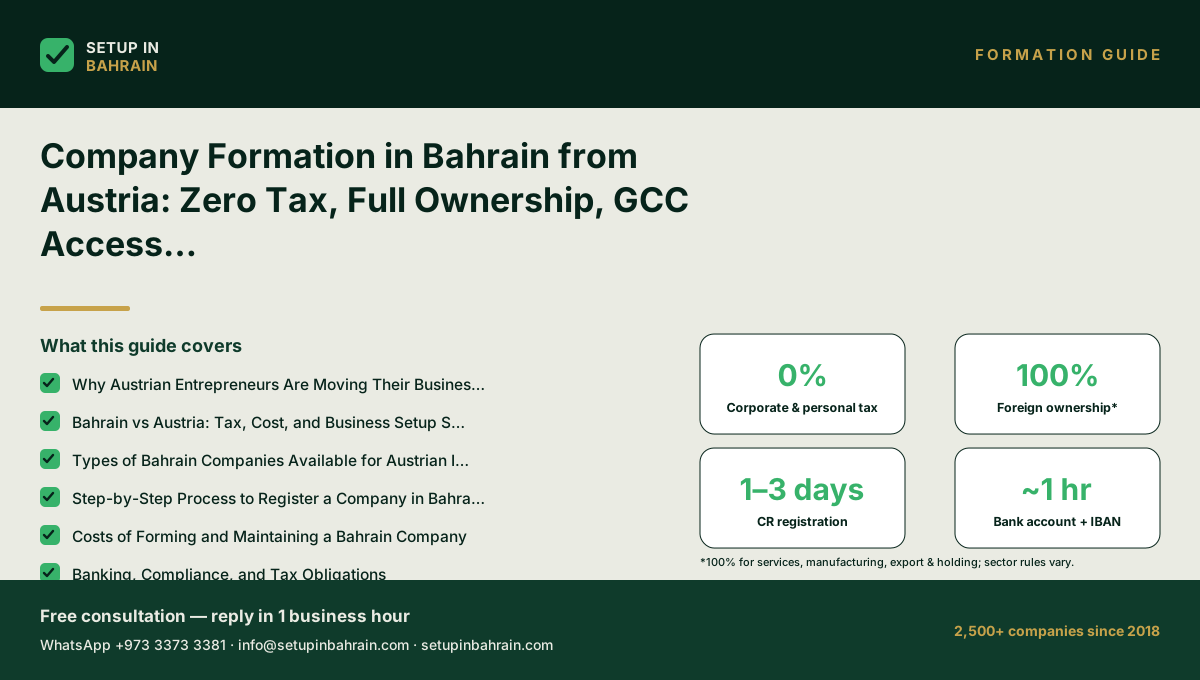
- Why Austrian Entrepreneurs Are Moving Their Business to Bahrain
- Bahrain vs Austria: Tax, Cost, and Business Setup Side-by-Side
- Types of Bahrain Companies Available for Austrian Investors
- Step-by-Step Process to Register a Company in Bahrain from Austria
- Costs of Forming and Maintaining a Bahrain Company
→ Complete guide: Company Formation in Bahrain — the full 2026 guide
View details
Ownership & capital
A Bahrain WLL can be owned by a single person — 100% foreign ownership applies to most activities, with no local partner required for services, manufacturing, export trading and holding companies. The minimum share capital is BHD 1 ; we recommend BHD 1,000 . This Makes bank account opening and investor visa approval smoother.
Thomas runs a software consulting firm in Linz. Last year, his GmbH generated €420,000 in pre-tax profit. After Austria's 25% corporate tax (Körperschaftstesteuer), he handed over €105,000 to the Finanzamt. Then came the Kommunalsteuer, mandatory Wirtschaftskammer membership fees, social security contributions. The endless UVA returns his accountant charges €180 each to file. By December, his effective take-home from that €420,000? Roughly €198,000 after all distributions and personal taxes.
Thomas started researching Bahrain in March 2025. By May, he had a fully operational WLL company in Manama, a corporate bank account with multi-currency functionality. Zero corporate income tax liability on his Gulf-based revenue streams. His Austrian GmbH still exists—handling European clients—but his new MENA contracts flow through Bahrain at generally no corporate income tax for most sectors.
This isn't a loophole. This isn't aggressive tax planning. This is legitimate international business structuring that thousands of European entrepreneurs execute every year. Austria just happens to make the math especially compelling because your domestic tax burden sits among the highest in the OECD.
This guide walks you through exactly how to replicate Thomas's structure: legally, efficiently. With full understanding of both Bahrain's benefits and Austria's ongoing obligations.
Why Austrian Entrepreneurs Are Moving Their Business to Bahrain
Let's cut through the marketing language other jurisdictions use. Bahrain offers something genuinely rare: a developed, stable, OECD-compliant financial center with zero corporate income tax and zero restrictions on foreign ownership. Not "low tax." Zero.
For Austrian business owners specifically, three factors make Bahrain exceptionally attractive.
The Austrian Tax Reality
Austria's corporate tax rate sits at 25%—among the highest in the European Union. But that headline figure understates your actual burden. Consider Markus, an engineering consultant from Lower Austria whose GmbH cleared €420,000 in revenue last year. After the corporate tax, social security contributions on his own salary. The compulsory Wirtschaftskammer fee, he was left with roughly €265,000 before personal distributions. The following week, he received another 18-page Finanzamt questionnaire about intra-EU services and had to file three separate UVA returns because one client paid late.
The compulsory Wirtschaftskammer (WKO) membership extracts fees based on your payroll and revenue. For a profitable SME, this easily reaches €15,000-€50,000 annually. You cannot opt out. The moment you register a Gewerbeschein, you're locked into this system.
Then there's the GmbH minimum capital requirement. While technically reduced to €10,000 for the gründungsprivilegierte GmbH, the standard requirement remains €35,000—half of which (€17,500) must be deposited before incorporation. This capital sits essentially frozen, serving no operational purpose for service-based or digital businesses. Compare this to Bahrain, where a WLL company requires just BHD 50 (about €125) in minimum capital for many business activities.
The GCC Gateway Reality
Austria has minimal trade infrastructure with the Middle East and North Africa region. Your local Wirtschaftskammer might offer occasional export seminars. There's no institutional pathway helping Austrian SMEs access the Gulf's $1.6 trillion economy.
Bahrain changes this equation entirely. As a full member of the Gulf Cooperation Council, a Bahraini company enjoys tariff-free access to Saudi Arabia (population 35 million), the UAE, Kuwait, Qatar, and Oman. Combined, that's a market of about 60 million consumers with GDP per capita figures ranging from $23,000 to $84,000—among the world's highest.
The geographic positioning matters too. Bahrain International Airport connects to every major Asian, African, and European hub. A morning meeting in Riyadh, afternoon calls with Mumbai clients, and you're still home for dinner. For Austrian entrepreneurs eyeing markets beyond the saturated DACH region, this connectivity is transformative.
The Regulatory Efficiency Factor
Austrian entrepreneurs know regulatory friction intimately. The average GmbH formation in Austria involves notarization appointments, Handelsgericht registration, Gewerbeanmeldung filings, Finanzamt registration, social security registration. Often a two-to-three month timeline before you can legally invoice a client.
Bahrain's Economic Development Board (EDB) has engineered a radically different experience. Foreign-owned companies register through the Sijilat online portal, often completing the entire process in 3-7 business days. No local sponsor required. No notarization of Austrian documents beyond apostille certification. No minimum investment thresholds for most business activities.
The World Bank's Doing Business reports consistently ranked Bahrain among the top 50 globally for ease of starting a business—specifically citing registration speed and minimal capital requirements. For Austrian entrepreneurs accustomed to bureaucratic complexity, the contrast is stark.
Bahrain vs Austria: Tax, Cost, and Business Setup Side-by-Side
Let's compare what you're actually facing in each jurisdiction. The numbers below reflect 2025-2026 requirements for a typical service-based or trading company.
Factor Austria (GmbH) Bahrain (WLL) |--------|---------------|---------------| Corporate Tax Rate 25% 0% VAT / Sales Tax 20% (USt) 10% (from January 2026, currently 0%) Minimum Share Capital €35,000 (€10,000 reduced) BHD 50 (~€125) for most activities Foreign Ownership Cap 100% (within EU) 100% (no restrictions) Formation Timeline 4-8 weeks 3-7 business days Annual Compliance Cost €5,000-€15,000+ €1,500-€4,000 Mandatory Chamber Fees Yes (Wirtschaftskammer) No Local Director Required No No (but recommended for banking) Personal Income Tax on Distributions Up to 55% (marginal) 0% Withholding Tax on Dividends 27.5% KESt 0% The capital efficiency alone deserves emphasis. Locking €17,500-€35,000 in a notary escrow account before your GmbH can legally exist makes sense for asset-heavy manufacturing—but for a digital consultancy, SaaS business, or trading company, it's dead capital. That same €35,000 deployed as working capital in Bahrain funds your first year's operations, marketing budget. Still leaves reserves.
The Hidden Austrian Costs
What the table doesn't capture is the cumulative administrative burden. Austrian entrepreneurs spend an estimated 218 hours annually on tax compliance—among the highest in the EU according to World Bank data. That's five and a half standard work weeks dedicated purely to feeding the bureaucratic machine.
Your Steuerberater (tax advisor) costs between €3,000-€12,000 annually depending on complexity. UVA returns filed monthly or quarterly add another €150-€200 per filing if outsourced. The Bilanz (annual financial statements) requires professional preparation, costing €2,000-€5,000 for a typical GmbH.
In Bahrain, annual compliance for a WLL company typically involves submitting a simplified financial return to the Ministry of Industry and Commerce (MOIC), renewing your Commercial Registration (CR), and maintaining basic corporate records. Total professional fees: €1,500-€4,000 annually for most SMEs.
Types of Bahrain Companies Available for Austrian Investors
Bahrain offers several corporate structures, each suited to different business models. Understanding these distinctions prevents costly restructuring later.
WLL (With Limited Liability Company)
The WLL is Bahrain's equivalent to the Austrian GmbH—a limited liability company suitable for most commercial activities. Since 2019 regulatory reforms, foreign nationals can own 100% of a WLL without requiring a Bahraini partner for most business categories.
Best for: Trading companies, professional services, consulting firms, technology companies, import/export operations.
Key characteristics:
- a single shareholder (one person can own 100%) (can be individuals or corporate entities)
- No maximum shareholder limit
- Minimum capital from BHD 50 depending on activity
- Must have at least one director (can be foreign)
- Requires Commercial Registration (CR) and relevant licenses
For Austrian entrepreneurs establishing their first Gulf presence, the WLL offers the optimal balance of flexibility, credibility. Operational simplicity.
single-shareholder WLL
Bahrain introduced the WLL structure specifically for solo entrepreneurs and holding company structures. One shareholder, one director—both can be the same foreign individual.
Best for: Individual consultants, holding structures, solo founders not yet requiring employees.
Key characteristics:
- Single shareholder permitted
- Minimum capital BHD 50 for most activities
- Simpler governance requirements
- Cannot undertake certain regulated activities
Austrian Einzelunternehmer (sole proprietors) often find the WLL structure mirrors their existing operating model while adding limited liability protection absent in Austrian sole proprietorships.
Branch Office
A branch office allows your existing Austrian GmbH to operate directly in Bahrain without creating a separate legal entity. The branch is legally an extension of the Austrian parent company.
Best for: Companies wanting to test the Bahraini market before full commitment, businesses requiring contracts to flow through their European entity.
Key characteristics:
- No separate legal personality from parent
- Profits attributed back to Austrian parent (potentially triggering Austrian tax)
- Requires local representative
- Full Commercial Registration required
The branch structure works well for market testing but offers limited tax planning benefits since profits generally flow back to your Austrian GmbH and face Körperschaftsteuer accordingly.
Holding Company
Bahrain's holding company regime permits structures that own shares in other Bahraini or international companies. Combined with 0% tax on dividends received and capital gains, this creates efficient multi-jurisdictional structures.
Best for: Entrepreneurs with multiple operating companies, family wealth structuring, private equity and investment activities.
Austrian entrepreneurs with existing GmbH structures sometimes establish a Bahraini holding company to receive dividends from regional subsidiaries before strategic repatriation to Austria—timing distributions to optimize personal tax outcomes.
Step-by-Step Process to Register a Company in Bahrain from Austria
The registration process has been streamlined greatly through Bahrain's Sijilat portal, but several steps require careful sequencing. Here's exactly what to expect.
Step 1: Business Activity Selection and Name Reservation
Begin by determining your Commercial Registration (CR) activity codes. Bahrain uses a standardized classification system—selecting the wrong codes limits your operational scope or triggers additional licensing requirements.
For Austrian entrepreneurs, common activity codes include:
- General Trading: Permits import/export of goods
- Management Consultancy: Covers most professional advisory services
- IT Services: Software development, digital services, technology consulting
- Marketing Services: Digital marketing, advertising, brand consulting
Name reservation happens through Sijilat. Your proposed company name cannot duplicate existing registrations and must include an appropriate suffix (WLL, WLL, etc.). Allow 1-2 business days for approval. Tip: have three backup names ready—popular generic names are often taken.
Step 2: Document Preparation and Apostille
Austrian documents require apostille certification before Bahrain authorities accept them. Documents typically needed:
- Passport copies of all shareholders and directors (color scans accepted initially; certified copies required for final registration)
- Proof of address (Austrian Meldezettel works, with official translation)
- Bank reference letter (from your Austrian Hausbank)
- Parent company documents (if your Austrian GmbH will be a shareholder): Firmenbuchauszug, Articles of Association
The Austrian Apostille authority (Apostillenstelle) processes requests within 3-5 business days. International formations experts can coordinate courier logistics if you're managing this remotely.
Step 3: Memorandum and Articles of Association
Bahrain requires standardized constitutional documents for your new company. These establish:
- Share capital and distribution among shareholders
- Director appointment procedures
- Profit distribution mechanisms
- Company objectives and permitted activities
Unlike Austrian Gesellschaftsvertrag requiring notarization, Bahrain's Memorandum can be signed in counterpart and submitted electronically. But, ensuring language aligns with your actual business operations matters—overly restrictive objectives can limit future pivots.
Step 4: Sijilat Registration Submission
With documents prepared, the actual registration happens through Bahrain's Sijilat online portal (sijilat.bh). The system guides you through:
- Company name confirmation
- Shareholder and director details entry
- Activity code selection
- Share capital declaration
- Document uploads
Registration fees vary by activity but typically range from BHD 50-200 (~€125-500). Processing time: 1-3 business days for standard applications.
Step 5: Commercial Registration Issuance
Upon approval, MOIC issues your Commercial Registration certificate—the primary legal document proving your company's existence. This CR number becomes your business identity across all government interactions.
Simultaneously, the system generates:
- Tax registration with the National Bureau for Revenue
- Social insurance registration (GOSI) for future employees
- Entry in the Commercial Registry database
Your company now legally exists and can begin operations.
Step 6: Municipal and Additional Licensing
Depending on your activities, additional licenses may be required:
- Municipal license: Required for physical office presence
- MOIC activity license: Certain regulated activities (financial services, education, healthcare) require specific approvals
- Industry-specific permits: Construction, food handling, professional services
For most Austrian entrepreneurs establishing consulting, trading, or technology companies, the standard CR plus municipal license suffices.
Step 7: Corporate Bank Account Opening
This step often proves most challenging for foreign entrepreneurs. Bahrain's banking sector, regulated by the Central Bank of Bahrain (CBB), maintains robust KYC/AML standards.
Required documents typically includes:
- Commercial Registration certificate
- Memorandum and Articles of Association
- Board resolution authorizing account opening
- Shareholder and director identification (passport, proof of address)
- Business plan or company profile
- Proof of source of funds
- Bank reference letters
Critical insight for Austrian applicants: Banks assess substance carefully. Applications accompanied by a Bahrain office lease, local director appointment, or evidence of genuine regional business rationale receive faster approval. Pure "paper company" applications face extended scrutiny or rejection.
Account opening timelines range from 2-6 weeks depending on bank and application quality. Major banks operating in Bahrain include:
- National Bank of Bahrain (NBB): Strong domestic presence, good SME services
- Bank of Bahrain and Kuwait (BBK): International focus, multicurrency accounts
- Ahli United Bank: Regional network across GCC
- Standard Chartered / HSBC: International correspondent banking relationships
For Austrian entrepreneurs specifically, banks with European correspondent relationships simplify fund transfers back to your Austrian accounts when legitimate repatriation occurs.
Costs of Forming and Maintaining a Bahrain Company
Transparency on costs helps you budget accurately. These figures reflect 2025-2026 pricing for standard formations.
Initial Formation Costs
| Cost Component | Typical Range (EUR) |
| Company registration (Sijilat fees) | €150-€400 |
| Name reservation | €25-€50 |
| Memorandum/Articles drafting | €400-€800 |
| Apostille and document certification | €150-€300 |
| Formation agent professional fees | €1,500-€3,500 |
| Initial municipal license | €200-€500 |
| Total Formation Budget | €2,500-€5,500 |
Annual Maintenance Costs
| Cost Component | Typical Range (EUR) |
| Commercial Registration renewal | €150-€300 |
| Municipal license renewal | €150-€400 |
| Registered office service (if used) | €1,200-€3,000 |
| Accounting and compliance | €1,000-€2,500 |
| Annual return filing | €200-€400 |
| Total Annual Maintenance | €2,500-€6,500 |
Virtual Office vs Physical Office
Austrian entrepreneurs not relocating personally often use Bahrain's virtual office infrastructure:
Virtual Office (from €100/month):
- Registered business address
- Mail handling and forwarding
- Use of meeting rooms on hourly basis
- Reception services for calls
Serviced Office (from €400/month):
- Private office space
- Full administrative support
- Meeting room access
- Visa allocation for staff
Full Office Lease (from €800/month):
- Dedicated premises
- Higher visa quota
- Complete operational independence
For genuine substance—which affects both banking approval and tax authority perception—some physical presence remains advisable even if not full-time.
Banking, Compliance, and Tax Obligations
Bahrain Banking Landscape
The Central Bank of Bahrain (CBB) regulates one of the Gulf's most sophisticated financial sectors. With over 400 financial institutions licensed, including major international banks, your corporate banking needs are well-served.
Practical banking considerations for Austrian entrepreneurs:
Multi-currency accounts: Most Bahraini banks offer accounts in BHD (pegged to USD at about 0.376), USD, EUR. GBP. This simplifies invoicing European clients in euros while maintaining local BHD liquidity.
International transfers: SWIFT transfers to Austrian banks execute within 1-3 business days. Fees range from BHD 15-50 (~€40-130) per transfer. For regular repatriation, negotiate fee structures with your bank.
Online banking: All major Bahraini banks provide English-language online banking platforms. Transaction limits and authorization protocols vary—clarify these during account setup.
Correspondent banking: For smooth EUR transfers to Austria, confirm your Bahraini bank's correspondent relationships. Banks with direct European correspondent connections offer faster clearing and lower intermediary fees.
Bahrain Tax Compliance
While Bahrain imposes 0% corporate income tax, compliance obligations still exist:
National Bureau for Revenue registration: Automatic upon company formation. You receive a Tax Identification Number for any relevant filings.
Value Added Tax: Bahrain implemented 5% VAT in 2019, increasing to 10% from January 2022. But, this applies primarily to local supplies. Exports of services to non-GCC clients are typically zero-rated. Most Austrian entrepreneurs serving international clients face minimal actual VAT burden.
Financial reporting: WLL companies must maintain proper accounting records. While statutory audit isn't mandatory for smaller companies, financial statements must be available for regulatory inspection.
Beneficial ownership registration: Bahrain maintains a beneficial ownership registry. Ultimate beneficial owners must be disclosed during formation and updated when changes occur.
Austrian Ongoing Obligations
Forming a Bahraini company doesn't eliminate your Austrian tax responsibilities—but it restructures them favorably when done correctly.
Controlled Foreign Corporation (CFC) Rules: Austria's CFC regulations (Hinzurechnungsbesteuerung) can attribute foreign subsidiary income to Austrian shareholders if the foreign company is "passively" managed from Austria. Proper substance in Bahrain—real decisions made there, genuine operational activity—mitigates CFC attribution.
Personal income tax: If you remain Austrian tax resident (maintaining your primary residence, family ties, or spending 183+ days annually in Austria), worldwide income is taxable. But, active business income from a foreign company where you hold management responsibilities may receive different treatment than passive investment income.
Reporting obligations: Austrian residents with foreign corporate holdings must report these in their annual Steuererklärung. Bank accounts held abroad (including through a company you control) require disclosure under CRS (Common Reporting Standard) automatic information exchange.
Double taxation: Austria and Bahrain have a Double Taxation Agreement (DTA) in force since 2011. This provides mechanisms to prevent the same income being taxed twice and establishes information exchange protocols.
Exit taxation: If you later relocate from Austria, Wegzugsbesteuerung (exit tax) provisions may crystallize unrealized gains on your Austrian GmbH holdings. Strategic timing matters greatly here.
Professional Austrian tax advice isn't optional—it's essential. The formation itself is straightforward; the ongoing tax optimization requires careful structuring.
What Can You Do With a Bahrain Company? Use Cases
Abstract tax savings matter less than concrete business applications. Here's how Austrian entrepreneurs actually deploy Bahraini structures.
International Services Contracting
Stefan provides IT security consulting to clients across Europe and the Middle East. Previously, all contracts flowed through his Vienna GmbH. After Bahrain formation, contracts with non-EU clients—especially Gulf-based companies—execute through his Bahraini WLL.
Tax impact: A €200,000 contract via Austrian GmbH generates ~€50,000 corporate tax plus eventual dividend taxation. The same contract through Bahrain: €0 corporate tax, €0 withholding on dividends.
Substance requirements: Stefan travels to Bahrain quarterly, maintains a serviced office, and conducts meaningful client meetings there. His Bahraini company has genuine operational reality.
E-commerce and Digital Products
Lisa sells online courses and digital templates to a global audience. Customer base: 40% DACH region, 25% Middle East, 35% rest of world. Her Austrian GmbH handled everything previously.
Restructured approach: Austrian GmbH continues serving DACH customers (where EU nexus makes sense). Bahraini company serves Middle East and international customers. Digital products delivered equally from either entity.
Practical consideration: Payment processing split between European (Stripe connected to Austrian bank) and Middle East (local payment gateways connected to Bahraini bank) optimizes both currency management and customer experience.
Trading and Import/Export
Michael imports specialty food products from Asia and distributes across GCC countries. His Austrian GmbH previously handled procurement, with goods shipped to Austria before reexport—generating Austrian customs duties, VAT. Logistics inefficiencies.
Optimized structure: Bahraini WLL conducts procurement and holds inventory in Bahrain's duty-free logistics zones. Direct shipment to GCC customers without Austrian transit.
Economic benefit: Eliminated 20% Austrian VAT on imports, reduced shipping costs, faster delivery to GCC customers. Generally no corporate income tax for most sectors on trading profits.
Regional Headquarters
Katharina's Austrian tech company secured contracts with Saudi governmental entities and UAE enterprise clients. These clients require local GCC presence for compliance with economic substance requirements and local content regulations.
Solution: Bahrain WLL serves as regional headquarters. Saudi and UAE clients contract with the Bahraini entity, satisfying local presence requirements. Technical delivery coordinated between Austrian development team and Bahrain-based project management.
Additional benefit: Bahrain provides easier visa and work permit processes than Saudi Arabia or UAE, allowing staff deployment flexibility across the region.
Holding Structure for Regional Investments
Wolfgang successfully exited an Austrian startup and now invests in Middle Eastern technology companies. Managing investments through his Austrian holding company triggers immediate Austrian taxation on any gains.
Restructured approach: Bahraini holding company makes regional investments. Capital gains and dividends received: 0% tax. Strategic repatriation to Austria timed according to personal tax planning.
Compliance note: This requires genuine investment activity from Bahrain, proper documents, and careful attention to Austrian CFC rules. The structure works; the execution matters.
Common Mistakes to Avoid When Setting Up in Bahrain
A decade of client experience reveals consistent errors Austrian entrepreneurs make. Learn from others' expensive lessons.
Mistake 1: Underestimating Banking Requirements
Too many founders complete company formation, then discover they cannot open a bank account. Banks reject applications lacking:
- Clear business rationale for Bahrain presence
- Evidence of expected transaction flows
- Substance indicators (office, local contacts)
- Properly certified documents
Mistake 2: Ignoring Austrian Tax Obligations
The Bahraini company pays 0% tax. Wonderful. But if you remain Austrian tax resident and improperly structure the arrangement, Austrian Finanzamt will seek to tax you on the foreign company's income anyway.
Solution: Engage an Austrian Steuerberater experienced in international structures before formation. The €2,000 spent on proper advice saves €50,000+ in unexpected tax assessments.
Mistake 3: Selecting Wrong Company Structure
Entrepreneurs occasionally form WLLs when WLLs better suit their needs, or vice versa. Restructuring later involves additional costs and administrative complexity.
Solution: Map your five-year business plan before selecting entity type. Consider shareholder additions, investor rounds, and activity expansions.
Mistake 4: Inadequate Substance
A Bahrain company existing only on paper, with all decisions made from your Vienna apartment, won't sustain scrutiny from either Austrian tax authorities (CFC rules) or Bahraini regulators (beneficial ownership and substance requirements).
Solution: Create genuine operational presence. Visit regularly. Document board meetings held in Bahrain. Maintain local banking and service provider relationships. Consider a local director or advisory board member.
Mistake 5: Overlooking VAT Implications
Bahrain's 10% VAT applies to local supplies. If your Bahraini company invoices Bahraini or GCC customers for VAT-taxable supplies, proper VAT registration, invoicing. Filing becomes mandatory.
Solution: Clarify VAT applicability for your specific business model. Export of services outside GCC is generally zero-rated; local supplies are not.
Mistake 6: Treating Formation as the End Goal
Company formation takes one week. Building a successful Gulf business takes years. Entrepreneurs who form companies without genuine business development plans often abandon them within 18 months, having spent money without generating returns.
Solution: Formation is step one. Have concrete client acquisition, partnership development, or expansion plans before incorporating.
FAQs: Company Formation in Bahrain from Austria
Can I own 100% of a Bahraini company as an Austrian citizen?
Yes. Since 2019 regulatory reforms, foreign nationals can own 100% of most Bahraini company types without requiring a local partner. Certain restricted activities (primarily relating to domestic services) retain ownership limitations. These rarely affect Austrian entrepreneurs establishing international business operations.
How long does company formation take from Austria?
The registration process itself completes in 3-7 business days through the Sijilat portal. But, total timeline including document preparation, apostille processing in Austria. Bank account opening typically runs 4-8 weeks from decision to full operational readiness.
Do I need to move to Bahrain to form a company?
No. Company formation and ongoing compliance can be managed remotely with appropriate service providers. But, genuine business substance—regular presence, local decision-making, physical office—strengthens both banking applications and tax authority defensibility.
What about the Austria-Bahrain Double Taxation Agreement?
The DTA, effective since 2011, prevents double taxation and provides mechanisms for tax credit where taxes are paid in both jurisdictions. More practically, it establishes information exchange—meaning Austrian authorities can verify your Bahraini company's activities if questions arise.
Will Austrian authorities challenge my Bahrain structure?
Austrian tax authorities may scrutinize foreign structures, especially if they appear designed purely for tax avoidance without business substance. Structures with genuine operational reality—actual clients served from Bahrain, real business activities, proper documents—withstand scrutiny. Substance matters more than structure.
Can my Austrian GmbH be a shareholder in the Bahraini company?
Yes. Your Austrian GmbH can hold shares in a Bahraini WLL. But, this creates different tax implications than personal shareholding. Dividends received by your Austrian GmbH from Bahrain may face Austrian corporate tax under participation exemption rules or otherwise. Structure this carefully with professional guidance.
What happens if Bahrain introduces corporate tax?
Bahrain has repeatedly affirmed its commitment to 0% corporate income tax as a cornerstone of economic policy. But, no tax regime is permanent. The UAE introduced 9% corporate tax in 2023. Bahrain's EDB has indicated no current plans to follow. Prudent entrepreneurs build structures resilient to policy changes.
How do I pay myself from the Bahraini company?
Directors can receive fees; shareholders receive dividends. Neither faces Bahraini tax. But, amounts received by Austrian tax residents constitute taxable income in Austria. The timing, characterization (salary vs. dividend), and amounts require coordination with Austrian tax planning.
Can I open a bank account remotely?
Initial account applications can be submitted remotely. Most Bahraini banks require at least one in-person meeting with authorized signatories. Budget for one trip to Bahrain during the setup phase. Some banks accept video verification, though this remains exceptional.
Is Bahrain on any blacklists?
No. Bahrain is not on the EU's list of non-cooperative tax jurisdictions. It's a full OECD member participating in automatic information exchange (CRS/AEOI), BEPS frameworks. Maintains compliant AML/CFT regulations. This white-list status is precisely why Bahrain works for legitimate international structuring while genuine tax havens more and more don't.
Why Work With Formation Professionals
The guidance above gives you comprehensive knowledge—but knowledge and execution differ. Professional formation services provide:
Speed: Experienced agents navigate Sijilat, anticipate documents requirements, and resolve issues before they cause delays. A 3-day formation versus a 3-week self-navigation attempt.
Banking relationships: Established formation professionals have banking contacts who prioritize referred applications. This matters enormously for first-time applicants.
Compliance systems: Ongoing obligations—CR renewals, license maintenance, registered address—happen automatically without your constant attention.
Problem resolution: When issues arise—and they occasionally do—professionals resolve them without requiring your direct intervention with Bahraini bureaucracy.
Austrian coordination: Quality formation partners either have Austrian tax expertise in-house or work with verified Austrian Steuerberater who understand cross-border structures.
For Austrian entrepreneurs whose time is better spent on actual business building, professional formation services represent investment, not cost.
Conclusion: Your Path Forward
Austria will remain your business foundation—European client relationships, quality infrastructure, and stable legal framework have genuine value. But confining your entire business to Austria's high-tax, high-compliance environment makes decreasing sense as your revenue scales.
Bahrain offers what few jurisdictions can: genuine generally no corporate income tax for most sectorsation, 100% foreign ownership, sophisticated banking infrastructure. Geographic positioning at the crossroads of European, Asian, and African markets. The regulatory reforms of 2019-2024 specifically targeted international entrepreneurs, removing barriers that previously made Gulf expansion impractical for European SMEs.
The Austrian entrepreneurs already operating in Bahrain share common characteristics: they acted while others debated, they invested in proper structuring rather than cutting corners, and they built genuine businesses rather than paper entities.
Thomas from Linz—the entrepreneur who opened this guide—processed his first Bahraini invoice in June 2025. That single contract, valued at €85,000, generated €0 corporate tax versus the €21,250 his Austrian GmbH would have owed. His annual Bahrain compliance costs: about €3,500. His first-year tax savings: over €60,000.
The mathematics apply equally to your situation. The question isn't whether Bahrain formation makes financial sense—for most Austrian entrepreneurs with international revenue potential, it clearly does. The question is whether you'll act on that knowledge.
Your next step: evaluate your current tax burden, identify which revenue streams could legitimately originate from a Bahraini entity. Consult qualified professionals to structure the arrangement properly. The formation itself takes days. The decision to begin takes longer for most people than it should.
Bahrain's Economic Development Board actively courts European entrepreneurs. Austria's Finanzamt will continue extracting 25%+ of your profits regardless. The opportunity cost of inaction compounds monthly.
Begin your evaluation today. The Gulf isn't going anywhere—but your competitors may already be there.
Bahrain Business Guides for Austria Citizens
Frequently Asked Questions
How long does it take to set up?
It takes 15 to 20 days. We file all forms for you. You do not need to wait long.
What does it cost?
Company formation: Standard BHD 1,340 with 3 months of office address; Gold BHD 1,700 with 6 months; Premium BHD 2,150 with 12 months and a cabin, officer table and chair, and two guest chairs. No formation package includes visas, including Premium. Investor/work visas are priced separately: BHD 755 for one year or BHD 953 for two years, in addition to the formation package. Ask for a written, itemized quotation confirming government fees and all inclusions before payment.
Do I need to visit Bahrain?
No. You can set up your firm from home. We do all the work online. Some banks may ask for one visit.
What tax will I pay?
You pay zero tax on your profits. Bahrain has no corporate income tax. This is a key benefit of the setup.
Can I own 100% of my firm?
Yes. Foreign owners can hold all shares. No local partner is needed. Full ownership is allowed.
What do I need to start?
You need a valid passport. You also need a trade name and a business address. We help you with all of these.
How do I open a bank account?
We guide you step by step. Most banks take 3 to 6 weeks. You will need your CR and firm papers.
Who issues the Commercial Registration (CR)?
The CR is issued by the MOICT. It is your legal right to trade in Bahrain. We file the CR for you.
Can I renew my CR each year?
Company renewal packages: BHD 530 with 3 months of office address; BHD 980 with 6 months; BHD 1,520 with 12 months. These are separate renewal packages, not visa fees.
How do I get started?
Fill in our form on this page. Our team will call you back. We map your best setup plan at no cost.
Steps to Form Your Company
- Pick your trade name. We check if it is free.
- Choose your business type. WLL is the most common.
- Sign the MOA. We draft and file all legal docs.
- Pay the state fees. About BHD 432 in total.
- Get your CR. Takes 15 to 20 days.
- Open your bank account. We guide each step.
- Start trading. You are ready to do business.
Key Facts
- Tax rate: 0%
- Foreign ownership: 100%
- Setup time: 15 to 20 days
- Company formation: Standard BHD 1,340 with 3 months of office address; Gold BHD 1,700 with 6 months; Premium BHD 2,150 with 12 months and a cabin, officer table and chair, and two guest chairs. No formation package includes visas, including Premium. Investor/work visas are priced separately: BHD 755 for one year or BHD 953 for two years, in addition to the formation package. Ask for a written, itemized quotation confirming government fees and all inclusions before payment.
- Company renewal packages: BHD 530 with 3 months of office address; BHD 980 with 6 months; BHD 1,520 with 12 months. These are separate renewal packages, not visa fees.
- Client rating: 4.8 stars
- Clients served: 2,500 and more
Quick Facts
- Tax rate: 0%
- Own all of your firm: Yes, 100%
- Time to set up: 15 to 20 days
- Company formation: Standard BHD 1,340 with 3 months of office address; Gold BHD 1,700 with 6 months; Premium BHD 2,150 with 12 months and a cabin, officer table and chair, and two guest chairs. No formation package includes visas, including Premium. Investor/work visas are priced separately: BHD 755 for one year or BHD 953 for two years, in addition to the formation package. Ask for a written, itemized quotation confirming government fees and all inclusions before payment.
- Company renewal packages: BHD 530 with 3 months of office address; BHD 980 with 6 months; BHD 1,520 with 12 months. These are separate renewal packages, not visa fees.
- Rating: 4.8 stars
- Clients: 2,500 and more
Why Bahrain?
Bahrain has no tax. You keep all your profits. This is rare in the Gulf.
You can own all of your firm. No local partner is needed. The law allows full foreign ownership.
Setup takes 15 to 20 days. We file all forms for you. You can do it all from home.
Bahrain has a free trade deal with the US. Your goods face low or no tariffs. This gives you access to big markets.
We have served 2,800+ clients from 44+ countries and maintain records to substantiate that total where needed. We have 113 Google reviews; reviews represent only some clients and are not the same as the total clients served.
Our Steps
- Tell us your plan. We advise you for free.
- We pick the right firm type for you.
- We file all your forms with MOICT.
- You get your CR in 15 to 20 days.
- We help you open a bank account.
- You are ready to trade. We stay with you.
Next Steps for Austria Citizens
You can set up a firm in Bahrain from Austria. You do not need to fly there first. We do all the work online.
Tell us your plan. We call you back the same day. We map the best route for you at no cost.
We file all your forms. We deal with MOICT and the state. You get your CR in 15 to 20 days.
After your CR, we help you get a bank account. We also help with your Investor Visa. One firm guides you at each step.
Why Our Clients from Austria Choose Us
- We speak your language. We know your needs.
- We have helped clients from Austria before.
- Our fee is clear. No surprise costs.
- We have a 4.8 star rating on Google.
- We have helped more than 2,500 clients set up in Bahrain.
Fill in the form on this page. We will be in touch soon. Let us help you start your Bahrain firm today.
Ready to set up in Bahrain from Austria?
Tell us your business idea. We map the right entity, ownership and timeline — then handle the filing while you focus on what matters.