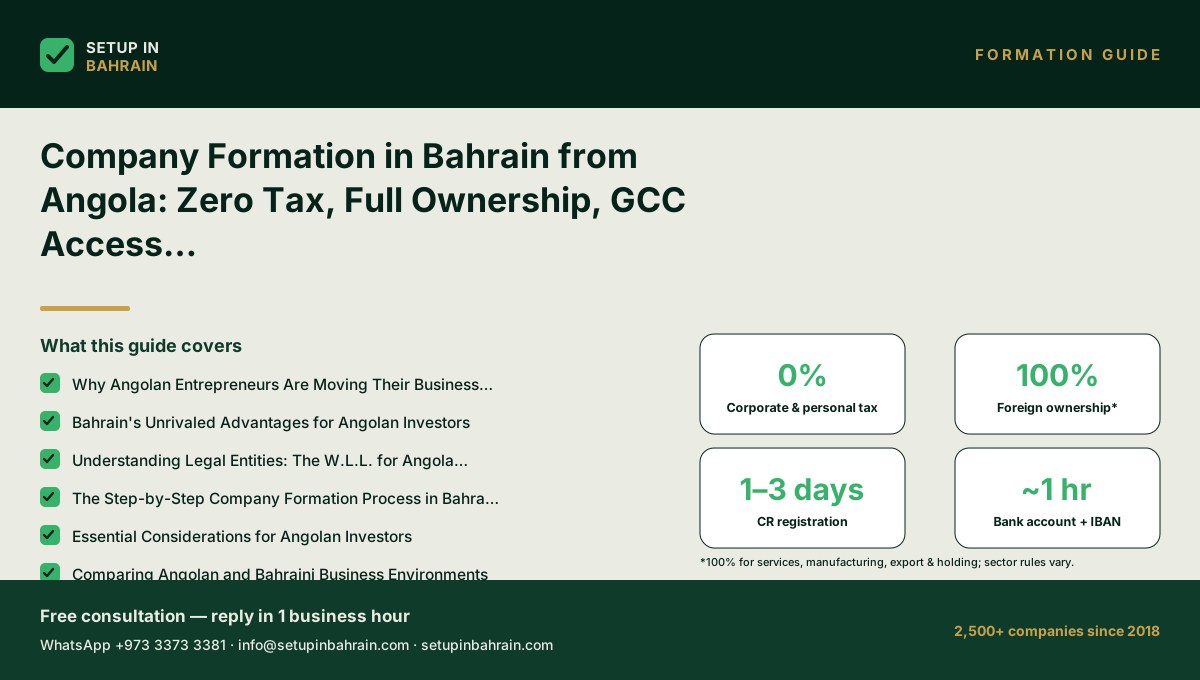
Complete guide for Angola entrepreneurs: form a company in Bahrain with generally no corporate income tax for most sectors, 100% foreign ownership. GCC market access. Costs, steps, visas, banking.
Key Takeaways
- Why Angolan Entrepreneurs Are Moving Their Business to Bahrain
- Bahrain's Unrivaled Advantages for Angolan Investors
- Understanding Legal Entities: The W.L.L. for Angolan Entrepreneurs
- The Step-by-Step Company Formation Process in Bahrain
- Essential Considerations for Angolan Investors
→ Complete guide: Company Formation in Bahrain — the full 2026 guide
View details
Ownership & capital
A Bahrain WLL can be owned by a single person — 100% foreign ownership applies to most activities, with no local partner required for services, manufacturing, export trading and holding companies. The minimum share capital is BHD 1 ; we recommend BHD 1,000 . This Makes bank account opening and investor visa approval smoother.
It’s 7:00pm in Luanda. After another long meeting, Jose, the owner of a thriving machine parts import business, opens his laptop to review his quarterly AGT tax filing. He soon realizes—yet again—the substantial sum the Angolan government expects from him: 25% industrial tax, mandatory social security payments, plus layer after layer of compliance costs. His bank has just warned him about delayed international transfers, a familiar and frustrating hurdle.
He wonders, not for the first time: “Is there anywhere in the region where business owners like me can actually keep our profits—and still access real global markets with ease?”
Jose’s frustration. His urgent need for a better solution, captures the reality for hundreds of leading Angolan entrepreneurs. Perhaps you’re Maria, who has spent years building a thriving manufacturing business. You’ve navigated the complexities of the Angolan market with grit and ingenuity, battling through labyrinthine bureaucracy and grappling with the relentless volatility of the Angolan Kwanza (AOA), which has depreciated by over 90% since the 2014 oil crash, eroding your hard-earned profits.
Every quarter, the thought of that 25% industrial tax rate looming over your balance sheet is a heavy burden, not to mention the mandatory AGT tax filings in Portuguese that add another layer of administrative complexity. You dream of expanding, of stability, of a place where your business can flourish without constant currency erosion or the heavy hand of taxation.
You've tried to secure US Dollars for international suppliers, only to hit the brick wall of the Banco Nacional de Angola's (BNA) foreign exchange restrictions, feeling the suffocating grip of limited USD access. Perhaps you’ve even faced the frustrating reality of mandatory local partners for certain sectors, knowing that your vision could be diluted and your control compromised.
Maria's story, like Jose's, is not unique. It's the daily reality for countless Angolan business owners across construction, oilfield services, agricultural exports, tech. Logistics. You are seeking a haven, a platform where your business spirit can finally be unleashed without these systemic headwinds. You’re looking for a jurisdiction that offers financial stability, a predictable regulatory environment. A gateway to larger markets.
This is precisely why Bahrain, a dynamic island nation in the heart of the Arabian Gulf, is rapidly becoming the destination of choice for astute Angolan entrepreneurs like you. It's a strategic pivot, not just a relocation. Bahrain offers an economic landscape that stands in stark contrast to the challenges you face at home: a generally no corporate income tax for most sectors, 100% foreign ownership, and unparalleled access to the world’s fastest-growing economies.
It's a country where the playing field is tilted in favor of global entrepreneurs, not local monopolies or burdensome state apparatuses.
Why Angolan Entrepreneurs Are Moving Their Business to Bahrain
Let's delve deeper into the specific pain points you, as an Angolan entrepreneur, are likely experiencing. How Bahrain offers a clear, strategic antidote.
The Weight of Angolan Taxation: The 25% Industrial Tax Burden
One of the most immediate and impactful frustrations for Angolan businesses is the heavy tax burden. Imagine a Luanda-based trading company owner who imports industrial equipment. In 2023, his business cleared AOA 180 million in profit. After the 25% industrial tax, plus mandatory social security contributions (which can add another 3-8% of payroll costs) and the administrative costs associated with AGT filing, he effectively kept roughly AOA 112 million.
That’s a significant portion of his hard work vanishing before he can even consider reinvestment or expansion.
This 25% industrial tax is not an isolated levy. It’s compounded by other mandatory contributions, municipal taxes. The sheer administrative overhead of maintaining compliance in a system often perceived as complex and opaque. For many, this constant erosion of profits makes it exceedingly difficult to build capital, innovate. Compete on a global scale. In Bahrain, the landscape is dramatically different. There is no corporate income tax for most businesses.
This isn't a temporary incentive; it's a foundational pillar of Bahrain's economic policy. Imagine keeping that entire AOA 180 million (or its equivalent in BHD) profit for your business, to reinvest, to grow, to innovate. This fundamental difference alone can transform your business's financial health and growth trajectory.
Navigating the Kwanza's Volatility and BNA's Grip
Beyond taxation, currency instability and foreign exchange restrictions present an even more insidious threat to Angolan businesses involved in international trade. The Angolan Kwanza (AOA) has suffered extreme volatility, depreciating by over 90% against the US Dollar since the 2014 oil crash. This isn't just a number; it translates directly into severely eroded purchasing power for imports, unpredictable costs for international suppliers. A constant struggle to preserve capital.
Consider our entrepreneur Jose again. After calculating his post-tax profit, the real problem began: converting that AOA 112 million into USD to pay his international suppliers. The Banco Nacional de Angola (BNA) imposes stringent foreign exchange restrictions, limiting access to hard currency. This often means waiting weeks, sometimes months, for foreign-exchange approval, navigating bureaucratic hurdles. Frequently resorting to parallel markets where the exchange rate is greatly less favorable.
In Jose's case, these BNA restrictions and the Kwanza’s continued slide meant he waited six weeks for foreign-exchange approval and lost another 18% to the parallel market differential. That's a double blow: time lost and another chunk of his profit evaporated.
Bahrain, by contrast, offers unparalleled financial stability. The Bahraini Dinar (BHD) is pegged to the US Dollar at a fixed rate of 1 BHD = 2.659 USD. This peg has been maintained for decades, providing a rock-solid foundation for business planning, international transactions. Capital preservation. The Central Bank of Bahrain (CBB) ensures a robust, transparent. Internationally integrated banking system where foreign exchange is readily available without arbitrary restrictions.
For an Angolan entrepreneur, this stability means predictable costs, seamless international payments. Peace of mind knowing your profits are secure from currency devaluation.
The Challenge of Local Partners and Administrative Labyrinths
Angolan business registration is often designed to serve the state more than the private investor. Many sectors, especially in construction, mining, oilfield services, and even logistics, require mandatory local partners. While some might argue this fosters local development, for the foreign or ambitious Angolan entrepreneur, it can mean a dilution of control, a forced sharing of profits, and potential disagreements over business strategy.
Your vision, your hard work. Your capital are never entirely your own when a mandatory partner is involved.
Also, the administrative environment in Angola, with its bilingual (Portuguese-only) filings to the AGT and often opaque bureaucratic processes, can be a major drain on time and resources. Obtaining permits, licenses, and navigating compliance can be a prolonged, frustrating, and unpredictable ordeal.
In stark contrast, the Bahrain Economic Development Board (EDB) and the Ministry of Industry and Commerce (MOIC) have built a one-stop shop for company formation. Their approach is streamlined, transparent, and designed to attract foreign investment. Critically for you, a Bahraini company can be 100% foreign-owned in most sectors, with zero requirement for a local partner for the vast majority of activities. This means complete control over your business, its strategy, and its profits.
The company formation process itself is remarkably efficient, often taking just a few weeks from start to finish, assuming all documents is in order.
Bahrain: A Strategic Counterpoint to Angolan Business Frictions
The picture is clear: Angola presents significant headwinds for ambitious entrepreneurs – high taxes, currency instability, foreign exchange restrictions. Mandatory local partnerships. Bahrain removes every one of those frictions. It offers:
- No Corporate Income Tax: Keep your profits.
- No Withholding Tax on Dividends: Distribute your earnings freely.
- Stable Currency: The BHD peg to the USD ensures predictability.
- Full Foreign Ownership: Your business, your control.
- Streamlined Registration: Efficient processes, minimal bureaucracy.
- Global Market Access: A gateway to the GCC, MENA, and beyond.
This isn't merely about escaping problems; it's about proactively positioning your business for exponential growth in a supportive and predictable environment.
Bahrain's Unrivaled Advantages for Angolan Investors
Beyond merely solving Angolan pain points, Bahrain offers a suite of proactive advantages that empower global entrepreneurs.
A Tax-Free Zone for Your Profits: Beyond Corporate Tax
We've touched upon the generally no corporate income tax for most sectors, but Bahrain's tax efficiency goes deeper. For most business activities, there is no corporate income tax, no personal income tax. No withholding tax on dividends, interest, or royalties. This means your business's profits remain largely intact, allowing for greater reinvestment, capital accumulation. Higher returns for shareholders.
While Bahrain did introduce a 5% Value Added Tax (VAT) in 2019, this is a consumption tax, common in most developed economies. Generally reclaimable for VAT-registered businesses on their inputs. Compared to Angola's 25% industrial tax and other levies, Bahrain's tax regime is fundamentally geared towards fostering business growth and attracting foreign direct investment. This creates an environment where your financial planning is simpler, more predictable, and ultimately, more profitable.
100% Foreign Ownership: Your Business, Your Control
For an Angolan entrepreneur used to the mandatory local partner requirements, the ability to maintain 100% foreign ownership in Bahrain is a game-changer. This means complete autonomy over strategic decisions, financial allocations, and operational control. You don't need to find a local shareholder to meet regulatory requirements, nor do you need to negotiate profit-sharing agreements that dilute your earnings.
This extends across a vast array of sectors, from manufacturing and trading to technology, services. Logistics, making Bahrain an exceptionally liberal investment environment. This policy, enshrined by the EDB and MOIC, reflects Bahrain’s commitment to attracting international capital and expertise.
Gateway to the GCC and Beyond: Market Access Amplified
Bahrain's strategic geographical location is one of its most compelling assets. Situated in the heart of the Arabian Gulf, it offers immediate and tariff-free access to the entire Gulf Cooperation Council (GCC) market, comprising Saudi Arabia, UAE, Qatar, Kuwait, and Oman. This market, with a combined GDP exceeding $1.6 trillion and a population of over 50 million affluent consumers, represents immense untapped potential for Angolan businesses looking to diversify their customer base.
Consider the King Fahd Causeway, a 25-kilometer bridge connecting Bahrain directly to Saudi Arabia, the largest economy in the GCC. This physical link facilitates seamless logistics and trade, making Bahrain an ideal logistics hub for distributing goods across the region. Also, Bahrain has a robust network of Free Trade Agreements (FTAs) with over 60 countries, including the United States, giving your business preferential access to major global markets.
For an Angolan company looking to expand its reach beyond the African continent, Bahrain provides an unparalleled platform for regional and international trade.
Economic Stability and Vision 2030
Bahrain boasts a mature and diversified economy, supported by strong macroeconomic fundamentals. The Kingdom's prudent fiscal policies, combined with a well-regulated financial sector overseen by the Central Bank of Bahrain (CBB), contribute to its reputation for stability. Unlike economies heavily reliant on a single commodity, Bahrain has made significant strides in economic diversification, moving beyond oil and gas to develop thriving sectors like financial services, manufacturing, logistics, information and communication technology (ICT), and tourism.
This diversification strategy is encapsulated in Bahrain's Economic Vision 2030 , a long-term economic development plan focused on sustainability, fairness. Competitiveness. The vision aims to transform Bahrain into a knowledge-based economy, attracting high-value investments and fostering innovation. This forward-looking approach ensures a stable and evolving business environment for your investment, providing confidence in long-term growth prospects. The World Bank consistently rates Bahrain highly for its ease of doing business, a testament to its commitment to fostering a competitive market.
A Business-Friendly Regulatory Environment
The regulatory framework in Bahrain is designed to be transparent, efficient, and supportive of business growth. The Ministry of Industry and Commerce (MOIC) acts as the primary regulator for commercial companies. The EDB plays a crucial role in attracting and facilitating foreign investment. Together, they have streamlined the company formation process, reduced bureaucratic hurdles, and fostered an environment of predictability.
Unlike some jurisdictions where regulations can change suddenly or be applied inconsistently, Bahrain prides itself on a legal system based on common law principles, providing clarity and consistency. Intellectual property rights are robustly protected. Commercial disputes can be resolved efficiently through specialized commercial courts or arbitration centers. This robust, yet flexible, regulatory environment minimizes risks and provides a solid foundation for your business operations.
Understanding Legal Entities: The W.L.L. for Angolan Entrepreneurs
When considering company formation in Bahrain, choosing the right legal entity is crucial. For most Angolan entrepreneurs, the With Limited Liability Company (WLL) is the most common, flexible, and recommended structure.
Why the WLL is Your Best Bet
The WLL structure offers several significant advantages that align perfectly with the needs of foreign investors:
Limited Liability: As the name suggests, your personal liability as an owner is limited to the amount of capital you have invested in the company. This protects your personal assets from business debts and obligations, a fundamental principle of modern business. 100% Foreign Ownership: This is a critical point we've emphasized. A WLL in Bahrain can be owned 100% by a single person with zero partners required.
This allows you to maintain full control and ownership, addressing a major pain point for Angolan entrepreneurs. Flexibility: WLLs are suitable for a wide range of business activities, from trading and services to manufacturing and holding companies. Ease of Formation: Compared to other structures, the WLL setup process is relatively straightforward and efficient. Credibility: A WLL is a recognized and credible legal form for doing business internationally.
Dispelling Myths: No WLL, Just Smart Ownership
It is absolutely critical to understand: There is NO WLL (Single Person Company) in Bahrain. Do not be misled by information from other jurisdictions or outdated sources. The correct and perfectly suitable entity for a single owner is the WLL. As mentioned, a WLL can be registered and owned by a single individual, providing all the benefits typically associated with a "single person company" concept, but under the WLL legal framework.
This distinction is important because trying to register a single-shareholder WLL will lead to delays and rejection. Focus solely on the WLL as your go-aid for sole ownership.
Capital Requirements: Legal Minimum vs. Practical Reality
This is another area where precise information is vital. Legally, the minimum share capital for a WLL in Bahrain is BHD 1 (one Bahraini Dinar). Yes, you read that correctly – one Dinar is the absolute legal minimum.
But, while BHD 1 is legally permissible, it is highly impractical for a functional business. Here’s why:
Bank Account Approval: Virtually no reputable bank in Bahrain will open a corporate bank account for a company with a mere BHD 1 capital. Banks require a more substantial initial deposit to show the company's financial seriousness and operational viability. They look for signs of a legitimate, active business. Investor Visa: If you, as the Angolan entrepreneur, intend to apply for an investor visa and residency in Bahrain, a BHD 1 capital company will not suffice.
The Bahraini authorities (EDB, LMRA) expect to see a meaningful investment that shows a commitment to establishing a substantive business.
So, as a practical recommendation, always aim for a minimum initial share capital of BHD 1,000 (one thousand Bahraini Dinars). This amount is generally sufficient to:
- Satisfy banks for corporate account opening: It shows a basic level of financial commitment.
- Support investor visa applications: It signals a more serious business intention to the authorities.
- Cover initial operational expenses: BHD 1,000 provides a small cushion for initial costs like registration fees, initial rent deposits, or minor purchases.
You can, of course, invest greatly more capital if your business model requires it. This will only strengthen your position with banks and immigration authorities. But BHD 1,000 is the practical, prudent starting point.
The Step-by-Step Company Formation Process in Bahrain
Setting up a company in Bahrain, especially a WLL, is remarkably streamlined compared to the Angolan process. Here’s a detailed breakdown of the phases involved:
Phase 1: Planning and Due Diligence
Before you even touch an application form, thorough planning is essential.
Define Your Business Activity: Clearly articulate what your company will do. Bahrain has a comprehensive list of commercial activities. Ensure your chosen activity is permitted for foreign ownership (most are) and that you have the necessary qualifications or licenses for regulated industries (e.g., financial services, healthcare). Choose Your Company Name: Select a unique name that complies with MOIC naming conventions. It must not be offensive, too generic, or infringe on existing trademarks.
You'll typically provide a few options in order of preference. Determine Your Share Capital: Based on our earlier discussion, plan for at least BHD 1,000 for practical reasons. Identify Shareholder(s) and Director(s): For a WLL, this can be a single individual (you). You'll need valid passport copies and potentially proof of address for all shareholders and directors. Registered Address: You will need a physical registered office address in Bahrain.
This could be a serviced office, a leased office space, or even a virtual office solution if your activities permit it. Appoint a Local Consultant/Agent: While not mandatory in the sense of a shareholder, engaging a local business setup consultant or legal firm (like a registered Company Secretary or Law Firm) is highly recommended. They will guide you through the process, prepare documents, liaise with government bodies, and ensure compliance.
This saves you immense time and avoids common pitfalls, especially given the language differences.
Phase 2: Registration with MOIC and EDB
This is where the formal application begins, typically facilitated by your chosen consultant.
Initial Approval Request (MOIC): * Application Submission: Your consultant will submit an application to the Ministry of Industry and Commerce (MOIC). This includes your proposed company name, business activities, shareholder details, and initial capital. * Name Reservation: Once approved, your company name will be reserved. * Activity Approval: MOIC verifies that your business activities align with regulations and grants initial approval.
For certain regulated activities (e.g., specific financial services, industrial manufacturing), additional approvals from relevant ministries or regulatory bodies (like the CBB for financial institutions or the Ministry of Health for medical clinics) might be required at this stage or shortly after. Your consultant will advise on this.
Drafting Memorandum and Articles of Association (MOA/AOA): * This is the foundational legal document for your WLL, outlining its purpose, structure, share capital, management, and rules of operation. Your consultant will draft this in Arabic and English, ensuring it complies with Bahraini Commercial Companies Law. * Notarization: The MOA/AOA, along with other required documents (e.g., passport copies, proof of address), will need to be notarized by a public notary in Bahrain.
If you are not physically present, your consultant can often manage this with a power of attorney.
Commercial Registration (CR) Issuance: * Once the MOA/AOA is notarized and all prior approvals (if any) are obtained, the full application is submitted to the MOIC. * The MOIC will then issue your company's Commercial Registration (CR) certificate. This is your company's official license to operate in Bahrain and is a crucial document, similar to a business license or certificate of incorporation in other countries.
The CR specifies your company name, CR number, legal type (WLL), registered address, and approved business activities.
Phase 3: Licensing and Operational Setup
With your CR in hand, you can now move towards full operational readiness.
Open a Corporate Bank Account: * This step is critical. You will need your CR, MOA/AOA, shareholder/director passport copies, and often proof of address. The bank will conduct its own due diligence (KYC – Know Your Customer) checks. * Crucial Insight for Angolans: Be prepared for enhanced due diligence from Bahraini banks due to Angola being perceived as a higher-risk jurisdiction for Anti-Money Laundering (AML) purposes.
Banks will require detailed information on the source of funds, the nature of your Angolan business. Your reasons for coming to Bahrain. Having all your documents in order, a clear business plan. A transparent explanation of your funds is paramount. The BHD 1,000 capital, as recommended, shows a concrete financial commitment that helps. * Once the account is opened, you will deposit the share capital into this account.
Some banks may require proof of this deposit before fully activating the account or for MOIC to finalize the CR.
Get Necessary Permits and Licenses: * Depending on your specific business activities, you may need additional operational licenses from sector-specific ministries or authorities. For example, if you are setting up a restaurant, you'll need health permits; if you're in financial consulting, you'll need CBB approval. Your consultant will help identify and secure these. * LMRA Registration: You'll need to register with the Labour Market Regulatory Authority (LMRA) if you plan to hire employees (including yourself as a working director/investor).
The LMRA manages work permits and ensures compliance with labor laws.
Investor Visa and Residency: * As an Angolan entrepreneur, you will likely want an investor visa to live and work in Bahrain. * The EDB and LMRA help this process. Once your company is registered and your capital is deposited, you can apply for an investor visa. This typically requires your passport, company documents (CR, MOA), and a medical check.
- The investor visa usually grants residency for one to three years, renewable thereafter, allowing you to sponsor family members as well. This is a clear path to establishing a life in Bahrain, unlike the often-complex visa processes in other regions.
Essential Considerations for Angolan Investors
Moving your business internationally involves more than just registering a company. Here are other vital aspects to consider for a seamless transition.
Banking in Bahrain: Navigating Account Opening
As highlighted earlier, banking is a critical step. While the Bahraini banking sector is world-class, reputable. Stable, Angolan entrepreneurs should prepare for stringent due diligence.
Due Diligence: Expect banks to ask detailed questions about the origin of your funds in Angola, your business history. Your specific business model in Bahrain. Be prepared to provide bank statements, company registration documents from Angola. A comprehensive business plan for your Bahraini entity. Relationship Management: It helps to establish a relationship with a bank even before your company is fully registered. Your chosen business setup consultant often has contacts within banks that can help streamline the process.
Required Documents: Typically, you'll need: * Company Commercial Registration (CR) * Memorandum and Articles of Association (MOA/AOA) * Passport copies for all shareholders, directors, and authorized signatories * Proof of residential address for all individuals * Company profile/business plan * Source of funds documents Timeframe: While some steps are fast, the bank account opening can sometimes take several weeks, especially with enhanced due diligence for certain nationalities. Factor this into your overall timeline.
The CBB ensures regulatory oversight, but individual banks have their own risk assessment policies.
Investor Visas and Residency: Your Path to Living and Working
For an Angolan entrepreneur, securing an investor visa means much more than just a permit to enter; it's your gateway to establishing a new home and a stable business base.
Eligibility: Generally, investors who establish a company in Bahrain and show sufficient capital investment (well above the BHD 1 legal minimum) are eligible. Process: After company registration and typically once your corporate bank account is operational, your company (or your PRO/consultant) will apply for your investor visa through the LMRA.
This involves: * Application form submission * Passport copy and passport-sized photos * Company documents (CR, MOA/AOA) * Medical examination in Bahrain * Fingerprinting (for residency ID card) Benefits: An investor visa typically grants a multi-year residency permit, allowing you to reside in Bahrain, open personal bank accounts, get a driving license, and sponsor your immediate family (spouse and children) to join you. This provides immense stability and a conducive environment for both your business and your family.
Permanent Residency: While direct permanent residency is not automatic, continuous investment and residency can lead to long-term visa options and, eventually, a path to permanent residency under specific conditions.
Office Space and Infrastructure: From Virtual to Physical
Bahrain offers a spectrum of office solutions to suit different business needs and budgets.
Virtual Office: For new businesses or those with minimal physical requirements, a virtual office provides a prestigious address, mail handling. Sometimes access to meeting rooms, without the overhead of a full-time physical office. This is an excellent starting point. Serviced Offices: These offer fully furnished offices, often with IT infrastructure, reception services. Meeting facilities, on flexible lease terms. They are ideal for growing businesses that need a professional presence without long-term commitments.
Traditional Leased Offices: For larger operations or those requiring specialized setups (e.g., manufacturing, laboratories), traditional office or industrial spaces are available for long-term lease. Business Incubators and Coworking Spaces: Bahrain has a vibrant startup ecosystem, supported by initiatives from entities like Tamkeen (Bahrain's labour fund) and various incubators. These offer collaborative environments, mentorship, and reduced costs for nascent businesses. Connectivity: Bahrain boasts world-class telecommunications infrastructure, high-speed internet. Reliable utilities, ensuring your business can operate efficiently.
Professional Support: Choosing the Right Local Partner (Consultant, not Shareholder)
While you don't need a local shareholder, having a reliable local support network is invaluable.
Business Setup Consultants: These firms specialize in guiding foreign investors through the entire company formation process. They handle documents, liaise with government ministries, and ensure compliance. Their expertise can save you considerable time, effort, and potential missteps. Legal Firms: For complex legal structures, contracts, or specific regulatory advice, engaging a local law firm is advisable.
Auditors and Accountants: Once your company is operational, you'll need local accounting and auditing services to ensure compliance with Bahraini financial regulations, VAT filings, and annual reporting requirements. PRO Services: Public Relations Officers (PROs) assist with government liaison, visa processing, labor permits. Other administrative tasks, allowing you to focus on your core business. Choosing the right professional support team is an investment that pays dividends in efficiency, compliance. Peace of mind.
Comparing Angolan and Bahraini Business Environments
To truly appreciate Bahrain's value proposition, let's look at a direct comparison of key business factors.
| Feature | Angola | Bahrain |
| :---------------------------- | :---------------------------------------------------------------------------- | :------------------------------------------------------------------------------------------ |
| Corporate Income Tax | 25% Industrial Tax (on profits) | 0% (for most businesses) |
| Currency Stability | High volatility (AOA >90% depreciation since 2014) | Highly stable (BHD pegged to USD for decades) |
| Foreign Exchange Access | BNA restrictions, limited USD access, parallel market issues | Free and open access to foreign currency, robust CBB-regulated banks |
| Foreign Ownership | Often requires mandatory local partners (many sectors) | 100% foreign ownership allowed (most sectors), WLL can be 100% single-person owned |
| Investor Visas | Complex, often tied to specific projects or high investment amounts | Streamlined investor visa process, tied to legitimate company setup, multi-year residency |
| Bureaucracy | Labyrinthine, often opaque, Portuguese-only filings | Streamlined (EDB, MOIC), transparent, efficient, English widely used |
Bahrain Business Guides for Angola Citizens
Frequently Asked Questions
How long does it take to set up?
It takes 15 to 20 days. We file all forms for you. You do not need to wait long.
What does it cost?
Company formation: Standard BHD 1,340 with 3 months of office address; Gold BHD 1,700 with 6 months; Premium BHD 2,150 with 12 months and a cabin, officer table and chair, and two guest chairs. No formation package includes visas, including Premium. Investor/work visas are priced separately: BHD 755 for one year or BHD 953 for two years, in addition to the formation package. Ask for a written, itemized quotation confirming government fees and all inclusions before payment.
Do I need to visit Bahrain?
No. You can set up your firm from home. We do all the work online. Some banks may ask for one visit.
What tax will I pay?
You pay zero tax on your profits. Bahrain has no corporate income tax. This is a key benefit of the setup.
Can I own 100% of my firm?
Yes. Foreign owners can hold all shares. No local partner is needed. Full ownership is allowed.
What do I need to start?
You need a valid passport. You also need a trade name and a business address. We help you with all of these.
How do I open a bank account?
We guide you step by step. Most banks take 3 to 6 weeks. You will need your CR and firm papers.
Who issues the Commercial Registration (CR)?
The CR is issued by the MOICT. It is your legal right to trade in Bahrain. We file the CR for you.
Can I renew my CR each year?
Company renewal packages: BHD 530 with 3 months of office address; BHD 980 with 6 months; BHD 1,520 with 12 months. These are separate renewal packages, not visa fees.
How do I get started?
Fill in our form on this page. Our team will call you back. We map your best setup plan at no cost.
Steps to Form Your Company
- Pick your trade name. We check if it is free.
- Choose your business type. WLL is the most common.
- Sign the MOA. We draft and file all legal docs.
- Pay the state fees. About BHD 432 in total.
- Get your CR. Takes 15 to 20 days.
- Open your bank account. We guide each step.
- Start trading. You are ready to do business.
Key Facts
- Tax rate: 0%
- Foreign ownership: 100%
- Setup time: 15 to 20 days
- Company formation: Standard BHD 1,340 with 3 months of office address; Gold BHD 1,700 with 6 months; Premium BHD 2,150 with 12 months and a cabin, officer table and chair, and two guest chairs. No formation package includes visas, including Premium. Investor/work visas are priced separately: BHD 755 for one year or BHD 953 for two years, in addition to the formation package. Ask for a written, itemized quotation confirming government fees and all inclusions before payment.
- Company renewal packages: BHD 530 with 3 months of office address; BHD 980 with 6 months; BHD 1,520 with 12 months. These are separate renewal packages, not visa fees.
- Client rating: 4.8 stars
- Clients served: 2,500 and more
Quick Facts
- Tax rate: 0%
- Own all of your firm: Yes, 100%
- Time to set up: 15 to 20 days
- Company formation: Standard BHD 1,340 with 3 months of office address; Gold BHD 1,700 with 6 months; Premium BHD 2,150 with 12 months and a cabin, officer table and chair, and two guest chairs. No formation package includes visas, including Premium. Investor/work visas are priced separately: BHD 755 for one year or BHD 953 for two years, in addition to the formation package. Ask for a written, itemized quotation confirming government fees and all inclusions before payment.
- Company renewal packages: BHD 530 with 3 months of office address; BHD 980 with 6 months; BHD 1,520 with 12 months. These are separate renewal packages, not visa fees.
- Rating: 4.8 stars
- Clients: 2,500 and more
Why Bahrain?
Bahrain has no tax. You keep all your profits. This is rare in the Gulf.
You can own all of your firm. No local partner is needed. The law allows full foreign ownership.
Setup takes 15 to 20 days. We file all forms for you. You can do it all from home.
Bahrain has a free trade deal with the US. Your goods face low or no tariffs. This gives you access to big markets.
We have served 2,800+ clients from 44+ countries and maintain records to substantiate that total where needed. We have 113 Google reviews; reviews represent only some clients and are not the same as the total clients served.
Our Steps
- Tell us your plan. We advise you for free.
- We pick the right firm type for you.
- We file all your forms with MOICT.
- You get your CR in 15 to 20 days.
- We help you open a bank account.
- You are ready to trade. We stay with you.
Next Steps for Angola Citizens
You can set up a firm in Bahrain from Angola. You do not need to fly there first. We do all the work online.
Tell us your plan. We call you back the same day. We map the best route for you at no cost.
We file all your forms. We deal with MOICT and the state. You get your CR in 15 to 20 days.
After your CR, we help you get a bank account. We also help with your Investor Visa. One firm guides you at each step.
Why Our Clients from Angola Choose Us
- We speak your language. We know your needs.
- We have helped clients from Angola before.
- Our fee is clear. No surprise costs.
- We have a 4.8 star rating on Google.
- We have helped more than 2,500 clients set up in Bahrain.
Fill in the form on this page. We will be in touch soon. Let us help you start your Bahrain firm today.
Ready to set up in Bahrain from Angola?
Tell us your business idea. We map the right entity, ownership and timeline — then handle the filing while you focus on what matters.