Register your Bahrain company from Albania with generally no corporate income tax for most sectors. Easy setup process, full support for Albanian entrepreneurs. Start your tax-free business today.
Key Takeaways
- Why Albania Entrepreneurs Are Moving Their Business to Bahrain
- What Makes Bahrain Unique for Albania Business Owners
- Legal Structures for Albania Entrepreneurs: Which Entity Suits Your Business?
- Step-by-Step Bahrain Company Formation Process for Albania Founders
- Costs and Budgeting: What to Expect as an Albania-Based Founder
→ Complete guide: Company Formation in Bahrain — the full 2026 guide
View details
Ownership & capital
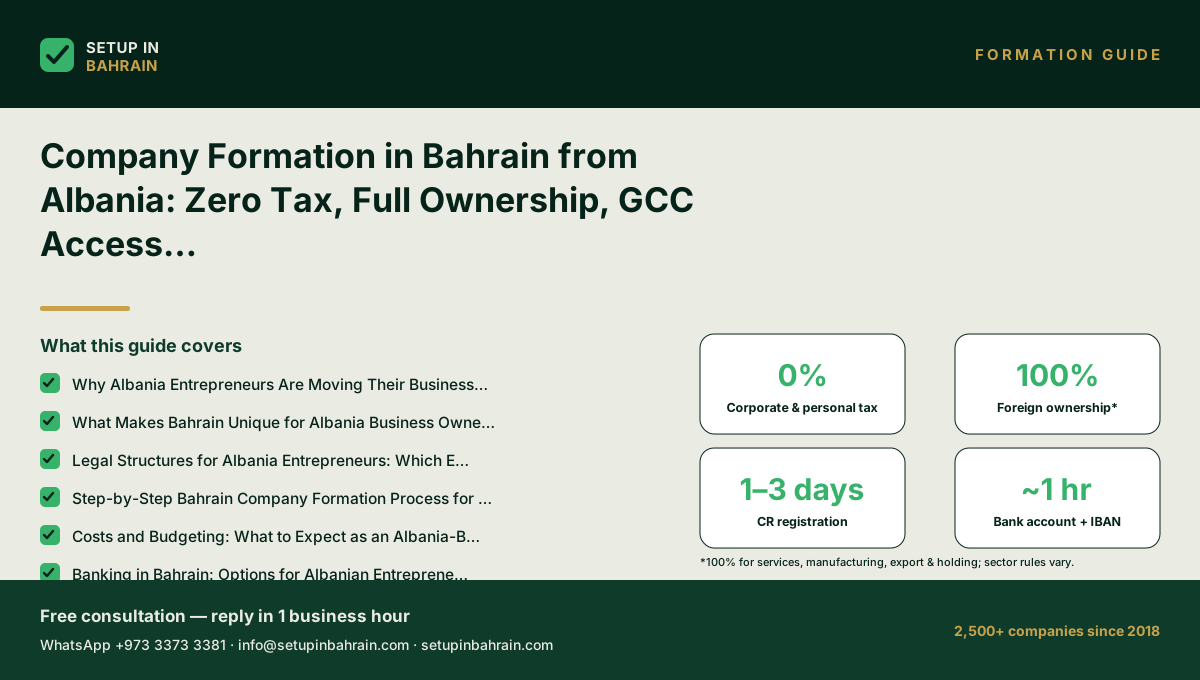
A Bahrain WLL can be owned by a single person — 100% foreign ownership applies to most activities, with no local partner required for services, manufacturing, export trading and holding companies. The minimum share capital is BHD 1 ; we recommend BHD 1,000 . This Makes bank account opening and investor visa approval smoother.
Klevis had spent seven years building his IT outsourcing company in Tirana. What started as three developers working from a small office near Skanderbeg Square had grown into a team of 19 specialists generating €580,000 in annual revenue. His clients included fintech startups in Berlin, e-commerce platforms in London, and a logistics company in Vienna. On paper, his business looked like an Albanian success story.
Then came the quarterly meeting with his accountant that changed everything.
The 15% corporate tax wasn't the problem—Klevis had budgeted for that. The real damage came from layers he hadn't fully calculated. Social insurance contributions consumed 28.1% of gross salaries. VAT compliance, with its endless TATIME portal crashes and manual reconciliation requirements, cost him two full working days every month. His bookkeeper spent 14 hours quarterly navigating the e-filing system that froze mid-submission at least once per reporting period.
But the currency situation delivered the knockout punch. Between January and September 2024, the Albanian lek depreciated 13.2% against the euro. Three major client payments that showed €47,000 in combined profit at invoicing delivered €38,900 in actual purchasing power by the time funds cleared and converted. A full €8,100 evaporated—not from operational mistakes, not from market conditions. From currency volatility entirely outside his control.
When Klevis tried to open a multicurrency account with a German digital bank to hedge this exposure, the compliance team requested additional documents. Then more documents. Then a six-week review period that stretched to four months, all because Albania's historical position on EU AML monitoring lists triggered enhanced due diligence protocols. The account was eventually approved. By then he'd lost two client opportunities that required stable EUR payment processing.
The breaking point arrived in November 2024. Klevis submitted a routine company amendment to Qendra Kombëtare e Biznesit—adding a single shareholder—expecting the standard 3-5 day processing. The amendment sat in limbo for 23 business days. No explanation. No status updates. Just silence while a €120,000 contract waited on verification of his updated company structure.
A fellow Albanian entrepreneur who had relocated his digital marketing agency to Manama the previous year told Klevis about Bahrain over coffee in Blloku. The numbers seemed impossible: Generally no corporate income tax for most sectors on most activities, zero personal income tax, zero withholding on dividends. A currency pegged to the US dollar since 1980 with effectively zero volatility. Company registration completed in 48-72 hours. Bank accounts opened in under two weeks. Full foreign ownership without local partner requirements.
Klevis flew to Bahrain in January 2025 for a preliminary visit. Three months later, his Bahraini WLL was operational, his CBB-regulated bank account was processing client payments, and his effective tax burden had dropped from 34% of net income to under 6%—consisting only of the modest fees and contributions Bahrain requires for worker permits and commercial registration renewals.
This guide exists because Klevis's story resonates with hundreds of Albanian entrepreneurs facing identical frustrations. If you run a growing business in Tirana, Durrës, Vlorë, or anywhere in Albania, and you've calculated the true cost of operating in a high-tax, volatile-currency, bureaucratically complex environment, the following 5,000+ words will show you exactly how Bahrain offers a strategic alternative—and precisely how to execute the transition.
Why Albania Entrepreneurs Are Moving Their Business to Bahrain
The decision to relocate a company internationally never stems from a single factor. Albanian entrepreneurs considering Bahrain typically reach their breaking point through a combination of compounding frustrations that make domestic growth more and more difficult.
The Real Tax Burden Beyond the 15% Rate
Albania's corporate income tax rate of 15% appears competitive on paper. The OECD average hovers around 23%, and neighboring countries like Greece charge 22%. But the headline rate tells only part of the story.
Albanian employers pay social insurance contributions of 16.7% on gross employee salaries, with employees contributing an additional 11.2%. For a software company paying competitive wages to retain skilled developers—essential for competing with remote offers from EU companies—these contributions add €8,000-12,000 annually per employee beyond their net salary.
VAT at 20% applies to most services, requiring monthly declarations through the TATIME e-filing system. The system itself has improved since its 2019 overhaul, but Albanian business owners consistently report technical failures during peak filing periods, manual corrections that require physical visits to tax offices, and reconciliation discrepancies that trigger audits lasting months.
The informal economy compounds these challenges. The International Monetary Fund estimates Albania's shadow economy at 28-32% of GDP, meaning compliant businesses compete against operators who undercut prices by avoiding tax obligations entirely. You pay full rates while competitors operate at a 15-20% cost advantage through non-compliance.
When you calculate the true burden—corporate tax, social contributions, VAT compliance costs. Competitive disadvantage against informal operators—a profitable Albanian company might retain only 45-55% of its gross revenue as actual deployable capital.
Currency Volatility: The Silent Profit Destroyer
The Albanian lek has exhibited volatility that makes international business planning nearly impossible. Between 2020 and 2025, ALL experienced the following movements against the euro:
| Year | Annual Depreciation vs EUR | Impact on €100,000 Contract |
| 2020 | -7.3% | -€7,300 |
| 2021 | -4.1% | -€4,100 |
| 2022 | -9.8% | -€9,800 |
| 2023 | -11.2% | -€11,200 |
| 2024 | -13.2% | -€13,200 |
The Bahraini dinar, by contrast, has maintained a fixed peg to the US dollar at 0.376 BHD per USD since 1980. This 45-year track record of monetary stability means that a contract signed today will deliver the same purchasing power when payment arrives next quarter, next year, or five years from now.
QKB Registration Delays and Bureaucratic Friction
Qendra Kombëtare e Biznesit (QKB) has digitized many company registration functions. Albanian entrepreneurs consistently report experiences that suggest significant operational gaps remain.
Standard company formation theoretically requires 1-2 days for simple structures. In practice, Albanian business owners report:
- Initial registration taking 5-8 business days during peak periods
- Shareholder changes requiring 10-25 business days
- Address modifications triggering full document re-verification
- Technical system failures losing submitted applications entirely
- Inconsistent requirements between different QKB offices
Each delay carries direct costs: contracts waiting for company verification, bank accounts frozen pending updated registration, clients questioning whether your company structure is problematic.
Bahrain's Sijilat system, operated by the Ministry of Industry and Commerce (MOIC), processes standard WLL formations in 48-72 hours. Commercial registration numbers issue within one business day of submission approval. The contrast in operational efficiency represents not just convenience but competitive advantage—you can respond to opportunities while competitors navigate bureaucratic timelines.
Banking Restrictions and International Reputation
Albania's historical challenges with financial sector oversight created lasting consequences for entrepreneurs seeking international banking relationships. Although Albania exited the FATF grey list in 2023 after implementing enhanced AML frameworks, the reputational residue persists.
European correspondent banks continue applying enhanced due diligence to Albanian-origin transactions. Account opening with international fintechs routinely triggers extended verification periods. Payment processing for Albanian companies faces higher scrutiny and longer settlement times than transactions from jurisdictions without historical compliance issues.
Bahrain presents the opposite profile. The Central Bank of Bahrain (CBB) maintains one of the region's most sophisticated regulatory frameworks, recognized by the Financial Stability Board and praised by IMF assessments. Bahraini companies access the global banking system without the automatic suspicion Albanian companies encounter.
Limited GCC Market Access
Albania's trade agreements focus primarily on European integration, with the Stabilization and Association Agreement forming the cornerstone of commercial relationships. While valuable for EU market access, these agreements provide minimal advantages for the fastest-growing commercial region in the world.
The GCC represents over $2.1 trillion in combined GDP, with Saudi Arabia alone planning $7 trillion in infrastructure investment through Vision 2030. The UAE, Qatar, Kuwait. Oman pursue similarly ambitious development programs requiring exactly the services Albanian entrepreneurs provide: software development, digital marketing, business consulting, specialized manufacturing.
An Albanian company pursuing these markets operates as a complete outsider, navigating visa restrictions, banking complications. The absence of any preferential trade framework. A Bahraini company, connected to GCC markets through the Gulf Cooperation Council's unified economic framework and a physical causeway to Saudi Arabia, operates as a regional insider with preferential access to the largest infrastructure investment wave in modern history.
What Makes Bahrain Unique for Albania Business Owners
Bahrain's appeal extends far beyond tax advantages. The Kingdom has deliberately positioned itself as the Gulf's most accessible business hub, implementing policies specifically designed to attract international entrepreneurs.
Genuine Generally no corporate income tax for most sectors: Not a Gimmick, Not a Special Zone
Unlike jurisdictions offering tax benefits limited to special economic zones or specific activities, Bahrain applies zero corporate income tax to all commercial activities except oil and gas extraction and banking operations above certain thresholds.
This means:
- Your software development company pays 0% on all profits
- Your e-commerce operation pays 0% on all profits
- Your consulting firm pays 0% on all profits
- Your trading company pays 0% on all profits
- Your digital marketing agency pays 0% on all profits
The Kingdom does not impose personal income tax, capital gains tax, wealth tax, or inheritance tax. Dividend distributions from your Bahraini company to yourself as shareholder attract zero withholding. The tax code is simple because there's barely any tax code to navigate.
Bahrain's only significant taxation is a 10% Value Added Tax implemented in 2019, aligned with the GCC VAT framework. Services exported outside Bahrain—which describes most Albanian entrepreneurs serving international clients—may qualify for zero-rating, further reducing the effective tax burden.
100% Foreign Ownership Without Sponsor Requirements
Until recently, Gulf business formation typically required a local sponsor or partner holding majority ownership. Bahrain eliminated these requirements fully.
Through the Economic Development Board (EDB) Investor Center, foreign entrepreneurs establish companies with complete ownership control. No Bahraini partner required. No profit-sharing mandates. No complex nominee structures. You own your company entirely, the same as you would in Albania but without the associated tax and currency burdens.
This matters enormously for Albanian entrepreneurs accustomed to full control over business decisions. You make strategic choices based on business logic, not political relationships with local sponsors whose interests may diverge from yours.
BHD-USD Peg: 45 Years of Monetary Stability
The Bahraini dinar's peg to the US dollar at 0.376 BHD/USD has held without adjustment since 1980. This isn't theoretical stability—it's demonstrated performance through multiple global financial crises, oil price collapses, regional conflicts. Pandemic disruptions.
For Albanian entrepreneurs accustomed to planning around currency volatility, this stability transforms business operations. You quote clients in USD or BHD knowing your costs in the same currency will remain proportional. You sign multi-year contracts without building currency hedging into pricing. You hold cash reserves without watching them depreciate against international purchasing power.
The Central Bank of Bahrain maintains substantial foreign reserves specifically to defend this peg. The Kingdom's sovereign wealth fund provides additional backing. The monetary stability is not accidental but actively maintained policy with demonstrated commitment.
Strategic Geographic Position
Bahrain occupies a unique geographic position that Albanian entrepreneurs consistently underestimate until experiencing it firsthand.
The King Fahd Causeway connects Bahrain to Saudi Arabia—the GCC's largest economy—in 25 minutes by car. A Bahraini company can maintain daily physical presence in Saudi markets without the complexity of Saudi company formation or the restrictions of Saudi business visas.
Bahrain International Airport offers direct flights to all GCC capitals, with Dubai 45 minutes away and Riyadh under an hour. London connects in 7 hours, Frankfurt in 6 hours, and Mumbai in 3.5 hours. From Bahrain, you access European clients, Gulf customers, and South Asian talent within a single day's travel.
For Albanian entrepreneurs whose clients span multiple continents, Bahrain's position in the GMT+3 timezone enables business hours overlapping with both European mornings and Asian afternoons—a scheduling advantage impossible to replicate from Tirana.
Legal Structures for Albania Entrepreneurs: Which Entity Suits Your Business?
Bahrain offers multiple corporate structures, each optimized for different business models and ownership requirements. Albanian entrepreneurs typically choose between three primary options.
WLL (With Limited Liability): The Standard Choice
The WLL functions similarly to Albania's SHPK structure, providing limited liability protection while allowing flexible ownership and management arrangements.
Key characteristics:
- Minimum capital: 50 BHD (about €125) for most activities
- Shareholders: 2-50 allowed; single-shareholder WLLs available for specific activities
- Foreign ownership: 100% permitted for most commercial activities
- Management: Board of managers or single manager acceptable
- Registration: 2-4 business days through MOIC
Best suited for:
- Service companies (IT, consulting, marketing, design)
- Trading operations importing/exporting goods
- Regional headquarters serving GCC markets
- Companies planning eventual local hiring
The WLL provides the credibility of a fully registered Bahraini commercial entity while maintaining operational flexibility. Most Albanian entrepreneurs establishing their first Bahrain presence choose this structure.
single-shareholder WLL: Solo Founder Simplicity
Bahrain's WLL structure allows individual entrepreneurs to establish companies without requiring additional shareholders or nominal partners.
Key characteristics:
- Minimum capital: 50 BHD for most activities
- Shareholders: Exactly one individual or corporate entity
- Foreign ownership: 100% permitted
- Management: Owner serves as sole director
- Registration: 2-3 business days
Best suited for:
- Individual consultants establishing regional presence
- Freelance professionals seeking corporate structure
- Entrepreneurs testing Bahrain before larger commitment
- Holdings for intellectual property or investments
The WLL eliminates the need for nominee shareholders or artificial partner arrangements sometimes required in other Gulf jurisdictions. If you operate as a solo founder, the WLL provides corporate legitimacy without unnecessary complexity.
Holding Company: For Multi-Entity Structures
Albanian entrepreneurs with multiple business lines or existing companies in other jurisdictions may benefit from Bahrain holding company structures.
Key characteristics:
- Minimum capital: Varies by activity
- Purpose: Holding shares in subsidiary companies
- Tax treatment: Zero tax on dividend income from subsidiaries
- Management: Board of directors required
- Registration: 5-7 business days due to additional review
Best suited for:
- Entrepreneurs consolidating multiple business entities
- Investment holding for regional acquisitions
- Family office structures managing generational wealth
- Multi-national structures optimizing corporate organization
Holding companies work especially well for Albanian entrepreneurs maintaining EU presence while establishing GCC operations. The Bahrain holding can own subsidiaries in multiple jurisdictions while benefiting from Bahrain's zero-tax environment on consolidated profits.
Comparison: Albanian SHPK vs. Bahrain WLL
| Factor | Albania SHPK | Bahrain WLL |
| Corporate tax | 15% | 0% |
| Dividend withholding | 8% | 0% |
| Minimum capital | 100 ALL (< €1) | 50 BHD (€125) |
| Registration time | 5-8 days typical | 2-4 days typical |
| Foreign ownership limit | 100% | 100% |
| Currency stability | 10-15% annual volatility | Fixed USD peg since 1980 |
| Social contributions | 28.1% gross salary | 0% for foreign workers |
| VAT rate | 20% | 10% (zero-rated exports) |
| Regional market access | EU focus | GCC preferential access |
Step-by-Step Bahrain Company Formation Process for Albania Founders
The practical formation process follows a structured sequence that Albanian entrepreneurs can navigate with proper preparation. Each stage has specific requirements and timelines.
Stage 1: Pre-Formation Planning (1-2 Weeks Before Application)
Before engaging Bahrain's registration system, complete several preparatory steps:
Activity determination: Bahrain's Commercial Registration system classifies business activities using specific codes. Choose activities precisely matching your intended operations. A software development company needs different activity codes than a software trading company, even if both involve software.
Company name reservation: Verify availability through MOIC's online portal and reserve your preferred name. Names must include entity type (WLL, WLL, etc.) and cannot duplicate existing registrations.
Document apostilling: Albania has ratified the Hague Apostille Convention, simplifying document authentication. Prepare apostilled versions of:
- Passport copies for all shareholders and directors
- Albanian company registration certificate (if applicable)
- Bank reference letters
- Proof of address documents
Capital source documents: While Bahrain doesn't require capital to be deposited before formation, banks will eventually require evidence that your capital comes from legitimate sources. Prepare documents showing business income, investment returns, or other compliant origins.
Stage 2: Ministry of Industry and Commerce Registration (3-5 Business Days)
The formation application proceeds through MOIC's Sijilat system:
Submit formation application including:
- Memorandum and Articles of Association
- Shareholder and director identification
- Registered office address
- Declared business activities
- Capital structure
MOIC review verifies documents completeness and activity eligibility. Straightforward applications typically clear within 48-72 hours. Applications involving regulated activities (financial services, healthcare, education) require additional agency approvals extending the timeline.
Commercial Registration issuance provides your CR number—the foundational identifier for all subsequent steps. The CR document enables bank account applications, visa processing, and commercial contracting.
Municipal license application follows CR issuance, typically processed within 24-48 hours for office-based businesses without physical customer premises.
Stage 3: LMRA Registration and Visa Processing (1-2 Weeks)
The Labour Market Regulatory Authority (LMRA) manages all work permit and visa processes:
Employer registration establishes your company in LMRA's system as an authorized employer.
Flexi Permit or standard work visa options exist depending on your intended physical presence:
- Full work permits for entrepreneurs relocating to Bahrain
- Investor visas for shareholders maintaining residence
- Multiple-entry business visas for entrepreneurs visiting regularly
Quota allocation determines how many foreign workers your company may sponsor. Initial allocations typically start at 3-5 permits, expandable based on demonstrated business activity.
Stage 4: Bank Account Opening (1-3 Weeks)
Central Bank of Bahrain regulates all banking activity, maintaining standards that help rather than impede international business:
Bank selection involves choosing between:
- International banks (HSBC, Standard Chartered, Citibank) offering global network connectivity
- Regional banks (NBB, BBK, Ahli United) providing strong GCC correspondent relationships
- Digital-first options (various fintech-licensed institutions) for technology-focused businesses
Account application requires:
- Commercial Registration certificate
- Memorandum and Articles of Association
- Shareholder and director passport copies with Bahrain visa stamps
- Proof of business address
- Initial deposit (typically 1,000-5,000 BHD depending on bank)
- Business plan or activity description
Due diligence completion includes standard KYC verification, source of funds confirmation, and beneficial ownership documents. Albanian entrepreneurs note that this process. Thorough, proceeds faster and with fewer complications than equivalent processes with European banks flagging Albanian origin.
Stage 5: Operational Activation (Ongoing)
With registration and banking complete, focus shifts to operational setup:
Office setup ranges from virtual office addresses (sufficient for many service businesses) to full commercial premises for companies requiring physical presence or warehouse space.
Accounting system setup aligned with Bahrain's financial reporting requirements and your own management needs.
Telecommunications and technology infrastructure leveraging Bahrain's advanced connectivity, including 5G networks covering the entire island.
Costs and Budgeting: What to Expect as an Albania-Based Founder
Transparent cost planning prevents surprises and enables accurate comparative analysis against continuing Albanian operations.
Formation Costs (One-Time)
| Item | Typical Range (BHD) | EUR Equivalent |
| MOIC registration fees | 100-300 | €250-750 |
| Name reservation | 20 | €50 |
| Municipal license | 50-150 | €125-375 |
| Legal/formation agent fees | 400-1,200 | €1,000-3,000 |
| Document apostilling in Albania | 50-100 | €125-250 |
| Memorandum drafting | 200-500 | €500-1,250 |
| Total Formation | 820-2,270 | €2,050-5,675 |
Annual Operating Costs
| Item | Typical Range (BHD/year) | EUR Equivalent |
| CR renewal | 100-200 | €250-500 |
| Municipal license renewal | 50-150 | €125-375 |
| Registered agent (if required) | 300-600 | €750-1,500 |
| Virtual office address | 600-1,200 | €1,500-3,000 |
| Physical office (if needed) | 3,600-12,000 | €9,000-30,000 |
| Accounting services | 1,200-3,600 | €3,000-9,000 |
| Annual audit (if required) | 800-2,000 | €2,000-5,000 |
| Work permit renewals (per person) | 500-800 | €1,250-2,000 |
| Total Annual (Virtual Office) | 3,050-5,750 | €7,625-14,375 |
Cost Comparison: Albania vs. Bahrain Operations
Consider an Albanian software company with €500,000 annual revenue and €150,000 net profit:
Operating from Albania:
- Corporate tax (15%): €22,500
- Effective currency loss (12% average): €18,000
- Social contributions (additional): €15,000
- Compliance costs: €8,000
- Total annual burden: €63,500
Operating from Bahrain:
- Corporate tax: €0
- Currency loss: €0 (USD peg stability)
- Social contributions (foreign workers): €0
- Bahrain operating costs: €12,000
- Total annual cost: €12,000
Annual savings: €51,500
This calculation doesn't include avoided frustration, recovered time previously spent on bureaucratic navigation, or the business opportunities accessible from Bahrain but unreachable from Albania.
Banking in Bahrain: Options for Albanian Entrepreneurs
The Central Bank of Bahrain licenses over 80 banks, creating competitive conditions that benefit business account holders.
Recommended Banks for Albanian Entrepreneurs
National Bank of Bahrain (NBB) Bahrain's oldest bank offers strong correspondent relationships throughout the GCC and excellent online banking infrastructure. Account minimums typically start at 1,000 BHD with competitive fee structures for international transfers.
Bahrain Islamic Bank (BIsB) For entrepreneurs serving clients in conservative GCC markets, Islamic banking credentials provide credibility advantages. Sharia-compliant structures don't restrict normal commercial operations but signal cultural alignment valued by Saudi and Kuwaiti partners.
HSBC Bahrain Global connectivity makes HSBC valuable for Albanian entrepreneurs maintaining significant European client relationships. The HSBC network facilitates faster, cheaper transfers to EU banks compared to purely regional institutions.
Standard Chartered Bahrain Strong Asian correspondent relationships benefit entrepreneurs serving clients in India, Pakistan, or Southeast Asia—markets more and more relevant for Bahrain-based businesses accessing South Asian talent.
Avoiding Albanian Banking Baggage
Albanian entrepreneurs consistently report that Bahrain bank account opening proceeds faster and with fewer complications than equivalent processes with European banks. This occurs because:
- Bahrain banks evaluate your current documents and business plan, not historical country associations
- CBB regulatory framework emphasizes business facilitation alongside compliance
- Local relationship managers have authority to approve accounts without escalation to distant compliance centers
- GCC banking culture values commercial activity differently than European institutions focused on liability minimization
The practical impact: Albanian entrepreneurs with legitimate businesses and proper documents report account opening within 10-14 business days, compared to 60-120+ days common with European fintechs applying enhanced Albanian-origin due diligence.
Navigating Albania Compliance When Operating from Bahrain
Establishing a Bahrain company doesn't automatically resolve Albanian tax obligations. Proper structuring ensures compliance while maximizing legitimate advantages.
Tax Residency Considerations
Albania taxes residents on worldwide income and non-residents on Albanian-source income. Key factors in residency determination:
Physical presence: Spending more than 183 days annually in Albania typically establishes tax residency regardless of other factors.
Center of vital interests: If your family, primary home. Social connections remain in Albania, authorities may assert residency even with reduced physical presence.
Habitual abode: Regular patterns of Albanian presence, even below 183 days, can trigger residency claims.
Practical approach: Albanian entrepreneurs legitimately relocating to Bahrain—establishing actual residence, obtaining Bahrain residency permits. Spending majority time in-kingdom—can typically establish Bahrain tax residency within one fiscal year. Consultation with qualified Albanian tax counsel before relocation ensures proper transition handling.
Controlled Foreign Corporation Rules
Albania's tax code includes provisions addressing foreign company ownership by Albanian residents. If you remain Albanian tax resident while owning a Bahrain company:
- Undistributed profits may be attributed to you personally
- Dividend treatment may differ from arm's-length assumptions
- Documents requirements increase greatly
These rules exist to prevent Albanian residents from accumulating income in zero-tax foreign companies while maintaining Albanian residency benefits. Genuine relocation to Bahrain eliminates these complications entirely.
Double Taxation Agreement Status
Albania and Bahrain have not concluded a double taxation agreement. This creates both complications and opportunities:
Complications: No automatic relief from potential double taxation situations; higher documents burden for cross-border transactions.
Opportunities: No treaty provisions limiting Bahrain's zero-tax treatment. Albanian authorities cannot claim information exchange rights under non-existent treaty provisions.
Albanian entrepreneurs operating legitimately—meaning actual Bahrain business substance, genuine residency. Compliant Albanian transition—rarely face practical double taxation issues despite treaty absence.
FAQs: Albania-Specific Questions About Bahrain Company Formation
Can I keep my Albanian company while operating from Bahrain?
Yes, many Albanian entrepreneurs maintain both structures during transition periods or permanently when business logic supports dual presence. The Albanian company may continue serving domestic clients or maintaining EU market access. The Bahrain entity handles GCC business and international operations. Intercompany transactions must be priced at arm's length to avoid transfer pricing challenges.
How do I handle existing Albanian employees if I move operations to Bahrain?
Several approaches work depending on your specific situation:
Remote employment: Continue employing Albanian team members working remotely, paid through your Albanian entity or as contractors to your Bahrain company. Albanian labor law applies to employment relationships; contractor structures require careful documents to avoid misclassification.
Relocation sponsorship: Key team members can relocate to Bahrain under work permits sponsored by your Bahrain company. LMRA processes work permits within 2-3 weeks for standard applications.
Hybrid structure: Maintain Albanian operations for locally-based team members while building Bahrain team for client-facing or management functions.
What happens to my TATIME obligations during the transition year?
The transition year requires careful coordination:
Corporate obligations: Your Albanian company continues filing requirements until formally dissolved or reduced to dormant status. Annual returns, VAT declarations, and employee withholding continue for any ongoing Albanian operations.
Personal obligations: Your personal Albanian tax obligations continue until you establish foreign residency. The year of departure typically requires prorated filing covering your Albanian-resident period.
Timing optimization: Many Albanian entrepreneurs structure transitions to begin in January, allowing full calendar-year separation between Albanian and Bahrain operations.
Is my Bahrain company legitimate for EU clients, or will they be suspicious?
Bahrain maintains strong international recognition. The Kingdom is:
- Member of the World Trade Organization
- Compliant with FATF anti-money laundering standards
- Recognized by EU financial regulators
- Signatory to major international commercial treaties
EU clients may initially have fewer associations with Bahrain than with Albanian companies. This Paradoxically works in your favor—Bahrain lacks Albania's historical AML reputation issues. From commercial and contracting perspectives, Bahrain companies present as credible international counterparties.
Can I physically stay in Albania while running my Bahrain company?
Technically possible but practically problematic. A Bahrain company with an owner who never visits, maintains no local presence. Operates entirely from Albania may face:
- Bahrain authorities questioning commercial substance
- Albanian authorities asserting the company is effectively Albanian-managed
- Banking complications from address mismatches
- Client concerns about actual business location
The legitimate approach involves establishing genuine Bahrain presence—not necessarily permanent relocation, but regular physical presence, actual decision-making in-country. Demonstrable business substance.
How long must I stay in Bahrain to maintain my setup legally?
Bahrain doesn't mandate minimum presence for company owners, but practical considerations suggest:
Residency permit maintenance: Most investor/owner permits require entry at least every 6 months to avoid automatic cancellation.
Banking relationship preservation: Banks may freeze accounts showing no local activity for extended periods.
Commercial substance demonstration: Tax authorities internationally more and more scrutinize companies with zero local presence. Regular visits, documented meetings, and genuine Bahrain business activity provide protection.
Practical recommendation: Albanian entrepreneurs typically spend 3-6 months annually in Bahrain during the first two years, establishing relationships and demonstrating substance, with flexibility to reduce physical presence once operations stabilize.
What about healthcare, schooling, and family considerations?
Bahrain offers developed infrastructure for resident families:
Healthcare: Private hospitals meeting international standards, including American Mission Hospital, Royal Bahrain Hospital, and specialty facilities. Health insurance packages for company owners and employees run 200-500 BHD monthly depending on coverage level.
Education: International schools following British, American, Indian, and IB curricula. Notable options include St. Christopher's School, British School of Bahrain, and Bahrain School. Annual fees range from 3,000-8,000 BHD depending on institution and grade level.
Housing: Rental apartments in expat-friendly areas like Juffair, Seef, or Amwaj Islands range from 350-800 BHD monthly for 2-3 bedroom units. Family villas in compounds with amenities run 800-1,500 BHD monthly.
Daily life: English widely spoken, international products available, moderate climate (hot summers require adaptation). Active expat community including Eastern European representation.
Timeline Summary: From Albania Decision to Bahrain Operation
| Week | Activity | Outcome |
| 1-2 | Preparation: Document gathering, apostilling, name research | Ready for application |
| 3 | MOIC application submission | Application in processing |
| 4 | CR issuance, municipal licensing | Legal entity established |
| 5-6 | Bank account application | Account pending |
| 6-7 | LMRA registration, visa applications | Work authorization processing |
| 7-8 | Bank account activation | Operational banking |
| 8-10 | Operational setup: office, accounting, systems | Fully operational company |
Expedited timeline with professional formation support: 4-6 weeks possible for straightforward cases.
Making the Decision: Is Bahrain Right for Your Albanian Business?
Bahrain company formation offers transformative advantages for the right Albanian entrepreneurs. The fit depends on your specific circumstances:
Strongest fit:
- Service businesses with international (especially GCC) clients
- Companies with €200,000+ annual revenue feeling tax burden acutely
- Entrepreneurs personally willing to spend significant time in Bahrain
- Businesses where currency stability directly impacts profitability
- Founders frustrated by Albanian banking and bureaucratic friction
Weaker fit:
- Businesses serving primarily Albanian domestic market
- Companies dependent on EU-specific certifications or market access
- Entrepreneurs unable or unwilling to travel to Bahrain regularly
- Businesses in regulated sectors with Albanian licensing requirements
Neutral factors to evaluate:
- Team location preferences (remote work more and more normalizes international structures)
- Family situation and relocation willingness
- Existing Albanian company investments and transition costs
- Client perception considerations in specific industries
Conclusion: Your Path from Albanian Ceiling to Bahrain Opportunity
Klevis processed his first client payment through his Bahrain company in March 2025. The invoice went out in USD, the payment arrived in USD to his NBB account. The full amount—minus a 0.15% transfer fee—was available for use. No 15% corporate tax. No 13% currency evaporation.
Bahrain Business Guides for Albania Citizens
Frequently Asked Questions
How long does it take to set up?
It takes 15 to 20 days. We file all forms for you. You do not need to wait long.
What does it cost?
Company formation: Standard BHD 1,340 with 3 months of office address; Gold BHD 1,700 with 6 months; Premium BHD 2,150 with 12 months and a cabin, officer table and chair, and two guest chairs. No formation package includes visas, including Premium. Investor/work visas are priced separately: BHD 755 for one year or BHD 953 for two years, in addition to the formation package. Ask for a written, itemized quotation confirming government fees and all inclusions before payment.
Do I need to visit Bahrain?
No. You can set up your firm from home. We do all the work online. Some banks may ask for one visit.
What tax will I pay?
You pay zero tax on your profits. Bahrain has no corporate income tax. This is a key benefit of the setup.
Can I own 100% of my firm?
Yes. Foreign owners can hold all shares. No local partner is needed. Full ownership is allowed.
What do I need to start?
You need a valid passport. You also need a trade name and a business address. We help you with all of these.
How do I open a bank account?
We guide you step by step. Most banks take 3 to 6 weeks. You will need your CR and firm papers.
Who issues the Commercial Registration (CR)?
The CR is issued by the MOICT. It is your legal right to trade in Bahrain. We file the CR for you.
Can I renew my CR each year?
Company renewal packages: BHD 530 with 3 months of office address; BHD 980 with 6 months; BHD 1,520 with 12 months. These are separate renewal packages, not visa fees.
How do I get started?
Fill in our form on this page. Our team will call you back. We map your best setup plan at no cost.
Steps to Form Your Company
- Pick your trade name. We check if it is free.
- Choose your business type. WLL is the most common.
- Sign the MOA. We draft and file all legal docs.
- Pay the state fees. About BHD 432 in total.
- Get your CR. Takes 15 to 20 days.
- Open your bank account. We guide each step.
- Start trading. You are ready to do business.
Key Facts
- Tax rate: 0%
- Foreign ownership: 100%
- Setup time: 15 to 20 days
- Company formation: Standard BHD 1,340 with 3 months of office address; Gold BHD 1,700 with 6 months; Premium BHD 2,150 with 12 months and a cabin, officer table and chair, and two guest chairs. No formation package includes visas, including Premium. Investor/work visas are priced separately: BHD 755 for one year or BHD 953 for two years, in addition to the formation package. Ask for a written, itemized quotation confirming government fees and all inclusions before payment.
- Company renewal packages: BHD 530 with 3 months of office address; BHD 980 with 6 months; BHD 1,520 with 12 months. These are separate renewal packages, not visa fees.
- Client rating: 4.8 stars
- Clients served: 2,500 and more
Quick Facts
- Tax rate: 0%
- Own all of your firm: Yes, 100%
- Time to set up: 15 to 20 days
- Company formation: Standard BHD 1,340 with 3 months of office address; Gold BHD 1,700 with 6 months; Premium BHD 2,150 with 12 months and a cabin, officer table and chair, and two guest chairs. No formation package includes visas, including Premium. Investor/work visas are priced separately: BHD 755 for one year or BHD 953 for two years, in addition to the formation package. Ask for a written, itemized quotation confirming government fees and all inclusions before payment.
- Company renewal packages: BHD 530 with 3 months of office address; BHD 980 with 6 months; BHD 1,520 with 12 months. These are separate renewal packages, not visa fees.
- Rating: 4.8 stars
- Clients: 2,500 and more
Why Bahrain?
Bahrain has no tax. You keep all your profits. This is rare in the Gulf.
You can own all of your firm. No local partner is needed. The law allows full foreign ownership.
Setup takes 15 to 20 days. We file all forms for you. You can do it all from home.
Bahrain has a free trade deal with the US. Your goods face low or no tariffs. This gives you access to big markets.
We have served 2,800+ clients from 44+ countries and maintain records to substantiate that total where needed. We have 113 Google reviews; reviews represent only some clients and are not the same as the total clients served.
Our Steps
- Tell us your plan. We advise you for free.
- We pick the right firm type for you.
- We file all your forms with MOICT.
- You get your CR in 15 to 20 days.
- We help you open a bank account.
- You are ready to trade. We stay with you.
Why Set Up in Bahrain?
Bahrain is a great place to run a firm. It has no tax. You keep all your profits. This is rare in the Gulf.
You can own your firm 100%. No local partner is needed. The law is clear and fair.
It is fast to set up. You can have a CR in 15 to 20 days. We file all forms for you.
Bahrain has a free trade deal with the US. Your goods face low or no tariffs. This gives you access to big markets.
The banks are good. The roads are good. The schools are good. It is a well-run state.
We have served 2,800+ clients from 44+ countries and maintain records to substantiate that total where needed. We have 113 Google reviews; reviews represent only some clients and are not the same as the total clients served.
Our Services
- Company formation: Standard BHD 1,340 with 3 months of office address; Gold BHD 1,700 with 6 months; Premium BHD 2,150 with 12 months and a cabin, officer table and chair, and two guest chairs. No formation package includes visas, including Premium. Investor/work visas are priced separately: BHD 755 for one year or BHD 953 for two years, in addition to the formation package. Ask for a written, itemized quotation confirming government fees and all inclusions before payment.
- Company renewal packages: BHD 530 with 3 months of office address; BHD 980 with 6 months; BHD 1,520 with 12 months. These are separate renewal packages, not visa fees.
- Investor Visa — from BHD 755
- Work Visa — LMRA managed
- Virtual office — from BHD 600 per year
- Bank account opening — 3 to 6 weeks
- Family visa — for spouse and kids
- UBO filing — as required by law
Bahrain at a Glance
- Tax rate: 0%
- Foreign ownership: 100%
- Setup time: 15 to 20 days
- Free trade deal: Yes, with the US
- Language: Arabic and English
- Currency: Bahraini Dinar (BHD)
- Time zone: UTC+3
- GDP growth: Steady and strong
How to Start
- Fill in the form on this page. It takes 3 minutes.
- We call you back the same day.
- We map the best plan for your firm type and goals.
- We file all forms. We deal with MOICT for you.
- You get your CR in 15 to 20 days.
- We help you open a bank account and get your visa.
- You are ready to trade. We stay with you.
Common Questions
Do I need to visit Bahrain to set up?
No. You can do it all from home. We file online. You may need one visit to open a bank account.
Is Bahrain safe for business?
Yes. Bahrain is a stable state. It has a clear legal system. Your firm and funds are safe here.
Can I hire staff from any country?
Yes. You can hire from any country. Each hire needs a work permit from LMRA. We manage this for you.
What type of firm should I set up?
Most clients choose a WLL. This is a limited liability firm. It is flexible and well-known in Bahrain. We advise you on the best type for your case.
How do I get in touch?
Fill in our form. We call you back the same day. You can also email us or use the chat on this page.
Ready to set up in Bahrain from Albania?
Tell us your business idea. We map the right entity, ownership and timeline — then handle the filing while you focus on what matters.