
Explore the C11 Entrepreneur Start-Up Visa 2026 guide, including eligibility, investment requirements, benefits, application process, costs. Pathways to...
Quick Summary
- Bahrain: generally no corporate income tax for most sectors. 100% foreign ownership.
- Company formation in 15–20 business days.
- We have served 2,800+ clients from 44+ countries and maintain records to substantiate that total where needed. We have 113 Google reviews; reviews represent only some clients and are not the same as the total clients served.
- Full support from our team of experts.
- Company renewal packages: BHD 530 with 3 months of office address; BHD 980 with 6 months; BHD 1,520 with 12 months. These are separate renewal packages, not visa fees.
Key Takeaways
- Entrepreneur Start-up Visa: A Complete Guide 2026
View details
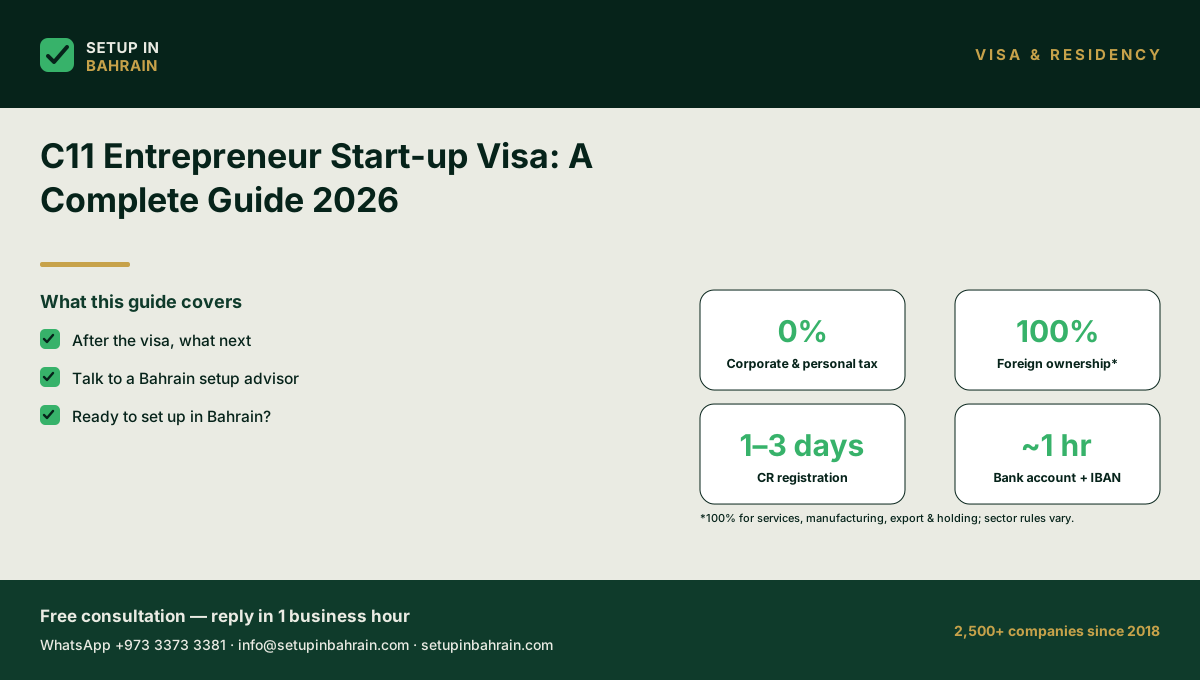
The Entrepreneur Start-up Visa 2026 has become one of the most attractive immigration pathways for global innovators and business founders. In today’s competitive economy, countries are actively welcoming entrepreneurs who can create jobs, introduce innovation. And contribute to long-term economic growth. This visa is specifically designed to support individuals who want to establish a new business in a foreign country while gaining legal residency. In 2026, the importance of the Entrepreneur Start-up Visa 2026 has increased greatly due to global shifts toward digital economies, remote businesses. And innovation-driven markets. Governments now prioritize scalable business ideas over traditional employment-based immigration, making this visa a powerful option for founders.
For entrepreneurs, this pathway offers not just relocation but access to funding ecosystems, international markets. Long-term residency options. It is a strategic route for individuals who want to expand globally and build sustainable ventures. For foreign businesses looking to register a company in Bahrain , get an investor visa . And open a corporate bank account , this digital logistics boom offers massive potential for growth and regional expansion.
Entrepreneur Start-up Visa: A Complete Guide 2026
📑 Table of Contents
- What is the Entrepreneur Start-up Visa 2026
- Key Benefits
- Eligibility Criteria
- Minimum Investment Requirement
- Investor Visa vs Entrepreneur Visa
- Required Documents
- Application Process
- Processing Time
- Costs & Fees
- Business Setup Requirements
- Job/Operational Requirements
- Property Ownership Rules
- Taxation
- Common Reasons for Rejection
- Advantages & Future Outlook
- FAQs
- Final Thoughts
1. 🚀 What is Entrepreneur Start-up Visa 2026
The Entrepreneur Start-up Visa 2026 is a government-approved immigration program that allows foreign entrepreneurs to establish and operate a new business in a host country. Unlike traditional work visas, this visa is not tied to employment but focuses on innovation, business creation. Economic contribution.
Applicants are typically required to present a scalable and innovative business idea. The visa allows them to reside legally while developing their start-up. Over time, successful businesses may lead to permanent residency or long-term settlement options.
The Entrepreneur Start-up Visa 2026 is widely used in countries that aim to attract tech founders, digital entrepreneurs. And global investors seeking growth options in stable economies.
2. 🌟 Key Benefits
The Entrepreneur Start-up Visa 2026 offers several important advantages for global founders.
- Legal right to establish and operate a business
- Access to developed financial and banking systems
- Opportunity to enter international markets
- Pathway to long-term or permanent residency
- Ability to sponsor family members
- Exposure to startup incubators and investors
One of the biggest advantages of the Entrepreneur Start-up Visa 2026 is that it prioritizes innovation over capital, allowing talented founders to succeed even with moderate funding.
3. 📋 Eligibility Criteria
To qualify for the Entrepreneur Start-up Visa 2026, applicants must meet specific requirements based on business viability and personal background.
Applicants are expected to show business experience or relevant industry expertise. A strong and realistic business idea is essential, along with the ability to execute it effectively.
Most countries also require applicants to show financial stability, proving they can support both personal living costs and initial business expenses. In many cases, endorsement from a recognized incubator or authority is also required.
4. 💰 Minimum Investment Requirement
Requirement | Details |
Startup Capital | Varies by country |
Operational Funds | 6–12 months coverage |
Funding Source | Personal / Investors / Grants |
Proof Requirement | Bank statements / funding letters |
The Entrepreneur Start-up Visa 2026 does not always require high investment but focuses on sustainable funding and realistic financial planning.
5. ⚖️ Investor Visa vs Entrepreneur Visa
Factor | Entrepreneur Start-up Visa | Investor Visa |
Focus | Innovation & startups | Capital investment |
Capital Requirement | Low to medium | High |
Risk Level | Higher | Lower |
Business Type | New ventures | Existing businesses |
Involvement | Active | Passive/Active |
The Entrepreneur Start-up Visa 2026 is ideal for innovators, while investor visas suit high-net-worth individuals.
6. 📄 Required Documents
Applicants must prepare a finish set of documents for approval.
A valid passport is required along with identity proof and photographs. A detailed business plan is essential, explaining the idea, market potential, and revenue model.
Financial documents such as bank statements, investment proof, or funding letters are also required. Educational qualifications and professional experience records strengthen the application.
7. ⚙️ Application Process
The application process for the Entrepreneur Start-up Visa 2026 follows a structured path.
First, the applicant develops a strong business concept and prepares a detailed business plan. This plan is then submitted to the immigration or business authority for evaluation.
If required, endorsement from an approved incubator or group is obtained. Once approved, the applicant receives a temporary residency permit to enter the country and begin operations.
Over time, the entrepreneur must actively manage the business and meet performance expectations for visa renewal or extension.
8. ⏳ Processing Time
The processing time for the Entrepreneur Start-up Visa 2026 usually ranges between two to six months depending on the country and application strength.
Applications with strong documents and innovative ideas are processed faster. But, additional verification or endorsement requirements may extend the timeline.
9. 💵 Costs & Fees
Category | Estimated Cost |
Application Fee | Medium |
Business Setup Cost | Variable |
Legal/Consulting | Medium |
Living Expenses | Country dependent |
The total cost of the Entrepreneur Start-up Visa 2026 depends mainly on business setup and living requirements rather than fixed visa fees.
10. 🏢 Business Setup Requirements
Entrepreneurs must establish a legally registered business in the host country.
The business must operate in an approved sector and comply with local laws. A physical or virtual office may be required depending on regulations.
Proper accounting systems and financial reporting are essential to maintain compliance under the Entrepreneur Start-up Visa 2026 program.
11. 👨💼 Job/Operational Requirements
One of the key expectations is job creation and operational activity.
Start-ups are encouraged to hire local employees as they grow. Businesses must show real economic activity rather than being inactive entities.
Failure to maintain operations can affect visa renewal under the Entrepreneur Start-up Visa 2026.
12. 🏠 Property Ownership Rules
In many countries, entrepreneurs under this visa may gain access to property ownership rights.
Some regions allow residential and commercial property ownership, while others impose restrictions in sensitive zones. These rules vary depending on local regulations.
13. 💸 Taxation
Tax systems vary by country but generally include corporate taxes and consumption taxes.
Most jurisdictions do not tax foreign personal income heavily, making the Entrepreneur Start-up Visa 2026 financially attractive for global founders.
Businesses are typically subject to corporate tax, VAT, or equivalent systems depending on the region.
14. ⚠️ Common Reasons for Rejection
Applications may be rejected for several reasons.
Weak or unrealistic business plans are the most common issue. Lack of financial proof or unclear funding sources can also lead to rejection.
Incomplete documents or failure to secure endorsement greatly reduces approval chances for the Entrepreneur Start-up Visa 2026.
15. 🌍 Advantages & Future Outlook
The future of the Entrepreneur Start-up Visa 2026 is highly promising as countries continue to compete for global talent.
Governments are more and more supporting innovation-driven immigration policies. Start-ups in technology, AI, fintech, and digital services are especially encouraged.
In the coming years, the Entrepreneur Start-up Visa 2026 is expected to become even more flexible, offering faster residency pathways and stronger funding support systems.
16. ❓ FAQs
- How long does approval take?
Usually 2–6 months depending on documents. - Can I bring my family?
Yes, most programs allow family sponsorship. - Do I need high investment?
No, focus is on business idea, not capital. - Is permanent residency possible?
Yes, after successful business performance. - Do I need experience?
Business or industry experience is strongly preferred.
17. 🧠 Final Thoughts
The Entrepreneur Start-up Visa 2026 is one of the most powerful global pathways for innovators and business founders. It provides access to international markets, legal residency, and supportive ecosystems designed for business growth.
Unlike traditional immigration routes, this visa rewards creativity, innovation, and execution rather than wealth alone. For entrepreneurs aiming to scale globally, it represents a strategic option to build sustainable and future-ready businesses.
With increasing global demand for innovation, the Entrepreneur Start-up Visa 2026 will continue to play a major role in shaping international entrepreneurship in the coming years.
Quick Facts
- Bahrain: generally no corporate income tax for most sectors
- Foreign ownership: 100% allowed
- Setup time: 15 to 20 days
- Company formation: Standard BHD 1,340 with 3 months of office address; Gold BHD 1,700 with 6 months; Premium BHD 2,150 with 12 months and a cabin, officer table and chair, and two guest chairs. No formation package includes visas, including Premium. Investor/work visas are priced separately: BHD 755 for one year or BHD 953 for two years, in addition to the formation package. Ask for a written, itemized quotation confirming government fees and all inclusions before payment.
- Company renewal packages: BHD 530 with 3 months of office address; BHD 980 with 6 months; BHD 1,520 with 12 months. These are separate renewal packages, not visa fees.
- Rating: 4.8 stars on Google
- Clients served: 2,500 and more
Why Choose Bahrain?
Bahrain has no income tax. It is easy to set up a firm here. The rules are clear and fair.
You can own 100% of your firm. No local partner is needed. This is rare in the Gulf region.
You can open a bank account with ease. You can hire staff from any country. You can live and work here too.
Bahrain has free trade deals with the US and the GCC. This gives you access to large markets. It is a smart base for your business.
How We Help You
We are a team of experts. We set up firms in Bahrain. We have helped 2,500 clients.
We do all the hard work. You just tell us your plan. We take care of the rest.
Our team files all forms. We deal with the state. We keep you up to date at each step.
We have a 4.8 star rating on Google. Our clients trust us. We are proud of that.
What You Get
- A valid CR in 15 to 20 days
- Zero tax on your profits
- Full foreign ownership — no local partner
- A bank account in 3 to 6 weeks
- An Investor Visa to live and work in Bahrain
- Staff from any country, via LMRA work permits
- A virtual office or a real one — your choice
Our Process
- You fill in our form. It takes 3 minutes.
- We call you back the same day.
- We check your plan and pick the right firm type.
- We draft your MOA and all legal files.
- We file with MOICT via the Sijilat portal.
- You get your CR in 15 to 20 days.
- We help you open your bank account.
- You can trade. You are done.
Key Numbers
- Tax rate: 0%
- Ownership: 100% foreign
- Time to set up: 15 to 20 days
- Company formation: Standard BHD 1,340 with 3 months of office address; Gold BHD 1,700 with 6 months; Premium BHD 2,150 with 12 months and a cabin, officer table and chair, and two guest chairs. No formation package includes visas, including Premium. Investor/work visas are priced separately: BHD 755 for one year or BHD 953 for two years, in addition to the formation package. Ask for a written, itemized quotation confirming government fees and all inclusions before payment.
- Company renewal packages: BHD 530 with 3 months of office address; BHD 980 with 6 months; BHD 1,520 with 12 months. These are separate renewal packages, not visa fees.
- Investor Visa: From BHD 755
- Virtual office: From BHD 600 per year
- Clients served: Over 2,500
- Star rating: 4.8 on Google
Bahrain vs Other GCC Markets
Bahrain is easy. The UAE needs a local sponsor for some firm types. Saudi Arabia has more rules.
Bahrain has zero tax. Qatar has no tax too, but the rules are more strict. Kuwait is more costly.
In Bahrain, you can own all of your firm. You do not need a local partner. This is a big plus.
Bahrain has a free trade deal with the US. This means your goods face low or no tariffs. No other GCC state has this deal.
Common Terms
- CR: Commercial Registration — your right to trade
- MOA: Memorandum of Association — your firm's legal deed
- WLL: With Limited Liability — the most common firm type
- LMRA: Labour Market Regulatory Authority — issues work and investor visas
- MOICT: Ministry of Industry — issues CRs and firm licenses
- Sijilat: The online portal to file your CR
Common Questions
Is it hard to set up a firm in Bahrain?
No. It is one of the easiest places in the Gulf. We do all the hard work for you. You can be set up in 20 days.
Do I need to live in Bahrain?
No. You can run your firm from home. You may visit once to open a bank account. The rest is done online.
How do I get started?
Fill in our form on this page. We call you back the same day. Our team maps your best plan at no cost to you.
Ready to set up in Bahrain?
Tell us your business idea. We'll map the right entity, ownership and timeline — then handle the filing while you build.