
Bank account opening in Bahrain vs UAE 2026: Compare requirements, costs, and benefits to choose the best option for your business.
View details
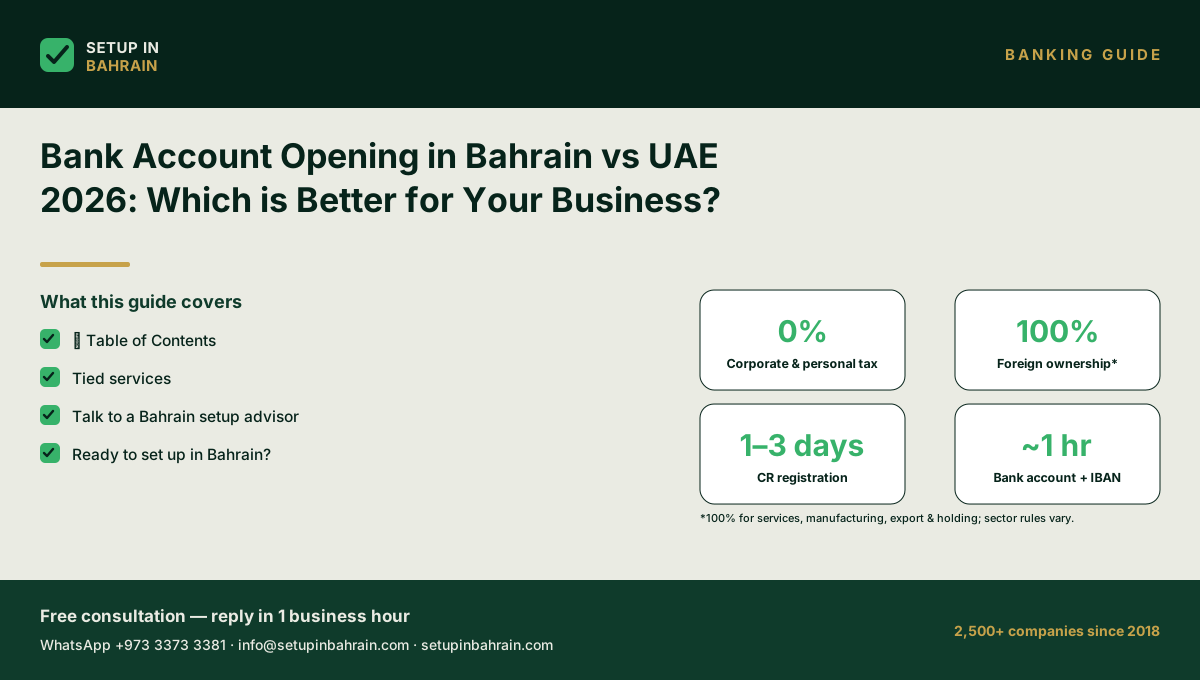
Choosing the right jurisdiction for business banking is one of the most strategic decisions a GCC-based company can make. Both Bahrain and the UAE offer strong financial infrastructure, solid regulatory frameworks, and access to regional markets. However, differences in costs, processing times, and compliance requirements make one option more suitable depending on your business profile. In 2026, understanding bank account opening in Bahrain vs UAE is essential for any entrepreneur or company entering the region.
For foreign businesses looking to register a company in Bahrain, obtain an investor visa, and open a corporate bank account, this digital logistics boom offers massive potential for growth and regional expansion.
Bank Account Opening in Bahrain vs UAE 2026: Which is Better for Your Business?
📋 Table of Contents
- What is Bank Account Opening in Bahrain vs UAE?
- Key Benefits of Each Jurisdiction
- Eligibility Criteria
- Minimum Deposit Requirements
- Bahrain vs UAE — Direct Comparison
- Required Documents
- Application Process
- Processing Time
- Costs & Fees
- Business Setup Requirements
- Operational Requirements
- Property Ownership Rules
- Taxation
- Common Reasons for Rejection
- Advantages & Future Outlook
- FAQs
- Final Thoughts
1. 🔍 What is Bank Account Opening in Bahrain vs UAE?
Bank account opening in Bahrain vs UAE refers to establishing a corporate banking facility in either the Kingdom of Bahrain or the United Arab Emirates. Both countries host internationally recognized banking systems — regulated by the CBB and CBUAE respectively. Both offer multi-currency accounts, digital banking, and trade finance. The key differences lie in cost, speed, compliance burden, and the type of business each market best serves.
2. ✅ Key Benefits of Each Jurisdiction
Bahrain:
- Lower minimum deposits and account fees
- Faster onboarding for SMEs and startups
- 100% foreign ownership in most sectors
- No corporate tax for most business activities
- More accessible compliance process for smaller businesses
UAE:
- Access to a larger and more diversified economy
- Greater number of international banking options
- Strong global brand recognition for UAE-registered companies
- Free zone banking with added structural flexibility
- Broader access to venture capital and institutional investors
3. 📋 Eligibility Criteria
Bahrain: Company registered with MOIC, valid CR certificate, full KYC for all directors and UBO, no sanctions on any principal, registered business address in Bahrain.
UAE: Company registered with DED or a free zone authority, valid trade license, full KYC and UBO disclosure, physical or registered address within the UAE.
4. 💰 Minimum Deposit Requirements
| Jurisdiction | Account Type | Min. Initial Deposit | Min. Monthly Balance |
|---|---|---|---|
| Bahrain — Local Bank | Standard Business | BHD 500 – 1,000 | BHD 500 |
| Bahrain — Int’l Bank | Premium Business | BHD 5,000 – 10,000 | BHD 2,500 |
| UAE — Local Bank | Standard Business | AED 10,000 – 50,000 | AED 25,000 |
| UAE — Int’l Bank | Premium Business | AED 50,000 – 100,000 | AED 50,000 |
Bahrain’s lower entry barriers make it the preferred choice for startups and SMEs entering the GCC for the first time.
5. ⚖️ Bahrain vs UAE — Direct Comparison
| Feature | Bahrain | UAE |
|---|---|---|
| Min. Deposit | BHD 500 – 1,000 | AED 10,000 – 50,000 |
| Corporate Tax | None (most sectors) | 9% above AED 375,000 |
| Processing Time | 5 – 10 working days | 2 – 6 weeks |
| Foreign Ownership | 100% in most sectors | 100% free zones; mainland varies |
| Compliance Level | Moderate | High |
| Banking Costs | Lower | Higher |
| Best Suited For | SMEs, startups | Large enterprises, global brands |
6. 📁 Required Documents
Both jurisdictions require the following:
- Certificate of Incorporation and commercial license or CR
- Memorandum and Articles of Association
- Board Resolution naming authorized signatories
- Passport copies of all directors and shareholders
- Proof of registered business address
- Source of funds declaration and UBO form
- Audited financials for existing companies; business plan for new ones
UAE banks often request additional documentation including shareholder structure charts and client or supplier references for foreign-owned entities.
7. 🪜 Application Process
Step 1: Choose your jurisdiction based on business size, budget, and target markets.
Step 2: Register your company — MOIC in Bahrain or DED/free zone authority in the UAE.
Step 3: Select a bank aligned with your industry and transaction needs.
Step 4: Attend a mandatory pre-application meeting at your chosen bank.
Step 5: Submit complete documentation to the corporate onboarding team.
Step 6: Pass KYC and AML compliance review for all principals and UBO
Step 7: Make your initial deposit to activate the account.
8. ⏱️ Processing Time
- Bahrain simple structure: 5 to 10 working days
- Bahrain complex or offshore structure: 4 to 8 weeks
- UAE free zone company: 2 to 4 weeks
- UAE mainland company: 3 to 6 weeks
Bahrain consistently processes applications faster, giving businesses an operational head start.
9. 💵 Costs & Fees
| Fee Type | Bahrain (BHD) | UAE (AED) |
|---|---|---|
| Account Opening Fee | BHD 0 – 100 | AED 0 – 500 |
| Annual Maintenance | BHD 60 – 300 | AED 1,000 – 5,000 |
| International Transfer | BHD 5 – 15 | AED 25 – 75 |
| Internet Banking Setup | Free – BHD 50 | Free – AED 200 |
10. 🏢 Business Setup Requirements
Both countries require a legally active commercial license or CR, a verifiable registered office, and at least one locally authorized signatory. UAE banks apply stricter substance requirements, particularly for free zone companies with limited physical operations. Bahrain offers a more accessible onboarding experience for newer and smaller businesses.
11. 👷 Operational Requirements
Both jurisdictions require proof of genuine business activity including contracts, projected transaction volumes, and supplier and customer details. UAE banks are more demanding in requesting operational evidence, especially for foreign-owned companies. Bahrain allows more flexibility for businesses in early operational stages, making the bank account opening in Bahrain vs UAE comparison clearly favor Bahrain for early-stage companies.
12. 🏠 Property Ownership Rules
Bahrain permits 100% foreign property ownership in designated investment zones. Commercial lease agreements are widely accepted as address proof. In the UAE, rules vary by emirate and zone — free zone companies must maintain offices within their respective zones. Both countries reject residential addresses as registered business premises.
13. 🧾 Taxation
Bahrain has no corporate income tax for most sectors, no personal income tax, no capital gains tax, and no withholding tax. VAT stands at 10%. The UAE introduced a 9% corporate tax in 2023 on profits above AED 375,000, with free zone companies potentially qualifying for a 0% rate if they meet substance requirements. UAE VAT is 5%. For tax-sensitive businesses, Bahrain holds a clear advantage in the bank account opening in Bahrain vs UAE decision.
14. ❌ Common Reasons for Rejection
- Vague or high-risk business activities on the license or CR
- Incomplete KYC or missing UBO declaration
- No documented source of initial funds
- No operational substance — no staff, office, or clients
- Negative background checks on directors or shareholders
- Inconsistencies between application details and documents
- Residential address used as registered business address
15. 🚀 Advantages & Future Outlook
Bahrain’s Vision 2030 and the UAE’s We the UAE 2031 strategy are both modernizing business banking. Bahrain leads on cost, speed, and SME accessibility. The UAE leads on scale and global brand recognition. Digital KYC, open banking, and fintech innovation are accelerating account opening in both markets. For cost efficiency and speed, Bahrain wins. For market scale and global presence, the UAE remains dominant.
❓ FAQs
Q1: Is it cheaper to open a business account in Bahrain or the UAE? Bahrain is significantly cheaper, with deposits starting at BHD 500 versus AED 10,000 to AED 50,000 in the UAE.
Q2: Which country is faster for account opening? Bahrain processes simple applications in 5 to 10 days. The UAE typically takes 2 to 6 weeks.
Q3: Can I open accounts in both Bahrain and the UAE? Yes. Many businesses maintain accounts in both jurisdictions to access different markets simultaneously.
Q4: Which is better for a startup? Bahrain is better suited for startups due to lower costs, faster processing, and more flexible compliance requirements.
Q5: Does UAE corporate tax affect the banking decision? Yes. The UAE’s 9% corporate tax makes Bahrain a more tax-efficient base for many SMEs and holding structures.
💬 Final Thoughts
When comparing bank account opening in Bahrain vs UAE, there is no single right answer only the right answer for your business. Bahrain wins on cost, speed, and accessibility. The UAE wins on scale and global recognition. Assess your business size, markets, compliance capacity, and budget before deciding. In 2026, both offer strong banking environments and the smartest businesses often leverage both.
Ready to set up in Bahrain?
Tell us your business idea. We'll map the right entity, ownership and timeline — then handle the filing while you build.
Official Bahrain government references
- Central Bank of Bahraincbb.gov.bh
- Sijilat — MOICT commercial registration portalsijilat.bh