
Discover Bahrain’s tax-friendly policies for businesses in 2026, including Generally no corporate income tax for most sectors benefits, VAT structure, and investor-friendly regulations...
Key Takeaways
- How Bahrain’s Tax-Friendly Policies for Businesses: The Definitive Guide 2026
View details
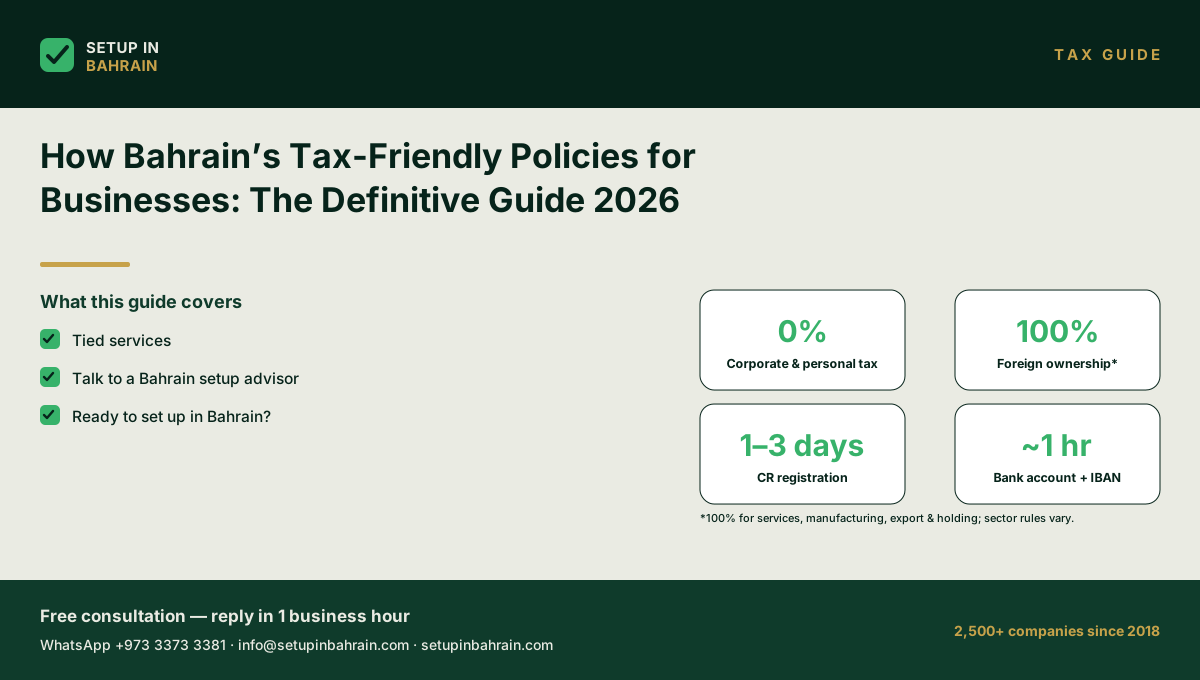
Bahrain has built one of the most attractive tax environments in the Middle East, making it a top destination for entrepreneurs, startups, and multinational companies. In 2026, Bahrain’s tax-friendly policies for businesses continue to play a major role in reducing operational burdens and encouraging foreign direct investment. These policies are designed to simplify compliance, support business growth, and maintain the country’s competitive edge in the GCC region.
Unlike many global markets where corporate taxation can significantly reduce profit margins, Bahrain offers a largely zero-tax environment for most businesses. This includes no standard corporate income tax, no personal income tax, and simplified compliance structures. However, recent developments such as VAT implementation and minimum tax frameworks for large multinational groups have added a layer of structured regulation. For business owners, understanding Bahrain’s tax-friendly policies for businesses is essential not only for setup planning but also for long-term financial optimization. This guide breaks down all major tax advantages, regulations, and strategic implications for 2026.
For foreign businesses looking to register a company in Bahrain, obtain an investor visa, and open a corporate bank account, this digital logistics boom offers massive potential for growth and regional expansion.
How Bahrain’s Tax-Friendly Policies for Businesses: The Definitive Guide 2026
Table of Contents
- Overview of Bahrain’s Tax System
- Corporate Tax Structure in Bahrain
- Personal Income Tax Policy
- Value Added Tax (VAT) System
- Sector-Specific Tax Rules
- Domestic Minimum Top-Up Tax (DMTT)
- Free Zones and Tax Exemptions
- Customs Duties and Import Policies
- Tax Incentives for Foreign Investors
- Government Business Support Programs
- Impact on Business Setup Costs
- SME Tax Advantages
- Compliance Requirements for Businesses
- Industry-Wise Tax Impact
- Comparison with Other GCC Countries
- Future Tax Policy Trends in Bahrain
- Final Thoughts
1. 📘 Overview of Bahrain’s Tax System
Bahrain’s tax system is built on simplicity and investment attraction. The country has positioned itself as a low-tax jurisdiction to support business growth and economic diversification.
Key features include:
- No general corporate income tax
- No personal income tax
- Low and structured indirect taxation (VAT)
- Sector-specific taxation only in limited industries
This makes Bahrain’s tax-friendly policies for businesses one of the strongest economic advantages in the region.
2. 🏢 Corporate Tax Structure in Bahrain
The most attractive feature of Bahrain’s tax system is the absence of general corporate income tax for most industries.
| Business Type | Tax Rate | Notes |
|---|---|---|
| Standard businesses | 0% | Applies to most sectors |
| Oil & gas sector | Up to 46% | Special sector taxation |
| Large multinationals | 15% (DMTT rule) | Applies under global tax rules |
Most companies operating in Bahrain continue to benefit from a generally no corporate income tax for most sectors, making it highly competitive for international investors.
3. 👤 Personal Income Tax Policy
One of Bahrain’s strongest advantages is that individuals are not subject to income tax.
This means:
- No tax on salaries
- No tax on freelance income
- No capital gains tax for individuals
This policy significantly enhances workforce attraction and reduces employment-related financial pressure on companies.
4. 💰 Value Added Tax (VAT) System
Bahrain applies a standard VAT system to diversify government revenue without burdening corporate profits.
Key details:
- Standard VAT rate: 10%
- Applies to most goods and services
- Certain exemptions (education, healthcare, etc.)
VAT is the only widely applicable business tax in Bahrain, and it is relatively low compared to global standards.
5. 🏭 Sector-Specific Tax Rules
Bahrain maintains targeted taxation only for specific industries, primarily energy-related sectors.
This includes:
- Oil and gas extraction
- Hydrocarbon refining
- Large-scale energy operations
Most other industries remain fully exempt from corporate tax, reinforcing Bahrain’s business-friendly reputation.
6. 📊 Domestic Minimum Top-Up Tax (DMTT)
In alignment with global tax reforms, Bahrain has introduced a minimum tax framework for large multinational enterprises.
Key points:
- Applies to companies with global revenues above €750 million
- Ensures a minimum effective tax rate of 15%
- Affects only large global corporations
For SMEs and startups, this rule has no impact, preserving Bahrain’s core tax advantage.
7. 🏝️ Free Zones and Tax Exemptions
Bahrain offers specialized free zones designed to attract foreign investment and industry-specific growth.
Benefits include:
- Full foreign ownership
- Customs duty exemptions
- Simplified licensing processes
- Profit repatriation freedom
| Free Zone | Focus Area | Benefit |
|---|---|---|
| Bahrain Logistics Zone | Logistics & trade | Customs exemption |
| Bahrain Airport Free Zone | Aviation & cargo | Fast clearance |
| Bahrain Investment Park | Manufacturing & tech | Tax-friendly operations |
These zones enhance Bahrain’s tax-friendly policies for businesses by reducing operational friction.
8. 🚢 Customs Duties and Import Policies
Bahrain follows GCC unified customs regulations with generally low import barriers.
Key features:
- Standardized GCC customs duties
- Free zone exemptions for qualifying goods
- Simplified import/export procedures
This reduces supply chain costs for trading and manufacturing companies.
9. 🌍 Tax Incentives for Foreign Investors
Foreign investors benefit heavily from Bahrain’s open tax structure.
Key incentives:
- No withholding tax on dividends or interest
- Full profit repatriation allowed
- 100% foreign ownership in most sectors
- Free zone tax benefits
These incentives make Bahrain especially attractive for international expansion.
10. 🏛️ Government Business Support Programs
The Bahraini government supports businesses through several initiatives:
- Startup funding programs
- Workforce training subsidies
- SME financial support schemes
- Investment promotion incentives
These programs indirectly enhance tax efficiency by reducing operational costs.
11. 📉 Impact on Business Setup Costs
Tax-friendly policies significantly reduce overall setup expenses.
| Cost Factor | Bahrain Impact |
|---|---|
| Corporate tax | 0% reduces long-term burden |
| Payroll tax | Not applicable |
| Compliance cost | Simplified system |
| Profit retention | High efficiency |
This makes Bahrain one of the lowest-tax-cost jurisdictions in the GCC.
12. 🏢 SME Tax Advantages
Small and medium enterprises benefit the most from Bahrain’s tax environment.
Advantages include:
- Generally no corporate income tax for most sectors burden
- Low compliance requirements
- Access to government incentives
- Reduced startup costs
This encourages entrepreneurship and innovation across sectors.
13. 📋 Compliance Requirements for Businesses
Even with low taxes, businesses must comply with basic regulations:
- VAT registration if threshold is met
- Proper accounting records
- Economic substance compliance for certain entities
- Annual reporting requirements
Compliance remains simple compared to global standards.
14. 🏭 Industry-Wise Tax Impact
| Industry | Tax Impact Level |
|---|---|
| Technology | Very low |
| Retail | Low (VAT applicable only) |
| Manufacturing | Low to moderate |
| Oil & Gas | High (sector tax applies) |
Most industries enjoy strong tax advantages under Bahrain’s system.
15. 🌐 Comparison with Other GCC Countries
Compared to regional competitors:
- Bahrain: generally no corporate income tax for most sectors (most sectors)
- UAE: 9% corporate tax introduced
- Saudi Arabia: 2generally no corporate income tax for most sectors (foreign entities)
This makes Bahrain one of the most tax-efficient jurisdictions in the GCC.
16. 🔮 Future Tax Policy Trends in Bahrain
Future developments may include:
- Expanded digital tax systems
- Stronger global tax alignment (OECD rules)
- Continued incentives for startups
- Stable VAT structure
Despite changes, Bahrain is expected to maintain its low-tax advantage.
17. 🏁 Final Thoughts
Bahrain’s tax-friendly policies for businesses in 2026 remain one of the strongest reasons investors choose the country for company formation. With Generally no corporate income tax for most sectors for most sectors, no personal income tax, and simplified VAT rules, Bahrain offers a highly efficient financial environment for business growth.
While global tax frameworks like minimum corporate tax rules are being introduced for large multinational companies, the core advantage for startups, SMEs, and foreign investors remains unchanged. Ultimately, Bahrain continues to stand out as a strategic, low-tax, business-friendly hub that supports profitability, scalability, and long-term economic success.
Ready to set up in Bahrain?
Tell us your business idea. We'll map the right entity, ownership and timeline — then handle the filing while you build.
Official Bahrain government references
- National Bureau for Revenue (VAT, DMTT)nbr.gov.bh
- Ministry of Industry, Commerce & Tourismmoic.gov.bh