
Click Here to WhatsApp Us for Business Inquiries.
Saturday to Thursday 08:00 - 17:00
Office 1502, Building 361, Road 1705, Block 317, Diplomatic Area , Kingdom of Bahrain
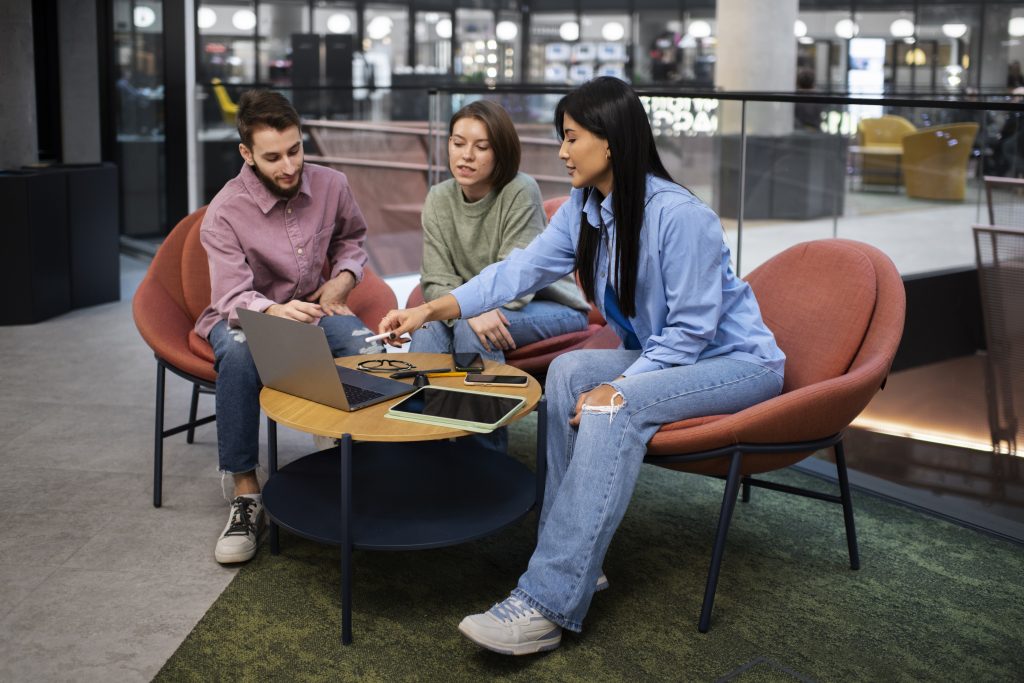
Co-working spaces are reshaping Bahrain’s commercial landscape by offering flexible, scalable, and cost-efficient office solutions tailored to startups, freelancers, SMEs, and multinational firms. As workplace expectations shift from rigid long-term leases to agile environments, co-working spaces are evolving into innovation ecosystems where collaboration, technology, and entrepreneurship intersect.
Driven by economic diversification strategies and digital transformation initiatives in Bahrain, co-working is no longer a niche concept; it is becoming an integral component of modern business infrastructure.
Co-working began gaining traction in the mid-2010s alongside the rise of startup culture and digital entrepreneurship. Initially centered around shared desks and open layouts, spaces have matured into fully serviced business hubs offering:
Year | Estimated Spaces | Key Development Trends |
2015 | 2–3 | Early startup-focused hubs |
2018 | 5–7 | Flexible packages and SME expansion |
2021 | 10–12 | Hybrid work acceleration, tech integration |
2024 | 15+ | Enterprise adoption, niche communities |
The steady increase reflects growing acceptance across multiple industries.
Several structural and economic factors are fueling demand:
Businesses are prioritizing flexibility and operational efficiency over traditional office ownership.
Government initiatives aimed at innovation and SME growth have indirectly accelerated co-working adoption. Through business-friendly regulations, licensing simplification, and funding access, authorities have fostered an entrepreneurial environment aligned with Bahrain’s economic diversification goals.
Programs supporting digital transformation and fintech development have further increased demand for collaborative workspaces.
Several established hubs operate across the Kingdom, including innovation-driven centers such as Bahrain FinTech Bay, which integrates co-working, acceleration programs, and investor access.
Other operators provide:
Co-working offers measurable advantages:
For growing companies, this translates into faster market entry and lower financial risk.
Startups particularly benefit from:
The environment encourages innovation through proximity to other entrepreneurs.
Large corporations are integrating co-working into long-term real estate strategies by:
Hybrid workforce strategies have made co-working a strategic rather than temporary solution.
Membership pricing varies by service level and location.
Typical Co-Working Price Range in Bahrain
Membership Type | Estimated Monthly Cost (BHD) | Core Features |
Hot Desk | 50–100 | Shared seating, Wi-Fi access |
Dedicated Desk | 120–180 | Reserved desk, storage |
Private Office | 250–500 | Enclosed office, meeting room access |
Enterprise Suite | 500+ | Custom layout, premium services |
Flexible packages make co-working accessible across business sizes.
Modern spaces emphasize digital infrastructure, including:
Technology integration enhances productivity and operational efficiency.
Community building is central to co-working success. Activities often include:
This ecosystem model encourages partnerships, knowledge exchange, and business development.
Sustainability is emerging as a differentiator, with operators adopting:
Green practices align with global ESG expectations and attract environmentally conscious members.
Key Challenges
Strategic Opportunities
Operators who innovate beyond desk space will sustain long-term growth.
Leading co-working providers have succeeded by:
Such models demonstrate how shared workspaces can become engines of economic development.
The future of co-working in Bahrain is shaped by:
As hybrid work becomes standard, co-working spaces are expected to evolve into full business ecosystems rather than simple office alternatives.