Start a business in Bahrain as an expat: 100% foreign ownership, zero income tax, company formation from BHD 1,340. Complete 2026 guide covering costs,...
View details
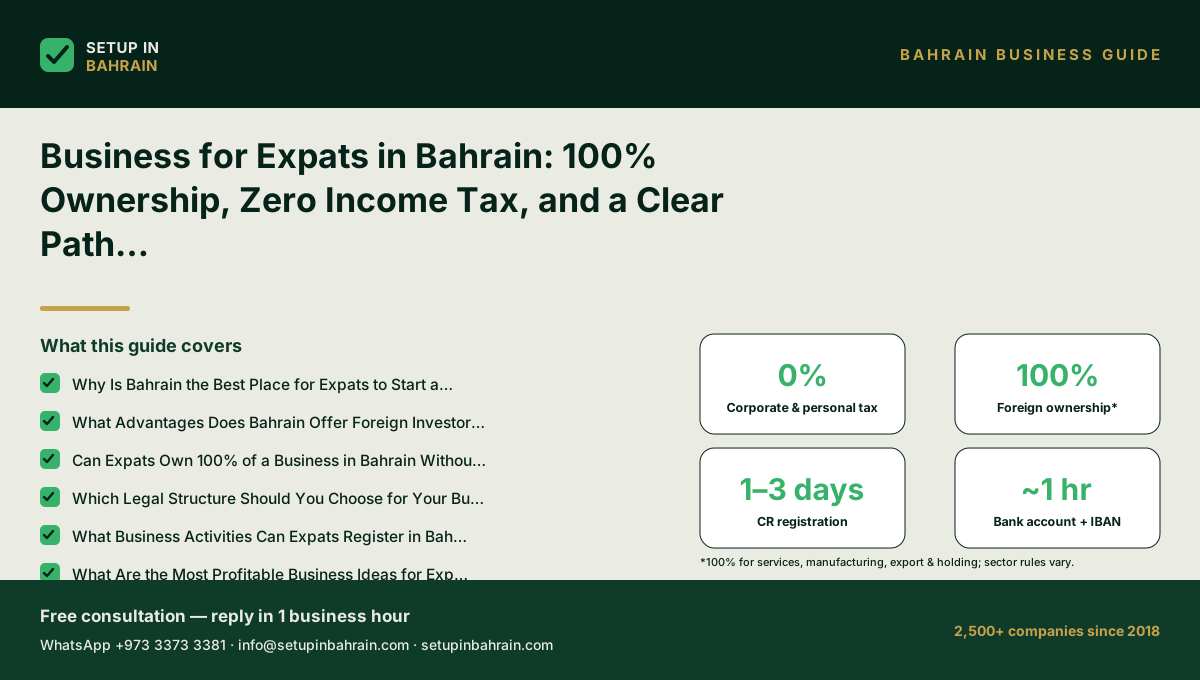
This is the guide to business for expats in Bahrain. It covers 100% ownership across 350+ activities. There is no personal income tax. No capital gains tax. Company formation takes 3–7 working days through the Sijilat portal.
Business for expats in Bahrain means 100% foreign ownership across 350+ activities. There is zero income tax. Registration takes 3–7 working days from BHD 1,340.
We have served 2,500+ clients and maintain records to substantiate that total where needed. Clients served are not the same as Google reviews; not every client has left a review. investor visa business bank account setup guides cost breakdowns
Why Is Bahrain the Best Place for Expats to Start a Business in the Middle East?
Starting a business for expats in Bahrain begins with one clear fact. The Kingdom allows 100% foreign ownership across 350+ activities. There is zero personal income tax. Company registration takes just 3–7 working days.
Bahrain sits in the Persian Gulf, east of Saudi Arabia. The King Fahd Causeway connects the two countries. This island nation offers what few Gulf countries can match. Rules are clear and managed through the Ministry of Industry and Commerce. You get direct access to the GCC market of over 50 million people.
That is why Bahrain ranks first in the Middle East on the InterNations Expat Insider survey. It also ranks first globally on the Expat Essentials Index for two years running.
The economy grew 2.5% in Q2 2025. Non-oil activities made up 85.2% of real GDP. This data comes from the Ministry of Finance and National Economy.
The fastest-growing areas tell a clear story. Professional and Technical activities grew 12%. Wholesale and Retail Trade rose 6.7%. Real estate grew 4.7%. This shift away from oil supports the Bahrain Economic Development Board's goal of drawing foreign investment into services, tech, and tourism.
Total FDI stock rose 5.4% to BHD 17.5 billion. Annual FDI inflows reached $1.8 billion in 2024. These figures come from the U.S. State Department's 2025 Investment Climate Statement. They show strong confidence from global investors.
In the UAE or Qatar, some activities still need a local sponsor. Bahrain does not. Expats can own their own business across 350+ activities. No Bahraini shareholder is needed. This policy has helped 2,500+ entrepreneurs from 40+ countries launch through Bahrain company formation since 2020.
Related Guides
What Advantages Does Bahrain Offer Foreign Investors Over Other Gulf Countries?
Several Gulf states compete for foreign investment. Bahrain stands apart with a clear set of policies that help expat business owners. The rules are open. The legal system follows global standards. The business climate welcomes foreign founders. These are facts backed by law and global rankings.
Zero Personal Income Tax and No Capital Gains Tax
Bahrain does not tax personal income. There is no capital gains tax. No wealth tax. No withholding tax. No inheritance tax. This applies to all residents, regardless of where they come from.
There is no corporate income tax for non-oil businesses either. The government did add a 15% top-up tax in January 2025. But this only applies to firms earning over $800 million per year under the OECD BEPS Pillar Two rules. Small and medium businesses are not affected at all.
The National Bureau for Revenue charges a 10% VAT on goods and services. Most basic items are exempt. For expats running a consultancy, e-commerce store, or services firm — the real corporate tax burden is zero.
100% Foreign Ownership Without a Local Sponsor
Under the Commercial Companies Law (Decree Law No. 21 of 2001), foreign investors can hold 100% of a WLL company. No local sponsor is needed. No silent partner.
The exceptions are narrow. Construction needs 51% Bahraini ownership. General trading inside Bahrain needs one Bahraini share. Services, IT, consulting, export trading, and holding companies all allow full foreign ownership. GCC and US citizens get 100% ownership in all sectors by default.
Strategic Location with Direct Saudi Arabia Access
Bahrain sits at the centre of the GCC economies. The King Fahd Causeway links it to Saudi Arabia — the Gulf's largest market with 35 million people. Bahrain International Airport flies direct to every major hub in the Middle East, Asia, and Europe. This makes Bahrain ideal for service firms and trading companies.
Cost of Living and Operating Advantage
EY studies for the Bahrain EDB confirm Bahrain has the lowest costs in the Gulf. Office space and labour run 20–40% cheaper than Dubai and Doha. For small business owners watching their cash, Bahraini Dinars go further here.
The cost of living for families is also affordable. Expats rate quality of life highly in global surveys. GDP grew 2.7% in Q1 2025, showing strong growth that draws investors from every continent.
| Advantage | Bahrain | UAE | Saudi Arabia | Qatar |
|---|---|---|---|---|
| 100% Foreign Ownership (most sectors) | Yes | Yes (since 2021) | Limited | Limited |
| Personal Income Tax | 0% | 0% | 0% | 0% |
| Corporate Tax (SMEs) | 0% | 9% (above AED 375K) | 20% | 10% |
| Local Sponsor Required | No | No (mainland) | Some sectors | Many sectors |
| Direct Saudi Arabia Access | 25 km Causeway | No | Domestic | No |
| Expat Essentials Ranking (InterNations) | 1st Globally | 2nd | 9th | Unranked |
Sources: U.S. State Department Investment Climate Statement 2025, Bahrain EDB, InterNations Expat Insider Survey 2023–2024.
Can Expats Own 100% of a Business in Bahrain Without a Local Partner?
Yes. Bahrain allows 100% foreign ownership across most business activities. The Ministry of Industry and Commerce manages this through the Sijilat portal. It applies to all foreign investors, from any country.
Here is how the rules work. Activities marked "Not Restricted" allow full foreign ownership. No Bahraini national needs to appear on the company register.
This covers a wide range: consulting, accounting, legal advisory, IT, software, e-commerce, digital services, education, healthcare, export trading, financial services (with CBB licensing), cleaning, recruitment, travel, real estate brokerage, and many more.
A few activities have limits. Construction needs 51% Bahraini ownership. General trading inside Bahrain uses a 9999+1 share setup. The foreign investor holds 9,999 shares. One share goes to a Bahraini partner. This is a small requirement. It does not give the partner control or profit rights.
Business ownership in Bahrain has real legal weight. Your Commercial Registration names you as the owner. You sign the deed. You control the bank account. You hire and remove managers. There is no hidden partner taking fees. This gives foreign investors full control from day one.
Which Legal Structure Should You Choose for Your Business in Bahrain?
Bahrain offers several company types under the Commercial Companies Law. The right choice affects your liability, banking options, and ability to sponsor work visas. Here is a clear comparison.
With Limited Liability Company (W.L.L) — Most Popular for Expats
The WLL is the top pick for foreign investors. It works like an LLC in other countries. A WLL can have a single owner or many. There is no minimum capital beyond BHD 1. But BHD 1,000 is advised for bank approval.
Your liability is limited to your capital. The company is a separate legal entity. This structure supports all activities — consulting, e-commerce, trading, and services.
Sole Proprietorship (Individual Establishment)
A sole proprietorship lets one person run a business under their own name. It suits freelancers and solo consultants. But liability is unlimited — your personal assets are at risk. It also limits bank account access and employee visas. For most expats, a WLL is safer.
Shareholding Company (B.S.C.)
A B.S.C. suits large operations. A closed B.S.C. needs BHD 250,000 minimum capital. A public B.S.C. needs BHD 1,000,000. These serve big investors, joint ventures, and firms planning to list on the Bahrain Bourse.
Partnership and Commandite Company
A General Partnership needs two partners with unlimited liability. A Limited Partnership (Commandite) mixes general and limited partners. These are rare for expat setups. Most choose the WLL instead.
Branch Office of a Foreign Company
A branch office lets a foreign company enter Bahrain without forming a new entity. The parent keeps full control and full liability. No capital deposit is needed. But you must have a commercial address and a local representative.
| Structure | Min. Capital | Liability | Best For |
|---|---|---|---|
| WLL Company | BHD 1 | Limited | Most expat businesses, startups, SMEs |
| Sole Proprietorship | None | Unlimited | Freelancers, solo consultants |
| B.S.C. Closed | BHD 250,000 | Limited | Large enterprises, joint ventures |
| B.S.C. Public | BHD 1,000,000 | Limited | Companies seeking public listing |
| General Partnership | None | Unlimited | Family firms, professional practices |
| Limited Partnership | None | Mixed | Investment vehicles |
| Branch Office | None | Parent liable | Multinationals, project-based work |
For most expats, the WLL is the best fit. It offers limited liability, easy banking, visa sponsorship, and simple admin. We use it for over 90% of the company formations we handle.
What Business Activities Can Expats Register in Bahrain?
The Ministry of Industry and Commerce lists over 630 official activities on the Sijilat 3.0 portal. Each has a code, description, and ownership status. When you register, you pick up to three activities for the base BHD 100 fee. Extra groups cost BHD 100 per three.
Major Business Sectors Open to 100% Foreign Ownership
Professional Services
Management consulting, accounting, auditing, legal advisory, HR consulting, and law firm support.
IT Solutions & Digital Services
Software, cloud computing, AI, cybersecurity, web development, and digital platforms.
E-Commerce & Online Business
Online retail, digital marketing, social media, content creation, and internet-based commerce.
Financial Services
Wealth management, investment advisory, insurance, fintech (via FinTech Bay). Needs CBB licensing.
Real Estate
Property brokerage, management, interior design, facility management, and development consulting.
Trading & Logistics
Export trading (100% owned), import/export, freight, warehousing, and supply chain services.
Education & Training
Private tutoring, corporate training, language schools, safety training, and edtech services.
Health & Wellness
Private hospitals, clinics, pharmacy management, fitness centres, and healthcare consulting.
Travel & Hospitality
Travel agencies, tourism, event management, catering, and hotel management services.
Renewable Energy
Solar installation, energy consulting, green tech solutions — backed by government support.
Security & Safety
Alarm systems, monitoring, private security consulting, and fire safety services.
Cleaning & Maintenance
Commercial cleaning, pest control, building upkeep, and facility management operations.
The full list of 630 activities is in our Business Activities Search Tool. Each listing shows ownership limits, required approvals, and whether extra licensing from the Central Bank of Bahrain or LMRA applies.
What Are the Most Profitable Business Ideas for Expats in Bahrain?
The right business idea depends on your skills, budget, and market demand. The most successful expat founders bring expertise from home and apply it locally.
Low-Investment Startup Ideas
E-commerce, freelance marketing, virtual assistant work, social media management, and online tutoring can start for under BHD 2,000. These digital businesses run from a virtual office. Overhead stays low. Scaling is fast. The government's digital push under Vision 2030 creates strong demand for tech-savvy providers.
Medium-Investment Business Ideas
Consulting firms, recruitment agencies, travel agencies, and design studios need BHD 5,000–15,000 in year one. These benefit from Bahrain's role as a gateway to Saudi Arabia. Companies there often seek outside consulting and services before expanding.
High-Growth Business Sectors
Fintech, renewable energy, cloud computing, water sports tourism, and wealth management attract bigger capital. The Bahrain EDB supports these through its Golden License programme and the Central Bank of Bahrain's sandbox.
Real Estate and Construction
Real estate brokerage allows 100% foreign ownership. So do property management and development consulting. Physical construction needs a Bahraini partner (51%). But Amwaj Islands, Reef Island, and the growing housing market create many openings for expat-owned firms near this sector.
Ready to Start Your Business as an Expat in Bahrain?
Our ACMA/CPA-qualified team has helped 2,500+ entrepreneurs from 40+ countries. Free consultation — no commitment.
What Should Expats Expect During the Company Registration Process?
Many expats expect red tape like Saudi Arabia or mainland UAE. The reality is much simpler. Bahrain's Sijilat portal handles most of the work online. The full process takes 3–7 working days.
What Makes the Expat Experience Different
As a foreign national, you need NPRA security clearance first. This does not apply to GCC citizens. It needs your passport copy and a form. The fee is BHD 250. It takes 1–3 working days. After that, the steps are the same for everyone: name booking, notarisation, address check, and CR issue through Sijilat.
Do You Need to Be in Bahrain?
No. Many expats set up their company from abroad. You grant a power of attorney to a licensed provider. They handle name booking, documents, notarisation, and address registration on your behalf. You can arrive after your CR is ready. Then you proceed to bank account opening and visa processing.
Common Expat Mistakes to Avoid
We see three errors most often. First: picking a sole proprietorship when a WLL would protect your assets. Second: selecting activities with extra restrictions by mistake. Third: filing without proper AML documents — which causes bank rejections weeks later. All three are easy to avoid with good planning.
For the full step-by-step process with timelines and checklists, see our Company Formation in Bahrain guide.
Detailed Guides
How Much Should Expats Budget for a Bahrain Business Setup?
Think beyond the registration fee. Your first-year budget covers setup, living costs, and working capital. Here is how experienced expat founders plan.
Company Setup: BHD 1,340 – BHD 2,150
Company formation: Standard BHD 1,340 with 3 months of office address; Gold BHD 1,700 with 6 months; Premium BHD 2,150 with 12 months and a cabin, officer table and chair, and two guest chairs. No formation package includes visas, including Premium. Investor/work visas are priced separately: BHD 755 for one year or BHD 953 for two years, in addition to the formation package. Ask for a written, itemized quotation confirming government fees and all inclusions before payment. Cost of Setting Up a Company in Bahrain
How Bahrain Compares for Expat Budgets
A similar setup in Dubai costs BHD 2,500–5,000. In Saudi Arabia, it exceeds BHD 5,000. Bahrain has the lowest entry cost in the GCC. That matters when you also pay for housing, relocation, and marketing.
First-Year Running Costs
Plan for these yearly costs: CR renewal (BHD 50), activity licence (BHD 100), BCCI membership (BHD 16), and office rent (BHD 400–1,200/year). Service businesses with a virtual office and no staff can run on just BHD 200/month.
The Hidden Cost: Banking Delays
The biggest risk is not the fees. It is a rejected bank account. If your documents lack AML compliance, banks delay or decline. That means 2–6 weeks with a company that cannot trade. Our bank-ready process fixes every document for banking compliance from the start.
What Tax Benefits Do Business Owners Get in Bahrain?
Bahrain's tax rules are among the best in the Gulf for small businesses. Here is what applies — and what does not — as of 2026.
No personal income tax. Bahrain does not tax earnings from any source. Your salary, dividends, and profits flow to you without any deduction.
No corporate income tax (non-oil). Businesses outside oil and gas pay zero tax. The 15% top-up tax from January 2025 only hits firms with $800M+ in yearly revenue. Your WLL or startup is not affected.
No capital gains tax. Profits from selling shares or property are not taxed. No withholding tax on dividends, royalties, or interest to non-residents.
No wealth or inheritance tax. There is no tax on stored wealth or family transfers.
10% VAT applies. The National Bureau for Revenue charges 10% VAT on taxable goods and services. Businesses above BHD 37,500 in yearly revenue must register and file quarterly. Many basic goods are exempt.
Social insurance. Employers pay into Bahrain's insurance system. The rate is rising from 11% to 17% for Bahraini staff. Expat staff rates are lower. This funds pensions, unemployment, and injury cover.
This tax setup — plus zero limits on sending profits abroad — makes Bahrain a top choice. Foreign investors avoid the complex tax rules found in the UAE, Saudi Arabia, or Western home countries. The US-Bahrain Free Trade Agreement also removes tariffs on qualifying goods between the two nations.
How Do You Get an Investor Visa and Residence Permit in Bahrain?
An investor visa (Investor Resident Permit) lets foreign owners live and work in Bahrain. It is processed through the Labour Market Regulatory Authority (LMRA) after company registration.
Investor Visa Requirements
You need an active Commercial Registration. You also need a corporate bank account with capital deposited. Other documents include passport copies (6+ months validity), medical clearance, and proof of your commercial address. The application goes through LMRA's online system.
Investor Visa Duration and Costs
The visa is issued for one year (BHD 755) or two years (BHD 953). This covers LMRA fees, residence permit card, and government charges. Renewal follows the same fee structure. Your permit stays valid as long as your CR is active.
Family Residency and Dependant Visas
Visa holders can sponsor their spouse and children. Dependant visa costs are separate but use the same LMRA system. Bahrain's family-friendly visa options make it easy to relocate with your household.
Visit Visa for Business Exploration
Before committing, many expats visit Bahrain first. They explore business openings, meet partners, and check the market. Visit visas are available on arrival for many nationalities. A visit visa does not allow work or trading — it is only for planning.
Full details including timelines and checklists in our Investor Visa Guide and Investor Visa Cost page.
How Do Work Visas and Work Permits Operate for Employees?
Once your business is running, you can sponsor staff through the LMRA. Work permits and work visas let you hire skilled people from any country.
The LMRA handles all employment visas and labour rules. You apply for permits through their online portal. Each permit has a monthly fee that funds Tamkeen, the national training programme. Fee amounts vary by company size and the ratio of Bahraini to expat staff.
Processing takes 1–3 weeks after LMRA approval. The employee enters Bahrain, completes a medical exam, and receives a residence card. The visa is tied to your company. If the employee moves to a new employer, a new permit is needed.
Job opportunities in Bahrain span finance, oil and gas, tech, construction, and services. The job market is open to skilled expats. Bahrain's bilingual culture (Arabic and English) makes it easy for global hires to fit in.
Full process and fees in our Bahrain Work Visa Guide.
How Do You Open a Business Bank Account in Bahrain?
A corporate bank account is essential after registration. Without it, you cannot deposit capital, take payments, or apply for your investor visa. Bahrain has 80+ banks, including local and global names in the Diplomatic Area.
You will need your CR, Deed of Association, passport copies of all shareholders, a business plan with expected transaction volumes, proof of address, and an initial deposit (BHD 1,000–5,000 depending on the bank).
The real challenge is not opening the account. It is passing the bank's AML compliance check. Banks review every new company against global AML standards. A "bank-ready" formation means your documents, capital, business plan, and address all satisfy these checks from day one.
This is where most competitors fail. They register the company and hand over a CR. Then they leave the owner to face banking alone. Our Bank Account Opening Guide explains what banks want and how we prepare every document.
What Is Daily Life Like for Expat Business Owners in Bahrain?
Bahrain ranks first in the MENA region on the InterNations Expat Insider survey. It also scores in the global top 10 for ease of settling in, language access, and digital government services.
Cost of Living
Life in Bahrain costs much less than in the UAE or Qatar. A single person can live well on BHD 500–800 per month. That covers rent, food, transport, and bills. Families spend BHD 1,200–2,000 monthly.
Rent varies by area. Amwaj Islands, Reef Island, and Juffair cost more. Riffa and Isa Town offer better value. The Bahraini Dinar is fixed to the US Dollar at BHD 1 = USD 2.65. This gives stability for planning.
Healthcare System
Bahrain has public and private hospitals. Government care is open to all residents at low rates. Most expat owners choose private health insurance for faster access and premium facilities.
Education for Families
International schools follow British, American, Indian, Pakistani, and IB programmes. Over 60 private schools serve expat families. The University of Bahrain is the largest public institution with around 30,000 students.
Lifestyle
Bahrain blends modern life with deep culture. Shopping, fitness, water sports, desert trips, and dining options are all here. The Gulf coastline offers year-round outdoor activities.
Communities from Sri Lanka, India, the Philippines, the UK, the US, and across the Middle East live here. This makes it easy for expats to build social and professional networks.
Work Culture
Sources and References
- U.S. Department of State — 2025 Investment Climate Statement: Bahrain
- Bahrain Ministry of Finance and National Economy — Q2 2025 Economic Report
- Bahrain Economic Development Board — Official Investment Portal
- Bahrain EDB — InterNations Expat Insider Survey Results
- Labour Market Regulatory Authority (LMRA) — Official Portal
- Sijilat — Bahrain's Commercial Registration Portal (MOICT)
- National Bureau for Revenue — VAT Regulations
- Bahrain eGovernment Authority — Government Services Portal
Ready to set up in Bahrain?
Tell us your business idea. We'll map the right entity, ownership and timeline — then handle the filing while you build.
Official Bahrain government references
- Sijilat — MOICT commercial registration portalsijilat.bh
- Bahrain Economic Development Boardbahrainedb.com