
This is not theory. Since 2018, we have helped over 2,690 business owners from 40+ countries. Solo consultants from London and Manchester. E-commerce sellers from New York and Toronto. Trading firms from Dubai and Abu Dhabi.
Tech startups from Paris and Berlin. Indian business owners in Sharjah and Ajman looking for a tax-free GCC base.
Every section below shows the real process we handle daily. The exact steps. The documents that cause delays. The ownership rules that decide if you qualify for 100% foreign ownership. If you are comparing Bahrain with Dubai, Riyadh, or other GCC countries — this guide gives you what you need.
Content is checked against the 2025 amendments to the Commercial Companies Law (Legislative Decree No. 38 of 2025). It is written by ACMA/CPA-qualified professionals who handle company setup every day.
Why Choose Bahrain for Your New Company? Tax-Free, Full Ownership, and Fast Setup
Every investor asks the same thing first: why Bahrain? Three reasons stand out. Zero tax. Full foreign ownership. And the fastest registration in the GCC.
Zero Corporate Tax, Zero Personal Tax, and Full Profit Repatriation
Bahrain charges zero percent across all major tax types. No corporate income tax. No personal income tax. No capital gains tax. No withholding tax. No tax on money you send home. You keep everything you earn. This is confirmed by the 2026 U.S. Investment Climate Statement.
| Tax Type | Rate |
|---|---|
| Corporate Income Tax | ✓ 0% |
| Personal Income Tax | ✓ 0% |
| Capital Gains Tax | ✓ 0% |
| Withholding Tax | ✓ 0% |
| Tax on Sending Funds Abroad | ✓ 0% |
| Value-Added Tax (local sales) | 10% |
| Value-Added Tax (service exports) | ✓ 0% |
VAT is 10% on local sales. It drops to 0% for service exports. This is great for digital agencies, SaaS firms, and global service businesses.
A British consultant in Dubai billing UK clients? Zero VAT. An Indian SaaS founder in the UAE exporting globally? 100% revenue kept. A Canadian running cross-border e-commerce? Zero corporate tax.
An American freelancer leaving the US? Tax-free income. A French agency owner expanding to the Gulf? 0% on every euro of exports. These are the legal rules — confirmed by the National Bureau for Revenue.
GCC Markets, Free Trade, and Global Reach
Bahrain sits at the centre of the Gulf region. Your company can reach 1.5 billion consumers across GCC markets and the wider Middle East. Saudi Arabia is connected by the King Fahad Causeway — direct road access to the region's biggest economy.
Bahrain has a Free Trade Agreement with the United States. This makes it ideal for American entrepreneurs. It also has trade deals with EFTA nations, New Zealand, and Singapore. The financial sector is regulated by the Central Bank of Bahrain.
Bahrain ranks among the easiest places to do business in the GCC. Startup founders from Berlin choose Bahrain. Business owners from Toronto expand here. UK consultants and parent companies setting up branches all find real opportunities.
The Bahrain Economic Development Board supports foreign investment in financial services, manufacturing, ICT, tourism, and logistics.
What Makes Bahrain's Business Environment Stand Out?
Foreign investors can own 100% of their company in about 95% of all registered activities. No local sponsor. No local partner for most sectors. Profits can be sent home with zero restrictions.
The rules are built for foreign entrepreneurs. Digital processes. English-language documents. A clear legal framework under the Commercial Companies Law. For a full overview, see our expat business guide.
We work with British nationals in the UK and Dubai. American citizens using the US-Bahrain FTA. Canadian entrepreneurs seeking lower taxes. French and German owners looking for a Gulf base close to European time zones.
Indian professionals in the UAE also grow their GCC operations through Bahrain. Each nationality benefits from open ownership rules and zero tax.
What Is the Company Formation Process in Bahrain?
Company formation in Bahrain follows five steps. NPRA security clearance. Sijilat name reservation. Municipality-verified address. Notarised Deed of Association. Corporate bank account with capital deposit. Each step must finish before the next starts. The full process takes 15 to 20 business days — the fastest in the GCC.
Step 1: Security Clearance and Document Preparation
🕐 3–5 business daysSubmit passport copies for all shareholders and directors to the NPRA. This background check screens for financial crimes, deportations, and security issues. It takes 3 to 5 business days. A rejection stops the entire process.
Good document preparation makes or breaks this step. Gather valid passports (minimum 6 months left), ID documents, and any corporate letters. British, American, Canadian, French, German, and Indian passport holders all follow the same process. Missing documents add 3 to 5 days per fix.
Step 2: Company Name Reservation Through the Sijilat Portal
🕐 3–5 business daysSubmit three proposed company names through the Sijilat portal. Rank them by preference. The Ministry checks each name against existing records.
Reserved names stay valid for sixty days. Your name must be unique and available in English and Arabic. Fill out the form carefully. Name errors delay company formation in Bahrain by days or weeks.
Step 3: Register Your Business Address
🕐 3–5 business daysEvery company needs a municipality-approved address. This is your official business address for all government mail. You can use a physical office, co-working space, or a licensed Virtual Office.
The municipality may check your office with digital photo audits. Virtual Offices work for consulting, tech, and holding companies. They are popular with UK consultants, Canadian e-commerce sellers, and German tech founders who run their Bahrain company from abroad.
Your office lease becomes a key part of your company documents. An expired lease triggers CR suspension right away. See our virtual office pricing for current rates.
Step 4: Articles of Association and Deed Signing
🕐 1 hourYour Articles of Association set out shareholder rights, board authority, share capital, and how the company runs. The Memorandum of Association covers your company structure, ownership split, and allowed activities. Both go to the Ministry of Justice for notarisation.
Standard deeds through Sijilat can be signed online. If you cannot attend, a notarised power of attorney lets your representative sign for you.
Step 5: Corporate Bank Account and Capital Deposit
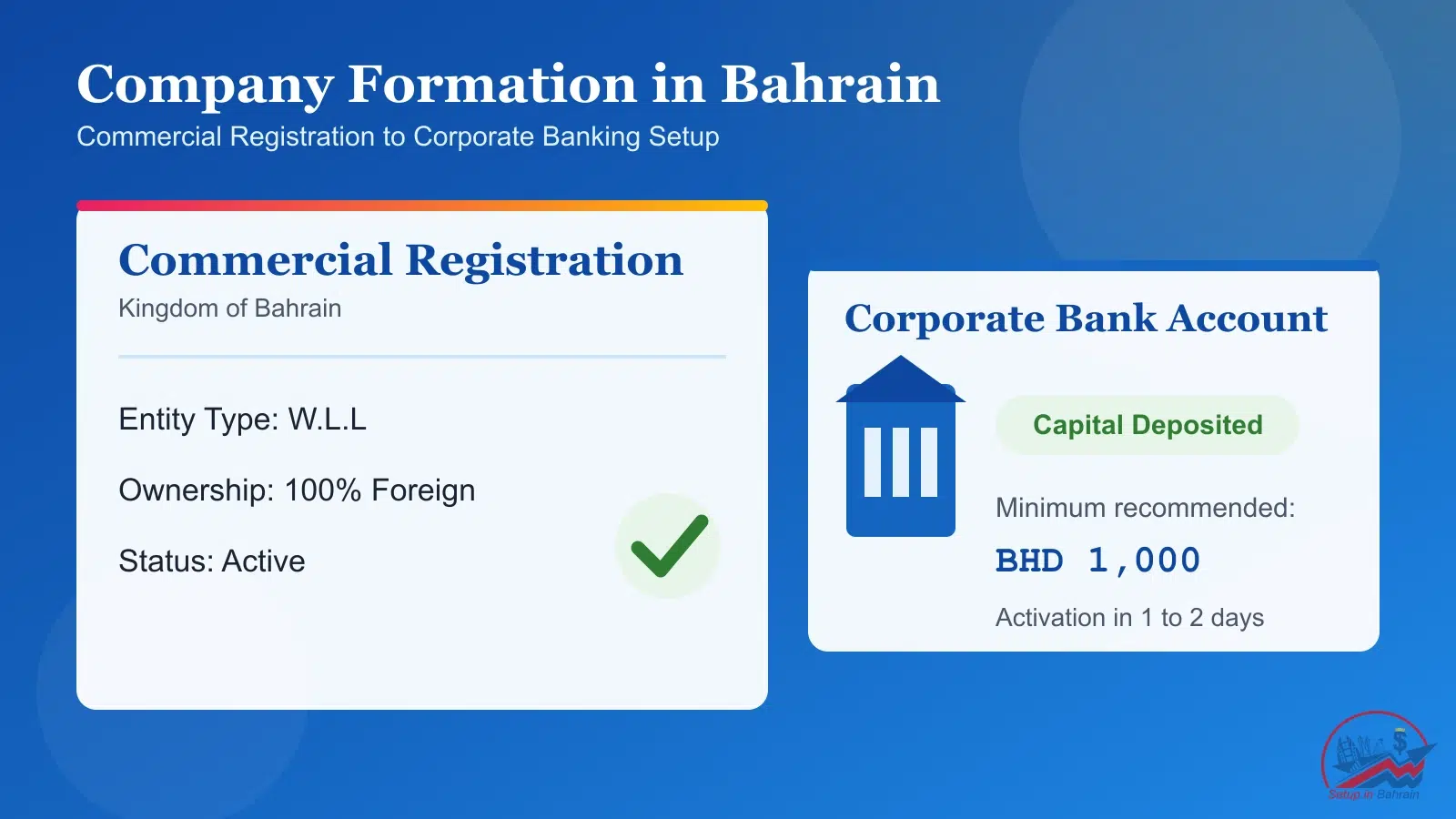
🕐 1 hourOpen your corporate bank account and deposit your share capital. Banks see low capital as a risk flag — we recommend an amount that fits your business type. Once the bank issues your capital deposit certificate, the Ministry activates your CR. You are now legal.
Bank account opening takes 1 to 2 business days with complete documents. The signatory must attend in person. American citizens benefit from Bahrain's strong US-compliant banking. British, Canadian, French, German, and Indian nationals find the process simple with proper paperwork.
Who Can Register a Company? Foreign Investors, Bahrainis, and GCC Citizens
Anyone can register a company in Bahrain. Bahraini nationals, GCC nationals, and foreign individuals or companies are all eligible. What matters is your nationality, business activities, and company type. Most service and manufacturing activities allow full foreign ownership.
Foreign investors register as sole shareholders or with partners. You need a valid passport, financial background check, and security clearance.
Overseas companies can set up a local subsidiary or a Branch Office. Citizens of the UK, US, Canada, France, Germany, India, UAE, Hong Kong, and New Zealand all benefit from Bahrain's open rules.
Bahraini nationals face no restrictions. GCC nationals get the same treatment. American citizens and Singapore investors get extra access through trade agreements.
100% Foreign Ownership — No Local Sponsor Needed
Over 350 activity codes let foreign investors hold 100% equity. No sponsorship. No local partner. You keep full control over decisions, profits, and governance.
Profit repatriation has zero restrictions. Send dividends and capital to London, New York, Toronto, Paris, Berlin, Mumbai, or anywhere else. No withholding taxes. Full ownership. Full control. That is what sets company formation in Bahrain apart.
Which Activities Allow Full Foreign Ownership?
Eligible activities include consulting, tech services, manufacturing, trading, logistics, education, and professional services. Export-based service providers qualify regardless of activity code. Free zone companies also benefit from tax breaks and simpler compliance.
The government maintains activity lists that show ownership rules by nationality. These change from time to time. Always check the list before you submit your application.
How Different Nationalities Register: UK, US, Canada, France, Germany, and India
British citizens get full 100% ownership across most sectors. UK passport holders living in the UAE often set up a Bahrain entity for tax-free service exports. They bill European clients from a 0% tax base instead of the UAE's 9% corporate tax.
American citizens get extra benefits from the US-Bahrain Free Trade Agreement. This includes wider market access and IP protections. Canadians — especially from Ontario, BC, and Alberta — pick Bahrain for 0% tax versus Canada's 26.5% rate.
French and German owners like Bahrain's time zone. GMT+3 is only two hours ahead of Paris and Berlin. This makes working with European clients easy.
Indian nationals in the UAE register Bahrain companies to grow their GCC footprint. They access Saudi Arabia via the Causeway. And they enjoy 0% personal income tax on dividends.
Restricted Sectors: When You Need a Local Partner
Construction needs 51% Bahraini ownership. Domestic trading needs a local partner — one share out of ten thousand. Financial services need Central Bank approval. Healthcare needs NHRA licensing. Education needs Ministry of Education approval. Always check requirements before you start.
Liability Protection Under Article 18 bis
Article 18 bis of the Commercial Companies Law separates your company debts from your personal assets. Creditors can pursue the company — but not your personal savings, property, or other assets. If the company fails, you only lose what you invested.
This is one of the strongest liability shields in the GCC. It is a key reason foreign investors from the UK, USA, Canada, France, Germany, and India choose Bahrain.
🇧🇭 Bahrain Company Ownership Checker
Discover your eligibility for 100% foreign ownership in 30 seconds
Check Your Eligibility
Answer 3 simple questions to find out if you qualify
Bahrain offers exceptional opportunities for foreign entrepreneurs:
- 100% foreign ownership allowed in most sectors
- 0% personal income tax
- 0% corporate tax for most businesses
- Gateway to GCC markets (Saudi Arabia, UAE, Kuwait, Qatar, Oman)
- Fast company registration (15-20 days)
Congratulations!
You qualify for 100% foreign ownership in Bahrain.
Your Bahrain Business Benefits
💡 Good to Know
Types of Companies in Bahrain: W.L.L, Branch Office, and More
The main company types are: WLL (most popular), Branch Office, Partnership, Closed Joint Stock, Public Shareholding, Free Zone Company, and Representative Office. Your choice affects ownership, liability, and compliance. The WLL is the default for most cases.
WLL Company (Limited Liability Company)
The WLL is the top choice for foreign investors and small business owners. It allows one to fifty shareholders. Capital is flexible. Foreign ownership goes up to 100% for most activities. Liability stays limited to what you invest.
You can register multiple activities under one CR. British consultants, American tech founders, Canadian e-commerce sellers, French agency owners, German SaaS companies, and Indian trading firms all use WLL.
| Feature | Detail |
|---|---|
| Shareholders | 1–50 (individuals or corporate) |
| Minimum Share Capital | Contact us for current amounts |
| Foreign Ownership | Up to 100% |
| Liability | Limited to capital only |
The old Single Person Company (SPC) merged into the WLL under the 2025 law changes. A single shareholder now owns 100% of a WLL with full liability protection under Article 18 bis.
Branch Office of a Foreign Company
A branch extends your existing business into Bahrain. No new legal entity is created. The parent company keeps full responsibility. You need parent company approval, financial statements, a board resolution, and a local manager. No minimum capital required.
This works well for UK Ltd companies, American LLCs, Canadian Corporations, French SAS/SARL entities, and German GmbH companies testing Bahrain first.
Partnership Company and Limited Partnership
A partnership works when two or more partners share management and profits. All partners carry joint and personal liability. Personal assets are at risk. A limited partnership mixes general partners (full liability) with limited partners (risk stops at their investment).
Closed Joint Stock and Public Shareholding
A closed joint stock company needs higher capital and limits share transfers. Good for private equity and family businesses. A public shareholding company needs at least seven founders. Shares trade on the Bahrain Bourse. Both have stricter rules than a WLL. Talk to a legal expert before choosing these.
Free Zone Company and Representative Office
Free zone companies enjoy extra tax breaks and simpler rules. A representative office lets you research the market without full commercial activity. Good for companies testing Bahrain before fully entering. Investment vehicles need Central Bank supervision.
How Long Does Company Registration Take?
Company formation in Bahrain takes 15 to 20 business days. That covers security clearance, name reservation, address approval, deed signing, and bank account opening. It is the fastest in the GCC.
| Step | Task | Duration |
|---|---|---|
| 1 | Security Clearance (NPRA) | 3–5 business days |
| 2 | Name Reservation | 3–5 business days |
| 3 | Business Address | 3–5 business days |
| 4 | Deed of Association Signing | 1 hour |
| 5 | Bank Account & Capital Deposit | 1 hour |
| Buffer | Coordination & Appointments | 5 business days |
Bahraini-owned and American/GCC-owned companies often finish faster. British, Canadian, French, German, and Indian passport holders follow the same 15–20 day timeline with complete documents.
Missing papers add 3 to 5 days per fix. An experienced company formation provider helps avoid these delays. In the UAE, the same process takes 25 to 35 days. Saudi Arabia takes 20 to 40. See our full cost breakdown.
What Documents Do You Need for Company Formation?
You need five things: passport copies, three proposed names, bank statements, extra ID if asked, and a capital deposit. Everything is submitted online through the Sijilat portal.
- Passport copies for all partners. Minimum 6 months validity. GCC residents also need CPR/Emirates ID/Iqama. UK residents need proof of address. US citizens need Social Security info for FATCA. Corporate shareholders need a certificate of incorporation and board resolution.
- Three proposed company names ranked by preference. Each must be unique and available in English and Arabic. The name check takes 3 to 5 business days.
- Six-month bank statements stamped by your bank. UK statements from Barclays, HSBC, or Lloyds work. US: Chase, Bank of America, or Wells Fargo. Canada: RBC, TD, or Scotiabank. Europe: BNP Paribas, Deutsche Bank, Crédit Agricole. India: SBI, HDFC, ICICI. UAE: Emirates NBD, ADCB, or Mashreq. Statements must show honest income — strange deposits cause delays.
- Extra ID if the bank or government asks for it. This could be a driving licence, national ID, second passport, or proof of address.
- Capital deposit. The bank gives you a certificate the same day. This activates your CR.
A business plan is not required for registration. But banks need one for account opening. The LMRA checks it for Investor Visa approval too. Having your documents ready is the best way to speed things up.
Government Authorities and Compliance Checks
Six authorities review your application. Each checks different things.
| Authority | Role | What They Check |
|---|---|---|
| MOICT | Licensing & registration | Activities, ownership, capital |
| NPRA | Security clearance | Background, crimes, deportations |
| LMRA | Work permits | Payroll, WPS, visa services |
| NBR | Tax | VAT registration & filing |
| Municipality | Address checks | Zoning, signage, commercial use |
| Central Bank | Financial licensing | Banking & finance approval |
The LMRA handles work permits after registration. The NBR requires VAT registration once your yearly turnover hits the threshold. Activity codes from your CR define what you can do. Going beyond them triggers fines.
What Compliance Checks Apply?
Authorities check that your funds come from honest sources. They look at transaction patterns, account history, and whether income matches your job. This strict process is why Bahrain CRs are trusted worldwide. Banks, HMRC (UK), the IRS (US), CRA (Canada), and European and Indian tax offices all recognise Bahrain's standards.
Red flags include large cash deposits and many international transfers. Complex company chains, crypto or gold trading, and past company closures also trigger review. Prepare your financial records before you submit.
How Does Digital Registration Work Through Sijilat?
Everything runs through the Sijilat portal. You submit documents online, track progress in real time, and get updates at each step. No paper needed for standard steps.
You only need to visit Bahrain in person for two things: bank account signing and Investor Visa medical exam. All other steps happen remotely. You can manage everything from London, New York, Toronto, Paris, Berlin, Mumbai, Dubai, or anywhere.
Tax, Corporate Tax, and VAT Registration in Bahrain
Bahrain charges 0% corporate tax. 0% personal income tax. 0% capital gains tax. 0% withholding tax. VAT is 10% on local sales and 0% on service exports.
This is why business owners choose Bahrain over higher-tax countries. The UK charges 25% corporate tax. The US charges 21%. Canada charges 26.5%. France charges 25%. Germany charges 30%. India charges 25%. Bahrain charges zero.
VAT on Local Sales and Service Exports
The National Bureau for Revenue runs VAT at 10% on local sales. Service exports carry a zero rate when the buyer is outside Bahrain. Digital agencies, SaaS companies, and consulting firms keep higher margins this way.
VAT registration is required once your yearly turnover crosses the threshold. You can register before that if you choose.
Bahrain has double tax agreements with the UK, France, Czech Republic, South Africa, and others. For Indian nationals, the Bahrain-India DTAA stops your income from being taxed twice.
New Corporate Tax in 2027 — Who It Affects
Oil and gas companies pay 46%. In 2027, Bahrain will start a corporate tax for large companies earning over one million dinars. Small and medium businesses are not affected.
Large multinationals with over EUR 750 million revenue face the OECD 15% minimum. For most business owners, Bahrain stays tax-free. See our cost guide for a full first-year breakdown.
Business Registration vs Business License
Registration creates your company's legal existence. A license (or trade license) allows specific activities within that company. They are different things. You can hold one registration with multiple licenses for different activities.
Picking the wrong activity code can trigger ownership limits or rejection. Get this right the first time. Your CR carries your company name, registration number, allowed activities, and expiry date. Banks and government bodies check this before working with you.
Which Business Activities Need Special Approval?
Restricted activities fall into three groups. First: activities needing Bahraini majority ownership (construction, government contracts). Second: activities needing a local partner share (domestic retail trading). Third: activities needing special licences (financial services, healthcare, education).
Some items are reserved for Bahraini nationals only. These include document clearance offices, religious pilgrimage services, and small traditional shops. Other sectors may open based on your investment size and qualifications. Always check before you apply.
🔍 Find Your Business Activity in Bahrain
Search 630 officially registered activities from Sijilat
📋 What's Included in Company Formation
Standard Timeline: 15-20 Business Days
Includes NPRA clearance, approvals & bank account setup
Why Is a Business Address Required?
Your registered address is where the government sends official mail. It is also the address for inspections and legal notices. Every company must have one.
Physical offices suit shops, factories, and client-facing businesses. Virtual Offices work for consulting, tech, and holding companies. They cut costs for new launches. This is the top choice for British, American, Canadian, French, German, and Indian entrepreneurs. Most run their company from the UAE or their home country.
The municipality checks offices regularly. An expired lease freezes your bank account, blocks CR renewal, and cancels your Investor Visa. Keep it current. See our virtual office pricing for rates.
Can You Manage Your Company From Outside Bahrain?
Yes. After the first visit, you can run everything remotely. CR renewals, VAT filings, payroll, and Ministry letters all process online through the Sijilat portal. You need a resident manager and a valid office address. The owner does not need to live in Bahrain.
British consultants manage from London. American SaaS founders run things from New York or Austin. Canadians operate from Toronto and Vancouver. French owners work from Paris.
German tech companies work from Berlin or Munich. Indian business owners in Dubai or Sharjah use Bahrain as a tax-free base alongside their UAE work.
The first visit covers three things: deed signing, bank setup, and Investor Visa medical. After that, everything is remote. This is a major plus of company formation in Bahrain.
Investor Visa and Work Permits After Registration
Once your company is registered, apply for an Investor Visa through the LMRA. This lets you live in Bahrain, run your business, sponsor family, and open personal bank accounts. It takes 5 to 7 business days after your CR is active.
The Investor Visa is one of the biggest benefits of company formation in Bahrain. British, American, Canadian, French, German, and Indian nationals all qualify. For Indians on UAE employment visas, it gives you residency tied to your own company — not an employer.
Work permits for staff need LMRA registration, job approval, and wage protection enrolment. See our Investor Visa cost breakdown for fees.
What Happens After Registration?
Your company is live. Now keep it compliant:
- Renew your CR every year before it expires. Late renewals cost more. Use the Sijilat portal.
- Keep your office address valid all year. Renew your office lease on time.
- Register with LMRA for work permits. Set up the wage protection system for all staff.
- File VAT returns on time if registered with NBR. Late filing leads to fines.
- Update beneficial ownership records yearly for AML rules.
- Register for social insurance for all employees.
See the CR renewal guide for full details. A gap in compliance triggers CR suspension, frozen accounts, and cancelled visas. Check our costs overview for yearly fees.
What Delays the Approval Process?
Missing documents are the biggest problem. A missing passport page, unsigned form, or forgotten bank statement pushes your file to the back of the queue. Each fix costs 3 to 5 business days. Check everything before you submit.
Activity mismatch is the second most common issue. If your chosen activity needs a local partner, you cannot register with full foreign ownership. Fix this by changing the ownership or picking a different activity.
Compliance issues can stop everything. Unclear wealth, messy bank records, or bad background results all raise red flags. Be honest from day one. A good company formation provider helps you clear these blocks.
When Bahrain May Not Be the Right Fit
Bahrain is not perfect for every business. Large projects needing public fundraising may find deeper capital markets elsewhere. Pharmaceutical manufacturing and advanced financial products have more mature setups in other countries.
If you only plan to sell in Bahrain with no regional expansion, the GCC gateway benefits matter less.
Our Company Formation Services
We cover every step. From document prep to bank account opening and Investor Visa processing. Our services include a municipality-verified address, internet, phone lines, receptionist, mail handling, and compliance support.
We serve entrepreneurs from the UK, US, Canada, France, Germany, India, and across the GCC. Whether you are in your home country or already in the UAE — we handle everything. Contact us for a free proposal. See our setup costs for package pricing.
Frequently Asked Questions
Start Your Company in Bahrain Today
Company formation in Bahrain runs through the Sijilat digital system under the Commercial Companies Law. Foreign investors from the UK, US, Canada, France, Germany, India, and everywhere else get equal ownership rights. Liability stays limited. Profits go home free. Standard setups finish in 15 to 20 business days.
To start: pick your activities, stamp your bank statements, and get a compliant office address. Contact Setup in Bahrain for a free consultation. We cover everything — from documents to bank account opening, Investor Visa, and ongoing compliance.
Have Questions About Your Specific Situation?
This guide covers the standard process. Every business is different. Your nationality, activity type, and ownership structure all affect the steps. British consultant? American tech founder? Canadian entrepreneur? French agency owner? German SaaS company? Indian professional? We can walk you through your specific case.
We have guided over 2,690 entrepreneurs through this process since 2018. We are happy to share what we have learned.